rea
Reverse engineer anything with agents, from app behavior down to native binaries.
- 475k
- TypeScript
- MIT
- 17 min ago
A Kivy GUI interface for OpenCV library in Python
Repo dromation/Simple-OpenCV, read from GitHub 1 d ago. dromation has not joined Take My Repo.
dromation/Simple-OpenCV is a public repo on GitHub by dromation. A Kivy GUI interface for OpenCV library in Python. It declares the MIT license on GitHub. It is written mainly in HTML, has 0 stars and last changed on 2026-11-06. Nobody has reviewed it on Take My Repo yet, which says nothing about its quality. Read from GitHub on 2026-11-22.
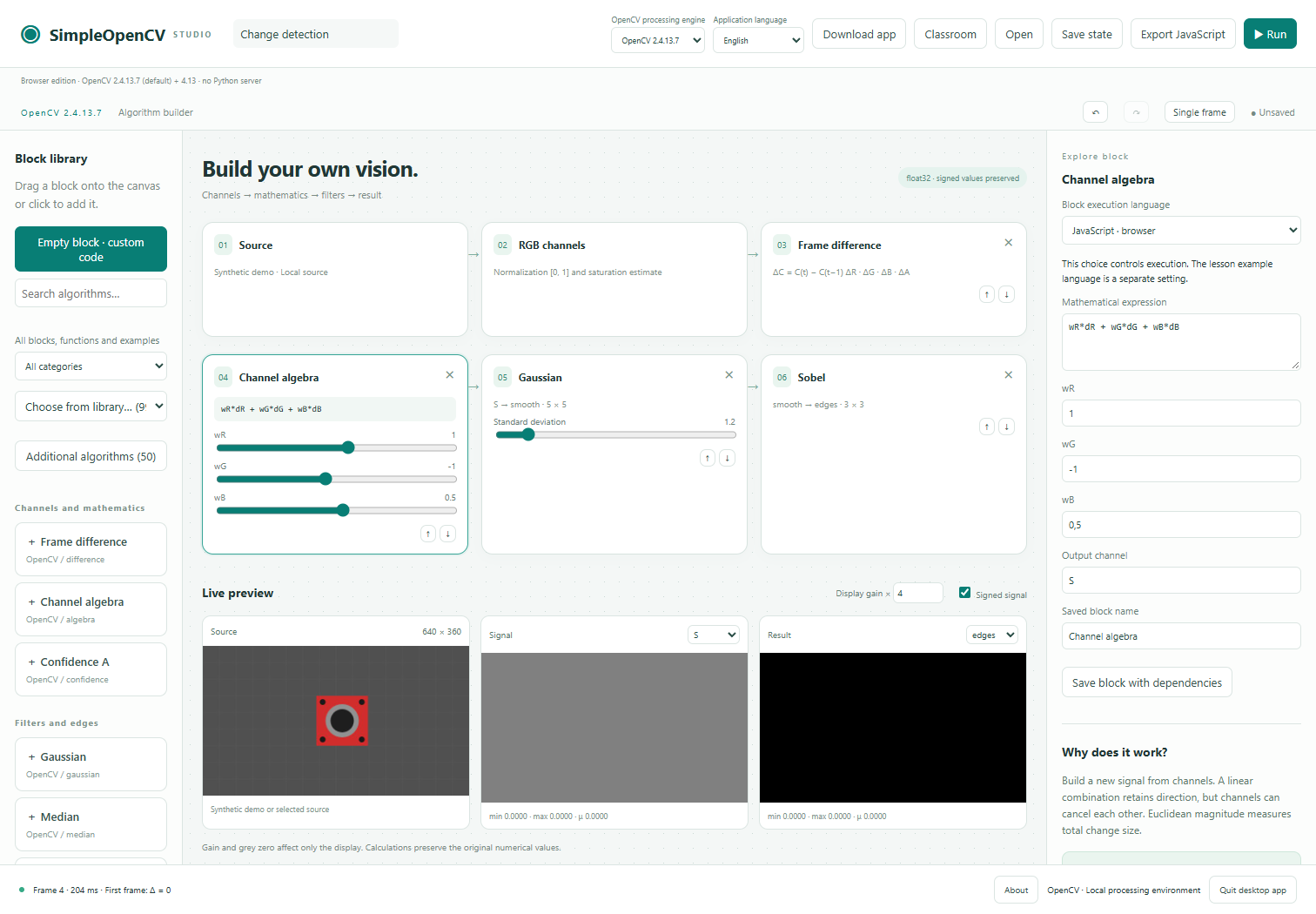
An open-source visual laboratory for computer vision. Separate RGB channels, write equations, connect processing blocks and inspect the results. Save your best configuration and export the algorithm for reuse.
Genuine OpenCV 2.4.13.7 is the default engine. OpenCV 4.13.0 is also bundled for explicit comparisons. New workspaces start in English; select another language in the header. Existing saved language and engine choices are preserved.
Download · Browser edition · Classroom · Contribute · Code of conduct · Licenses · Legacy
Choose your platform from the Download app button on the application page, or download a ZIP below. Extract it, then open the executable. The launcher opens the complete application in your default browser. No Python, Node.js or Go installation is needed. Both OpenCV engines, lessons and licenses are bundled.
| Platform | Download | Open after extraction |
|---|---|---|
| Windows 10/11 · Intel/AMD x64 | Windows ZIP | SimpleOpenCV.exe |
| Linux · Intel/AMD x64 | Linux x64 ZIP | ./SimpleOpenCV |
| Linux · ARM64 | Linux ARM64 ZIP | ./SimpleOpenCV |
| macOS 13+ · Intel | macOS Intel ZIP | SimpleOpenCV.app |
| macOS 13+ · Apple Silicon | macOS Apple Silicon ZIP | SimpleOpenCV.app |
Use a current browser with WebAssembly. Keep the launcher running; Quit desktop
app in the footer stops it. Linux extractors must preserve executable permissions
(chmod +x SimpleOpenCV if necessary). Community builds are unsigned and macOS
bundles are not notarized. Startup details and build instructions.
Image / camera → RGB + confidence → frame differences → channel algebra
             → filters → edges / thresholds → components / lines

S = wR·ΔR + wG·ΔG + wB·ΔB
| Build | Explore | Keep |
|---|---|---|
| 28 block types and a searchable library | RGB, signed differences and synthetic channels | JSON configurations with engine version |
| Editable formulas, kernels and parameters | Gaussian, median, Sobel, Scharr, morphology, Canny and Hough | Reusable blocks and example sequences |
| Empty blocks for custom code | Image, video, demo and explicitly permitted camera input | Runnable JavaScript export in portable/HTML editions |
| Classroom inside the app | Mathematics, detection recipes and programming examples | Local projects and downloadable backups |
The browser edition executes custom JavaScript. Python/C/C++/Java code can be kept as disabled drafts; compiling those languages requires the developer/server edition and its configured runtimes. The 2.4 browser build exposes core/imgproc operations for the current blocks, not every OpenCV module. The derived A channel is an experimental confidence weight, not an additional physical camera sensor.
Projects live in your browser's local storage. Website and desktop origins have separate storage; transfer JSON and reselect media when moving between them. No camera opens automatically. The default scene is synthetic.
The idea grew from the author's SimpleCV experiments with separate RGB channels and per-channel subtraction. SimpleOpenCV turns that experimental approach into a workspace where changing an equation, parameter or processing order is visible immediately. The project builds on Dromation's Simple-OpenCV repository and was previously called SimpleMotocam. Read the fuller story in About inside the app.
The original repository is preserved under legacy and on the
legacy branch. The internal Python package remains simplemotocam for compatibility.
SimpleCV is an inspiration, not a bundled dependency or an official affiliation.
git clone https://github.com/dromation/Simple-OpenCV.git
cd Simple-OpenCV
python -m venv .venv
# Windows: .venv\Scripts\activate
# Linux/macOS: source .venv/bin/activate
python -m pip install -e ".[dev]"
python tools/package_static.py
python -m http.server 8780 --bind 127.0.0.1 --directory dist
Open http://127.0.0.1:8780/SimpleOpenCV-HTML/. For native Python and compiled
custom-language blocks, prepare the genuine 2.4 native worker using the
backend guide, then run python -m simplemotocam.studio.
For executable downloads, use the portable build guide.
See CONTRIBUTING.md, contrib and the code of conduct. Small reproducible experiments, clearer mathematics, language reviews and useful block sequences are welcome.
Project-authored code is MIT, retaining the original Dromation attribution. OpenCV 2.4 uses its BSD notice; OpenCV 4.13 uses Apache-2.0. Dependencies retain their own licenses. Original license texts, provenance and version boundaries are available offline in About and THIRD_PARTY_NOTICES.md.
dromation/Simple-OpenCV is a public repo on GitHub by dromation. A Kivy GUI interface for OpenCV library in Python.
It declares the MIT license on GitHub.
Its maker has not tagged a system, so it is unknown here. Its README says what it needs.
Open "Take it" on its page: Take My Repo writes an install plan for your machine and hands it to your AI agent (Claude Code, Codex or Cursor), which asks you before each step. Take My Repo has not tested it on any machine.
Its last change on GitHub was on 2026-11-06. Take My Repo does not judge from that whether it is maintained.
Nobody has reviewed it on Take My Repo yet, which says nothing about its quality.
Reverse engineer anything with agents, from app behavior down to native binaries.
Open source UI framework written in Python, running on Windows, Linux, macOS, Android and iOS
OpenPose: Real-time multi-person keypoint detection library for body, face, hands, and foot estimation