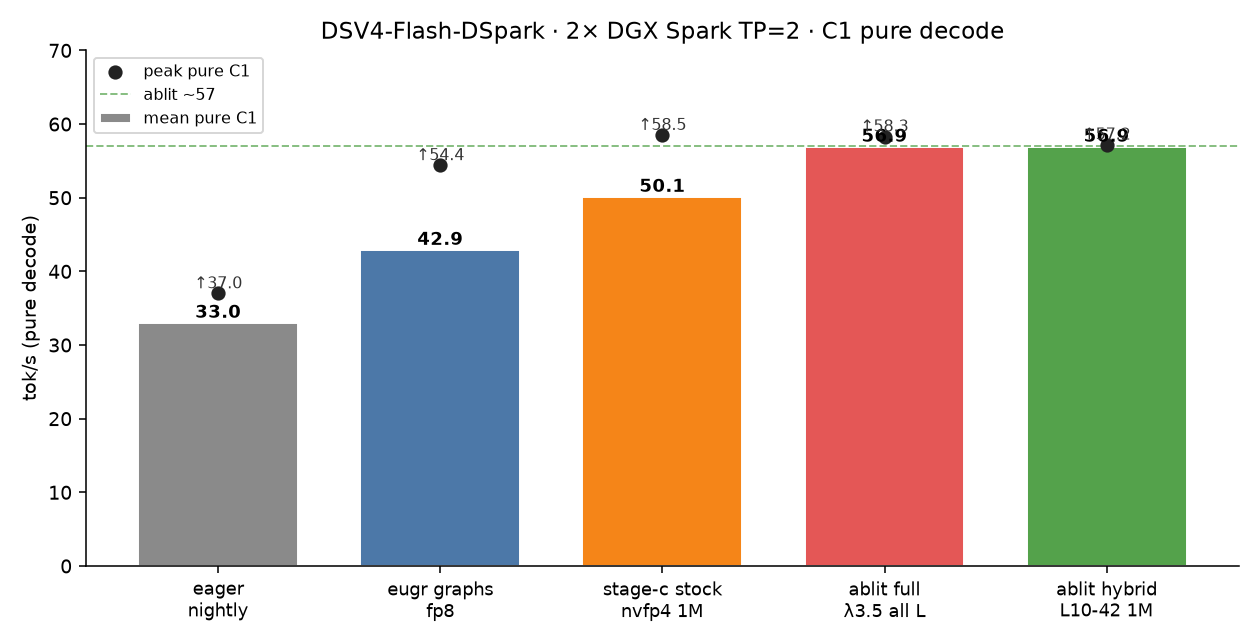

Keys-Setup-Autonomous-Self-Improving-Local-Inference-Stack
Autonomous self-improving 4x DGX Spark (GB10) MoA stack + LoRA loop (DSV4F router, Qwen3.6/Omni/TwoTower/Gemma). Hermes MoA routing, ~90% local, self-LoRA. Includes a SINGLE-SPARK recipe (all-Gemma-4: 31B brain + DiffusionGemma + 12B) to build the same on 1 GB10.
- 24
- 3 mo ago
Repo drowzeys/Keys-Setup-Autonomous-Self-Improving-Local-Inference-Stack, read from GitHub 1 min ago. drowzeys has not joined Take My Repo.
In short
drowzeys/Keys-Setup-Autonomous-Self-Improving-Local-Inference-Stack is a public repo on GitHub by drowzeys. Autonomous self-improving 4x DGX Spark (GB10) MoA stack + LoRA loop (DSV4F router, Qwen3.6/Omni/TwoTower/Gemma). Hermes MoA routing, ~90% local, self-LoRA. Includes a SINGLE-SPARK recipe (all-Gemma-4: 31B brain + DiffusionGemma + 12B) to build the same on 1 GB10. It declares no license on GitHub. Public does not mean open source: without a license, nobody is granted the right to reuse it. It is written mainly in Python, has 24 stars and last changed on 2026-08-17. Nobody has reviewed it on Take My Repo yet, which says nothing about its quality. Read from GitHub on 2026-11-21.
Keys-Setup — Autonomous Self-Improving Local Inference Stack
w/ LoRA training, using Hermes MoA assignment, for a 4× DGX Spark (GB10) cluster
🖥️➡️1️⃣ Only have ONE DGX Spark? → Single-Spark Recipe
Build the same self-improving MoA + LoRA loop on a single GB10 — all-Gemma-4 stack (Gemma-4-31B brain + DiffusionGemma + Gemma-4-12B), with architecture & routing diagrams and a Hermes-consumable MoA activation plan. Same logic, one box.
A single-operator, four-node NVIDIA DGX Spark (GB10, 128 GB unified, sm_121a / Blackwell-consumer) cluster wired over a 200 G MikroTik RoCE fabric, running a Mixture-of-Agents (Hermes MoA) router that keeps ~90 % of all AI work on local silicon and escalates only the residual ~10 % — deep audit, hard reasoning, frontier research — to a rate-limited cloud model. The stack watches its own transcripts, mines them for supervision, and continuously LoRA-trains the local models so that the local share grows over time. The orchestrator is not a script — it is a served model (DeepSeek-V4-Flash · DSpark) acting as router, aggregator, and training-signal collector.

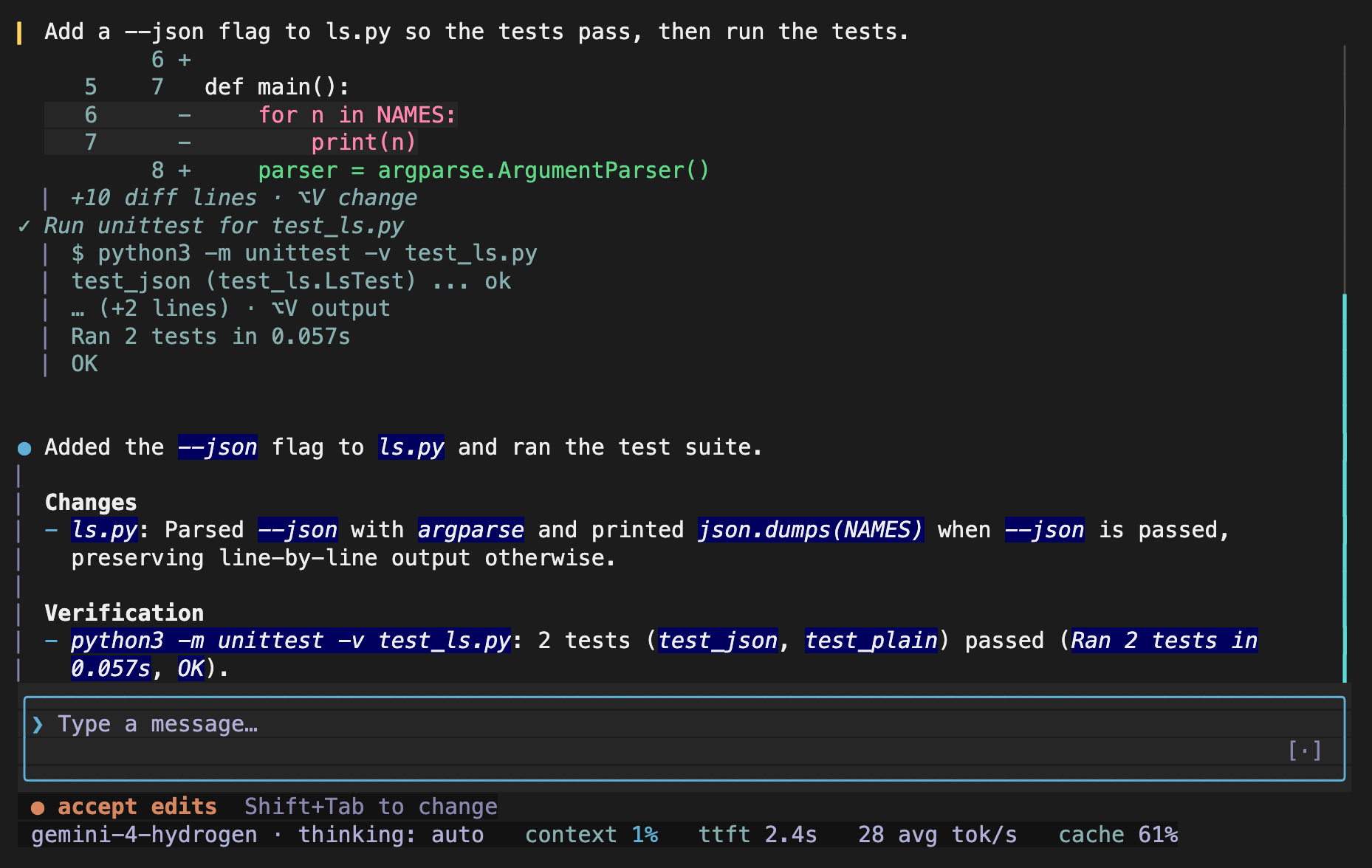
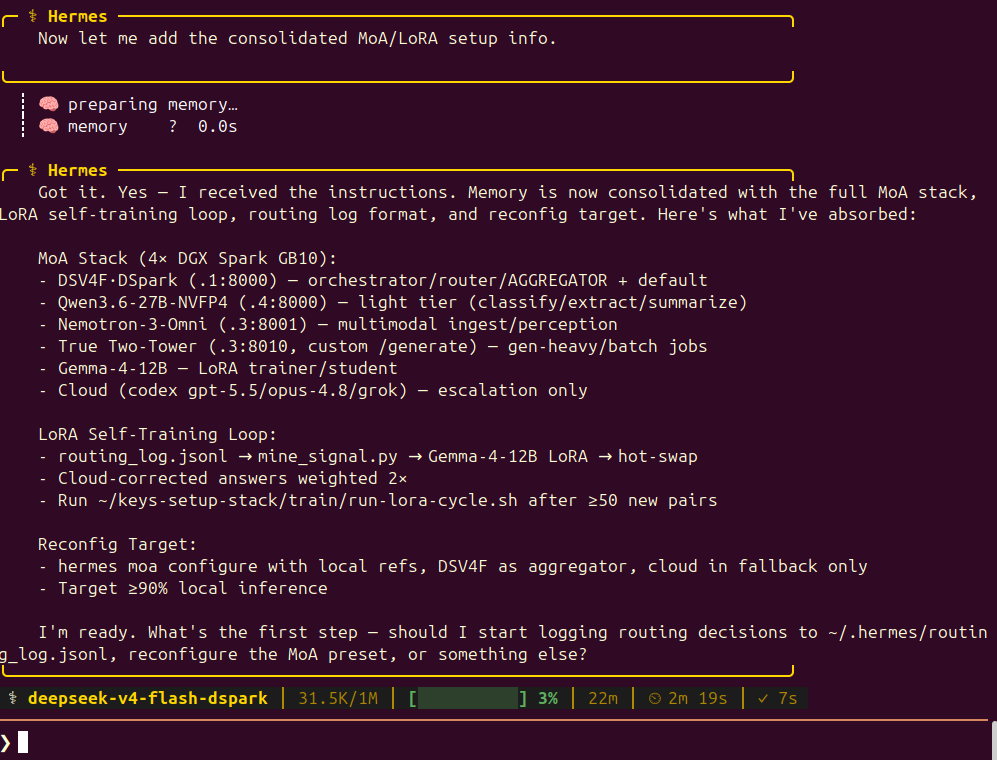
The Hermes agent (running on deepseek-v4-flash-dspark) confirming it has absorbed the full MoA roster, the LoRA self-training loop, the routing-log schema, and the local-first reconfig target.
UPDATE — 2026-07-05 19:30 UTC — The two-hook MoA routing pipeline is now live and allowlisted.
routing_router.py(pre_llm_call) classifies every task and routes to the cheapest competent agent;routing_log.py(post_llm_call) captures task+verdict pairs to~/.hermes/routing_log.jsonlfor the LoRA self-training loop. The routing log is ready formine_signal.pyconsumption — every cloud escalation is weighted 2× as gold training data.

The MoA routing pipeline in action — pre_llm_call routing + post_llm_call capture feeding the Gemma-4-12B LoRA self-improvement loop.
Only have one DGX Spark? The whole stack collapses onto a single GB10 with the same routing logic and LoRA loop — see docs/single-spark-recipe.md: an all-Gemma-4 build (Gemma-4-31B brain + DiffusionGemma + Gemma-4-12B) with architecture + routing-decision diagrams and a Hermes-consumable MoA activation plan.
0. Prerequisites — model roster & role on the stack
| # | Model (as served) | Quant / runtime | Where it lives | Role in the stack |
|---|---|---|---|---|
| 1 | DeepSeek-V4-Flash · DSpark (spec-decode, γ=5) | FlashMLA + DSpark, TP=2 (2 replicas over 4 nodes) | Replica A r0↔r1, Replica B r2↔r3 |
Orchestrator / Aggregator / Router. The MoA "brain": decomposes tasks, routes to specialists, aggregates their drafts, votes, and emits the LoRA training signal. |
| 2 | True Two-Tower NVFP4 (Nemotron-Labs TwoTower-30B-A3B mask-diffusion) | NVFP4 experts (e2m1 + block-16 scale), consolidated to ONE GPU, served hot | r3:8010 (tt-server, persistent) |
Parallel/batch draft & diffusion generation. NVFP4 (21 GB/tower) collapses the old 118 GB two-node model onto a single Spark → frees a node. See § Two-Tower: single- vs dual-GPU — ~29 tok/s single-GPU gen-heavy, 1.57× over the AR-simulated variant; dual-GPU is faster (38.85) if you spend the second Spark. |
| 3 | Nemotron-3-Nano-Omni-30B-A3B (+ A4Q native-fp4 attention) | NVFP4 + nvfp4 KV, A4Q prefill | co-resident on r3:8001 (~38.9 GB) |
Omni perception front-end — audio + vision + text ingest. Turns raw multimodal input into structured context for the router and into training pairs for Gemma. Runs two-models-on-one-Spark alongside TwoTower. |
| 4 | Gemma-4-12B | BF16/LoRA fine-tune runtime | dedicated training node (rotates) | The LoRA trainer / student. Trains on omni-derived supervision (Nemotron-Omni transcribes/describes → Gemma learns). Small enough for fast LoRA epochs on one GB10; distills cloud-audit corrections back into the local stack. |
| 5 | Qwen-3.6-27B-NVFP4 (+ A4Q) | NVFP4 + nvfp4 KV, util 0.6 | r0:8000 (qwen36-nvfp4-a4q) |
Light / high-throughput inference tier. Cheap classify / extract / summarize / rewrite / short chat. Peak ≈ 68.6 agg tok/s @ C8; 256 K native context. Soaks the bulk of easy requests so the brain stays free. |
| 6 | Cloud frontier (Claude / Codex / Grok) — rate-limited | API (external) | off-cluster | Occasional escalation only: audit of local outputs, genuinely hard reasoning, and open-web research. Every cloud answer is captured as gold supervision → LoRA'd into the local stack so the same question is answered locally next time. |
Cluster fabric: 4× GB10 on a MikroTik CRS804-4DDQ, 200 G-baseCR4 (RoCE, enp1s0f1np1 / rocep1s0f1). Nodes r0–r3 on the private 200 G fabric. Storage golden copies live on r0/r3; r1/r2 are transient compute/VRAM nodes.
Two-Tower: single-GPU vs dual-GPU (honest numbers)
The diffusion Two-Tower can run as two towers on two Sparks (each tower on its own GB10, denoiser ↔ context over the 200 G fabric) or consolidated onto one Spark once NVFP4 shrinks each tower 59 → 21 GB. They are not the same on speed — measured same-session on r3, 256 tokens:
| Deployment | Config | tok/s | Note |
|---|---|---|---|
| Dual-GPU (2 Sparks) | gen-heavy bench256 |
38.85 | towers compute in parallel on two GPUs — fastest |
| Single-GPU (1 Spark) — diffusion | gen-heavy bench256 |
28.98 | both towers serialize on one GPU; frees a whole node |
| Single-GPU (1 Spark) — diffusion | coherent generation | 15.1–17.9 | NFE-dependent; real content needs more denoise steps |
| Single-GPU (1 Spark) — AR-simulated | gen-heavy | 18.44 | context-tower autoregressive baseline |
| Single-GPU (1 Spark) — AR-simulated | coherent generation | 21.50 | AR edges diffusion on eval-style prompts |
How to choose:
- Want speed → spend the second Spark. Dual-GPU (38.85) beats single-GPU diffusion (28.98) by ~34%, because the two towers run their forward passes in parallel; consolidating serializes that compute onto one GPU and removing the fabric copies doesn't recover it.
- Want to conserve resources → single-GPU true Two-Tower (diffusion), not the AR-simulated variant. On gen-heavy work the diffusion tower does 28.98 vs the AR baseline's 18.44 → 1.57×, and it frees an entire node (co-resides with Nemotron-Omni at ~85 GB of 121). The AR-simulated single-GPU repo is the fallback when you can't afford diffusion's denoise passes; on short/eval prompts AR is actually competitive (21.5 vs ~16). The tradeoff is NFE-dependent: diffusion wins as generation gets longer/gen-heavy, AR wins on short factual answers.
Companion repos: dual-GPU diffusion · single-GPU AR-simulated. Raw numbers in
bench/twotower_single_vs_dual.json.
1. Architecture flow chart
flowchart TD
    subgraph INPUT["🎙️ Input surface"]
        U[User / agents / events]
        MM[Audio · Image · Video · Text]
    end

    subgraph PERC["Perception (Spark r3 — two models, one node)"]
        OMNI["**Nemotron-3-Omni-30B + A4Q**<br/>multimodal → structured context"]
        TT["**True Two-Tower NVFP4**<br/>diffusion batch generation<br/>(single-GPU, 21GB/tower)"]
    end

    subgraph BRAIN["🧠 Orchestrator — DSV4F · DSpark (TP=2 ×2 replicas)"]
        ROUTER{{"**Hermes MoA Router**<br/>classify · decompose · assign"}}
        AGG["**Aggregator / Voter**<br/>merge drafts · self-consistency"]
        SIG["**Training-signal collector**<br/>logs (task, route, draft, verdict)"]
    end

    subgraph LOCAL["Local specialist tier (~90% of traffic)"]
        QWEN["**Qwen3.6-27B-NVFP4 + A4Q**<br/>light: classify/extract/summarize<br/>68 tok/s @C8 · 256K ctx"]
        OMNI2["Omni · perception recall"]
        TT2["TwoTower · gen-heavy batch"]
    end

    subgraph CLOUD["☁️ Cloud escalation (~10%, rate-limited)"]
        FRONT["**Claude / Codex / Grok**<br/>audit · hard reasoning · research"]
    end

    subgraph TRAIN["🔁 Self-improvement loop"]
        MINE["Transcript miner<br/>select high-value pairs"]
        GEMMA["**Gemma-4-12B LoRA trainer**<br/>omni-input supervision"]
        ADAPT["LoRA adapters →<br/>hot-swap into local models"]
    end

    U --> MM --> OMNI
    MM --> ROUTER
    OMNI -->|structured ctx| ROUTER
    ROUTER -->|easy| QWEN
    ROUTER -->|perception| OMNI2
    ROUTER -->|batch/gen| TT
    ROUTER -->|"hard / audit / research (10%)"| FRONT
    QWEN --> AGG
    OMNI2 --> AGG
    TT --> AGG
    FRONT --> AGG
    AGG --> SIG
    AGG -->|answer| U
    SIG --> MINE
    FRONT -->|gold labels| MINE
    MINE --> GEMMA
    OMNI -->|omni training pairs| GEMMA
    GEMMA --> ADAPT
    ADAPT -.hot-swap.-> QWEN
    ADAPT -.hot-swap.-> OMNI2
    ADAPT -.distill.-> ROUTER
    ADAPT -.->|"local share ↑ over time"| ROUTER
2. Workflow — request lifecycle
- Ingest. Any modality lands on Nemotron-3-Omni (Spark
.3), which produces a text/structured representation (transcription, caption, OCR, scene/graph). Pure-text requests skip straight to the router. - Route (Hermes MoA). The DSV4F·DSpark brain classifies the task and assigns it to the cheapest agent that can satisfy it:
- trivial/light → Qwen3.6-27B (throughput tier),
- perception recall / grounding → Nemotron-Omni,
- gen-heavy / parallel drafting → Two-Tower diffusion,
- genuinely hard / needs audit / needs the open web → cloud frontier (budget-gated).
- Aggregate. Multiple agents may answer the same prompt (MoA); the brain votes / merges / self-consistency-checks and returns one answer.
- Log the signal. Every
(task, chosen route, candidate drafts, final verdict, cloud correction?)tuple is written to the training-signal store. - Escalate rarely. The router is tuned so ≥90 % of requests never touch the cloud; the ~10 % that do are the most informative ones (novel/hard) — exactly the samples worth learning from.
3. LoRA training feedback loop (why the local share grows)
The orchestrator is also the teacher-selector. The loop:
DSV4F router/aggregator ──emits──▶ (task, drafts, verdict, cloud-gold?)
        │
        ▼
   Transcript miner ── picks high-value pairs:
        • cloud-corrected answers (local was wrong → gold exists)
        • high-agreement local wins (cheap self-distillation)
        • omni-derived pairs (Nemotron transcript ↔ desired output)
        │
        ▼
   Gemma-4-12B  ──LoRA fine-tune (omni-input aware)──▶ adapter Δ
        │
        ▼
   Hot-swap adapter into the *serving* specialist (Qwen / Omni / router draft head)
        │
        ▼
   Next time the same class of task arrives → answered LOCALLY, no cloud call
- Gemma-4-12B is the student/trainer because it is small enough to LoRA in fast epochs on one GB10 yet strong enough to absorb frontier corrections, and it accepts omni-derived inputs so multimodal lessons flow in.
- Cloud answers are never wasted — each escalation buys a permanent local capability. The cloud bill trends down as the adapters accumulate.
- DSV4F is the natural signal source because it already sees every task, every route decision, and every aggregate verdict — the router log is the training set.
4. Why these models (design reasoning)
- DSV4F·DSpark as brain/router. MLA + DSpark spec-decode gives the best reasoning-tok/s on GB10, and our concurrency patch (Patch 1+2) unlocks correct batch>1 serving (≈190 tok/s @16, ≈380 @32 across both replicas). A router must handle many concurrent decisions cheaply → this is the one model that both reasons well and batches.
- Two-Tower NVFP4 consolidated to one GPU. NVFP4 quantization of the routed experts (118 GB → 21 GB/tower) is what makes the diffusion model fit on a single Spark instead of two — freeing an entire node for training/serving. Diffusion beats AR on gen-heavy batches once experts are 4×-smaller per NFE.
- Nemotron-3-Omni + two-models-on-one-Spark. One node hosts both Omni (perception) and Two-Tower (batch gen) because A4Q + NVFP4 shrink each enough (~85 GB combined of 121 GB, ~36 GB headroom) to co-reside — the cluster gets multimodal ingest "for free" without spending a node.
- Qwen3.6-27B-NVFP4 as the light tier. A4Q native-fp4 attention + 256 K native context + ~68 tok/s @C8 make it the ideal high-throughput sponge for the long tail of easy requests, keeping the expensive brain idle for the hard ones.
- Cloud frontier, rate-limited. Kept deliberately small in the traffic mix: it exists to be the ground-truth oracle for audit and the hardest 10 %, and — crucially — to manufacture training labels the local stack then internalizes.
5. Why Hermes MoA for a hybrid setup
Mixture-of-Agents treats each model as an agent with a competence profile; Hermes is the assignment layer that maps every incoming task to the cheapest competent agent (and, for hard tasks, to several agents whose drafts the brain aggregates). This is the right abstraction for a hybrid local+cloud system because:
- Cost-aware routing is first-class — the "cheapest competent agent" rule is exactly what drives the 90/10 local:cloud split, and it re-balances automatically as LoRA adapters make local agents more competent (the cheap tier keeps winning more tasks).
- Aggregation gives cloud-grade answers from local models — MoA voting across Qwen + Omni + TwoTower drafts often matches a single cloud call, so escalation is reserved for true novelty.
- The router log is the training corpus — because Hermes records the (task → agent → verdict) decision for everything, the self-improvement loop gets its supervision for free, with no separate data-collection pipeline.
- Graceful degradation & swap-in — agents can drop out (node down, model reloading) or swap adapters live without the router changing; the hybrid stays online.
6. Repo layout (planned)
.
├── README.md                     ← this document
├── docs/
│   ├── architecture.md           ← flow chart + node plan
│   ├── model-roster.md           ← per-model serve recipes & benches
│   └── lora-loop.md              ← signal mining + Gemma training spec
├── router/                       ← Hermes MoA config, competence profiles, cost table
├── serve/                        ← per-model launch scripts (qwen36 / omni-a4q / twotower / dsv4f)
├── train/                        ← transcript miner + Gemma LoRA harness + adapter hot-swap
└── bench/                        ← concurrency + context sweeps (Qwen3.6 results included)
Status: scaffolding. Serve recipes and the Qwen3.6-27B-NVFP4 A4Q benchmark (concurrency + 6K–256K context) are validated and included; router/train modules are the active build-out.
Questions
What is Keys-Setup-Autonomous-Self-Improving-Local-Inference-Stack?
drowzeys/Keys-Setup-Autonomous-Self-Improving-Local-Inference-Stack is a public repo on GitHub by drowzeys. Autonomous self-improving 4x DGX Spark (GB10) MoA stack + LoRA loop (DSV4F router, Qwen3.6/Omni/TwoTower/Gemma). Hermes MoA routing, ~90% local, self-LoRA. Includes a SINGLE-SPARK recipe (all-Gemma-4: 31B brain + DiffusionGemma + 12B) to build the same on 1 GB10.
Is Keys-Setup-Autonomous-Self-Improving-Local-Inference-Stack open source?
It declares no license on GitHub. Public does not mean open source: without a license, nobody is granted the right to reuse it.