advanced-java
😮 Core Interview Questions & Answers For Experienced Java(Backend) Developers | 互联网 Java 工程师进阶知识完全扫盲:涵盖高并发、分布式、高可用、微服务、海量数据处理等领域知识
- 79k
- Java
- CC-BY-SA-4.0
- 10 d ago
POST a job → any script can pick it up and execute it. A dead-simple distributed job bus for bots and scripts.
Repo dsecurity49/Intent-Bus, read from GitHub 2 d ago. dsecurity49 has not joined Take My Repo.
dsecurity49/Intent-Bus is a public repo on GitHub by dsecurity49. POST a job → any script can pick it up and execute it. A dead-simple distributed job bus for bots and scripts. It declares the MIT license on GitHub. It is written mainly in Python, has 29 stars and last changed on 2026-11-19. Nobody has reviewed it on Take My Repo yet, which says nothing about its quality. Read from GitHub on 2026-11-22.
😮 Core Interview Questions & Answers For Experienced Java(Backend) Developers | 互联网 Java 工程师进阶知识完全扫盲:涵盖高并发、分布式、高可用、微服务、海量数据处理等领域知识
Run code on any device from anywhere — using just HTTP.
Intent Bus is a zero-infrastructure job coordination system with retries, atomic locking, priority scheduling, and cross-device workers.
Built for developers who want something lighter than Redis, RabbitMQ, or Firebase, while still being more reliable than cron.
No external broker. Just a minimal Flask + SQLite core.
/intent/claim/fulfill/<id>Claims are lease-based and automatically expire if a worker disappears before fulfillment.
graph LR
    A[Cloud Script] -->|POST /intent| B[Intent Bus]
    B -->|claim + fulfill| C[Worker]
    C -->|execute task| D[Phone / System Action]
| Tool | Problem |
|---|---|
| Cron | No coordination, no retries, silent failures |
| Redis / Celery | Requires running and maintaining infrastructure |
| RabbitMQ | Heavier operational complexity |
| Firebase | Vendor lock-in, SDK overhead, pricing at scale |
| Intent Bus | ✅ Small deployable core with minimal ops |
Intent Bus is designed for low-to-medium traffic workloads and performs well under moderate concurrency when deployed with Docker.
Intent Bus supports two auth modes for regular clients and a separate admin auth layer.
X-API-KEY: your_key_here
Works with curl, bash scripts, and lightweight devices.
Strict auth supports:
The Python SDK handles this automatically.
Enable globally using:
BUS_REQUIRE_SIGNATURES=true
Admin endpoints (/admin/*) use separate credentials:
X-Admin-Token: <BUS_ADMIN_SECRET>pip install intent-bus
export INTENT_API_KEY="your_key_here"
intent-bus publish send_notification '{"instruction":"Hello"}' -n default
intent-bus listen send_notification -n default -c notify
pip install intent-bus
from intent_bus import IntentClient

with IntentClient(api_key="your_key_here") as client:
    published = client.publish(
        goal="send_notification",
        payload={"instruction": "Hello from the cloud"},
        idempotency_key="task_123",
        priority=500,
    )

    print(f"Published: {published.id}")
private (default) — only workers using the same API key can claim the jobpublic — any authenticated worker in the namespace can claim itPublic jobs should only be used in trusted environments.
from intent_bus import IntentClient, WorkerRuntime

def handler(job):
    print("Received:", job.payload.get("instruction"))

    return {
        "result": "delivered",
        "result_type": "text",
    }

client = IntentClient(api_key="your_key_here")
runtime = WorkerRuntime(client=client)

runtime.listen(
    goal="send_notification",
    handler=handler,
)
Workers must be idempotent. The same job may be delivered more than once if:
- the worker crashes mid-execution
- the lease expires before
/fulfillis called- the network drops after the server marks the job fulfilled but before the response arrives
- the bus retries due to an ambiguous failure
SDK repo: https://github.com/dsecurity49/Intent-Bus-sdk
curl -X POST https://your-bus.render.com/intent \
  -H "Content-Type: application/json" \
  -H "X-API-KEY: your_key_here" \
  -d '{"goal":"send_notification","payload":{"instruction":"Hello"}}'
curl -X POST https://your-bus.render.com/intent \
  -H "Content-Type: application/json" \
  -H "X-API-KEY: your_key_here" \
  -d '{"goal":"send_notification","payload":{"instruction":"Urgent"},"priority":900,"delay":5.0}'
# Claim
curl -s -X POST \
  "https://your-bus.render.com/claim?goal=send_notification" \
  -H "X-API-KEY: your_key_here"

# Fulfill
curl -s -X POST \
  "https://your-bus.render.com/fulfill/<INTENT_ID>" \
  -H "Content-Type: application/json" \
  -H "X-API-KEY: your_key_here" \
  -d '{"claim_token":"<TOKEN>","result":"done","result_type":"text"}'
If a job is not fulfilled within 60 seconds, it is automatically requeued with exponential backoff.
Workers should respect the
Retry-Afterheader after receiving204 No Content.
open ──► claimed ──► fulfilled
                │
                ▼
              open (retry with backoff)
                │
                ▼
              dead ──► dead-letter queue
Dead letters can be inspected through admin endpoints and retried later.
client.publish(
    goal="run_backup",
    payload={"instruction": "/data"},
    target_worker="termux-phone-1",
)
Worker:
curl -X POST \
  "https://your-bus.render.com/claim?goal=run_backup" \
  -H "X-API-KEY: key" \
  -H "X-Worker-ID: termux-phone-1"
client.publish(
    goal="transcribe_audio",
    payload={"instruction": "meeting.mp3"},
    required_capability="whisper",
)
Worker:
curl -X POST \
  "https://your-bus.render.com/claim" \
  -H "X-API-KEY: key" \
  -H "X-Worker-Capabilities: whisper,ffmpeg,gpu"
Both fields can be combined.
Requirement:
python -c "import sqlite3; print(sqlite3.sqlite_version)"
Install:
git clone https://github.com/dsecurity49/Intent-Bus.git
cd Intent-Bus
pip install -r server-requirements.txt
git clone https://github.com/dsecurity49/Intent-Bus.git
cd Intent-Bus
mkdir -p bus_data && chmod 755 bus_data
docker-compose up -d
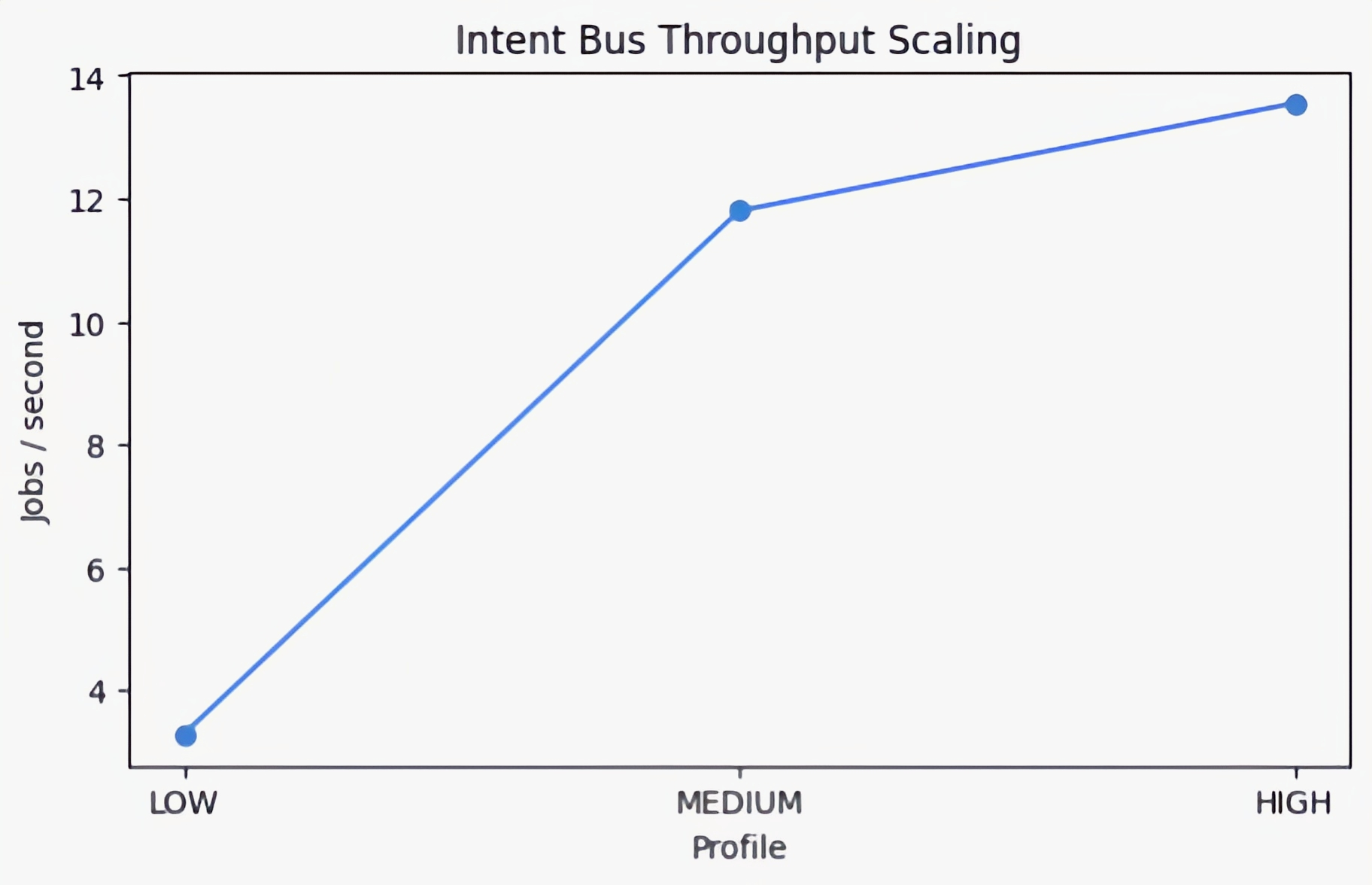
| Profile | PythonAnywhere Free | Render (Docker) | Android 12 (Termux) |
|---|---|---|---|
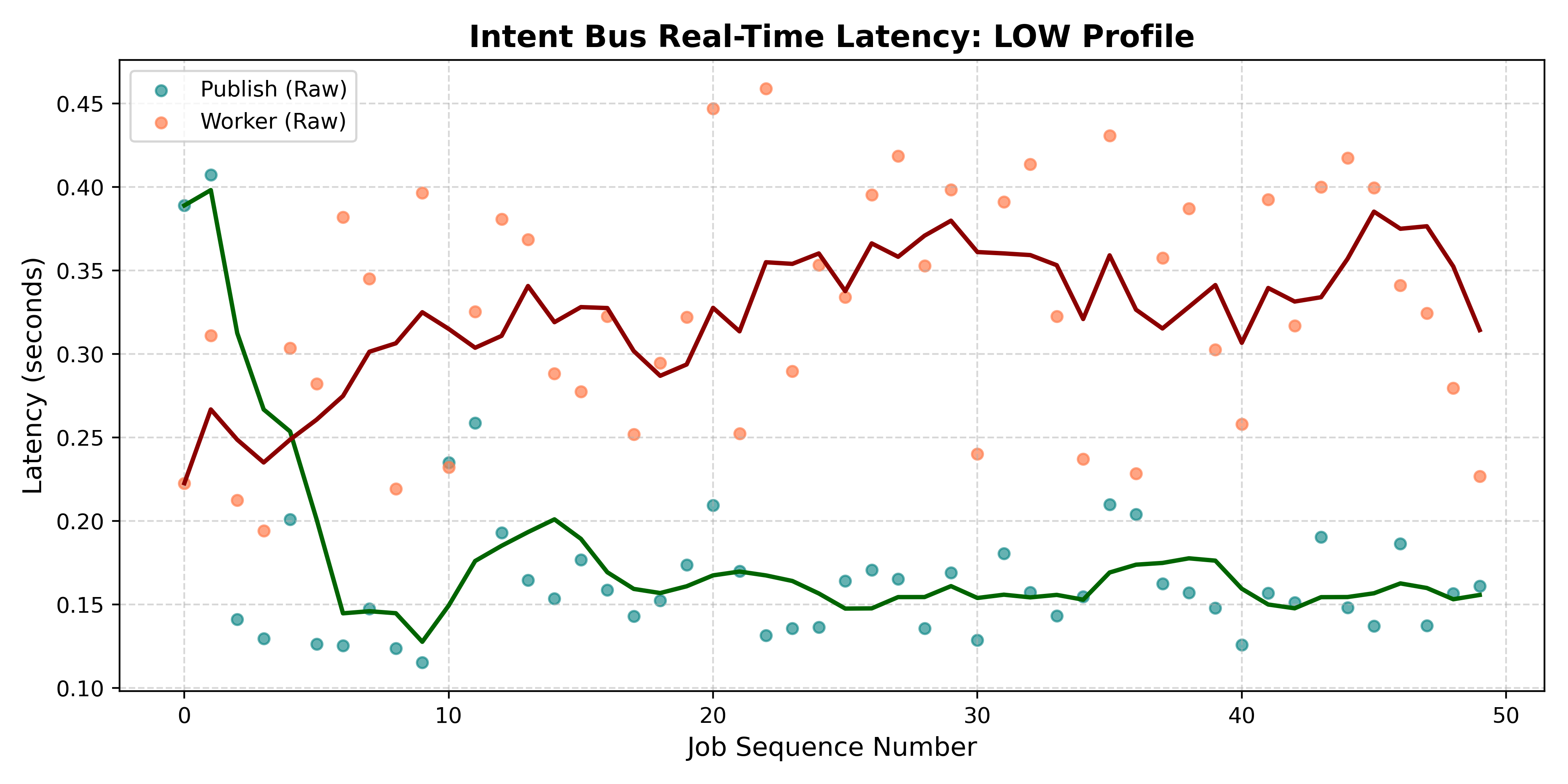
| Light (5w, 50j) | ✅ Works | 100% / 3.72 j/s / P99 0.594s | 100% / 4.74 j/s / P99 0.314s |
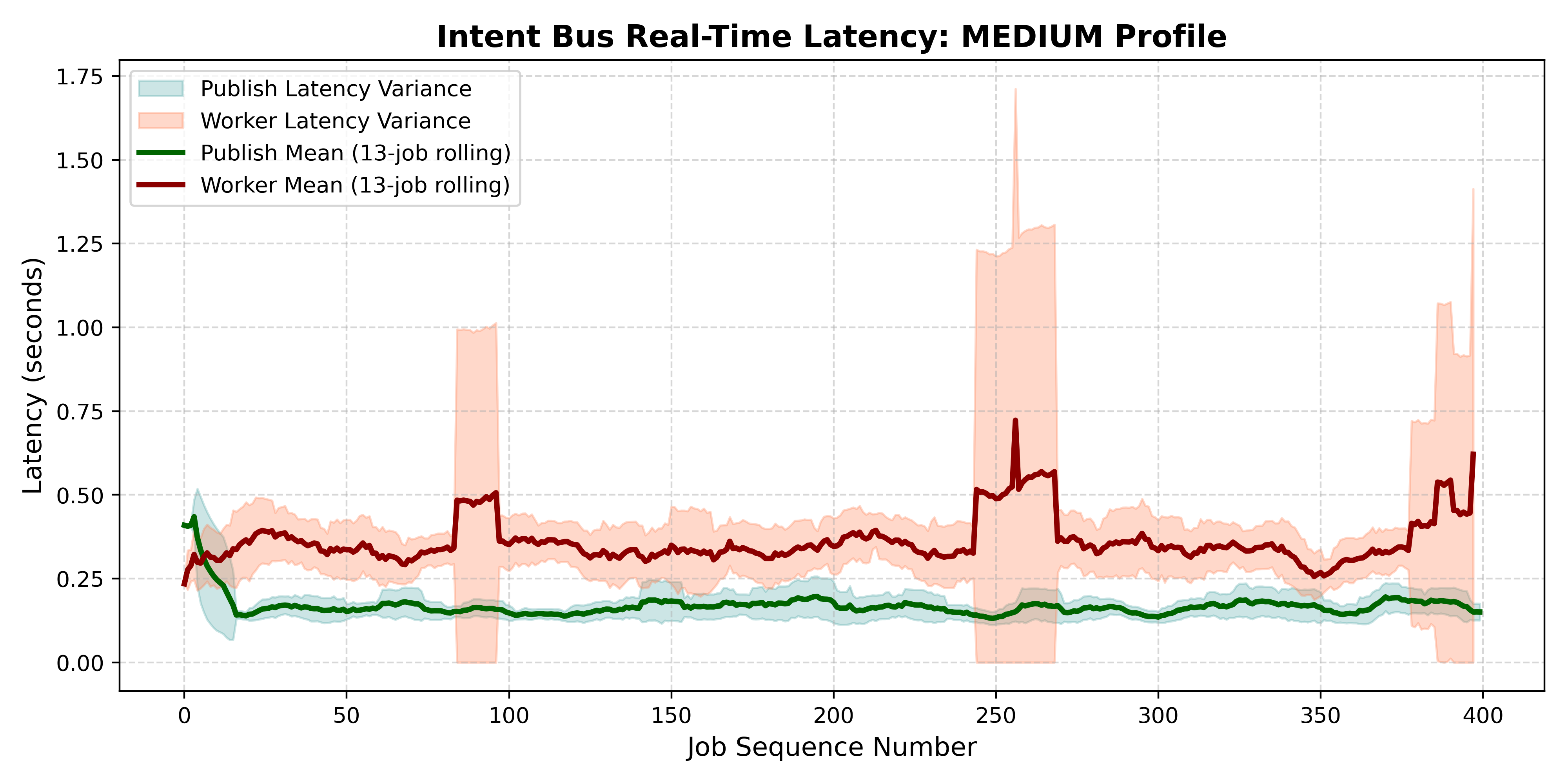
| Medium (15w, 500j) | ❌ 100% Network Errors | 99.5% / 13.27 j/s / P99 0.517s | 99.5% / 18.76 j/s / P99 2.028s |
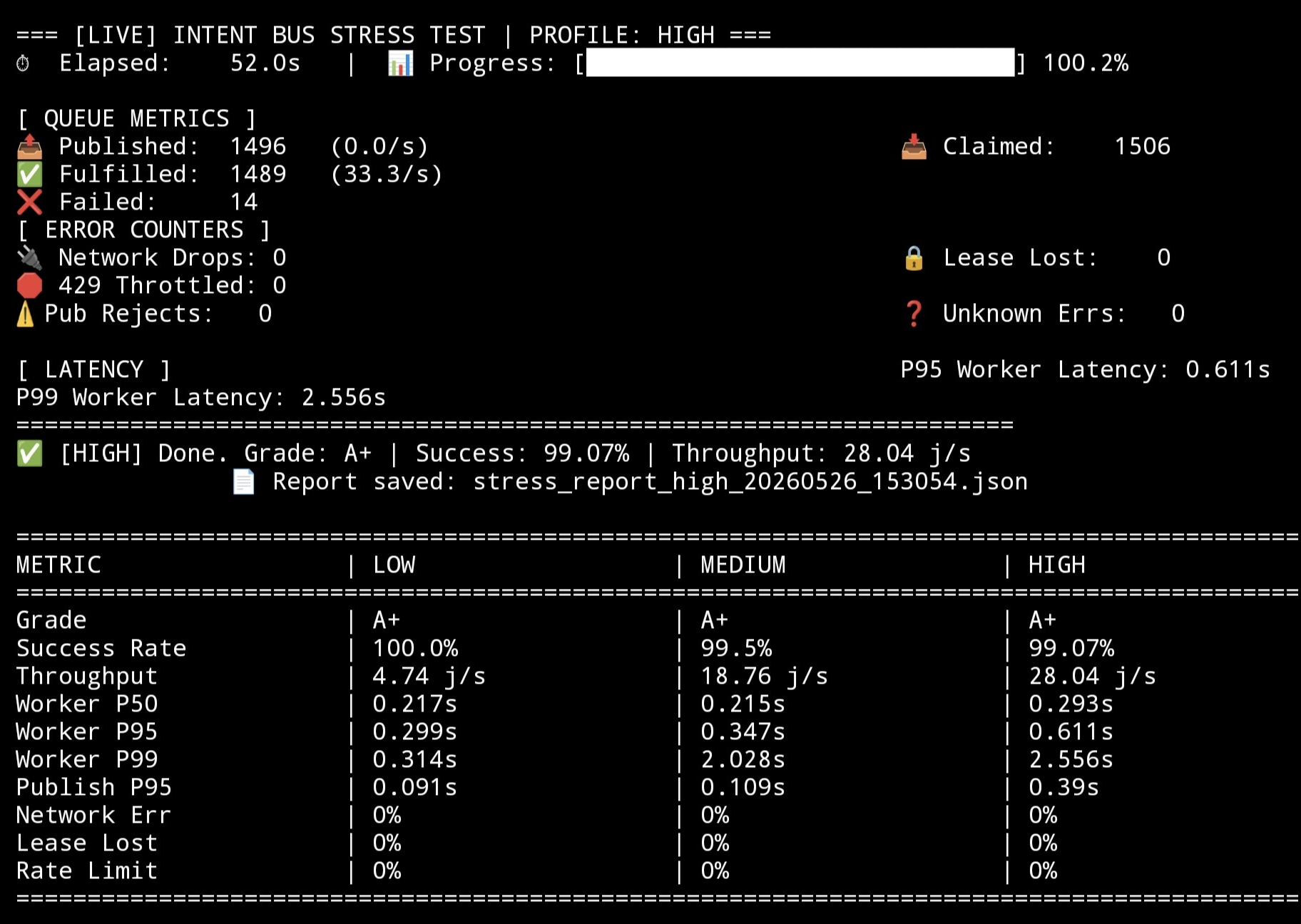
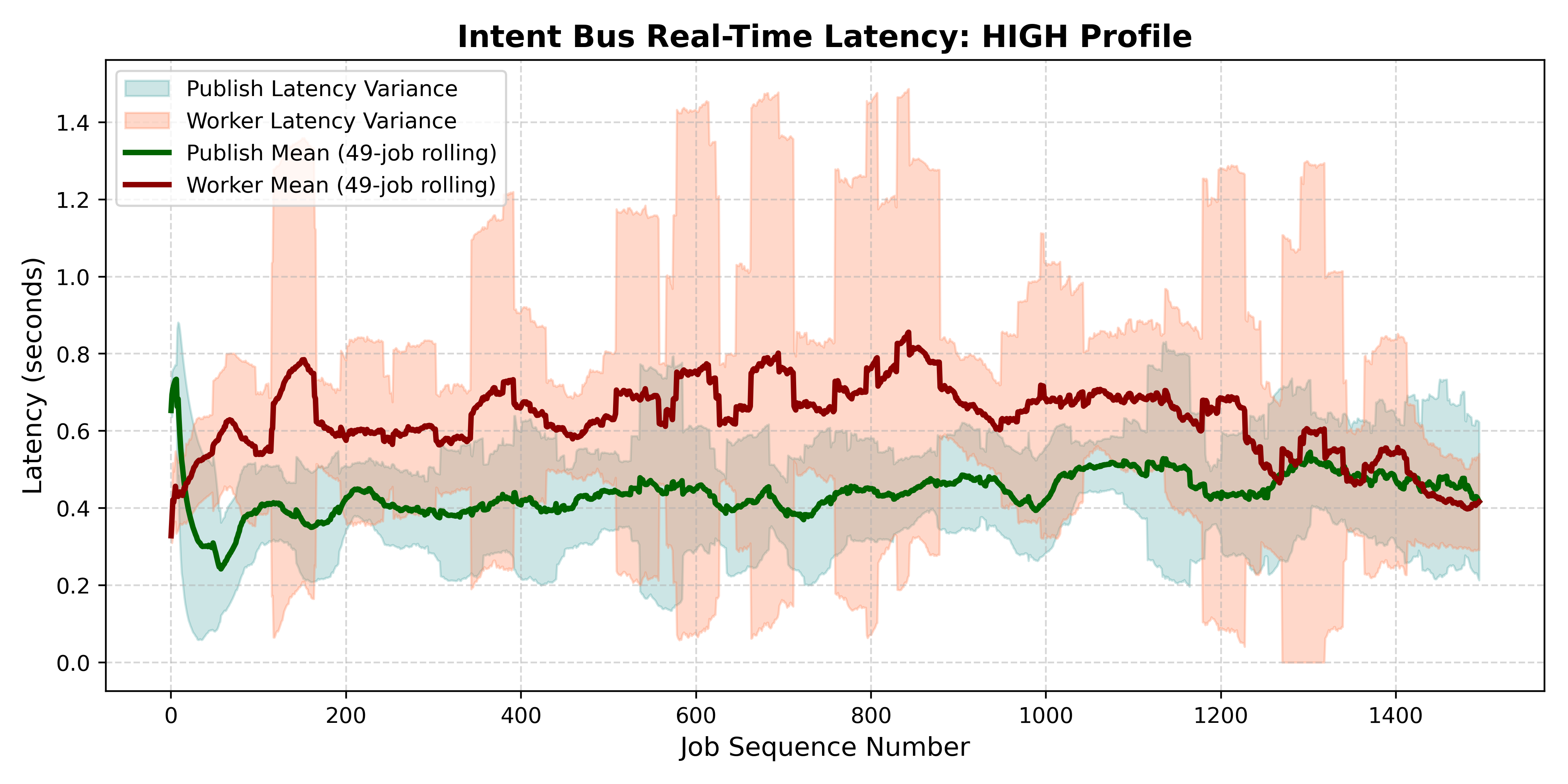
| Heavy (40w, 2000j) | ❌ Failed | 99.01% / 13.62 j/s / P99 2.586s | 99.07% / 28.04 j/s / P99 2.556s |
| Extreme (100+w, 5000j) | ❌ Failed | Not tested | 98.89% / 18.52 j/s / P99 9.002s |
Benchmark runs recorded (v7.61 validation run, 2026-05-24):
Android 12 phone running the server via Termux outperformed the Render free tier at Heavy load. PythonAnywhere free tier is not recommended due to single-threaded request handling.
Higher concurrency increases tail latency, but the system remains stable under sustained contention.
Stress test running on Android 12 phone via Termux
Light automation workloads with tightly clustered latency.
Moderate queue contention with graceful SQLite WAL lock waiting.
Sustained concurrent polling and fulfillment with increased tail latency under load.
Deploy with Docker on:
Multi-threaded deployments handle concurrent worker polling more comfortably.
The server has been stress-tested running directly on an Android 12 phone via Termux, sustaining 28 j/s at A+ grade under heavy load — outperforming a Render free tier container.
PythonAnywhere free tier is not well suited for high-concurrency worker polling because a single-threaded app process can create backlog under sustained load.
Based on current testing:
Larger payloads can be enabled by increasing:
app.config["MAX_CONTENT_LENGTH"]
MAX_PAYLOAD
| Variable | Description |
|---|---|
BUS_SECRET |
Main API key |
BUS_ADMIN_SECRET |
Admin token |
DASHBOARD_PASSWORD |
Dashboard password |
BUS_DB_PATH |
SQLite DB path |
BUS_REQUIRE_SIGNATURES |
Require HMAC auth |
BUS_CLEANUP_INTERVAL_SECONDS |
Cleanup interval |
BUS_TRUST_PROXY |
Enable proxy trust |
| Method | Endpoint | Description |
|---|---|---|
POST |
/intent |
Publish a job |
POST |
/claim |
Claim a job |
POST |
/fulfill/<id> |
Fulfill a claimed job |
POST |
/fail/<id> |
Fail a claimed job |
GET |
/result/<id> |
Fetch stored result |
POST |
/set/<key> |
Set KV entry |
GET |
/get/<key> |
Get KV entry |
dsecurity49/Intent-Bus is a public repo on GitHub by dsecurity49. POST a job → any script can pick it up and execute it. A dead-simple distributed job bus for bots and scripts.
It declares the MIT license on GitHub.
Its maker tagged it for macOS, Windows and Linux, or as Docker or cross-platform. That is declared by the maker; Take My Repo has not tested it.
Open "Take it" on its page: Take My Repo writes an install plan for your machine and hands it to your AI agent (Claude Code, Codex or Cursor), which asks you before each step. Take My Repo has not tested it on any machine.
Simple angular2 app with python-flask backend ( Learning Angular2 )
The Flask server that communicates with my FB Messenger chatbot
The Postgres development platform. Supabase gives you a dedicated Postgres database to build your web, mobile, and AI applications.
Stop renting your intelligence. Own it with AnythingLLM. Everything you need for a powerful local-first agent experience
Its last change on GitHub was on 2026-11-19. GitHub counts 1 open issue and pull requests. Take My Repo does not judge from that whether it is maintained.
Nobody has reviewed it on Take My Repo yet, which says nothing about its quality.
Take My Repo cannot say: it does not audit code and has not run Intent-Bus. What is known comes from GitHub. It declares the MIT license on GitHub. Its last change was on 2026-11-19. It has 29 stars, which measure popularity, not safety. Nobody has reviewed it on Take My Repo yet, which says nothing about its quality. Read the source before you run it. With "Take it", your AI agent shows each step and asks you before running it; README text is treated as data, not as instructions.