
seqdedupe
Lock free deduplication of contigious sequences (multi thread)
- 0
- MIT
- 1 d ago
Repo dunnock/seqdedupe, read from GitHub 22 min ago. dunnock has not joined Take My Repo.
In short
dunnock/seqdedupe is a public repo on GitHub by dunnock. Lock free deduplication of contigious sequences (multi thread). It declares the MIT license on GitHub. It is written mainly in Rust, has 0 stars and last changed on 2026-11-22. Nobody has reviewed it on Take My Repo yet, which says nothing about its quality. Read from GitHub on 2026-11-24.
seqdedupe
Lock-free deduplication of u64 sequence numbers for a fixed set of threads
(x86-64 with CX16). Each thread holds a Worker and calls register(seq).
The first call for a sequence number returns New, and every later call
returns Duplicate. A sequence number older than the retained window returns
TooOld.
use seqdedupe::{new_workers, Registration, Window};
use std::num::NonZeroUsize;

let mut workers = new_workers(Window::Last256, NonZeroUsize::new(2).unwrap(), 0, 0)?;
let mut b = workers.pop().unwrap();
let mut a = workers.pop().unwrap();
std::thread::scope(|s| {
    s.spawn(move || assert_eq!(a.register(5), Registration::New));
    s.spawn(move || { b.register(3); });
});
Worker::snapshot() returns the watermark and the sequence numbers still
missing from the window, both taken at the same logical instant.
Build requirement: cmpxchg16b
Last64 to Last512 use a 128-bit LOCK CMPXCHG16B, written as inline
assembly so it can never fall back to a lock. That code is compiled only
when the target enables the cmpxchg16b feature, which the default
x86_64 Rust target does not. Without it, new_workers returns
InitError::MissingTargetFeature("cmpxchg16b") for those modes; Latest
works either way.
Applications using this crate must enable the feature themselves. Target
features apply to the whole build, and Cargo ignores a dependency's own
.cargo/config.toml, so add one of these to your application:
# .cargo/config.toml in your application
[target.x86_64-unknown-linux-gnu]
rustflags = ["-C", "target-feature=+cmpxchg16b"]
# or a CPU level that includes it:
# rustflags = ["-C", "target-cpu=x86-64-v2"]   # or "native"
or set it per build: RUSTFLAGS="-C target-feature=+cmpxchg16b" cargo build.
The instruction is part of the x86-64-v2 baseline. This repository's
own .cargo/config.toml sets the flag for its tests and benchmarks.
Modes
| Mode | History kept below the watermark |
|---|---|
Latest |
None: a single AtomicU64. Anything at or below the watermark is TooOld. |
Last64 |
64 predecessors, stored inline in the 128-bit header. |
Last128 / Last256 / Last512 |
N predecessors, stored in immutable preallocated slots. |
The library has no runtime dependencies. new_workers_with(.., Tuning)
exposes these tuning knobs:
- the header load instruction;
- a scalar or SIMD shift, including AVX-512 VBMI2;
- the
seq == high + 1fast path; - slot protection:
Optimistic(the default) orHazard; reclaim_batch,pre_protectandrecheck_before_cas.
Use cases
- A/B feed arbitration. Exchanges publish market data on redundant
multicast feeds. Each feed-handler thread registers every packet. The
thread that gets
Newprocesses the packet, and the others drop it. The faster feed wins each packet, with no lock and no arbiter thread. - Multi-path or replicated ingest. Telemetry, IoT or trading events are replicated over several links, regions or UDP paths, so every receiver thread sees most messages more than once.
- At-least-once consumers. A Kafka or NATS consumer, or a retrying RPC client, gets messages redelivered after a timeout or failover. With a monotonic per-producer sequence, each message is processed exactly once, using bounded memory and no per-message allocation.
- Gap detection.
snapshot().missing()lists the sequence numbers no feed has delivered yet. That list feeds a retransmission request or a snapshot recovery. - Fan-in of replicated logs. Several replicas push the same entries, and each log index is applied exactly once.
- Latest-value-wins streams (
Latest). For quotes or state updates, anything older than the newest message is stale anyway. This is the cheapest mode, but it reports both a duplicate and a late fill-in asTooOld.
Choosing a window. N must cover the worst reordering between feeds, in
messages: the maximum feed skew × the message rate. For example, feeds up to
2 ms apart at 200k msg/s are up to 400 messages apart, so use Last512. A
sequence number more than N behind the watermark is TooOld, even if it was
never seen.
Latency under live-feed traffic
benches/latency.rs replays a simulated live feed through every mode, and
through HashSet512, a baseline built on scc::HashSet with the same
answers and a 512-message window (benches/common/hashset.rs).
- Streams. 2 or 4 redundant streams, each a pinned thread on its own physical core. Each stream delivers the same ids in order, at 10k, 50k and 200k msg/s.
- Bursts. Messages arrive in bursts of geometric size (mean 8), and burst starts form a Poisson process. Every stream sees the same burst at the same message ids.
- Per-stream timing. Each stream reaches a burst after its own exponential delay (mean 2 µs). Within the burst, it spaces messages by its own exponential gaps (mean 1 µs).
- Loss. Each stream loses 1% of messages, and the other streams fill them in.
- Measurement. Each thread spins until a message is due, then times the
register()call withRDTSCinto an HDR histogram. Each configuration ran for 5 s on an EPYC 9845 (Zen 5c) with default tuning, giving 0.1–4 M samples. - Timer resolution. On this CPU the TSC advances in 10 ns steps, and the
timer's own cost (20 ns) is subtracted. An uncontended call reads as one
step, shown as
<10, and a two-step reading is shown as<20. Timing 1000 calls together gives about 6 ns per uncontended call. Readings of 50 ns and up span many steps and are barely affected.
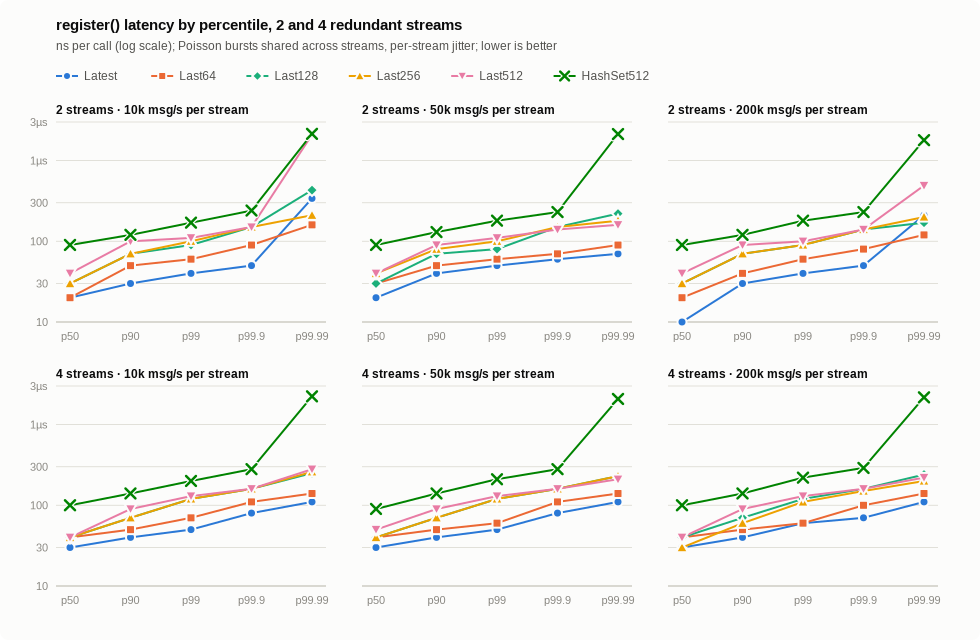
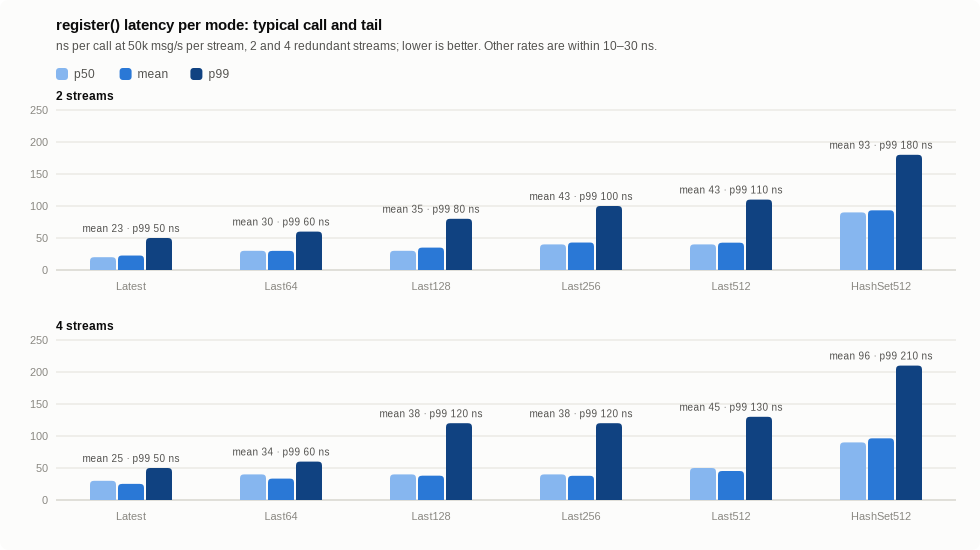
All latencies are p50 / p99 / p99.9, in nanoseconds.
2 streams
| Mode | 10k msg/s | 50k msg/s | 200k msg/s |
|---|---|---|---|
| Latest | <20 / 40 / 50 | <20 / 50 / 60 | <10 / 40 / 50 |
| Last64 | <20 / 60 / 90 | 30 / 60 / 70 | <20 / 60 / 80 |
| Last128 | 30 / 90 / 150 | 30 / 80 / 150 | 30 / 90 / 140 |
| Last256 | 30 / 100 / 150 | 40 / 100 / 150 | 30 / 90 / 140 |
| Last512 | 40 / 110 / 150 | 40 / 110 / 140 | 40 / 100 / 140 |
| HashSet512 | 90 / 170 / 240 | 90 / 180 / 230 | 90 / 180 / 230 |
4 streams
| Mode | 10k msg/s | 50k msg/s | 200k msg/s |
|---|---|---|---|
| Latest | 30 / 50 / 80 | 30 / 50 / 80 | 30 / 60 / 70 |
| Last64 | 40 / 70 / 110 | 40 / 60 / 110 | 40 / 60 / 100 |
| Last128 | 40 / 120 / 160 | 40 / 120 / 160 | 40 / 120 / 160 |
| Last256 | 40 / 120 / 160 | 40 / 120 / 160 | 30 / 110 / 150 |
| Last512 | 40 / 130 / 160 | 50 / 130 / 160 | 40 / 130 / 160 |
| HashSet512 | 100 / 200 / 280 | 90 / 210 / 280 | 100 / 220 / 290 |
The LastN modes answer New for one delivery in S (50.5% with 2 streams,
25.25% with 4) and Duplicate for the rest. Latest answers TooOld for
35–37% of deliveries with 2 streams, and 56–58% with 4.
LastNvsHashSet512. EveryLastNmode is faster at every percentile, rate and stream count.Last512, with the same 512-message window, is 2–2.5× faster at p50 (40–50 vs 90–100 ns) and 1.5–1.8× faster at p99 (100–130 vs 170–220 ns).- At p99.99 it takes 0.16–0.5 µs (2.1 µs in one run) against 1.8–2.2 µs.
- The baseline hashes, takes a bucket lock and touches a bucket line that
another stream just wrote. A
LastNmode needs one header load and at most one slot word.
- 2 vs 4 streams. Doubling the streams adds up to 40 ns at p99 for
Last128–Last512, at most 10 ns forLatestandLast64, and 30–40 ns forHashSet512. Each id is contended by more cores, so more header-line transfers happen and more CASes lose. Last64vsLast128–Last512.- The wider windows add 20–70 ns at p99, more with 4 streams. A duplicate behind the watermark must read a slot line that the winning stream just wrote on another core.
Last64keeps the history in the header line itself and reads it with a locked load, which keeps its p99 at 60–70 ns with 2 or 4 streams. Use it when 64 messages of reordering are enough.
Last128vsLast256vsLast512. These are within 30 ns of each other at p99. A bigger window costs the extra cache line, not the shift.LatestvsLast64.- Both read their header with a locked load.
Latestdoes less work: up to 10 ns faster at p50, 10–20 ns at p99 and 10–40 ns at p99.9. Latestcannot tell "already seen" from "late and never seen". So when the fastest stream loses a message, the late fill-in from another stream is rejected.- That discards 0.6–0.7% of distinct messages. With 2 streams,
Newis 50.13–50.16% of deliveries against 50.50% for theLastNmodes; with 4, it is 25.09–25.10% against 25.25%.
- Both read their header with a locked load.
- Locked loads.
LatestandLast64read the header with a locked RMW instead of a plain load. ForLatestthat costs up to 10 ns at p50 and cuts p99 by up to 30 ns and p99.9 by 10–50 ns (the plain-load version isLatestPlainin the CSV). - Message rate. Results are within 10–30 ns from 10k to 200k msg/s. At these rates, the streams rarely collide on the header CAS, so the latency is mostly cache-line transfers. A thread that sleeps between messages, instead of spinning, would also pay cold-cache misses.
- Reproducibility. p99.9 and below repeat within 10–40 ns between runs and seeds (the TSC resolution is about 10 ns). p99.99 and max vary by 2× or more (interrupts, SMIs), so treat them as orders of magnitude.
The raw data is in bench-results/latency-epyc-9845.csv (summary) and
bench-results/latency-epyc-9845-curves.csv (percentile curves).
Building, testing and benchmarking
cargo test --release            # .cargo/config.toml enables cmpxchg16b

# Saturation throughput matrix (~10 min), or a quick subset
cargo bench --bench register
cargo bench --bench register -- --quick --only main --threads 1,4
# One configuration, for perf record
cargo bench --bench register -- --only main --threads 16 --targets Last512 --loads Dups --reps 3

# Live-feed latency, then the SVG charts
cargo bench --bench latency -- --rates 10,50,200 --streams 2,4 --secs 5 \
    --burst-mean 8 --gap-ns 1000 --jitter-ns 2000 --loss 0.01 --out bench-results/latency-HOST
python3 scripts/latency_charts.py bench-results/latency-HOST docs
Without --out, the latency benchmark writes target/latency-HOST.csv and
target/latency-HOST-curves.csv.
scc is a dev-dependency, used only by the baseline in the benchmarks and
tests.
Further reading
DESIGN.md: constraints, invariants, design choices, and the testing and benchmarking methodology.BENCHMARKS.md: throughput under saturation, the contention analysis (including whyHashSet512wins 16-thread lockstep duplicates on throughput), and the tuning experiments.
License
MIT. See LICENSE.
Questions
What is seqdedupe?
dunnock/seqdedupe is a public repo on GitHub by dunnock. Lock free deduplication of contigious sequences (multi thread).
Is seqdedupe open source?
It declares the MIT license on GitHub.
Does seqdedupe run on macOS, Windows or Linux?
Its maker has not tagged a system, so it is unknown here. Its README says what it needs.
How do I install seqdedupe?
Open "Take it" on its page: Take My Repo writes an install plan for your machine and hands it to your AI agent (Claude Code, Codex or Cursor), which asks you before each step. Take My Repo has not tested it on any machine.
Is seqdedupe still maintained?
Its last change on GitHub was on 2026-11-22. Take My Repo does not judge from that whether it is maintained.