
UnseenViewTAS
Official code for "Towards Generalizing Temporal Action Segmentation to Unseen Views" (IJCV 2025)
- 0
- 6 d ago
Repo emadRad/UnseenViewTAS, read from GitHub 1 min ago. emadRad has not joined Take My Repo.
In short
emadRad/UnseenViewTAS is a public repo on GitHub by emadRad. Official code for "Towards Generalizing Temporal Action Segmentation to Unseen Views" (IJCV 2025). It declares no license on GitHub. Public does not mean open source: without a license, nobody is granted the right to reuse it. It is written mainly in Python, has 0 stars and last changed on 2026-11-18. Nobody has reviewed it on Take My Repo yet, which says nothing about its quality. Read from GitHub on 2026-11-24.
Similar repos
tensorflow
An Open Source Machine Learning Framework for Everyone


Towards Generalizing Temporal Action Segmentation to Unseen Views
Official code for "Towards Generalizing Temporal Action Segmentation to Unseen Views". [Paper (IJCV)] [arXiv]

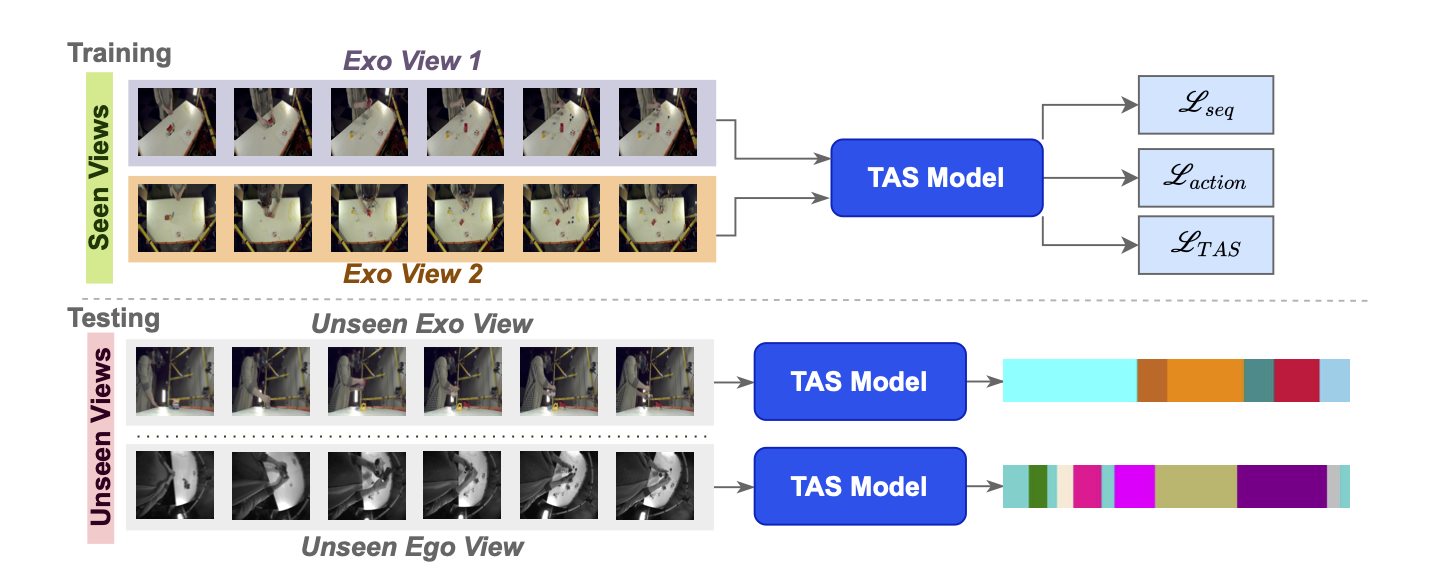
We address temporal action segmentation on unseen camera views: the views used for evaluation are not available during training, e.g. a new exocentric view or an egocentric view. On top of the standard segmentation loss L_TAS, a Siamese network with shared weights is trained with two losses:
- sequence loss L_seq (
MODEL.SEQUENCE_LOSS_WEIGHT, λ): makes the frame-wise representations of two synchronized views of the same sequence similar; - action loss L_action (
MODEL.ACTION_LOSS_WEIGHT, β): makes the representations of two segments with the same action label from different views similar.
Both losses use the negative cosine similarity between the output of a predictor head (MLP) for one input and the (stop-gradient) representation of the other input. The segmentation network is LTContext. The full objective is L = L_TAS + λ L_seq + β L_action.
1. Installation
Requirements: Linux, an NVIDIA GPU, and conda (or Python 3.9 with pip). The code was tested with Python 3.9, PyTorch 2.0.0 and CUDA 11.7.
git clone https://github.com/emadRad/UnseenViewTAS.git
cd UnseenViewTAS

# option A: conda
conda env create -f environment.yml
conda activate uvtas

# option B: pip (inside a Python 3.9 virtual environment)
pip install -r requirements.txt
requirements.txt installs the CUDA 11.7 build of PyTorch. For another CUDA version, install torch==2.0.0 and
torchvision==0.15.1 following the PyTorch instructions
first, then remove the two torch lines from requirements.txt and run pip install -r requirements.txt.
Check the installation:
python -c "import torch; print(torch.__version__, torch.cuda.is_available())"2. Data
All commands must be run from the root of the repository: the annotations and splits in data/ are loaded relative to
the working directory. The features are loaded from DATA.PATH_TO_DATA_DIR.
2.1 Annotations (data/)
| Dataset | Included in this repository | To download |
|---|---|---|
| Assembly101 | train/val splits (data/assembly101/{train,val}.csv), coarse action labels (data/assembly101/coarse-annotations/) |
data/assembly101/fine-grained-annotations/train_segm_modified_l.csv (see below) |
| IKEA ASM | frame-wise action labels (data/ikea_asm/segm_anns_pv/), class mapping |
– |
The action loss on Assembly101 samples pairs of fine-grained action segments. They are read from
data/assembly101/fine-grained-annotations/train_segm_modified_l.csv, which is derived from the
fine-grained annotations of Assembly101 and contains, for every
fine-grained segment, the video, view, start/end frame, action class, toy id, and the action type (assembly/disassembly)
with the start/end frame of the corresponding coarse segment.
Download train_segm_modified_l.csv (110 MB)
and place it at data/assembly101/fine-grained-annotations/train_segm_modified_l.csv, e.g. with
gdown:
pip install gdown
mkdir -p data/assembly101/fine-grained-annotations
gdown 16SH7xAk4LfugBC4Tn16EGGuI77ZulYAk -O data/assembly101/fine-grained-annotations/train_segm_modified_l.csv
md5sum data/assembly101/fine-grained-annotations/train_segm_modified_l.csv   # 6109d5b4d559eb492f88e9898fb9f4a1
2.2 Features (DATA.PATH_TO_DATA_DIR)
The models use pre-extracted frame-wise features, stored as float32 .npy files of shape [T, D]:
<DATA.PATH_TO_DATA_DIR>/features/<DATA.FEATURE_BACKBONE>/
    Assembly101:  <action_type>_<video_id>/<view>.npy       e.g. assembly_nusar-2021_action_both_9011-b06b_..._154253/C10095_rgb.npy
    IKEA ASM:     <furniture>/<video>/<view>.npy             e.g. Kallax_Shelf_Drawer/0001_black_table_02_01_2019_08_16_14_00/dev3.npy
For Assembly101, the features of a recording are stored separately for the assembly and disassembly part
(video_start_frame/video_end_frame in data/assembly101/{train,val}.csv) at 30 fps; the models sub-sample them by
DATA.FRAME_SAMPLING_RATE.
| Features | DATA.FEATURE_BACKBONE |
MODEL.INPUT_DIM |
|---|---|---|
| DINOv2 ViT-L/14, frame-wise, not fine-tuned | dinov2_vitl14_spatial |
1024 |
| MViTv2-L (MaskFeat), fine-tuned on the seen views of Assembly101 | mvit_tuned_assembly101_tempo_spatial_16x1_seen_views |
1152 |
TODO (authors): link the released features.
Extracting DINOv2 features. tools/extract_dinov2_features.py extracts frame-wise DINOv2 ViT-L/14 features of a video
(short side resized to 256, center crop 224, normalization with mean 0.45 / std 0.225) and stores them in the layout above.
It needs git to fetch a pinned commit of the DINOv2 repository (the weights are downloaded via torch.hub).
python tools/extract_dinov2_features.py \
    --video /path/to/assembly101/videos/<video_id>/C10095_rgb.mp4 \
    --out /path/to/assembly101/features/dinov2_vitl14_spatial/assembly_<video_id>/C10095_rgb.npy \
    --start-frame 2833 --end-frame 6959    # assembly part of the recording (video_start_frame, video_end_frame)
Our released features were extracted with a clip-based pipeline (16-frame clips) and are shifted by about 15 frames compared to the output of this script; otherwise they agree (cosine similarity ~0.99 per frame).
3. Training
Every config trains our method (L_TAS + λ L_seq + β L_action) for one dataset and feature type:
| Config | Dataset | Features | λ | β |
|---|---|---|---|---|
configs/Assembly101/MViTv2L.yaml |
Assembly101 | MViTv2-L | 0.5 | 0.2 |
configs/Assembly101/DINOv2L.yaml |
Assembly101 | DINOv2-L | 1.0 | 1.0 |
configs/IkeaASM/DINOv2L.yaml |
IKEA ASM | DINOv2-L | 0.5 | 0.2 |
python run_net.py \
  --cfg configs/Assembly101/MViTv2L.yaml \
  DATA.PATH_TO_DATA_DIR /path/to/assembly101 \
  OUTPUT_DIR ./experiments
Any option of uvtas/config/defaults.py can be overridden on the command line as KEY VALUE pairs, e.g.
MODEL.SEQUENCE_LOSS_WEIGHT 0.5 MODEL.ACTION_LOSS_WEIGHT 0.2 RNG_SEED 1.
Notes:
- The model is evaluated on
TRAIN.EVAL_SPLITafter every epoch. Each linejson_stats: {"_type": "val_epoch", ...}of the log contains the metrics of the seen and unseen views (seen/…,unseen/…and, for Assembly101,unseen_exo/…andunseen_ego/…). F1 and MoF are in [0, 1], Edit in [0, 100]. - GPU memory: training on Assembly101 with
TRAIN.BATCH_SIZE 3needs almost 48 GB (we used one RTX A6000). IKEA ASM needs less than 16 GB. - Data loading is the bottleneck on Assembly101; increasing
DATA_LOADER.NUM_WORKERS(default 2) speeds up training. The results do not depend on the number of workers in expectation, but bitwise reproducibility for a givenRNG_SEEDrequires the same number of workers.
Outputs are written to <OUTPUT_DIR>/<config name>/:
checkpoints/<expr_num>/checkpoint_epoch_000XX.pyth, best_checkpoint.pyth
val_metrics/<expr_num>/epoch_XXX.csv     metrics per validation video and view
tb/<expr_num>/                           TensorBoard logs (tensorboard --logdir <OUTPUT_DIR>)
logs/                                    log files
4. Evaluation
python run_net.py \
  --cfg configs/Assembly101/MViTv2L.yaml \
  DATA.PATH_TO_DATA_DIR /path/to/assembly101 \
  TRAIN.ENABLE False \
  TEST.ENABLE True \
  TEST.CHECKPOINT_PATH /path/to/checkpoint.pyth \
  TEST.SAVE_RESULT_PATH ./results
The metrics are saved to <TEST.SAVE_RESULT_PATH>/<dataset>/<config name>/<split>/:
summary.csv: mean F1@{10,25,50}, F1@Avg, Edit and MoF (accuracy) of the seen views, the unseen views and, for Assembly101, the unseen exocentric and egocentric views;testing_metrics.csv: the metrics of every video and view.
Add TEST.SAVE_PREDICTIONS True to also store the frame-wise predictions and ground truth.
TODO (authors): add pretrained checkpoints.
5. Unseen-view protocols
| Dataset | Seen (training) views | Unseen views |
|---|---|---|
| Assembly101 | Exo1–Exo6 | Exo7 (C10395_rgb), Exo8 (C10379_rgb); Ego1–Ego4 (HMC_*) |
| IKEA ASM | dev1, dev2 |
dev3 |
The unseen views are set by DATA.UNSEEN_EXO_VIEWS and DATA.UNSEEN_EGO_VIEWS. The names of the Assembly101 views
are listed in uvtas/dataset/assembly101.py.
Citation
@article{bahrami2025unseenviews,
  title   = {Towards Generalizing Temporal Action Segmentation to Unseen Views},
  author  = {Bahrami, Emad and Zatsarynna, Olga and Francesca, Gianpiero and Gall, Juergen},
  journal = {International Journal of Computer Vision},
  year    = {2025},
  doi     = {10.1007/s11263-025-02703-0}
}
Acknowledgement
This repository builds on LTContext. The code structure is inspired by SlowFast, the multi-head attention is based on xFormers, and the evaluation code is taken from MS-TCN.
License
This work is licensed under a Creative Commons Attribution-NonCommercial 4.0 International License.
Questions
What is UnseenViewTAS?
emadRad/UnseenViewTAS is a public repo on GitHub by emadRad. Official code for "Towards Generalizing Temporal Action Segmentation to Unseen Views" (IJCV 2025).
Is UnseenViewTAS open source?
It declares no license on GitHub. Public does not mean open source: without a license, nobody is granted the right to reuse it.
Does UnseenViewTAS run on macOS, Windows or Linux?
Its maker tagged it for Linux. That is declared by the maker; Take My Repo has not tested it.


