ollama
Get up and running with Kimi, GLM, MiniMax, DeepSeek, gpt-oss, Qwen, Gemma and other models.
- 188k
- Go
- MIT
- 4 h ago
nanoGPT-like codebase for LLM training
Repo epfml/llm-baselines, read from GitHub 14 min ago. epfml has not joined Take My Repo.
epfml/llm-baselines is a public repo on GitHub by epfml. nanoGPT-like codebase for LLM training. It declares the MIT license on GitHub. It is written mainly in Python, has 120 stars and last changed on 2025-11-07. Nobody has reviewed it on Take My Repo yet, which says nothing about its quality. Read from GitHub on 2026-11-24.
Get up and running with Kimi, GLM, MiniMax, DeepSeek, gpt-oss, Qwen, Gemma and other models.
Implement a ChatGPT-like LLM in PyTorch from scratch, step by step
A modular codebase to experiment with transformers, inspired by nanoGPT.
Install dependencies:
pip install -r requirements.txt
Run a simple training on the Slimpajama dataset (6B subset, 24GBs decompressed, takes a few minutes to download):
python ./src/main.py --config_format base
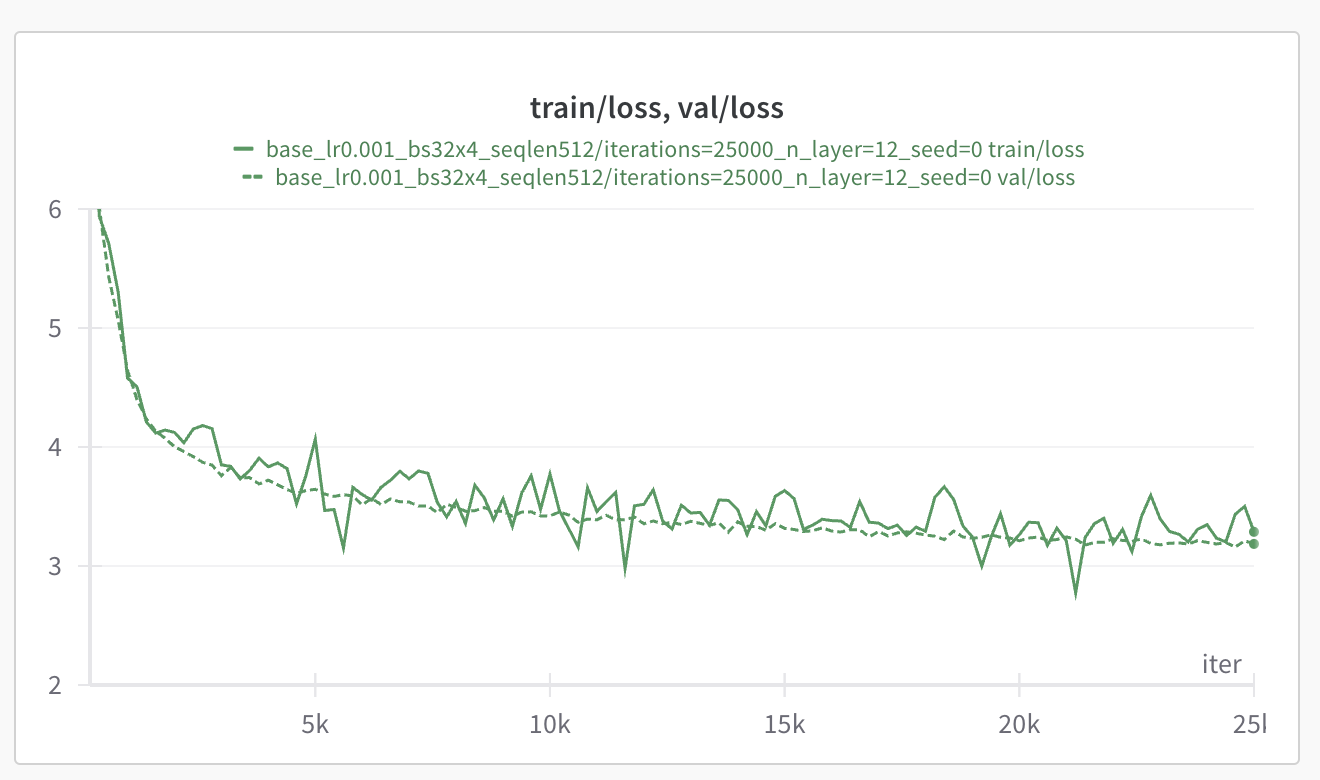
The above command trains a 123.59M parameters model. It trains for 25k iterations with a batch size of 128=32x4 (4 gradient accumulation steps), using a cosine schedule with a maximum learning rate of 1e-3 that is reduced to 1e-4 at the end of training. The model is saved in the ./exps folder.
This training takes roughly ~3h on a single A100 (80GB) GPU. The plot of the training and validation loss should look roughly like this:
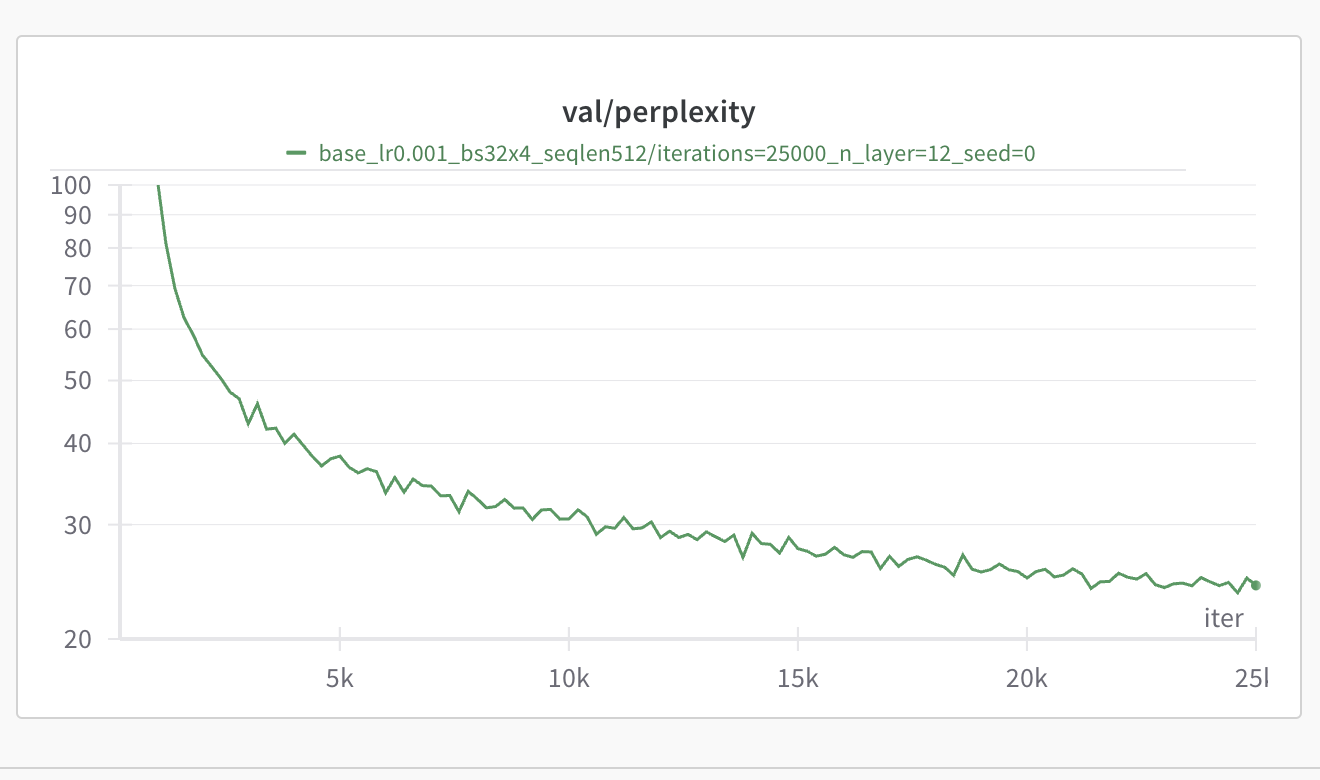
You can check out the wandb run for yourself here.
Here are the possible parameters you can use (copypasted from config/base.py):
# General training params
parser.add_argument('--batch_size', default=32, type=int)
parser.add_argument('--acc_steps', default=4, type=int)
parser.add_argument('--seed', default=0, type=int) # random seed for the parameters
parser.add_argument('--data_seed', default=1337, type=int) # random seed defining the data ordering
parser.add_argument('--eval_interval', default=200, type=int)
parser.add_argument('--full_eval_at', nargs="+", type=int)
parser.add_argument('--eval_batches', default=64, type=int)
parser.add_argument('--device', default='cuda:0', type=str) # see below to run on multiple GPUs
parser.add_argument('--iterations', default=25000, type=int) # total number of training iterations
parser.add_argument('--warmup_steps', default=300, type=int)
parser.add_argument('--lr', default=1e-3, type=float)
parser.add_argument('--wsd_final_lr_scale', default=0.0, type=float) # wsd scheduler
parser.add_argument('--wsd_fract_decay', default=0.1, type=float) # wsd scheduler
parser.add_argument('--decay_type', default='linear', choices=['linear', 'cosine', 'exp', 'miror_cosine', 'square', 'sqrt'])
parser.add_argument('--weight_decay', default=0.1, type=float) # I recommend you keep this value, else instabilities might arise
parser.add_argument('--beta1', default=0.9, type=float) # adam parameter
parser.add_argument('--beta2', default=0.95, type=float) # adam parameter
parser.add_argument('--scheduler', default='cos', choices=['linear', 'cos', 'wsd', 'cos_inf', 'none'])
parser.add_argument('--final_div_factor', default=1, type=float) # cosine and linear schedulers
parser.add_argument('--cos_inf_steps', default=0, type=int) # cos_inf scheduler
parser.add_argument('--opt', default='adamw', choices=['adamw', 'sgd', 'muon', 'soap', 'ademamix', 'lion', 'sf-adamw', 'sf-sgd', 'signsgd', 'signum', 'prodigy', 'sophiag', 'adopt', 'mars', 'adafactor', 'lamb', 'scion', 'scion-light', 'd-muon', 'muon-pytorch'])
parser.add_argument('--eval_freq', default=200, type=int) # in iterations
parser.add_argument('--results_base_folder', default="./exps", type=str) # where the checkpoints will be saved
parser.add_argument('--grad_clip', default=0.0, type=float) # default value is 1.0 in nanoGPT
parser.add_argument('--momentum', default=0.9, type=float)
parser.add_argument('--shampoo_beta', default=-1.0, type=float)
parser.add_argument('--precondition_frequency', default=10, type=int) #for SOAP and Sophia
parser.add_argument('--max_precond_dim', default=10000, type=int)
parser.add_argument('--merge_dims', default=False, type=bool) # merge dimensions till the product of the dimensions is less than or equal to max_precond_dim
parser.add_argument('--precondition_1d', default=False, type=bool)
parser.add_argument('--normalize_grads', default=False, type=bool)
parser.add_argument('--soap_data_format', default='channels_first', type=str)
parser.add_argument('--correct_bias', default=True, type=bool)
parser.add_argument('--nesterov', default=False, type=bool) # whether to use Nesterov-style momentum
parser.add_argument('--muon_ns_steps', default=5, type=int) # the number of steps to use in the newton schulz, if it is iterative
parser.add_argument('--muon_lr_factor', default=0.02, type=float) # a factor by which to reduce the lr for muon
parser.add_argmunet('--adema_beta3', default=0.9, type=float) # beta3 in AdEMAMix
parser.add_argument('--adema_alpha', default=2.0, type=float) # alpha in AdEMAMix
parser.add_argument('--adema_beta3_warmup', default=None, type=int) # AdEMAMix hyperparameter
parser.add_argument('--adema_alpha_warmup', default=None, type=int) # AdEMAMix hyperparameter
parser.add_argument('--schedulefree_r', defalut=0.0, type=float) # schedulefree hyperparameter
parser.add_argument('--weight_lr_power', default=2.0, type=float) # schedulefree hyperparameter
parser.add_argument('--log_interval', default=50, type=int)
parser.add_argument('--dampening', default=0.0, type=float)
parser.add_argument('--prodigy_beta3', default=None, type=float) # coefficients for computing the Prodidy stepsize using running averages
parser.add_argument('--prodigy_decouple', default=True, type=bool) # Use AdamW style decoupled weight decay
parser.add_argument('--prodigy_use_bias_correction', default=False, type=bool)
parser.add_argument('--prodigy_safeguard_warmup', default=False, type=bool) # Remove lr from the denominator of D estimate to avoid issues during warm-up stage. Off by default.
parser.add_argument('--prodigy_fsdp_in_use', default=False, type=bool)
parser.add_argument('--sophia_rho', default=0.04, type=float)
parser.add_argument('--mars_type', default='mars-adamw', choices=['mars-adamw', 'mars-lion', 'mars-shampoo'],)
parser.add_argument('--mars_vr_gamma', default=0.025, type=float)
parser.add_argument('--mars_is_approx', default=True, type=float)
parser.add_argument('--mars_lr', default=3e-3, type=float)
parser.add_argument('--mars_beta1', default=0.95, type=float)
parser.add_argument('--mars_beta2', default=0.99, type=float)
parser.add_argument('--adafactor_decay_rate', default=-0.8, type=float)
parser.add_argument('--lamb_use_bias_correction', default=False, type=bool)
parser.add_argument('--adopt_decouple', default=True, type=bool)
parser.add_argument('--adopt_eps', default=1e-6, type=float)
parser.add_argument('--scion_lmh_scale', default=10.0, type=float)
parser.add_argument('--scion_emb_scale', default=1.0, type=float)
parser.add_argument('--scion_tr_scale', default=3.0, type=float)
parser.add_argument('--weight_average', action='store_true') # uniform weight averaging (or SWA)
parser.add_argument('--wa_interval', default=5, type=int, help='How often to take the average (every k steps). Must divide wa-horizon.')
parser.add_argument('--wa_horizon', default=500, type=int, help='How frequently we save uniform model averages. Should divide '
+ 'latest-ckpt-interval, otherwise some points may not be saved ' + 'correctly.')
parser.add_argument('--wa_dtype', default='float32', type=str, choices=['float32', 'float64'])
parser.add_argument('--wa_use_temp_dir', action='store_true')
parser.add_argument('--wa_sweep_horizon', action='store_true')
parser.add_argument('--max_num_wa_sweeps', default=5, type=int)
parser.add_argument('--exponential_weight_average', action='store_true') # EMA of weights
parser.add_argument('--ewa_interval', default=10, type=int, help='How often to take the EWA average (every k steps).')
parser.add_argument('--ewa_decay', default=0.95, type=float, help='EWA decay parameter (between 0.9 and 1).')
parser.add_argument('--ewa_after_warmup', action='store_true', help='Start EWA after warmup steps.')
# Dataset params
parser.add_argument('--dataset', default='slimpajama', choices=['slimpajama', 'wikitext', 'shakespeare-char', 'arxiv', 'arxiv2000', 'arxiv+wiki', 'openwebtext2', 'redpajama', 'redpajamav2', 'fineweb', 'finewebedu', 'c4', 'arc_easy', 'arc_challenge', 'hellaswag', 'logiqa', 'piqa', 'sciq', 'humaneval', 'gsm8k', 'kodcode', 'mathqa', 'medqa'])
parser.add_argument('--tokenizer', default='gpt2', type=str, choices=['gpt2', 'mistral'])
parser.add_argument('--vocab_size', default=50304, type=int)
parser.add_argument('--data_in_ram', action='store_true') # force the data to RAM, you most likely do not need this
# Model params
parser.add_argument('--model', default='base', choices=['base', 'llama', 'mup_gpt', 'mup_llama',])
parser.add_argument('--parallel_block', action='store_true')
parser.add_argument('--use_pretrained', default='none', type=str) # 'none', 'gpt2' or a path to the pretraind model
parser.add_argument('--from_dense', action='store_true')
parser.add_argument('--init_std', default=0.02, type=float)
parser.add_argument('--dropout', default=0.0, type=float) # keep to 0 unless in low data regime (e.g. wikitext)
parser.add_argument('--n_head', default=12, type=int)
parser.add_argument('--n_layer', default=12, type=int) # depth in (att + ff) blocks
parser.add_argument('--n_embd', default=768, type=int) # hidden size ...
parser.add_argument('--sequence_length', default=512, type=int)
parser.add_argument('--dtype', default='bfloat16', type=str, choices=['float32', 'float16', 'bfloat16'],)
parser.add_argument('--bias', default=False, type=bool)
parser.add_argument('--compile', action='store_true') # if true then model is compiled
 parser.add_argument('--untied_embeds', action='store_true') # disables weight tying between lm_head.weight and wte.weight
parser.add_argument('--rmsnorm_eps', default=1e-5, type=float) # used by the llama model
parser.add_argument('--multiple_of', default=256, type=int) # used by the llama model make SwiGLU hidden layer size multiple of large power of 2
parser.add_argument('--moe', action='store_true')
parser.add_argument('--moe_routing', default='standard_gating', type=str, choices=['standard_gating', 'expert_choice'],)
parser.add_argument('--moe_num_experts', default=8, type=int)
parser.add_argument('--capacity_factor', default=2.0, type=float) # only used for expert choice routing
parser.add_argument('--moe_num_shared_experts', default=0, type=int) # deepseek routing, experts that are always active
parser.add_argument('--moe_router_loss', default='load_balancing_z_loss', type=str, choices=['entropy', 'load_balancing_only', 'load_balancing_z_loss'],)
parser.add_argument('--moe_num_experts_per_tok', default=2, type=int)
parser.add_argument('--moe_entropy_loss_factor', default=0.01, type=float)
parser.add_argument('--moe_aux_loss_factor', default=0.1, type=float)
parser.add_argument('--moe_z_loss_factor', default=0.01, type=float)
parser.add_argument('--moe_softmax_order', type=str, default='topk_softmax', choices=['softmax_topk', 'topk_softmax'],)
parser.add_argument('--plot_router_logits', action='store_true')
parser.add_argument('--scale_emb', default=10, type=int) # mup arguments --- the base model width that mup has been configured on
parser.add_argument('--scale_base_model', default=256, type=int)
parser.add_argument('--scale_depth', default=1.4, type=float)
# Checkpointing
parser.add_argument('--results_base_folder', default='./exps', type=str)
parser.add_argument('--permanent_ckpt_interval', default=0, type=int)
parser.add_argument('--latest_ckpt_interval', default=0, type=int)
parser.add_argument('--resume_from', default=None, type=str)
parser.add_argument('--resume_from_swa', default=None, type=str)
parser.add_argument('--auto_resume', default=True)
# logging params (WandB)
parser.add_argument('--wandb', action='store_true') # whether to use wandb or not
parser.add_argument('--wandb_project', default='my-project', type=str)
parser.add_argument('--wandb_entity', default=None, type=none_or_str) # for the team projects
parser.add_argument('--wandb_run_prefix', default='none', type=str) # is added before the autogenerated experiment name
parser.add_argument('--eval_seq_prefix', default="Once upon a time", type=str) # prefix used to generate sequences
parser.add_argument('--log_dynamics', action='store_true')
parser.add_argument('--dynamics_logger_cfg', default='./src/logger/rotational_logger.yaml', type=str)
parser.add_argument('--log_parameter_norms', action='store_true') # logs the L2 norm of the parameters
parser.add_argument('--norm_order', default=2) # order of the model norm to log
# Distributed args
parser.add_argument('--distributed_backend', default=None, type=str, required=False,
                    choices=distributed.registered_backends())  # distributed backend type (e.g. nccl)
You need to give your wandb authorize key in order to send the data to your wandb account. If you start jobs on a server without access to prompt, then you can set the WANDB_API_KEY variable within your script:
# this is a script that could be executed on a server
pip install -r requirements.txt # install req.
export WANDB_API_KEY="put your authorize key here, to find it: https://wandb.ai/authorize"
python ./src/main.py --config_format base --wandb --wandb_project "my awesome project" --n_layer 7 --model base --seed 123
The structure of the project is the following:
src/
    main.py         # pick the right data, model, optimizer, and training function
    config/
        __init__.py # contains CONFIG_FORMAT_TO_MODULE_MAP mapping the name given to the --config_format flag with a python conf file
        base.py     # config for the base model
    data/
        utils.py    # contains the get_dataset function
        fineweb.py # load/process fineweb
        fineweb_edu.py    # load/process fineweb edu
        shakespeare.py # load/process the Shakespeare dataset
        benchmarks.py # load/process benchs, e.g., hellaswag, gsm8k, arc_challenge
        c4.py # load/process the c4 dataset
        slimpajama.py
        ...
    models/
        utils.py    # contains the get_model function
        base.py     # contains the standard transformer base architecture
        llama.py    # llama architecture
        mup.py # implementation of muP
        mup_llama.py # muP-styled llama architecture
    optim/
        utils.py    # contains eval and get_batch functions
        base.py     # training function for the base and llama models
        ...
    distributed/
        # code to enable simple distributed training
Given the above structure, to add your own model, you can just fork the ./src/models/base.py file, do your modifications, then if necessary fork the ./src/optim/base.py in case you need some custom training loop or evaluation. You also need to fork the ./src/config/base.py file to add your own parameters, which imply adding your new config to the mapping CONFIG_FORMAT_TO_MODULE_MAP in ./src/config/__init__.py. To add a new dataset, create a new file in the data folder, check wikitext.py for the expected format.
epfml/llm-baselines is a public repo on GitHub by epfml. nanoGPT-like codebase for LLM training.
It declares the MIT license on GitHub.
Its maker has not tagged a system, so it is unknown here. Its README says what it needs.
Open "Take it" on its page: Take My Repo writes an install plan for your machine and hands it to your AI agent (Claude Code, Codex or Cursor), which asks you before each step. Take My Repo has not tested it on any machine.
100+ AI Agents, Agent Skills and RAG Apps - Free and Open Source.
Official repository of OFA (ICML 2022). Paper: OFA: Unifying Architectures, Tasks, and Modalities Through a Simple Sequence-to-Sequence Learning Framework
Its last change on GitHub was on 2025-11-07. Take My Repo does not judge from that whether it is maintained.
Nobody has reviewed it on Take My Repo yet, which says nothing about its quality.
Take My Repo cannot say: it does not audit code and has not run llm-baselines. What is known comes from GitHub. It declares the MIT license on GitHub. Its last change was on 2025-11-07. It has 120 stars, which measure popularity, not safety. Nobody has reviewed it on Take My Repo yet, which says nothing about its quality. Read the source before you run it. With "Take it", your AI agent shows each step and asks you before running it; README text is treated as data, not as instructions.