cLua
A high-performance Lua code coverage tool with C++ collector and Go AST parser, supporting dynamic injection and LCOV reports.
- 35
- MIT
- 13 d ago
Repo esrrhs/cLua, read from GitHub 21 h ago. esrrhs has not joined Take My Repo.
In short
esrrhs/cLua is a public repo on GitHub by esrrhs. A high-performance Lua code coverage tool with C++ collector and Go AST parser, supporting dynamic injection and LCOV reports. It declares the MIT license on GitHub. It is written mainly in Go, has 35 stars and last changed on 2026-11-10. Nobody has reviewed it on Take My Repo yet, which says nothing about its quality. Read from GitHub on 2026-11-23.
Similar repos
graphify
Turn any codebase, with its docs, SQL schemas, configs, and PDFs, into a queryable knowledge graph. A /graphify skill for Claude Code, Cursor, Codex, and Gemini CLI: local deterministic AST parsing, every edge explained, no vector store.

cLua
A high-performance, lightweight code coverage tool for Lua (supports Lua 5.3+). Built with a C++ data collection engine and a Go-based AST parser to provide precise, low-overhead line and function coverage statistics.
Table of Contents
- Features
- Architecture & Workflow
- Prerequisites
- Build and Installation
- Reproducible Build & Tests
- Usage Guide
- Analyzing & Visualizing Results
- Automated Coverage Service (CluaHelper)
- Related Projects
- License
Features
- 🚀 High Performance & Low Overhead: The core data collection library is written in C++ with minimal Lua hook overhead, keeping the performance impact on host applications to an absolute minimum.
- 🔌 Flexible Integration: Can be imported directly within scripts using
require "libclua"or dynamically injected into running production/testing processes via hookso without requiring server restarts or code changes. - 🎯 Precise AST Analysis: The parser is written in Go and analyzes the Lua syntax tree (AST) to compute exact file-level and function-level line coverage metrics and execution counts.
- ⏸️ Pause & Resume: Supports
cl.pause()andcl.resume()to selectively exclude critical or non-target code segments during testing. - 📊 Rich Visual Reports: Exports to standard LCOV format, allowing seamless HTML report generation with
genhtml. - 🌐 Automated Coverage Service: Provides
clua_helperwith Client, Server, and Generator modes to automate injection, aggregation, and web hosting across multiple testing environments.
Architecture & Workflow
+-----------------------+
|  Target Process (Lua) |
|  +-----------------+  |
|  |   libclua.so    |  |  == (write coverage) ==>  test.cov (Binary Data)
|  +-----------------+  |                                  |
+-----------------------+                                  |
                                                           v
                                                  +-----------------+
                                                  |   clua (CLI)    |
                                                  +-----------------+
                                                     |           |
                                    (Terminal Stats) v           v (Export LCOV)
                                       Function & File       test.info
                                       Coverage Rates            |
                                                                 v (genhtml)
                                                           HTML Dashboard
Prerequisites
- OS: Linux (x86_64)
- Lua: 5.3 or higher (development headers and libraries such as
lua.hrequired) - C++ Compiler: GCC / Clang (with C++11 support)
- CMake: 3.13 or higher
- Go: 1.19 or higher (must match
go.modand CI;go.sumis required for a reproducible module build) - LCOV (optional, for HTML reports): install via
apt install lcovoryum install lcov
Build and Installation
From a clean checkout, the supported entry point is:
make
This builds libclua.so, clua, and clua_helper in the current directory. The same steps can be run manually:
1. Build C++ Collector Library (libclua.so)
cmake -S . -B build
cmake --build build
cp build/libclua.so .
This generates libclua.so. If lua.h is not on the default include path (for example it lives in /usr/include/lua5.4), pass -DLUA_INCLUDE_DIR=/usr/include/lua5.4 to cmake.
2. Build Coverage Parser (clua)
go build -mod=readonly -o clua clua.go
This compiles the clua command-line utility used to parse binary coverage files. -mod=readonly uses the pinned versions and checksums in go.mod / go.sum.
3. Build Coverage Service (clua_helper)
go build -mod=readonly -o clua_helper clua_helper.go
This compiles clua_helper, which provides client, server, and report generator services.
Reproducible Build & Tests
Go 1.19 is the required language version in go.mod, this README, and CI (go-version-file: go.mod). After changing Go module dependencies, run go mod tidy or make tidy and commit the updated go.sum. Do not disable module checksum verification.
An automated end-to-end test exercises the documented workflow: load libclua.so from test.lua, write a coverage file, parse it with clua, and export LCOV. The test asserts that the coverage file is produced, that parse results include the expected file and function coverage, and that the LCOV output contains valid TN / SF / DA / LF / LH / end_of_record records.
make test
# or, after `make`:
go test -mod=readonly -count=1 ./e2e
Usage Guide
Method 1: Direct Embedding in Lua Scripts
Load and start the coverage collector inside your Lua scripts:
-- 1. Load libclua.so
local cl = require "libclua"

-- 2. Start recording coverage
-- Parameter 1: Output coverage file path (default: "luacov.data")
-- Parameter 2: Periodic auto-save interval in seconds (0 = disabled, flushes only on cl.stop())
cl.start("test.cov", 5)

-- (Optional) Pause and resume coverage collection as needed
-- cl.pause()
-- cl.resume()

-- 3. Execute your workload
do_something()

-- 4. Stop recording and flush data to disk
cl.stop()
Note: Ensure
LUA_CPATHincludes the directory containinglibclua.so, for example:LUA_CPATH="./?.so;;" lua test.lua.
Method 2: Dynamic Process Injection via hookso
Using hookso, you can inject coverage collection into a running process without stopping or recompiling it:
Obtain the
lua_State*pointer in the target process: For example, inspect the first argument oflua_settop(L)(assuming the process ID is$PID):./hookso arg $PID liblua.so lua_settop 1 # Example output: 123456Inject and load
libclua.so:./hookso dlopen $PID ./libclua.soCall
start_covto begin profiling: Equivalent to invokingstart_cov(L, "./test.cov", 5)inside the process:./hookso call $PID libclua.so start_cov i=123456 s="./test.cov" i=5Call
stop_covto stop profiling and flush data: Equivalent to invokingstop_cov(L):./hookso call $PID libclua.so stop_cov i=123456
Analyzing & Visualizing Results
Terminal Console Output
Parse the generated coverage file with the clua utility:
./clua -i test.cov
Example output:
total points = 27, files = 1
coverage of /home/project/cLua/test.lua:
    local cl = require "libclua"
    cl.start("test.cov", 5)

1   function test1(i)
10      if i % 2 then
10          print("a "..i)
        else
            print("b "..i)
        end
11  end

1   function test2(i)
40      if i > 30 then
19          print("c "..i)
        else
21          print("d "..i)
        end
41  end

1   function test3(i)

51      if i > 0 then
51          print("e "..i)
        else
            print("f "..i)
        end

52  end

    test4 = function(i)

        local function test5(i)
12          print("g "..i)
15      end

15      for i = 0, 3 do
12          test5(i)
        end

4   end

102 for i = 0, 100 do
101     if i < 10 then
10          test1(i)
91      elseif i < 50 then
40          test2(i)
        else
51          test3(i)
        end
    end

4   for i = 0, 2 do
3       test4(i)
    end

1   cl.stop()

/home/project/cLua/test.lua total coverage 78% 22/28
/home/project/cLua/test.lua function coverage [function test1(i)] 66% 2/3
/home/project/cLua/test.lua function coverage [function test2(i)] 100% 3/3
/home/project/cLua/test.lua function coverage [function test3(i)] 66% 2/3
/home/project/cLua/test.lua function coverage [test4 = function(i)] 75% 3/4
/home/project/cLua/test.lua function coverage [local function test5(i)] 100% 1/1
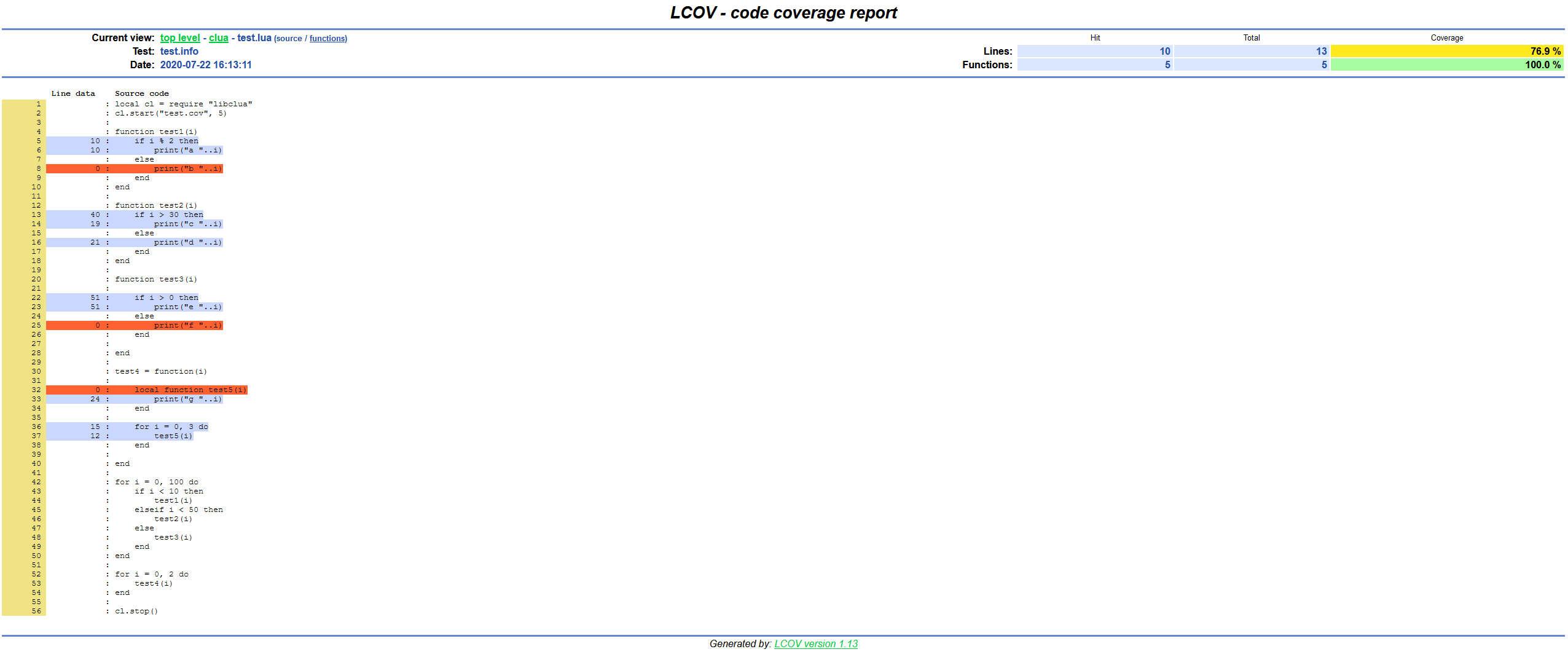
The number preceding each line indicates its execution count, while blank entries indicate unexecuted lines. Overall file coverage and per-function coverage summaries are displayed at the end.
Generating LCOV and HTML Visual Reports
Export coverage data to standard LCOV info format:
./clua -i test.cov -lcov test.infoGenerate an HTML dashboard using LCOV's
genhtml:genhtml -o htmltest test.infoOpen
htmltest/index.htmlto explore the overview report:
Click into individual source files for line-by-line coverage details:
Tip: Multiple
.infofiles can be merged together usinglcov(lcov -a run1.info -a run2.info -o merged.info) to combine coverage from multiple test runs.
Automated Coverage Service (CluaHelper)
clua_helper provides an automated coverage collection system supporting Client, Server, and Generator (Gen) modes. Run ./clua_helper -h to see all available flags.
1. CluaHelper Client
Runs on the target host, discovers target processes, injects libclua.so, monitors source code changes, and reports coverage files periodically to the server:
./clua_helper -type client \
  -bin target_binary_name \
  -getluastate "command_to_get_lua_state, e.g.: liblua.so lua_settop 1" \
  -path /path/to/source/code \
  -server http://server_ip:8877
2. CluaHelper Server
Runs on the central server, receives coverage reports from clients, stores files locally, and serves the generated static HTML dashboard:
./clua_helper -type server -port 8877
3. CluaHelper Generator
Runs on the central server to aggregate received coverage files, merge results with source code, and generate static HTML reports:
./clua_helper -type gen \
  -covpath /path/to/server/saved/cov \
  -path /path/to/local/source/code \
  -clientpath /path/to/client/source/code
After generation, visit http://server_ip:8877/static/ in your browser to inspect the live dashboard:
Related Projects
License
This project is licensed under the MIT License.
Questions
What is cLua?
esrrhs/cLua is a public repo on GitHub by esrrhs. A high-performance Lua code coverage tool with C++ collector and Go AST parser, supporting dynamic injection and LCOV reports.
Is cLua open source?
It declares the MIT license on GitHub.
Does cLua run on macOS, Windows or Linux?
Its maker has not tagged a system, so it is unknown here. Its README says what it needs.
How do I install cLua?
Open "Take it" on its page: Take My Repo writes an install plan for your machine and hands it to your AI agent (Claude Code, Codex or Cursor), which asks you before each step. Take My Repo has not tested it on any machine.