ECC
The agent harness performance optimization system. Skills, instincts, memory, security, and research-first development for Claude Code, Codex, Opencode, Cursor and beyond.
- 309k
- JavaScript
- MIT
- 3 d ago
Data science and Machine Learning AI agent
Repo f4roukb/open-data-sci, read from GitHub 4 d ago. f4roukb has not joined Take My Repo.
f4roukb/open-data-sci is a public repo on GitHub by f4roukb. Data science and Machine Learning AI agent. It declares the Apache-2.0 license on GitHub. It is written mainly in Python, has 37 stars and last changed on 2026-10-31. Nobody has reviewed it on Take My Repo yet, which says nothing about its quality. Read from GitHub on 2026-11-19.
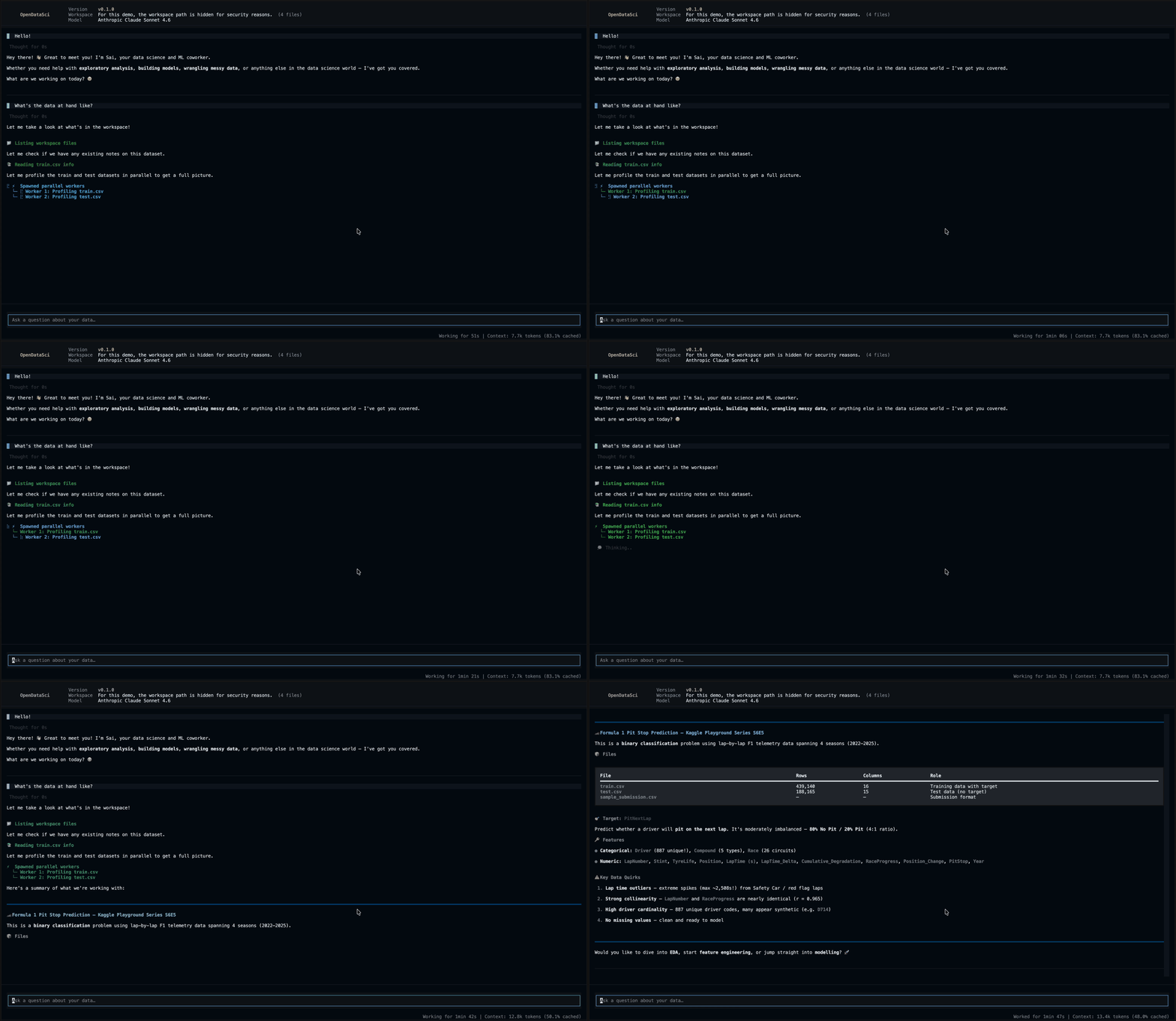
OpenDataSci is a secure AI agent specialized in data science and machine learning. It works autonomously: plans, codes, corrects itself, iterates, and accumulates knowledge about your data across sessions. A from-scratch run scored top-30% among 3,000+ teams in a live Kaggle competition, with zero guidance. OpenDataSci runs anywhere: It ships to run locally on your Linux/macOS device offering a Claude-Code-adjacent experience, it's cloud-portable (AWS, GCP, Azure), and is compatible with self-hosted deployments (any OpenAI-compatible server).
OpenDataSci v0.1.0 scored AUC 0.95069 -- Top-30% finish among 3k+ teams and 36k+ submissions. (Kaggle Playground Series S6E5)
The task was to predict whether an F1 driver will pit on the next lap. Pit stops are rare, making class imbalance a core challenge. The right call depends on dozens of interacting variables that require careful feature engineering and proper temporal handling.
The winner scored AUC 0.95503 across 195 submissions. That marginal gap relative to OpenDataSci's one-shot resolution cost a month of full-time work: a dozen model families, deep learning, notebooks with up to 400 hand-engineered features, AutoML sweeps across 4 libraries, AutoFE tools that either failed or timed out, and 186 out-of-fold models to ensemble. Claude was used throughout, yet repeatedly had to be talked out of giving up early and kept regenerating entire notebooks for marginal impact.
OpenDataSci needed one instruction: try to win the competition. Given only the zipped data, with no domain hints, prompt tuning, or human guidance, it explored the data, engineered features, tuned models, built diverse ensembles, and created a submission.
Find the winner's full writeup here.
Most "AI for data" tools turn you into the bottleneck. Every experiment starts with re-explaining your data from scratch. Every output still needs a data scientist to verify. Every wrong turn costs a full cycle: prompt, wait, review, correct, repeat. And the moment you close the session, every insight and learned quirk of your dataset is gone.
OpenDataSci is the expert you need. It plans rigorously, executes, and catches its own mistakes before they reach you. When it goes in the wrong direction, it self-corrects. Every insight it uncovers is persisted and carried forward across sessions, so the next experiment starts smarter than the last. You set the goal. It does the work.
| Near-zero config | Point it at your data and go — a setup wizard walks you through provider/model choice on first run |
| Full workflow | EDA, cleaning, feature engineering, modelling, evaluation, visualisation, reporting |
| Self-correcting | Reviews and revises its own steps, and recovers from wrong turns without starting over |
| Sandboxed execution | Runs real Python safely inside your workspace |
| Parallel agents | Up to 3 concurrent subagents running parallel code executions — in the background, non-blocking |
| Per-project knowledge accumulation | Data schema, profiles, and notes carry over across sessions |
| Skills | Built-in skills (e.g., Data Science, Machine Learning) plus bring-your-own via Markdown files in .opendatasci/skills/ |
| Web search | Look up papers, docs, and library changelogs mid-analysis |
| MCP | Connect internal tools, databases, and proprietary APIs |
| Built-in TUI | Use within your development environment (e.g., VSCode, Cursor) or from any terminal |
| Human-in-the-loop | Pauses at genuine decision forks, then gets on with it |
OpenDataSci supports every major cloud provider and fully self-hosted deployments. Use your existing infrastructure, stay within your compliance boundary, or keep costs low with a local model.
You can take it a step further and mix providers within a single session: one model for heavy reasoning, another for lightweight tasks like summarisation.
Every stateful dependency the agent relies on is built behind a swappable interface rather than tied to your local machine. The shipped implementations all run locally, but the architecture lets you replace any of them with a cloud-backed equivalent without touching the agent itself. See Cloud Portability in the library README, including the full table of dependencies and their recommended cloud implementations.
No setup friction. OpenDataSci ships with the complete stack a practitioner would need.
| Domain | Libraries |
|---|---|
| DataFrames | Polars, Pandas |
| Database connectivity | DuckDB |
| File formats | Excel/Parquet/Feather (via Pandas), XML (lxml) |
| Numerics | NumPy, SciPy |
| Classical ML | scikit-learn, LightGBM, CatBoost, XGBoost, statsmodels |
| Deep learning (optional) | PyTorch, JAX, Flax, Optax, Transformers, Sentence-Transformers |
| AutoML / tuning | Optuna |
| Forecasting | Prophet |
| Interpretability | SHAP |
| Anomaly detection | PyOD |
| Imbalanced data | imbalanced-learn |
| Dimensionality reduction | UMAP |
| Graph analysis | NetworkX |
| Feature engineering | category-encoders |
| Visualisation | matplotlib, seaborn, plotly |
The full documentation is available at opendatasci.readthedocs.io, covering getting started, the Python SDK API reference, and configuration.
Full installation and configuration instructions are in the library README, including provider setup, environment variables, TUI flags, slash commands, key bindings, and the Python SDK reference.
The examples directory covers every supported provider across three usage patterns:
If you already know what you're doing, OpenDataSci removes the friction that eats your time: boilerplate EDA, repetitive feature engineering cycles, juggling notebooks across experiments. You stay focused on what actually requires your judgment, like improving business metrics.
Use it as a first-pass analyst: let it explore the data, surface what matters, and run the baseline while you think about strategy. Spin up parallel experiments without managing multiple environments. Inject your domain knowledge via skill files and have it applied consistently across every run. When you want to take the wheel, take it. OpenDataSci hands off cleanly.
The benchmark above was a from-scratch run with no expert guidance. With yours, it will certainly further!
f4roukb/open-data-sci is a public repo on GitHub by f4roukb. Data science and Machine Learning AI agent.
It declares the Apache-2.0 license on GitHub.
Its maker has not tagged a system, so it is unknown here. Its README says what it needs.
Open "Take it" on its page: Take My Repo writes an install plan for your machine and hands it to your AI agent (Claude Code, Codex or Cursor), which asks you before each step. Take My Repo has not tested it on any machine.
Its last change on GitHub was on 2026-10-31. Take My Repo does not judge from that whether it is maintained.
Nobody has reviewed it on Take My Repo yet, which says nothing about its quality.
The agent harness performance optimization system. Skills, instincts, memory, security, and research-first development for Claude Code, Codex, Opencode, Cursor and beyond.
12 weeks, 26 lessons, 52 quizzes, classic Machine Learning for all
A list of Free Software network services and web applications which can be hosted on your own servers
The 30 Days of Python programming challenge is a step-by-step guide to learn the Python programming language in 30 days. This challenge may take more than 100 days. Follow your own pace. These videos may help too: https://www.youtube.com/channel/UC7PNRuno1rzYPb1xLa4yktw