e-invoice-eu
🇪🇺 💶 Generate e-invoices (E-Rechnung in German) conforming to EN16931 (Factur-X/ZUGFeRD, UBL, CII, XRechnung aka X-Rechnung) from LibreOffice Calc/Excel data or JSON.
- 383
- TypeScript
- 6 d ago
GitHub Action that runs the official ConnectingEurope EN 16931 XSLT artefacts (CII/UBL): 1.3.17 by default, 1.3.16 opt-in.
Repo facturxapi/validate-einvoice, read from GitHub 12 min ago. facturxapi has not joined Take My Repo.
facturxapi/validate-einvoice is a public repo on GitHub by facturxapi. GitHub Action that runs the official ConnectingEurope EN 16931 XSLT artefacts (CII/UBL): 1.3.17 by default, 1.3.16 opt-in. It declares no license on GitHub. Public does not mean open source: without a license, nobody is granted the right to reuse it. It is written mainly in Python, has 4 stars and last changed on 2026-11-16. Nobody has reviewed it on Take My Repo yet, which says nothing about its quality. Read from GitHub on 2026-11-22.
GitHub Action that runs the official ConnectingEurope EN 16931 XSLT
artefacts (CII and UBL) on XML invoices and reports every
svrl:failed-assert: 1.3.17 by default (in force since 15/11/26),
1.3.16 on request.
A green job means: the vendored stylesheets of the selected version
(1.3.17 by default, 1.3.16 with version: '1.3.16') produced zero
svrl:failed-assert on the files you passed. The Action does not call
a remote API, does not read PDF attachments, and does not certify a
document.
| Ref | What it is |
|---|---|
@v1 |
Mutable major tag (Marketplace channel). It moves to each new v1.x.y; it points at v1.3.0 (EN 16931 1.3.17 by default). |
@v1.3.0 |
Release tag, never moved once published. Default rules 1.3.17; version: '1.3.16' still selects 1.3.16. |
@v1.2.0 |
Previous release: default rules 1.3.16, 1.3.17 opt-in. |
@v1.1.2 |
Older release, 1.3.16 only (a805a904f9fa1a7d51db5a4160e863748cc3733d). |
| Full commit SHA of a release | The frozen tree. Each release's notes give it. |
v1.3.0The Commission's registry of EN 16931 artefacts
lists 1.3.17 as published on 12/10/26 and in force from 15/11/26.
v1.3.0 makes it the default, so a workflow on @v1 runs the new rules
and can see new or renamed rule ids. To keep 1.3.16, set
version: '1.3.16' or pin v1.2.0.
1.3.17 renames the IGIC and IPSI rules (upstream #519), and not the same way in both syntaxes:
| Rules | 1.3.16 | 1.3.17 CII | 1.3.17 UBL |
|---|---|---|---|
IGIC (L) |
BR-AF-01…10 |
BR-IP-01…10 |
BR-IG-01…10 |
IPSI (M) |
BR-AG-01…10 |
BR-IG-01…10 |
BR-IP-01…10 |
It also removes CII-SR-471. A fail-on id written for the other
version does not fail the job: the Action prints a ::warning naming
the id it uses instead, per syntax, and keeps filtering on it
(CII-SR-471 is ignored with a warning under 1.3.17). An id that the
selected XSLT does not contain under either name is a configuration
error (exit 2), since it could never fire.
Every release from v1.1.1 on pins third-party Actions by commit SHA,
installs Python dependencies with --require-hashes, and refuses
invoices with a DOCTYPE or external entities before Saxon runs.
v1.0.0 and v1.1.0 have none of this; do not pin them.
Same-repo workflow (this repository checked out):
- uses: ./
  with:
    files: invoices/**/*.xml
Downstream consumer, frozen on a release commit (SHA from the release notes):
- uses: facturxapi/validate-einvoice@8a3d0a25a3047ce664b806b2211d8ddc85c19dfc # v1.3.0
  with:
    files: invoices/**/*.xml
Mutable channel — @v1 follows the latest v1.x.y (not frozen):
- uses: facturxapi/validate-einvoice@v1
  with:
    files: invoices/**/*.xml
Copy-paste workflow: examples/validate-invoices.yml (uses: ./ for same-repo).
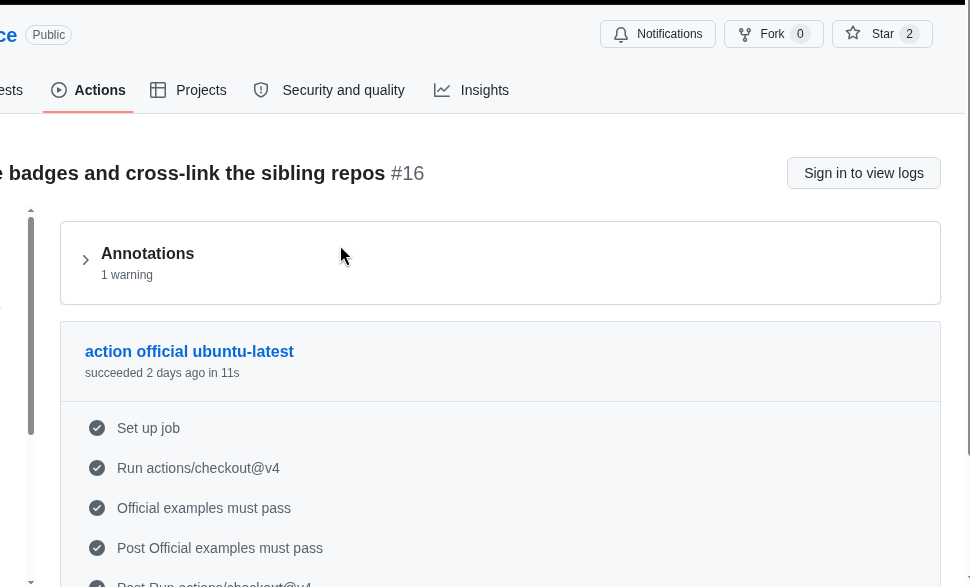
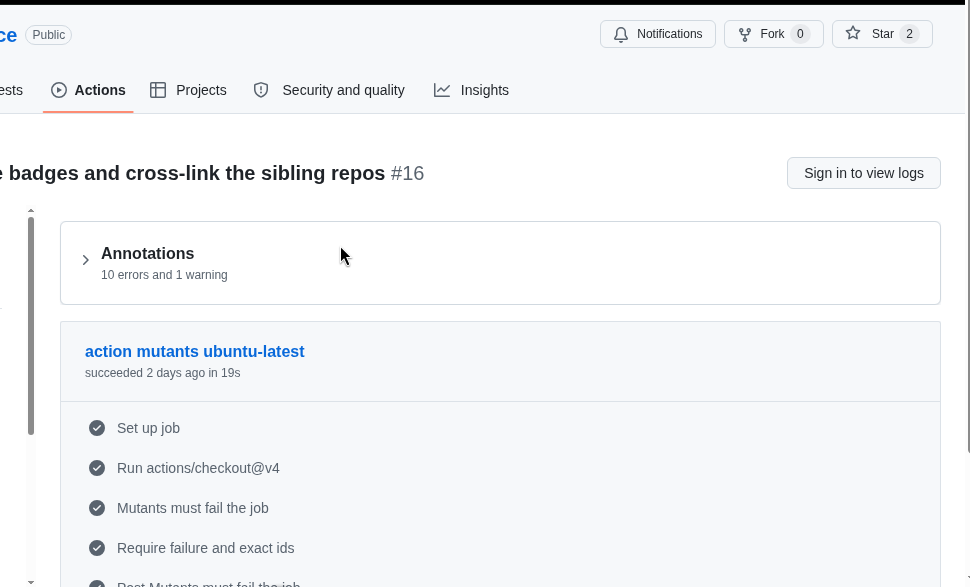
v1.4.0.02 / v1.4.0.03).Public run on @v1 as it stood that day (v1.1.0, b364f7c3, before the hardening shipped in v1.1.1). One green workflow: official examples pass; mutants make the Action step fail (expected).
fail-onWhen this repository is checked out as the workflow repo (or vendored):
- uses: ./
  with:
    files: invoices/**/*.xml
# Frozen — full commit SHA of a release
- uses: facturxapi/validate-einvoice@8a3d0a25a3047ce664b806b2211d8ddc85c19dfc # v1.3.0
  with:
    files: invoices/**/*.xml
    fail-on: failed-assert

# Previous rules — EN 16931 1.3.16 on the current release
- uses: facturxapi/validate-einvoice@v1
  with:
    files: invoices/**/*.xml
    version: '1.3.16'

# Mutable — @v1 major tag (follows the latest v1.x.y)
- uses: facturxapi/validate-einvoice@v1
  with:
    files: invoices/**/*.xml
    fail-on: failed-assert

# Report only — same-repo or pinned release SHA
- uses: ./
  with:
    files: invoices/**/*.xml
    fail-on: never

# Fail only if one of these rule ids fires
- uses: ./
  with:
    files: invoices/**/*.xml
    fail-on: BR-CO-15,BR-02
| Name | Required | Default | Meaning |
|---|---|---|---|
files |
yes | — | Glob(s) of XML invoices, relative to the workspace. Separate several globs with a newline or a comma. Zero matches fail the job (exit 2). |
syntax |
no | auto |
auto reads the document-element namespace. cii / ubl force one syntax and fail if the document does not match. |
fail-on |
no | failed-assert |
failed-assert: any svrl:failed-assert fails the job. never: report only. Comma-separated ids: fail only if one of those ids fires. An id renamed between 1.3.16 and 1.3.17 is translated with a warning; an id the selected XSLT does not contain under either name is a configuration error (exit 2). |
version |
no | 1.3.17 |
1.3.17 or 1.3.16, the two vendored releases. Any other value is a configuration error. |
| Name | Meaning |
|---|---|
verdict |
pass or fail |
failed-count |
Number of files with at least one svrl:failed-assert |
report |
Canonical JSON report (stable keys, no timestamps) |
report-sha256 |
SHA256 of that JSON |
report-path |
Workspace-relative path of the written file (en16931-report.json) |
Each file in the JSON has: path, syntax, verdict,
failed_assert_count, failed_assert_ids, sha256, xslt,
xslt_sha256.
The job also writes GitHub annotations (::error file=…,title=<id>::)
and a markdown table on the job summary. Invoice bytes are never logged.
The oracle is the pair of official XSLT files, hashed on every run. A different stylesheet is a different oracle; pins are not auto-updated.
| Version | Syntax | Vendored file | SHA256 |
|---|---|---|---|
| 1.3.17 (default) | CII | vendor/en16931-1.3.17/xslt/EN16931-CII-validation.xslt |
0757f07909938b1b297b8356ab7b66406c89f1b342325385d6a2def998c817f0 |
| 1.3.17 (default) | UBL | vendor/en16931-1.3.17/xslt/EN16931-UBL-validation.xslt |
fc4e6cfa8596bba0c2abd19038a98960c6ee9fc1f44566787c115efd4f4aca7c |
| 1.3.16 | CII | vendor/en16931-1.3.16/xslt/EN16931-CII-validation.xslt |
0b234dea2bbfee739b7761e607a992c17fab88773014ef56355b6158cfb1cc53 |
| 1.3.16 | UBL | vendor/en16931-1.3.16/xslt/EN16931-UBL-validation.xslt |
39f9d282867f1a49e7708d9e29a53da89643e1ee56f10cec1ebcf1277595fcbd |
Source of those octets: ConnectingEurope eInvoicing-EN16931 tags
validation-1.3.17
and validation-1.3.16 (en16931-cii-<version>.zip /
en16931-ubl-<version>.zip, inner path xslt/EN16931-*-validation.xslt).
Machine-readable pins of the latest release:
vendor/upstream.json.
The weekly workflow .github/workflows/upstream-drift.yml
re-downloads the latest CII/UBL release and fails if the tag or the
XSLT hashes moved. It never rewrites the pins.
Engine pin: saxonche==13.0.0 (SaxonC-HE 13.0). The JSON report is
canonical (sort_keys, no timestamps, relative paths). Two consecutive
runs of the same files must produce the same report-sha256.
Invoices that contain a DOCTYPE are refused before XSLT (stdlib expat).
User bytes are read once; files[].sha256 is those raw bytes; Saxon
transforms a private snapshot of the same bytes. See
docs/LIMITS.md.
auto maps:
urn:un:unece:uncefact:data:standard:CrossIndustryInvoice:100 → CIIurn:oasis:names:specification:ubl:schema:xsd:Invoice-2 or …CreditNote-2 → UBLpython3 scripts/selftest.py
On POSIX you can also run ./scripts/selftest.sh. Both install
saxonche==13.0.0, check the 10 official examples (must be green),
check the 10 mutants (must be red with the ids in
testdata/MUTANTS.md), compare two consecutive report hashes, run the
unit tests, and run the identity gate. Any difference is a failure.
XRechnung-O.xml is an official EN 16931 category-O example, not a
CIUS proof.EUPL 1.2 for this Action. The vendored XSLT (validation-1.3.17 and
validation-1.3.16) and the official examples (validation-1.3.17) are
ConnectingEurope EN 16931 artefacts, also EUPL 1.2, unmodified. Mutants are modified copies (see NOTICE).
facturxapi/validate-einvoice is a public repo on GitHub by facturxapi. GitHub Action that runs the official ConnectingEurope EN 16931 XSLT artefacts (CII/UBL): 1.3.17 by default, 1.3.16 opt-in.
It declares no license on GitHub. Public does not mean open source: without a license, nobody is granted the right to reuse it.
Its maker has not tagged a system, so it is unknown here. Its README says what it needs.
Open "Take it" on its page: Take My Repo writes an install plan for your machine and hands it to your AI agent (Claude Code, Codex or Cursor), which asks you before each step. Take My Repo has not tested it on any machine.
Its last change on GitHub was on 2026-11-16. Take My Repo does not judge from that whether it is maintained.
🇪🇺 💶 Generate e-invoices (E-Rechnung in German) conforming to EN16931 (Factur-X/ZUGFeRD, UBL, CII, XRechnung aka X-Rechnung) from LibreOffice Calc/Excel data or JSON.
Nobody has reviewed it on Take My Repo yet, which says nothing about its quality.
A curated list of open source software for Europe — institutions, regulations, standards, and cross-border infrastructure
A source-available invoice, quote, project and time-tracking app built with Laravel
A desktop application, that creates and validates ZUGFeRD invoices.
Sourced map of e-invoicing specs, validators, libraries and corpora (EN 16931, Factur-X, ZUGFeRD, XRechnung). Not a ranking.
Reproducible EN 16931 validation oracles — ConnectingEurope 1.3.17 fixtures, SVRL receipts, and mutants.
Small, dated, replayable cases for French e-invoicing checks (EN 16931, Factur-X, French CTC): expected, observed, receipts.
Dolibarr module: check an e-invoice (Factur-X / CII) against the official EN 16931 and French rules before sending it. GPL-3.0.