ATmega-Transistor-Tester
Small version of the famous component tester from mikrocontroller.net
- 177
- C
- 4 y ago
Find the right switch. Scrapes data-sheets and ranks FETs by power loss in a DCDC converter
Repo fl4p/fetlib, read from GitHub 6 h ago. fl4p has not joined Take My Repo.
fl4p/fetlib is a public repo on GitHub by fl4p. Find the right switch. Scrapes data-sheets and ranks FETs by power loss in a DCDC converter. It declares no license on GitHub. Public does not mean open source: without a license, nobody is granted the right to reuse it. It is written mainly in Python, has 9 stars and last changed on 2026-08-18. Nobody has reviewed it on Take My Repo yet, which says nothing about its quality. Read from GitHub on 2026-11-23.
Small version of the famous component tester from mikrocontroller.net
Utilities for parsing MPS and SMPS file formats.
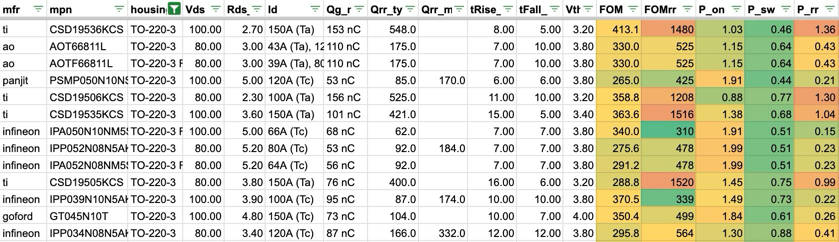
This toolset tries to help you with designing a DC/DC converter.
It basically consists of three parts:
What it does:
You can start by defining your DC/DC load parameters, DcDcLoadParams, currently synchronous buck converter only:
It will then start to discover mosfets directly from manufacturers websites (current implemented: TI, Infineon, Toshiba, ST, onsemi, vishay, nexperia/nxp, huayi, Alpha&Omega, TaiwanSemi, Qorvo) or Digikey search results.
After pre-selecting for breakdown voltage and drain current, it'll start downloading the data sheets. Once this is done, it processes the data sheets with different methods (see below TODO) and generates a normalised data sheet object. Out of this data sheet object we create the MOSFET specifications, which describes the parts Rds_on, gate charge curve and other parameters:
Qgs, Qgd, Qgs2, Qg_th, Q_swV_pl (miller plateau voltage)C_ossQrrWith the given DC/DC load parameters and gate drive parameters mentioned earlier, we compute gate charge curve for the high-side (HS) and low-side (LS) switch. With the gate charge we estimate power loss during (dis-)charge of the gate-source and miller capacitance. We also consider revers recovery losses of the synchronous rectifier (buck: LS) body diode.
This way we can rank all mosfets by their power loss in the HS or LS slot. This is expected to be much mure accurate
than
using the Figure-of-Merit Rds_ON*Qg.
The model was used during the design process of a 1 kW MPPT tracker (Fugu2) and we fed back real-life experience into
the model. Proper verification still needs to be done (measuring real gate drive curve, reverse recovery effect).
The power loss computation currently lacks a temperature rise model.
References:
sudo snap install tabula, https://github.com/tabulapdf/tabula/releases/download/v1.2.1/tabula-jar-1.2.1.zip)sudo apt-get install -y poppler-utils)git clone --recurse-submodules https://github.com/fl4p/fetlib
cd fetlib
python3 -m venv venv
. ./venv/bin/activate
pip install -r requirements.txt
# fetch a set of data-sheets (mostly 80-200V power mosfets):
git clone https://github.com/open-pe/fet-datasheets datasheets
# additional dependencies:
- `gs` (Ghostscript)
- qpdf
- sips
- CUPS_PDF (www.cups-pdf.de/)
- Tabula
- FontForge
acquire a parts list from Digikey. go to digikey.com
narrow down the search filters so your have 500 or less results.
download the CSV file (click Download Table / First 500 Results)
save the CSV file under parts-lists/digikey/ folder
Open main.py and adjust adjust the DCDC operating point:
# buck converter
dcdc = DcDcSpecs(vi=62, vo=27, pin=800, f=40e3, Vgs=12, ripple_factor=0.3, tDead=500e-9)
vi              input voltage
vo              output voltage
pin             input power, alternatively you can set `io` (I_out) or `ii` (I_in).
f               switching frequency
Vgs             gate drive voltage for both HS and LS
ripple_factor   peak-to-peak coil current divided by mean coil current (assuming CCM)
tDead           gate driver dead-time (happens 2 times per period)
Run python3 main.py --config-file apps/proj/buck.yaml and it will download all datasheets (if not already found), extract values and compose a CSV
file with loss estimations for the given DC-DC converter.
The process will finish with an output like this:
written fets-buck-62V-27V-30A-40kHz.csv
stored 1259 parts
The CSV file includes these power loss values (see Power Loss Model for details):
P_on        HS conduction loss ~ (D * I² * Rds)
P_on_ls     LS conduction loss ~ ((1 - D) * I² * Rds)
P_sw        HS switching loss ~ max(tRise + tOff, 2 * Qsw / (Vgs / rg) )
P_rr        reverse recovery loss when used as LS (sync fet) ~ Qrr
P_dt_ls     LS dead time loss ~ (tDead * Vsd)
And these aggregated power values for the 2 slots HS, LS and for the 2p case each:
P_hs        total loss caused by HS switch
P_2hs       total HS loss with 2 parallel switches

P_ls        total loss in LS switch
P_2ls       total LS loss with 2 parallel switches
If a input value for power computation is missing the power values will be float('nan') (empty CSV cell).
Vsd (body diode forward voltage) defaults to 1 V if not available. V_plateau (miller plateau voltage) defaults to
4.5V.
See the equations in powerloss.py.
We pick a set of switches for LS and HS, inductor and capacitors. Then we compute loss for different output currents and plot the results like this (the plot includes loss in switches, inductor, capacitors):

A good starting point to discovery suitable switches is the DigiKey parametric search (see above how to import CSVs).
To include the latest and greatest products, you need to go to the manufacturers' website.
We implemented automated discovery of new products for Infineon, Toshiba and TI,
see dslib/parts_discovery.py.
The program collects part specification values from different sources:
dslib/manual_fields.pyValues for Rds_on and Qgd are usually shown in the search results (Digikey, LCSC). Nexar API doesn't show the Qrr, and (tRise+tFall) only for some parts (especially values for newer chips are missing here). So we need to extract characteristics for the power loss model from the Datasheet. We use 3 techniques:
Priority = insertion order (first non-NaN value per stat wins; later stages fill gaps):
ref)text) — runs first, both to win and to shrink the remaining need_symbolsread_sheet, + read_charts for Vpl) — unconditionaltabular) — expensive, so runs last and is skipped/narrowed once text+read_sheet cover the needed symbolsFor the power loss compution we need a single discrete value of relevant fields (e.g. Rds_on, Qsw, Qrr).
Datasheet specify min./max/typ values and sometimes there are multiple rows for a single value under different
testing conditions e.g. temperature, Vdd, Id, and transients di/dt and dv/dt.
| Rds_on | Vg=10V | max | |
| Qg | |||
| tRise/Fall | typ,max,min | ||
Downloads for some datasheet are protected by anti-robot mechanism. To avoid this, we use pyppeteer (Python port of puppeteer) with Chromium to simulate human user interaction. This will handle JS challenges, redirects and if the link points to a PDF-Preview page, we look for a download button and click it.
Chromiums PDF must be disabled, because we cannot access it through pupeteer.
chromiumUserDataPath/Default/Preferences:
"plugins": {"always_open_pdf_externally": true},
TODO:
The power loss model for a DC-DC buck is based on the application notes rOHM: Calculation of Power Loss (Synchronous) and TI: Power Loss Calculation With Common Source Inductance Consideration for Synchronous Buck Converters. We assume CCM mode, coil current never touches zero.
Note that loss from LS reverse recovery P_rr is dissipated in HS.
In other words, poor performance of LS heats up the HS.
The generated CSV file includes the estimated losses caused by a transistor when placed in the HS or LS slot (not their
power dissipation).
Note that LS losses in the body diode depend on Vsd and the driver dead time. Consider placing a Schottky diode parallel to the LS. This can reduce voltage drop and the reverse recovery effect. Take care about parasitic inductances between the LS and the Schottky diode. This might even lower reverse recovery loss, because the LS body diode never powers up. See Toshiba Product Guide 2009 on page 18.
Qrr can be defined by design and values from the data-sheet are not subject to production test. Qrr depends on temperature, reverse voltage V_R, forward current I_F and forward current transient dif/dt. Most datasheets only specify a single value under some given conditions. DS of IQD016N08NM5 includes one for dif/dt=100A/us and dif/dt=1000A/us.
Some datasheets (infineon, 400V fets) specify Qfr mosfet forward recovery, which is the same as body diode reverse
recovery. (TODO verify)
fl4p/fetlib is a public repo on GitHub by fl4p. Find the right switch. Scrapes data-sheets and ranks FETs by power loss in a DCDC converter.
It declares no license on GitHub. Public does not mean open source: without a license, nobody is granted the right to reuse it.
Its maker has not tagged a system, so it is unknown here. Its README says what it needs.
Open "Take it" on its page: Take My Repo writes an install plan for your machine and hands it to your AI agent (Claude Code, Codex or Cursor), which asks you before each step. Take My Repo has not tested it on any machine.
An Arduino project for a 2016 Ford Mustang Ecoboost that uses OBD2 data and displays the currently selected gear and a simple gear shift indicator on a round LCD display.
Electronic Devices Lab - Autumn Semester 2022 - Indian Institute of Technology Bombay
An Arduino project boost gauge for a 2016 Ford Mustang Ecoboost. OBD2 data is used to display turbo boost pressure, current gear, vehicle speed and a shift indicator graph.
Its last change on GitHub was on 2026-08-18. Take My Repo does not judge from that whether it is maintained.
Nobody has reviewed it on Take My Repo yet, which says nothing about its quality.
Take My Repo cannot say: it does not audit code and has not run fetlib. What is known comes from GitHub. It declares no license on GitHub. Public does not mean open source: without a license, nobody is granted the right to reuse it. Its last change was on 2026-08-18. It has 9 stars, which measure popularity, not safety. Nobody has reviewed it on Take My Repo yet, which says nothing about its quality. Read the source before you run it. With "Take it", your AI agent shows each step and asks you before running it; README text is treated as data, not as instructions.