
ECC
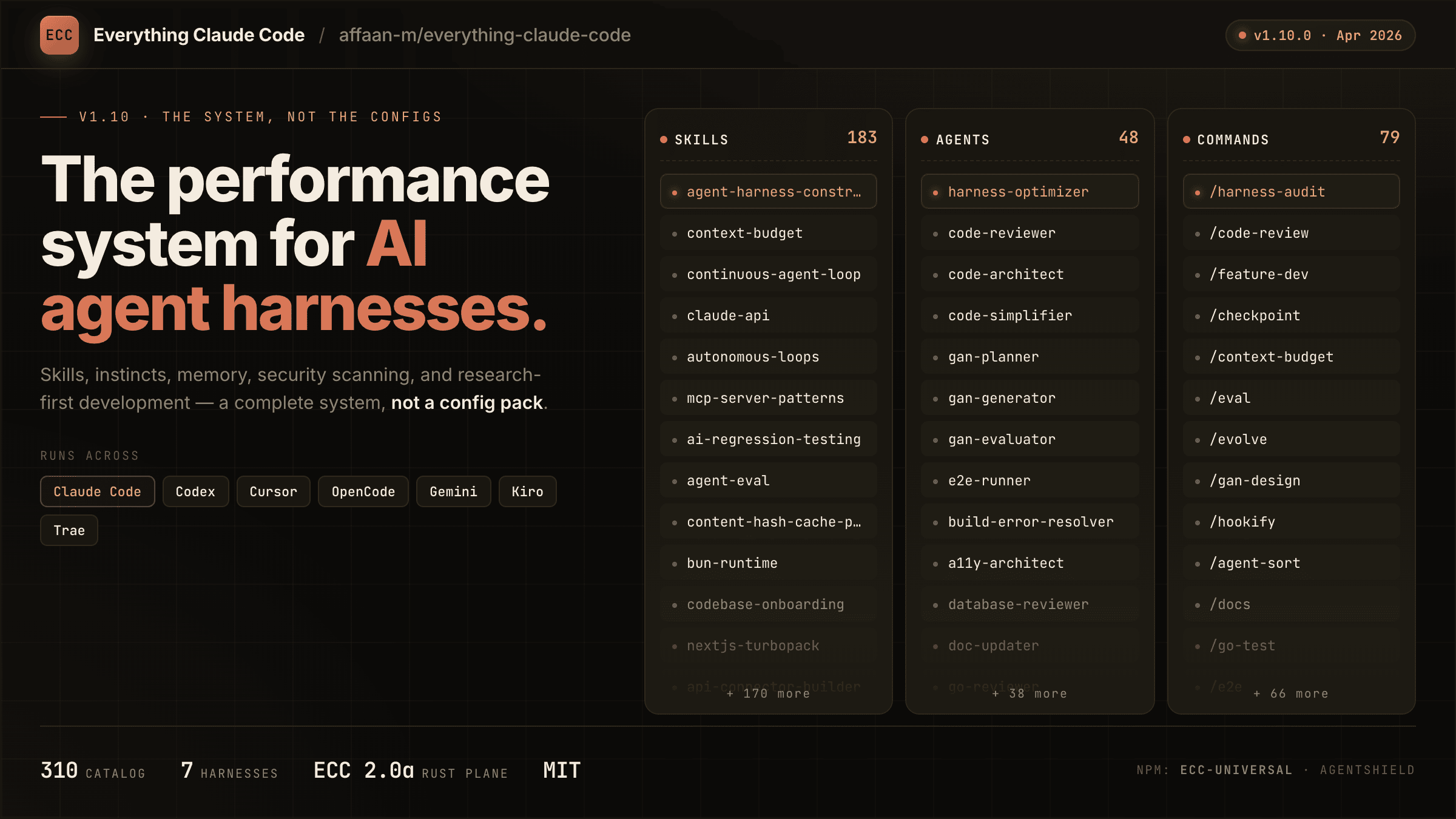
The agent harness performance optimization system. Skills, instincts, memory, security, and research-first development for Claude Code, Codex, Opencode, Cursor and beyond.
- 309k
- JavaScript
- MIT
- 3 d ago
End-to-end encrypted memory for AI agents — portable, yours forever.
Repo graphprotocol/totalreclaw, read from GitHub 16 h ago. graphprotocol has not joined Take My Repo.
graphprotocol/totalreclaw is a public repo on GitHub by graphprotocol. End-to-end encrypted memory for AI agents — portable, yours forever. It declares no license on GitHub. Public does not mean open source: without a license, nobody is granted the right to reuse it. It is written mainly in TypeScript, has 0 stars and last changed on 2026-11-20. Nobody has reviewed it on Take My Repo yet, which says nothing about its quality. Read from GitHub on 2026-11-21.

End-to-end encrypted memory + knowledge graph for AI agents — portable, yours forever
Website · npm (plugin) · npm (MCP) · PyPI · Getting Started · Architecture
Status: private beta — free tier open, no credit card, no waitlist.
Your AI remembers everything — without remembering it for Big Tech. And starting with v1, every memory is structured: 6 speech-act types, provenance, scope, and volatility on every entry.
Most AI memory products store your data unencrypted server-side, or leave encryption up to your deployment. TotalReclaw can't read your data by design — that's the difference between a privacy promise and a structural guarantee.
| TotalReclaw | Typical hosted memory | |
|---|---|---|
| Server sees your memories in plaintext? | Never — E2E encrypted on-device | Yes |
| One-click plain-text export? | Yes | Varies |
| Works across agents? | Yes — OpenClaw, Claude Desktop, Hermes, ZeroClaw, any MCP host | Usually SDK-locked |
| Storage you control? | Yes — public chain or your own PostgreSQL | Vendor database |
New in v1 (April 2026): memory taxonomy (6 types), source-weighted reranking, 4 new MCP tools (
totalreclaw_pin/totalreclaw_unpin/totalreclaw_retype/totalreclaw_set_scope), protobuf v4 wire format. v1 is the default on every client. Existing vaults decrypt transparently. See the v1 migration guide.
One command per client. v1 is the default — no env toggles, no feature flags.
Prefer the chat-driven install? Paste one host-agnostic line into any agent (OpenClaw, Hermes, Claude Desktop / Cursor / Windsurf):
Install TotalReclaw. See https://totalreclaw.xyz/install— a short alias for the universal dispatcher (install.md).
| Client | Install |
|---|---|
| OpenClaw | openclaw plugins install @totalreclaw/totalreclaw |
| Claude Desktop (and other MCP chat apps) | Add npx -y @totalreclaw/mcp-server to the app's MCP config, restart, then ask "Set up TotalReclaw" — see the Claude Desktop guide |
| Claude Code / Cursor / Windsurf | claude mcp add -s user totalreclaw -- npx -y @totalreclaw/mcp-server (or the JSON config), then ask "Set up TotalReclaw" — see the coding-tools guide |
| Codex (CLI, IDE extension, ChatGPT desktop app) | codex plugin marketplace add graphprotocol/totalreclaw then codex plugin add totalreclaw@totalreclaw, restart, then ask "Set up TotalReclaw" — see the Codex guide |
| NanoClaw | @totalreclaw/skill-nanoclaw (bundled via NanoClaw) + set TOTALRECLAW_RECOVERY_PHRASE in deployment env — see the NanoClaw guide |
| Python / Hermes | pip install totalreclaw |
| Rust / ZeroClaw | cargo add totalreclaw-memory |
| IronClaw | via the generic MCP server (first-class integration paused) — see IronClaw setup |
Then set one env var on your host:
export TOTALRECLAW_RECOVERY_PHRASE="your twelve word recovery phrase here"
If you don't have a phrase yet, the setup wizard generates one. See the client setup guide for per-platform details.
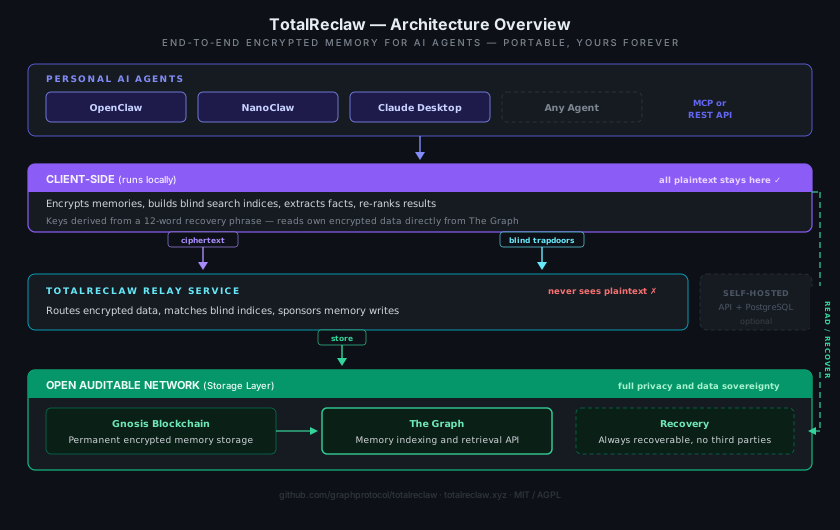
Full technical deep dives: Architecture, Memory Taxonomy v1, Tiered Retrieval.
v1 shipped across every client in April 2026. Highlights:
claim / preference / directive / commitment / episode / summary. Replaces the ambiguous 8-type v0 list.source (user / user-inferred / assistant / external / derived), scope (work / personal / health / family / creative / finance / misc / unspecified), volatility (stable / updatable / ephemeral).totalreclaw_pin, totalreclaw_unpin, totalreclaw_retype, totalreclaw_set_scope. Invoked by natural language ("pin that", "file that under work").Full details: v1 migration guide and memory types guide.
Already using another AI assistant with memory? Tell your agent:
Supported sources: ChatGPT (memories or conversations.json), Claude (memory export), Gemini (Google Takeout), Mem0 (API or file), MCP Memory Server (JSONL). All imports are encrypted client-side before storage. See the import guide.
On the managed service, the free tier includes one lifetime import; re-importing from additional sources is a Pro feature. See pricing.
View and curate your memories at app.totalreclaw.xyz — no install required. Your recovery phrase is entered locally and never leaves your device; decryption happens entirely in the browser, so the server only ever serves ciphertext.
| Package | Description | Install |
|---|---|---|
| @totalreclaw/totalreclaw | OpenClaw plugin — automatic encrypted memory | openclaw plugins install @totalreclaw/totalreclaw |
| @totalreclaw/mcp-server | MCP server for Claude Desktop and other MCP clients | npx @totalreclaw/mcp-server setup |
| @totalreclaw/client | Client library (encryption, indexing, search, re-ranking) | npm install @totalreclaw/client |
| totalreclaw | Python client + Hermes Agent plugin | pip install totalreclaw |
Free: 250 memories/month, permanently stored on Gnosis mainnet, end-to-end encrypted — no credit card required. Pro: 3,000 memories/month, plus LLM-guided dedup and custom extraction intervals. See pricing →
Run the open-source server with PostgreSQL — no dependency on totalreclaw.xyz:
cd server && cp .env.example .env && docker-compose up -d
Set TOTALRECLAW_SELF_HOSTED=true and TOTALRECLAW_SERVER_URL=http://localhost:8080 on the client. Both modes encrypt identically — the difference is where the encrypted blobs are stored.
totalreclaw/
├── client/          TypeScript client library (encryption, indexing, search, re-ranking)
├── rust/            Rust core (XChaCha20-Poly1305, LSH, reranker) — compiles to WASM + PyO3
├── python/          Python client library + Hermes Agent plugin
├── skill/           OpenClaw plugin (automatic memory via lifecycle hooks)
├── skill-nanoclaw/  NanoClaw skill package + MCP bridge
├── mcp/             MCP server for Claude Desktop and other MCP clients
├── app/             Vault SPA (Vite + React) — managed-mode read UI
├── server/          Self-hosted server (FastAPI + PostgreSQL)
├── contracts/       Smart contracts (Gnosis Chain)
├── subgraph/        The Graph subgraph (AssemblyScript indexer)
├── docs/            Architecture, specs, and guides
└── tests/           Integration, parity, and E2E tests
graphprotocol/totalreclaw is a public repo on GitHub by graphprotocol. End-to-end encrypted memory for AI agents — portable, yours forever.
It declares no license on GitHub. Public does not mean open source: without a license, nobody is granted the right to reuse it.
Its maker has not tagged a system, so it is unknown here. Its README says what it needs.
Open "Take it" on its page: Take My Repo writes an install plan for your machine and hands it to your AI agent (Claude Code, Codex or Cursor), which asks you before each step. Take My Repo has not tested it on any machine.
Its last change on GitHub was on 2026-11-20. Take My Repo does not judge from that whether it is maintained.
Nobody has reviewed it on Take My Repo yet, which says nothing about its quality.
The agent harness performance optimization system. Skills, instincts, memory, security, and research-first development for Claude Code, Codex, Opencode, Cursor and beyond.
Persistent Context Across Sessions for Every Agent – Captures everything your agent does during sessions, compresses it with AI, and injects relevant context back into future sessions. Works with Claude Code, OpenClaw, Codex, Gemini, Hermes, Copilot, OpenCode + More
Reverse engineer anything with agents, from app behavior down to native binaries.
Graph Node indexes data from blockchains such as Ethereum and serves it over GraphQL
The Graph library for building GraphQL-based dapps in a decentralized way.




