

ECC
The agent harness performance optimization system. Skills, instincts, memory, security, and research-first development for Claude Code, Codex, Opencode, Cursor and beyond.
- 311k
- JavaScript
- MIT
- 3 d ago
A minimalist side-brain CLI for AI agents — 跨厂商模型提供独立第二意见,支持并行互证、多轮辩论与图像生成,让 Agent 多一个思考视角。
Repo icheer/brain-cli, read from GitHub 1 min ago. icheer has not joined Take My Repo.
icheer/brain-cli is a public repo on GitHub by icheer. A minimalist side-brain CLI for AI agents — 跨厂商模型提供独立第二意见,支持并行互证、多轮辩论与图像生成,让 Agent 多一个思考视角。. It declares the MIT license on GitHub. It is written mainly in Go, has 5 stars and last changed on 2026-11-18. Nobody has reviewed it on Take My Repo yet, which says nothing about its quality. Read from GitHub on 2026-11-25.
The agent harness performance optimization system. Skills, instincts, memory, security, and research-first development for Claude Code, Codex, Opencode, Cursor and beyond.
English | 简体中文

The repo is named
brain-cli; the binary command isbrain.
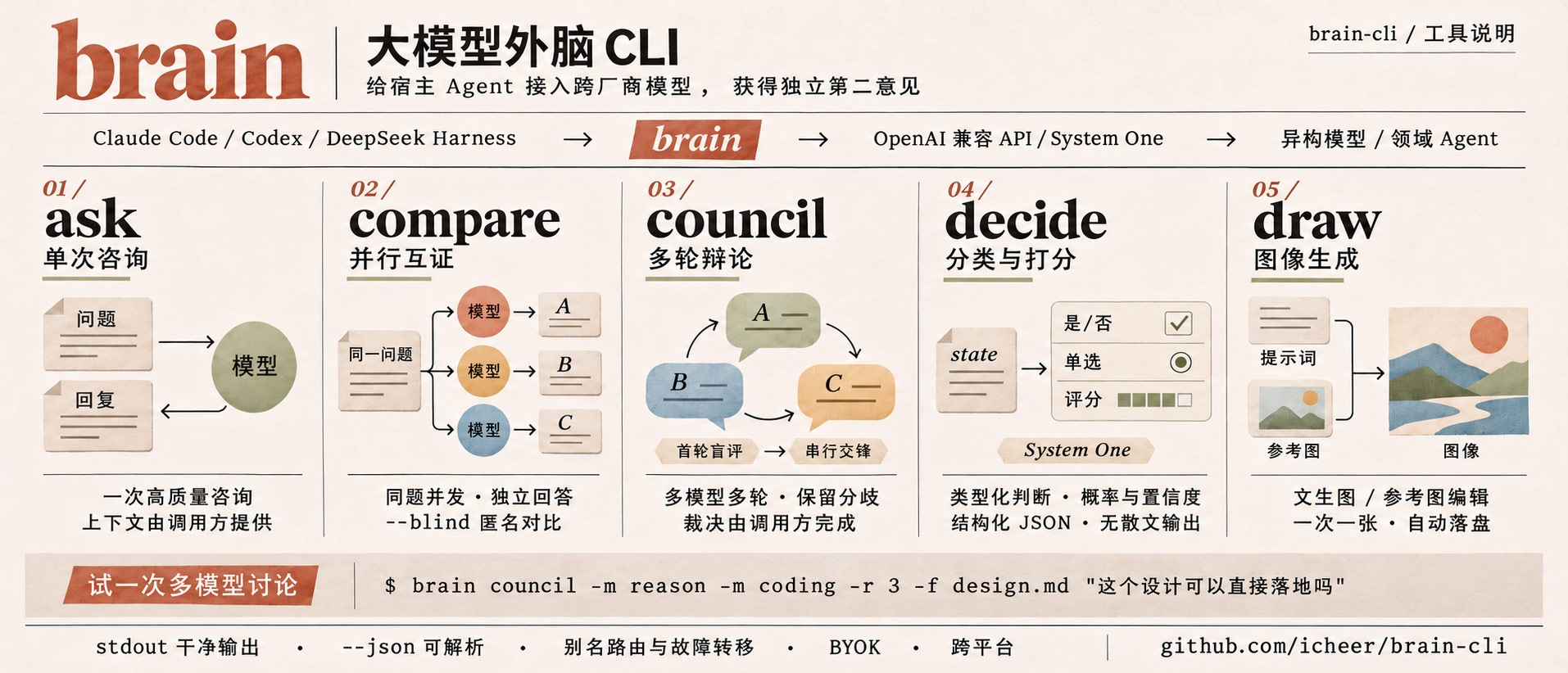
brain is a minimalist CLI that acts as a "side brain" for host agents (Claude Code, Codex, DeepSeek Harness, etc.): it calls an LLM gateway via the OpenAI Chat Completions compatible protocol, performs one high-quality advisory/analysis call, and hands the result back to the agent cleanly. The same model reviewing its own conclusions cannot catch its own systematic bias — brain plugs in heterogeneous cross-vendor models as an independent second opinion.
-f multi-file / -i image multimodal input work out of the box; multi-source inputs are wrapped in XML-style tags (<user_message>/<attachment>/<stdin>) for unambiguous context separationfast / reason / coding / vision aliases plus automatic failover (retry with backoff, switch along the chain, noted on stderr) — agents never memorize model namesbrain compare -m a,b -m reason sends the same question to several models at once; replies concatenated under ===== model: X ===== headers (--json gives responses[]). In compare, an alias is a model-group shortcut and each leg does no failover; --blind prints anonymous Model_A/B to guard the adjudicator against brand biasbrain council: N models discuss one topic over rounds — round 1 goes out blind-parallel (kills first-speaker anchoring), later rounds are serial with a growing transcript so later speakers critique earlier ones (default snake order; --order rotate|fixed changes the layout, --blind anonymizes seats as Model_A/B across prompts and output); the final round states each seat's position, what changed, and unresolved disagreements. Lenses/stances need no syntax: a seat-to-lens table written into the context is the protocol. Seats retry same-model only (a mid-council model swap would be identity fraud); absences are marked, and paid-for speeches survive early termination or SIGINTbrain decide: System One typed judgments — ask a set of yes/no, choice, or score questions about a state and get probabilities plus optional confidence (zero prose); stdout is the jq-ready answers JSON directly. Sub-second at roughly 1/200th of chat pricing. Classification and scoring only (reading order, investigation routing, queue triage) — judgments needing reasoning stay with ask/council; protocol is the TypeSafe wire (/v1/systemone) de-facto standard only; same-model retries, never cross-model failover (calibration baselines must not drift); images ride the --extra-body escape hatchbrain draw: one call, one image, auto-saved. Protocol is inferred from the model name (contains gemini → Gemini native, anything else → OpenAI Images; draw.type overrides); a separate optional draw: config section falls back to your existing base_url/api_key, and --aspect/--res are unified semantics translated per protocol. -i reference images switch to edit mode; --extra-body passes protocol-specific params through (grok's aspect_ratio etc.; top level on openai, merged into imageConfig on gemini). stdout prints exactly the saved file path; --json gives the usual single object. No auto-retry — images are billed per piece-e low|medium|high|… and --max-output-tokens N, both passed through as-is (unset = model/gateway defaults; tiers are model-specific — e.g. Zhipu GLM-5.3 only has low/high/max)--extra-body / --extra-headers: any request-body field (temperature, response_format, vendor-specific…) and HTTP header passes through as a top-level JSON assign (inline or @file, repeatable and merged in order); reserved keys are rejected to prevent self-sabotage, --dry-run shows the merged result; mirrors OpenAI SDK's extra_body/extra_headers--json always emits exactly one object (jq parses unconditionally; error.code matches the exit code)data:{"error":…} payload) + 15s stderr heartbeat (local progress display, zero network traffic) + one overall budget (retries eat the same deadline) — verified item by item against real one-api-family gateway behavior, not textbook HTTPBRAIN_LANG > LC_ALL/LC_MESSAGES/LANG (zh* → Chinese, anything else set → English) > timezone fallback (UTC+8 → Chinese); override any time with BRAIN_LANG=zh|enInstall the brain skill for me: https://github.com/icheer/brain-cli
The agent opens the repo and follows the steps below — this part is written for it:
skills/brain/ directory into the host's skill directory — Claude Code: ~/.claude/skills/brain (user-level) or .claude/skills/brain inside a project; other hosts usually .agents/skills/brainbash install.sh inside that directory — downloads the platform binary from Releases into the skill dir (SHA256-verified); append --link to also symlink it into /usr/local/bin for direct terminal usebrain ping. Without a gateway configured, ping fails with fix hints — at that point have the user run brain init (interactive wizard) or brain config set by themselves in their own terminal: the key is typed by the user straight into a local 0600 file and never travels through the agent chat (conversation transcripts may be retained); never type or request plaintext keys on the user's behalfThe binary is ready in the current session; the skill itself takes effect from the next session. Manual steps below.
brain is BYOK (Bring Your Own Key): it provides no model service itself. You need the address and key of any OpenAI-compatible API — not necessarily a "gateway"; official APIs work directly, for example:
| Service | base_url |
|---|---|
| OpenAI | https://api.openai.com/v1 |
| OpenRouter (multi-vendor aggregator) | https://openrouter.ai/api/v1 |
| DeepSeek | https://api.deepseek.com/v1 |
| Zhipu | https://open.bigmodel.cn/api/paas/v4 |
# Install (pick one)
bash skills/brain/install.sh        # skill scenario: download the binary into the skill dir from Releases (SHA256-verified)
                                    #   append --link to also symlink it into /usr/local/bin (re-running upgrades both),
                                    #   or --global to install there only (auto-sudo if not writable)
# Primary upgrade path: just run brain update once installed — it locates the
#             skill dir and delegates to install.sh (SKILL.md/installer sync
#             included; --check reports versions only; exit codes programmable)
# Windows: run the same script in Git Bash (installs brain.exe; global default ~/bin) or WSL
# Re-running install.sh upgrades in place: it auto-detects your install layout (symlink /
# global / skill-dir) and refreshes SKILL.md from the same release tarball (v0.10.3+)
# Uninstall: bash skills/brain/install.sh --uninstall (removes every installed binary
#            and the global link; idempotent; config file and skill docs stay)
# or grab your platform's package from https://github.com/icheer/brain-cli/releases
go install github.com/icheer/brain-cli@latest   # developers

# Configure (once; the key lives only in a local 0600 file, never in any repo)
brain init                                            # interactive wizard, or the three lines below:
brain config set base_url https://api.openai.com/v1   # any OpenAI-compatible service
brain config set api_key sk-xxxx
brain config set default_model gpt-5.6                # optional; see config.example.yaml for a full example

# First question
brain ping
brain ask -m fast "introduce yourself in one sentence"   # -m also accepts literal model IDs; -e low/medium/high… tunes reasoning effort (optional)
# Multi-model cross-checks — adjudication is always yours (brain ships no built-in judge)

# Parallel: same question to N models at once, replies under ===== model: X ===== headers
brain compare -m reason -f report.md "stress-test the reasoning in this report"
brain compare -m reason -f report.md --json "stress-test the reasoning in this report" | jq -r '.responses[] | select(.ok) | .content'

# Serial debate (council): round 1 blind-parallel, then snake-serial rounds with a growing
# transcript — later speakers critique earlier ones; the final round states each seat's
# position, what changed, unresolved disagreements. Total calls = models × rounds.
brain council -m reason -m coding -f design.md "should this design adopt SQLite for storage"

# Lenses/stances are just context: write a seat-to-lens table via -s. Each seat is told its
# own model ID when it speaks, so it claims the table line that names it — that is the
# whole mapping. One hard rule: the table must spell the RESOLVED model IDs (-m panel
# expands to the chain's IDs — the alias never reaches the seats); everything else
# (separator, wording, layout) is free-form.
brain council -m panel -f design.md \
  -s "seat lenses: aihub/gpt-6-astra = security & failure isolation; anti/gemini-3.8-flash = performance & delivery speed" \
  "should this design ship as is"
# Decisions (System One typed judgments; stdout = jq-ready answers JSON)
brain config set decide.model jev-latest                # once; TypeSafe wire /v1/systemone
brain decide --noul "is_urgent=does this convey urgency" "ticket body…"   # yes/no shorthand (repeatable)
brain decide -Q '{"dept":{"type":"choice","criteria":{"billing":"money","technical":"bugs"}}}' "ticket body…"
brain decide --json --noul "q=x?" "state" | jq -r '.answers.q.noul'
# Classification and scoring only (ranking/routing); typed output does not immunize
# against well-typed wrong answers
# Image generation (auto-saves to cwd; stdout = the saved path)
brain config set draw.model gemini-3.1-flash-image   # once; draw.base_url/api_key optional (fall back to top-level)
brain draw --res 1K "a cute cat wearing a tiny knitted hat, watercolor style"
brain draw -i cat.jpg "change the hat to red"        # reference image -> edit mode
brain draw -m grok-imagine-image-2.0 --extra-body '{"aspect_ratio":"16:9"}' "..."  # protocol-specific params
# --aspect 1:1|16:9|9:16|… and --res 1K|2K|4K translate per protocol; no auto-retry (billed per image)
For agents: copy or link skills/brain/ into .claude/skills/ (or .agents/skills/); SKILL.md teaches the host agent when to call brain, how, and when not to.
Host agents ship their own subagent mechanism (e.g. Claude Code's Task tool): same model, tool access, isolated context. brain complements it rather than replacing it — the crux is "swap in a different brain" vs. "spawn another copy of yourself":
| Dimension | brain (side-brain CLI) | host subagent |
|---|
icheer/brain-cli is a public repo on GitHub by icheer. A minimalist side-brain CLI for AI agents — 跨厂商模型提供独立第二意见,支持并行互证、多轮辩论与图像生成,让 Agent 多一个思考视角。.
It declares the MIT license on GitHub.
Its maker tagged it for macOS, Windows and Linux, or as Docker or cross-platform. That is declared by the maker; Take My Repo has not tested it.
Open "Take it" on its page: Take My Repo writes an install plan for your machine and hands it to your AI agent (Claude Code, Codex or Cursor), which asks you before each step. Take My Repo has not tested it on any machine.
Reverse engineer anything with agents, from app behavior down to native binaries.
Fair-code workflow automation platform with native AI capabilities. Combine visual building with custom code, self-host or cloud, 400+ integrations.
Knowledge infrastructure to make your agents smarter. Search, scrape and access 550+ data providers through one API.
Its last change on GitHub was on 2026-11-18. GitHub counts 0 open issues and pull requests. Take My Repo does not judge from that whether it is maintained.
Nobody has reviewed it on Take My Repo yet, which says nothing about its quality.
Take My Repo cannot say: it does not audit code and has not run brain-cli. What is known comes from GitHub. It declares the MIT license on GitHub. Its last change was on 2026-11-18. It has 5 stars, which measure popularity, not safety. Nobody has reviewed it on Take My Repo yet, which says nothing about its quality. Read the source before you run it. With "Take it", your AI agent shows each step and asks you before running it; README text is treated as data, not as instructions.





