grafana
The open and composable observability and data visualization platform. Visualize metrics, logs, and traces from multiple sources like Prometheus, Loki, Elasticsearch, InfluxDB, Postgres and many more.
- 78k
- TypeScript
- AGPL-3.0
- 5 min ago
Difference-in-Differences causal inference in Python. Callaway-Sant'Anna, Synthetic DiD, Honest DiD, event studies. sklearn-like API, validated against R.
Repo igerber/diff-diff, read from GitHub 1 h ago. igerber has not joined Take My Repo.
igerber/diff-diff is a public repo on GitHub by igerber. Difference-in-Differences causal inference in Python. Callaway-Sant'Anna, Synthetic DiD, Honest DiD, event studies. sklearn-like API, validated against R. It declares the MIT license on GitHub. It is written mainly in Python, has 415 stars and last changed on 2026-11-23. Nobody has reviewed it on Take My Repo yet, which says nothing about its quality. Read from GitHub on 2026-11-23.
The open and composable observability and data visualization platform. Visualize metrics, logs, and traces from multiple sources like Prometheus, Loki, Elasticsearch, InfluxDB, Postgres and many more.
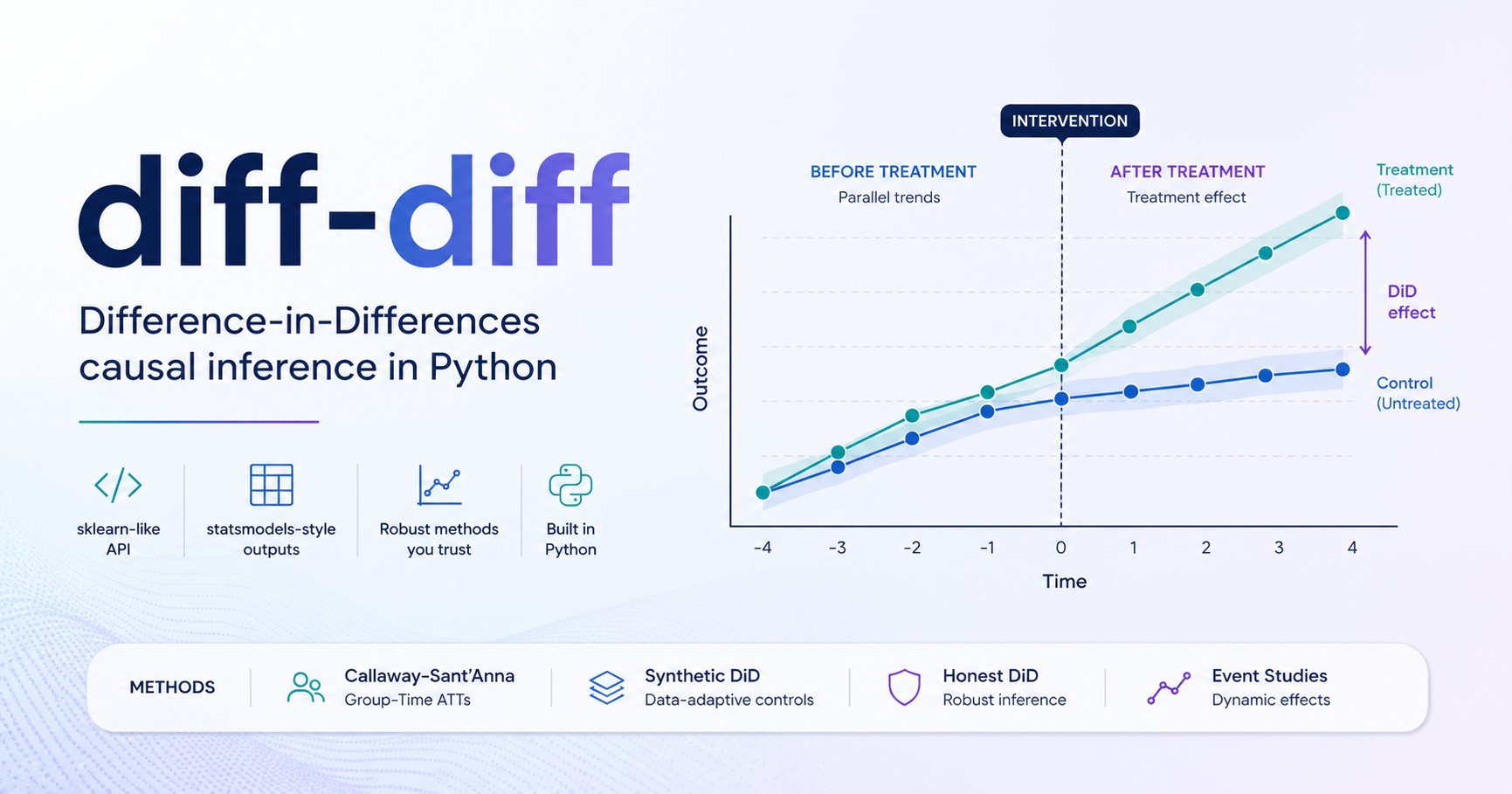
A Python library for Difference-in-Differences (DiD) causal inference - sklearn-like estimators with statsmodels-style outputs, built for econometricians, marketing analysts, and data scientists running campaign-lift, policy, and staggered-rollout analyses.
pip install diff-diff
For development:
git clone https://github.com/igerber/diff-diff.git
cd diff-diff
pip install -e ".[dev]"
import pandas as pd
from diff_diff import DifferenceInDifferences  # or: DiD

data = pd.DataFrame({
    'outcome': [10, 11, 15, 18, 9, 10, 12, 13],
    'treated': [1, 1, 1, 1, 0, 0, 0, 0],
    'post': [0, 0, 1, 1, 0, 0, 1, 1],
})

did = DifferenceInDifferences()
results = did.fit(data, outcome='outcome', treatment='treated', post='post')
print(results)              # DiDResults(ATT=3.0000, SE=1.7321, p=0.1583)
results.print_summary()     # full statsmodels-style table
did, synthdid, fixestIf you are an AI agent or LLM using this library, call diff_diff.get_llm_guide() for a concise API reference with an 8-step practitioner workflow (based on Baker et al. 2025). The workflow ensures rigorous DiD analysis - testing assumptions, running sensitivity analysis, and checking robustness, not just calling fit().
from diff_diff import get_llm_guide

get_llm_guide()                 # concise API reference
get_llm_guide("practitioner")   # 8-step workflow (Baker et al. 2025)
get_llm_guide("full")           # comprehensive documentation
get_llm_guide("autonomous")     # autonomous-agent variant
The guides are bundled in the wheel - accessible from a pip install with no network access. After estimation, call practitioner_next_steps(results) for context-aware guidance on remaining diagnostic steps.
Measuring campaign lift? Evaluating a product launch? Rolling out a policy in waves? diff-diff handles the causal inference so you can focus on the business question.
aggregate_survey() to roll respondent-level microdata into a geographic-period panel with inverse-variance precision weights for second-stage DiDBusinessReport and DiagnosticReport are experimental preview classes that produce plain-English output and a structured to_dict() schema from any fitted estimator result except the two rejected by type (EventStudyResults surfaces and DurationDiDResults) - wording and schema will evolve. See docs/methodology/REPORTING.md for usage and stability notes.
For rigorous DiD analysis, follow these 8 steps. Skipping diagnostic steps produces unreliable results.
check_parallel_trends(), equivalence_test_trends(); staggered: inspect CS event-study pre-period coefficients (generic PT tests are invalid for staggered designs). Insignificant pre-trends do NOT prove PT holds.BaconDecomposition to diagnose TWFE bias.estimator.fit(data, ...). Always print the cluster count first and choose inference method based on the result (cluster-robust if >= 50 clusters, wild bootstrap if fewer - for DifferenceInDifferences pass cluster=; TwoWayFixedEffects auto-clusters at unit level).compute_honest_did(results) for bounds under PT violations (the TwoWayFixedEffects event_study=True surface, CS, or dCDH natively; a StackedDiD results.aggregate('event_study') container also admits - Stacked needs kappa_pre >= 2), run_all_placebo_tests() for 2x2 falsification, specification comparisons for staggered designs.results.aggregate('group')/'event_study' (post-fit, no refit); SA: results.event_study_effects / to_dataframe(level='cohort'); Stacked: results.aggregate('event_study')/'simple' post-fit views (surface always computed since 3.9); EDiD: results.aggregate(...) post-fit from retained EIFs (3.9); ImputationDiD/TwoStageDiD: results.aggregate(...) post-fit from panel-backed kits (3.9); ContinuousDiD: results.aggregate('dose'/'simple'/'event_study') post-fit (3.9; dose/simple are views, event_study recomputes); subgroup re-estimation.Full guide: diff_diff.get_llm_guide("practitioner").
event_study=True) for period-specific treatment effectsLPDiD/TROP non_absorbing). Alias DCDH.survey_design= for HC1 / CR1 (Wave E.1 Binder TSL) and Conley (Wave E.2 panel-aware stratified-Conley sandwich on per-period PSU totals; extended in Wave E.2 follow-up to conley_lag_cutoff > 0 via panel-block composition with within-PSU serial Bartlett HAC — lag>0 requires an effective PSU via explicit survey_design.psu or injected cluster=<col>); SurveyDesign.subpopulation() preserves full-design n_psu / df_survey via zero-padded scores (Wave E.3, R svyrecvar(subset()) form)in_space_placebo(), plus ADH-2015 leave_one_out() + in_time_placebo() robustness, Firpo-Possebom (2018) test-inversion confidence sets, and Chernozhukov-Wüthrich-Zhu (2021) conformal inference)fit(..., first_treat=) selects the staggered engine)d̲ = 0 / QUG) or WAS_{d̲} on Design 1 (d̲ > 0, continuous-near-d̲ or mass-point), with a multi-period event-study extension (last-treatment cohort, pointwise CIs). Panel-only in this release - repeated cross-sections rejected by the validator. Alias HAD.takeup= with a first-stage block and weak-identification warning; covariates via covariates= - CCFT 2019, same estimand, covariate-aware bandwidths). Canonical att is the bias-corrected estimate with a coherent robust CI (rdrobust's printed headline is att_conventional). Alias RDD.ETWFE.igerber/diff-diff is a public repo on GitHub by igerber. Difference-in-Differences causal inference in Python. Callaway-Sant'Anna, Synthetic DiD, Honest DiD, event studies. sklearn-like API, validated against R.
It declares the MIT license on GitHub.
Its maker has not tagged a system, so it is unknown here. Its README says what it needs.
Open "Take it" on its page: Take My Repo writes an install plan for your machine and hands it to your AI agent (Claude Code, Codex or Cursor), which asks you before each step. Take My Repo has not tested it on any machine.
DoWhy is a Python library for causal inference that supports explicit modeling and testing of causal assumptions. DoWhy is based on a unified language for causal inference, combining causal graphical models and potential outcomes frameworks.
Statsmodels: statistical modeling and econometrics in Python
12 weeks, 26 lessons, 52 quizzes, classic Machine Learning for all
Bring data to life with SVG, Canvas and HTML. :bar_chart::chart_with_upwards_trend::tada:
Apache Superset is a Data Visualization and Data Exploration Platform
Its last change on GitHub was on 2026-11-23. Take My Repo does not judge from that whether it is maintained.
Nobody has reviewed it on Take My Repo yet, which says nothing about its quality.
Take My Repo cannot say: it does not audit code and has not run diff-diff. What is known comes from GitHub. It declares the MIT license on GitHub. Its last change was on 2026-11-23. It has 415 stars, which measure popularity, not safety. Nobody has reviewed it on Take My Repo yet, which says nothing about its quality. Read the source before you run it. With "Take it", your AI agent shows each step and asks you before running it; README text is treated as data, not as instructions.