
dInfer
dInfer: An Efficient Inference Framework for Diffusion Language Models
- 492
- Apache-2.0
- 3 wk ago
Repo inclusionAI/dInfer, read from GitHub 1 min ago. inclusionAI has not joined Take My Repo.
In short
inclusionAI/dInfer is a public repo on GitHub by inclusionAI. dInfer: An Efficient Inference Framework for Diffusion Language Models. It declares the Apache-2.0 license on GitHub. It is written mainly in Python, has 492 stars and last changed on 2026-11-05. Nobody has reviewed it on Take My Repo yet, which says nothing about its quality. Read from GitHub on 2026-11-25.
AI models this project points to
- inclusionAI/LLaDA2.0-miniLinked in the README
- inclusionAI/LLaDA2.0-flashLinked in the README
- inclusionAI/LLaDA2.0-mini-previewLinked in the README
- inclusionAI/LLaDA2.0-flash-previewLinked in the README
- inclusionAI/LLaDA-MoE-7B-A1B-BaseLinked in the README
- inclusionAI/LLaDA-MoE-7B-A1B-InstructLinked in the README
- GSAI-ML/LLaDA-8B-BaseLinked in the README
- GSAI-ML/LLaDA-8B-InstructLinked in the README

Introduction
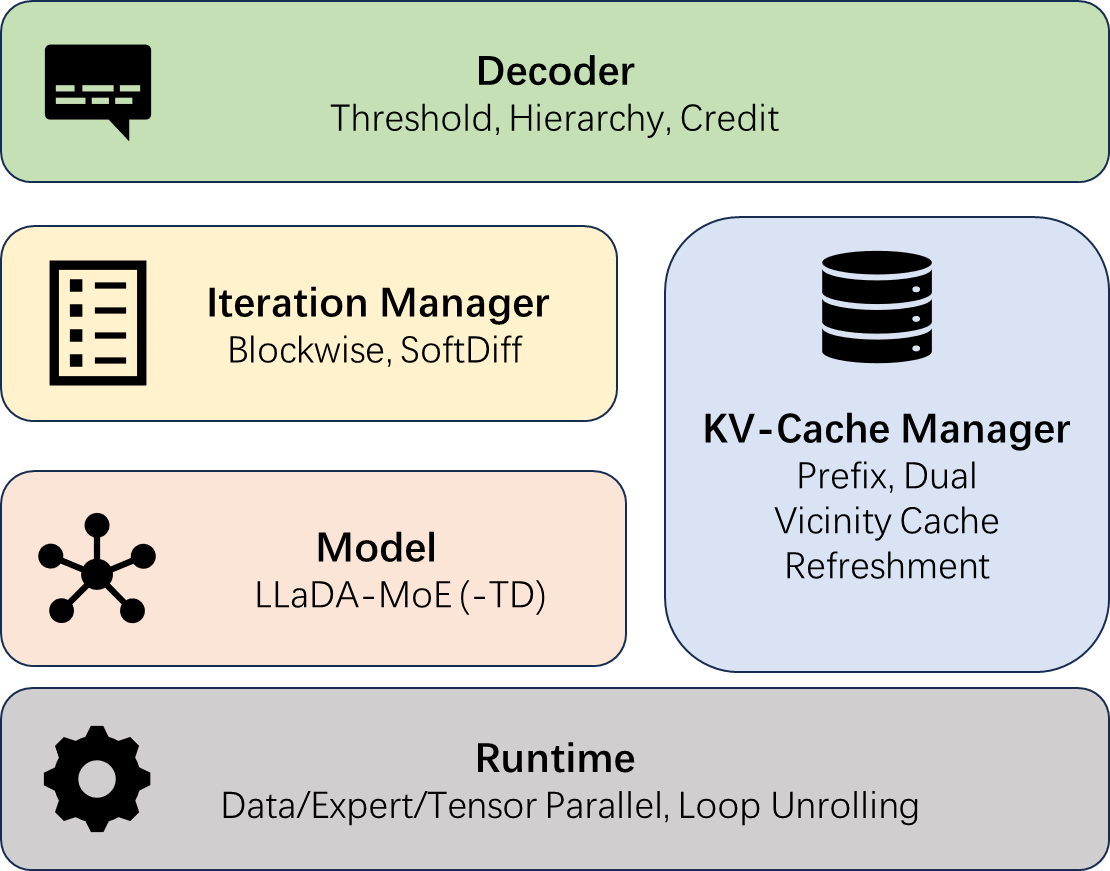
dInfer is an efficient and extensible inference framework for dLLMs. As illustrated in the following architecture, it modularizes inference into four components: model, diffusion iteration manager, decoder and KV-cache manager. It provides well-designed APIs for flexible algorithms combinations in each component. It now supports batched inference for improved throughput.

Figure: Overall Architecture of dInfer
dInfer supports multiple dLLM variants, including LLaDA, LLaDA-MoE and LLaDA2.
News
[2025/12/21] release v0.2. The major features of this release can be found here.
[2025/12/10] Support and speed up the formal version of block diffusion LLMs (LLaDA2-mini and LLaDA2-flash). Support quant versions of LLaDA2-mini and LLaDA2-flash.
[2025/11/15] Support the inference on block diffusion LLMs (LLaDA2-mini-preview and LLaDA2-flash-preview).
[2025/10/10] Release the first version of the dInfer framework.
Contents
Supported Models
dInfer supports multiple diffusion language model variants with different architectures and sizes. Below are the HuggingFace model links and their corresponding implementation files:
| Model | Size | Implementation | HuggingFace Link |
|---|---|---|---|
| LLaDA2.0-mini | 16B | LLaDA2MoeModelLM | inclusionAI/LLaDA2.0-mini |
| LLaDA2.0-flash | 100B | LLaDA2MoeModelLM | inclusionAI/LLaDA2.0-flash |
| LLaDA2.0-mini-preview | 16B | LLaDA2MoeModelLM | inclusionAI/LLaDA2.0-mini-preview |
| LLaDA2.0-flash-preview | 100B | LLaDA2MoeModelLM | inclusionAI/LLaDA2.0-flash-preview |
| LLaDA-MoE-7B-A1B-Base | 7B | LLaDAMoeModelLM | inclusionAI/LLaDA-MoE-7B-A1B-Base |
| LLaDA-MoE-7B-A1B-Instruct | 7B | LLaDAMoeModelLM | inclusionAI/LLaDA-MoE-7B-A1B-Instruct |
| LLaDA-8B-Base | 8B | LLaDAModelLM | GSAI-ML/LLaDA-8B-Base |
| LLaDA-8B-Instruct | 8B | LLaDAModelLM | GSAI-ML/LLaDA-8B-Instruct |
| LLaDA-1.5 | 8B | LLaDAModelLM | GSAI-ML/LLaDA-1.5 |
Quick Start
Install dInfer
git clone https://github.com/inclusionAI/dInfer.git
cd dInfer
pip install .
To use it with vLLM backend (it works with LLaDA and LLaDA-MoE), please install vLLM.
pip install vllm==0.10.2
To use it with SGLang backend (it works with LLaDA2), please install SGLang.
pip install sglang==0.5.3.post1
Convert to FusedMoE (LLaDA-MoE only)
To run LLaDA-MoE model downloaded from HuggingFace, we need to first convert it to a format supported by dInfer. dInfer provides a script tools/transfer.py for the format conversion.
1) Download and Convert
pip install -U huggingface_hub hf_transfer
export HF_HUB_ENABLE_HF_TRANSFER=1

# Download Instruct checkpoint
hf download inclusionAI/LLaDA-MoE-7B-A1B-Instruct \
  --repo-type model \
  --local-dir /path/to/LLaDA-MoE-7B-A1B-Instruct

# Convert to FusedMoE
python -m tools.transfer \
  --input  /path/to/LLaDA-MoE-7B-A1B-Instruct \
  --output /path/to/LLaDA-MoE-7B-A1B-Instruct-fused
2) Load the model
from dinfer.model import AutoModelForCausalLM
from transformers import AutoTokenizer
m = "/path/to/LLaDA-MoE-7B-A1B-Instruct-fused"
tok = AutoTokenizer.from_pretrained(m, trust_remote_code=True)
model = AutoModelForCausalLM.from_pretrained(m, trust_remote_code=True, torch_dtype="bfloat16")
Run Inference
Benchmark (speed only)
Measure throughput (TPS) only; predictions are saved under --output_dir with no automatic scoring.
-
LLaDA2 model
- LLaDA2-flash Dataset profiling (threshold decoder, TP across 4 GPUs):
python benchmarks/benchmark_dataset_sglang.py \ --model_name inclusionAI/LLaDA2.0-flash \ --dataset dataset_path \ --gen_len 2048 \ --block_length 32 \ --gpu 0,1,2,3 \ --output_dir runs/llada2_flash \ --use_tp \ --parallel_decoding threshold \ --threshold 0.9 \ --cache prefix \ --use_bd- LLaDA2-mini Dataset profiling (threshold decoder, TP across 4 GPUs):
python benchmarks/benchmark_dataset_sglang.py \ --model_name inclusionAI/LLaDA2.0-mini \ --dataset dataset_path \ --gen_len 2048 \ --block_length 32 \ --gpu 0,1,2,3 \ --output_dir runs/llada2_mini \ --use_tp \ --parallel_decoding threshold \ --threshold 0.9 \ --cache prefix \ --use_bd -
LLaDA, LLaDA1.5 and LLaDA-MoE model
- LLaDA-MoE Dataset profiling (threshold decoder, TP across 4 GPUs):
python benchmarks/benchmark_dataset.py \
--model_name inclusionAI/LLaDA-MoE-7B-A1B-Instruct \
--model_type llada_moe \
--dataset dataset_path \
--gen_len 1024 \
--block_length 64 \
--gpu 0,1,2,3 \
--output_dir runs/llada_moe_threshold \
--use_tp \
--parallel_decoding threshold \
--threshold 0.8 \
--cache dual \
--prefix_look 16 \
--after_look 16 \
--warmup_times 4 \
--cont_weight 0.3
- LLaDA Single-sample profiling (threshold decoder, TP across 4 GPUs):
python benchmarks/benchmark.py \
  --model_name GSAI-ML/LLaDA-8B-Instruct \
  --model_type llada \
  --gen_len 2048 \
  --block_length 32 \
  --gpu 0,1,2,3 \
  --use_tp \
  --parallel_decoding threshold \
  --threshold 0.9 \
  --cache prefix
- LLaDA, LLaDA1.5, LLaDA-MoE can use benchmark_dataset.py and benchmark.py.
Evaluation with lm-eval (speed + accuracy)
- Built on HuggingFace
lm-eval-harnessto compute TPS and benchmark scores. - Tasks provided:
gsm8k_llada: math reasoning.mbpp_sanitized_llada: sanitized Python code generation.
- For more examples and comprehensive instructions, see our quickstart guide.
Benchmark Results
The inference speed (TPS) on LLaDA-MoE
dInfer delivers over 1,100 TPS at batch size 1 on HumanEval and on average 800+ TPS across six benchmarks on a single node with 8×H800 GPUs.

Figure: Benchmark results on LLaDA-MoE
Speedup comparisons:
- 10× faster than Fast-dLLM while maintaining accuracy
- 2-3× faster than Qwen2.5-3B on vLLM (LLaDA-MoE) with comparable quality
The inference speed (TPS) on LLaDA2-flash-CAP
The inference speed is measured on LLaDA2-flash-CAP (with 100B parameters) on 8 H20 GPUs (parallel decoding threshold=0.95, generation length=1000).
| Benchmark | batch size = 1 | batch size = 32 |
|---|---|---|
| openai_humaneval | 753.10 | 2558.51 |
| gsm8k | 591.90 | 2111.79 |
| IFEval | 222.60 | 931.89 |
| CruxEval-O | 562.90 | 1967.08 |
| mbpp | 773.00 | 2262.45 |
| AVG | 580.70 | 1966.34 |
Limitations
- Block Diffusion: Not supported on LLaDA Dense/MoE models (use
--use_bdwith LLaDA2 only)
Contact us
- Wechat Group

Citation
@article{dinfer,
    title={dInfer: An Efficient Inference Framework for Diffusion Language Models},
    author={Yuxin Ma, Lun Du, Lanning Wei, Kun Chen, Qian Xu, Kangyu Wang, Guofeng Feng, Guoshan Lu, Lin Liu, Xiaojing Qi, Xinyuan Zhang, Zhen Tao, Haibo Feng, Ziyun Jiang, Ying Xu, Zenan Huang, Yihong Zhuang, Haokai Xu, Jiaqi Hu, Zhenzhong Lan, Junbo Zhao, Jianguo Li, Da Zheng},
    year={2025},
    journal={arXiv preprint arXiv:2510.08666}
}
Questions
What is dInfer?
inclusionAI/dInfer is a public repo on GitHub by inclusionAI. dInfer: An Efficient Inference Framework for Diffusion Language Models.
Is dInfer open source?
It declares the Apache-2.0 license on GitHub.
Does dInfer run on macOS, Windows or Linux?
Its maker has not tagged a system, so it is unknown here. Its README says what it needs.
How do I install dInfer?
Open "Take it" on its page: Take My Repo writes an install plan for your machine and hands it to your AI agent (Claude Code, Codex or Cursor), which asks you before each step. Take My Repo has not tested it on any machine.