Awesome-Multimodal-Large-Language-Models
:sparkles::sparkles:Latest Advances on Multimodal Large Language Models
- 18k
- 3 wk ago
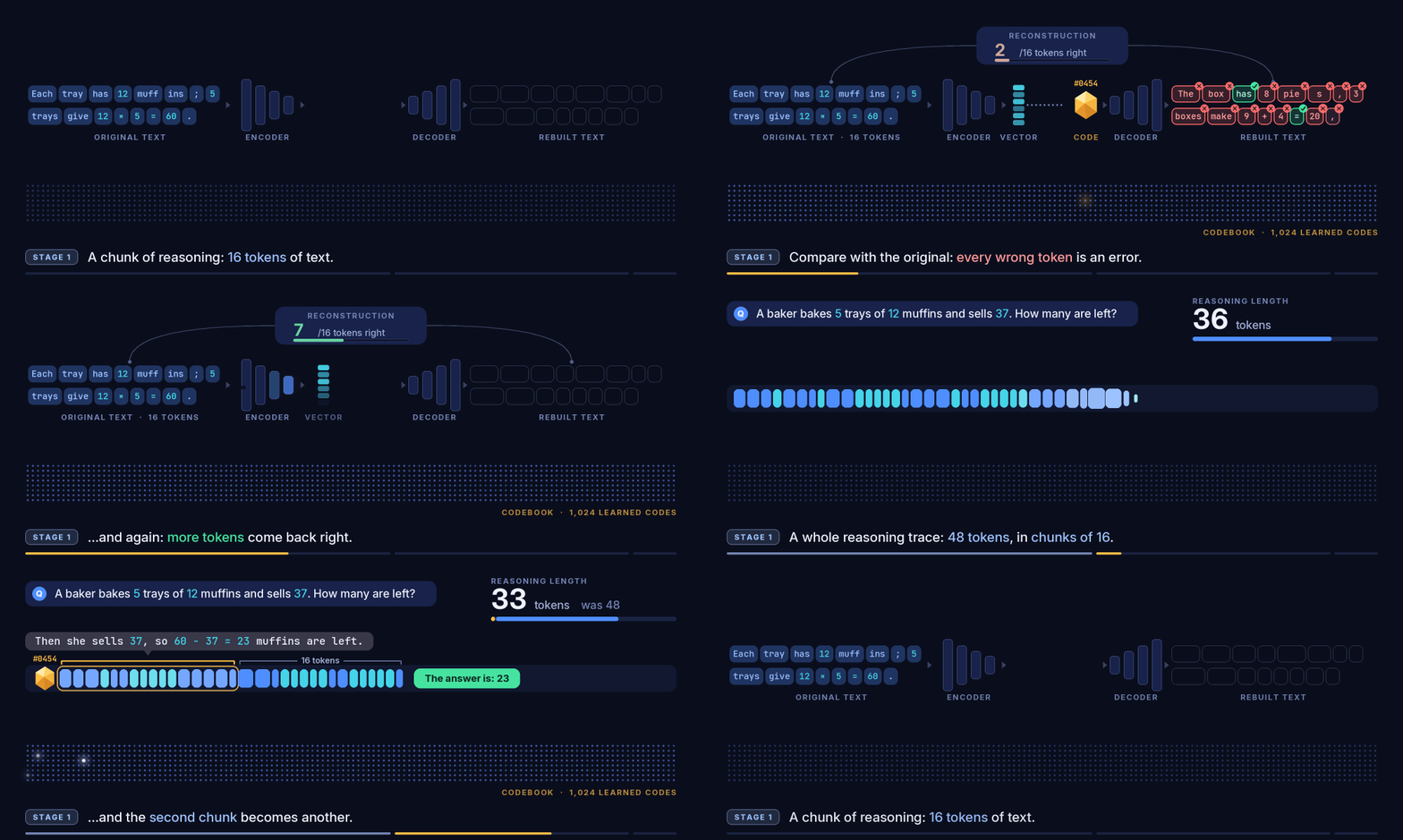
Unofficial implementation of Token Assorted (ICML 2025): reasoning with mixed latent + text tokens. VQ-VAE and LLM fine-tuning, both stages.
Repo infocusp/token_assorted, read from GitHub 1 min ago. infocusp has not joined Take My Repo.
infocusp/token_assorted is a public repo on GitHub by infocusp. Unofficial implementation of Token Assorted (ICML 2025): reasoning with mixed latent + text tokens. VQ-VAE and LLM fine-tuning, both stages. It declares no license on GitHub. Public does not mean open source: without a license, nobody is granted the right to reuse it. It is written mainly in Python, has 3 stars and last changed on 2026-10-30. Nobody has reviewed it on Take My Repo yet, which says nothing about its quality. Read from GitHub on 2026-11-20.

Unofficial implementation of Token Assorted: Mixing Latent and Text Tokens for Improved Language Model Reasoning (100+ citations as of Oct 2026), covering both stages of the math-reasoning pipeline.
Paper link: https://arxiv.org/abs/2502.03275
Paper summary. Chain-of-thought traces are long, and much of their text serves fluency rather than reasoning. The paper replaces the initial part of each trace with discrete latent tokens produced by a VQ-VAE, keeps the rest as ordinary text, and fine-tunes an LLM on this hybrid sequence with an extended vocabulary. To help the model adapt to the unseen latent tokens, training randomly varies how much of the trace is latent, mixing latent and text tokens. The result is shorter reasoning traces (an average 17% reduction in trace length), and the authors report that the approach consistently outperforms their baselines on logical and mathematical reasoning benchmarks, e.g. +4.1% on GSM8K with Llama-3.2-3B.
src/train.py,
src/encode_dataset.py, src/decode_codes.py).src/stage2_finetune.py,
src/stage2_data.py, src/stage2_eval.py).meta-math/MetaMathQA) from HuggingFace.src/train.py — trains the VQ-VAE.src/encode_dataset.py — converts the CoT portion of each example into discrete code indices
and writes a JSONL artifact. This file is the Stage-1 → Stage-2 hand-off boundary.src/decode_codes.py — decodes code indices back to text, for sanity checks / interpretability.src/stage2_data.py — extends the Llama tokenizer with 1026 latent tokens
(<boLatent>, <eoLatent>, <Latent-code-0..1023>) and builds the randomized latent/text training
mix from the JSONL artifact.src/stage2_finetune.py — fine-tunes unsloth/Llama-3.2-1B(or 3B) on those assorted
sequences.src/stage2_eval.py — greedy-decode evaluation on GSM8K, MATH and five
out-of-domain math benchmarks, each scored by its own official evaluator (src/official_eval.py).This repo covers only the paper's math-reasoning experiments; the two other domains it evaluates, navigation/planning and logical reasoning, are not implemented:
unsloth/Llama-3.2-* mirrors (1B, 3B and their Instruct variants) instead of Meta's official meta-llama/Llama-3.2-* repos, because the official ones are gated and we did not get access.Requires Python 3.10+ and a single CUDA GPU for full training, with an NVIDIA driver that supports CUDA 12.8 (the smoke test runs on CPU). Multi-GPU is not supported. We tested with Python 3.12 and CUDA 12.8 on an NVIDIA RTX PRO 6000 Blackwell Server Edition, 96 GB. Later versions may work, we have not tested that.
Trains a VQ-VAE on MetaMathQA that compresses each chain-of-thought into a short sequence of discrete latent codes (16 text tokens → 1 code, codebook of 1024 entries) and decodes those codes back to text. The loss, components and architecture walkthrough are in src/README.md.
🤗 Pre-trained checkpoint: the Stage-1 weights (seed 0, 100k steps) can be downloaded from Hugging Face: infocusp/stage1-VQ-VAE.
uv venv --python 3.12
source .venv/bin/activate
uv pip install -r requirements.txt
Tokenizer: Stage 1 and Stage 2 must share one tokenizer, unsloth/Llama-3.2-1B. It is the tokenizer_name config field.
# 1) Smoke test (CPU, offline, ~25 s)
python -m src.train --config config/vqvae_llama.yaml --smoke

# 2) Full training (GPU, 100k steps, ~3 h)
#    batch size: --batch-size N (default 32, uses ~17 GB of GPU memory)
python -m src.train --config config/vqvae_llama.yaml \
    --mlflow-tracking-uri sqlite:///mlflow.db

# 3) Encode every example's CoT into latent codes (the Stage-2 input), run after training run from previous command is completed
python -m src.encode_dataset --checkpoint runs/vqvae-llama/best.pt \
    --split train --compress-target cot --out ./data/metamath_latent_codes.jsonl

# 4) (optional)Sanity check: decode codes back to text
python -m src.decode_codes --checkpoint runs/vqvae-llama/best.pt \
    --codes ./data/metamath_latent_codes.jsonl --num-examples 5

# 5) (optional) Round-trip eval: encode held-out validation CoT, decode it back from its codes, report token_f1 / number_preserved
python -m src.roundtrip_eval --run-dir runs/vqvae-llama
Useful flags: --device {auto,cuda,mps,cpu}, --resume <ckpt>, --limit N, --no-mlflow (MLflow
logging is on in the shipped configs via mlflow: true; runs land in ./mlruns unless --mlflow-tracking-uri is set), --no-deterministic (training is bit-reproducible by default, ~2–11% slower).
Any config field can also be edited in config/vqvae_llama.yaml or overridden with a CLI flag; the
hyperparameters are listed in src/README.md.
Note: The paper's authors did not publish Stage-1 (VQ-VAE) results, so the numbers below are our own measurements with no reference values to compare against.
Printed to the terminal every log_every steps (train) and every eval_every steps (val):
loss — total training objective, recon_ce + vq_loss.recon_ce — reconstruction cross-entropy (nats/token) of the decoder output vs. the original tokens, over non-pad positions of the full sequence X.recon_acc — fraction of non-pad tokens the decoder reconstructs correctly (argmax equals the target).vq_loss — quantizer loss; with the EMA codebook it is only β · commitment (shown as 0.0 on val by design).codebook_active_frac — fraction of the |E| codebook entries used in the current batch (capped by the number of valid codes per batch).codebook_perplexity — exp(entropy) of the code-usage distribution in the batch: ~1 means collapse onto one code, ~|E| means uniform usage.lr — current learning rate (train only).global_active_frac, global_perplexity — the same two codebook statistics accumulated over the whole validation set, the reliable collapse signal (val only).Printed by the post-training round-trip eval, which encodes held-out validation CoT and decodes it back from its codes:
token_f1 — bag-of-tokens (multiset) F1 between the decoded and the original CoT token ids.number_preserved — fraction of the distinct numbers in the original CoT that also appear in the decoded CoT.Table legend:
ConvTranspose1d.recon_* and global_* are measured on the validation split (last 2,000 rows); token_f1 and number_preserved are round-trip metrics on 100 held-out validation examples.| Metric | 🔁 Repeat up-sampler | ✨ Learned up-sampler | 🧱 Learned up-sampler + vanilla blocks |
|---|---|---|---|
| 📝 Reconstruction | |||
recon_ce ↓ |
2.992 ± 0.011 | 🥇 2.163 ± 0.007 | 2.227 ± 0.004 |
recon_acc ↑ |
0.3059 ± 0.0017 | 🥇 0.4735 ± 0.0010 | 0.4563 ± 0.0011 |
| 🗂️ Codebook health | |||
global_active_frac ↑ |
0.809 ± 0.016 | 🥇 0.874 ± 0.012 | 0.840 ± 0.003 |
global_perplexity ↑ |
682.0 ± 20.7 | 🥇 785.9 ± 14.3 | 751.5 ± 1.1 |
| 🔄 Round-trip decode | |||
token_f1 ↑ |
0.493 ± 0.005 | 🥇 0.612 ± 0.003 | 0.602 ± 0.004 |
number_preserved ↑ |
0.155 ± 0.004 | 🥇 0.467 ± 0.017 | 0.445 ± 0.027 |
Fine-tunes unsloth Llama-3.2 series models on assorted latent+text sequences: the first m CoT text tokens of each example are replaced by their latent codes, with m randomized per example. The vocabulary extension, randomized replacement and training loop are in src/README.md.
🤗 Pre-trained checkpoint: the fine-tuned Llama-3.2-1B Latent model can be downloaded from Hugging Face and run directly, without re-training: infocusp/stage2-LLM.
1. Base model weights. The base Llama-3.2-1B weights (~2.5 GB model.safetensors) must be present in the HF
cache — Stage 1 only downloaded the tokenizer. The first Stage-2 run fetches them automatically, or pre-fetch them with:
hf download unsloth/Llama-3.2-1B
2. Dependencies. Stage 2 extends the Stage-1 .venv with pure-Python deps only (no CUDA extensions):
uv pip install "peft==0.19.1" "accelerate==1.14.0" "fire==0.7.1"
uv pip install --no-deps "llama-cookbook==0.0.5.post1"
Ask the released Stage-2 model a question. It needs the dependencies from step 2 of Setup. The first run downloads the model (~2.5 GB) from the Hugging Face Hub; later runs use the cache.
# To use a model you trained yourself instead, replace infocusp/stage2-LLM with its output_dir,
# e.g. --model runs/stage2-llama1b
python -m src.stage2_infer --model infocusp/stage2-LLM \
    --question "A school bus has 9 rows with 4 seats in each row. If 27 seats are taken, how many seats are empty?"
Output (greedy decoding, so the same question always gives the same output):
Question:
A school bus has 9 rows with 4 seats in each row. If 27 seats are taken, how many seats are empty?

Generation:
<boLatent><Latent-code-970><eoLatent> 4 = 36 seats.
If 27 seats are taken, then there are 36 - 27 = 9 empty seats.
#### 9
The answer is: 9<|end_of_text|>
The response opens with a latent code (<Latent-code-970>) that stands in for the first 16 tokens of the reasoning; the rest is ordinary text, ending in The answer is: 9.
# 0) Smoke test (CPU, ~1 min once the weights are cached) — does not run the training loop
python -m src.stage2_finetune --config config/stage2_llama1b.yaml --smoke

# 1) Full fine-tune (GPU, 1 epoch over 395k records) — writes the model + tokenizer to output_dir
#    batch size: --batch-size N (default 4, uses ~63 GB of GPU memory; effective batch = N × 8 grad-accum steps)
#    Llama-3.2-3B: use --config config/stage2_llama3b.yaml instead (batch 2 × 16 grad-accum steps)
python -m src.stage2_finetune --config config/stage2_llama1b.yaml \
    --mlflow-tracking-uri sqlite:///mlflow.db

# 2) Eval one benchmark (GPU, greedy decode) — official-scorer accuracy + mean generated tokens
python -m src.stage2_eval --adapter runs/stage2-llama1b --dataset gsm8k --split test
#    datasets: gsm8k, math (in-domain); college-math, deepmind-math, olympiad-math, theoremqa,
#    gaokao-math-2023 (out-of-domain).
#    larger batches are supported for speed: --batch-size 64 (default 1)

# 3) Eval all 7 benchmarks, GPU — prints a summary table, writes eval_<dataset>.json into
#    the adapter dir. Refuses to overwrite existing results (OVERWRITE=1 to override).
bash scripts/eval_stage2_all.sh runs/stage2-llama1b
#    subset: DATASETS="gsm8k theoremqa"   quick test: LIMIT=200   preview only: DRY_RUN=1
#    all options are documented in the script header
All hyperparameters live in config/stage2_llama1b.yaml; MLflow runs land in the experiment
stage2(SFT). Health signals: decreasing train/val loss during training and shorter traces than a
text-only CoT baseline.
Approximate wall time per run (1 epoch full fine-tune, then evaluation on all 7 benchmarks; the Instruct models take about the same as their base models):
| Base | Variant | Train | 7-benchmark eval |
|---|---|---|---|
| Llama-3.2-1B | CoT / Latent | ~1.0 h | ~0.5 h |
| Llama-3.2-1B | Sol-Only | ~0.3 h | ~0.1 h |
| Llama-3.2-3B | CoT | ~3.1 h | ~1.7 h |
| Llama-3.2-3B | Latent | ~2.6 h | ~1.0 h |
| Llama-3.2-3B | Sol-Only | ~1.1 h | ~0.1 h |
Loss — mean token-level cross-entropy (nats/token) of next-token prediction over every token except [BOS] and the prompt; train_epoch_loss and eval_epoch_loss average it over the training epoch and the validation set (the live progress-bar value is the per-micro-batch loss divided by gradient_accumulation_steps).
Perplexity — exp(loss): train_perplexity = exp(train_epoch_loss) and eval_ppl = exp(eval_epoch_loss).
Accuracy — accuracy_official in %: the share of greedy generations that the benchmark's own official evaluator marks correct (GSM8K and MATH test sets plus five out-of-domain benchmarks).
Mean generated tokens — mean_gen_tokens: average response length per problem, counted up to and including EOS and capped at max_new_tokens = 512; every latent code counts as one token.
Setup. 4 base models (Llama-3.2-1B, 1B-Instruct, 3B, 3B-Instruct) × 3 training variants × 3 seeds (42, 43, 44) = 36 deterministic full fine-tunes (1 epoch on MetaMathQA, lr 1e-4, effective batch 32), each evaluated greedily in fp32 on all 7 benchmarks. The variants are Sol-Only (prompt → answer, no reasoning), CoT (full text reasoning) and Latent (assorted latent + text, the paper's method). 🔬 ours rows are mean ± sample std over the 3 seeds; 📄 paper rows are the paper's numbers as printed (Su et al., Tables 4.2 and 4.3). The paper's models are Llama-3.2-1B, Llama-3.2-3B and Llama-3.1-8B, so the Instruct models have no paper counterpart and the 8B model is not reproduced here.

| Variant | Source | 🏠 MATH | 🏠 GSM8K | 🌍 Gaokao-Math-2023 | 🌍 DM-Math | 🌍 College-Math | 🌍 Olympiad-Math | 🌍 TheoremQA | 📊 All |
|---|---|---|---|---|---|---|---|---|---|
| Sol-Only | 🔬 ours | 2.6 | 2.4 | 🥇 6.7 | 3.3 | 0.8 | 🥇 1.9 | 2.9 | 2.9 |
| 📄 paper | 🥇 4.7 | 🥇 6.8 | 0.0 | 🥇 10.4 | 🥇 5.3 | 1.3 | 🥇 3.9 | 🥇 4.6 | |
| CoT | 🔬 ours | 🥇 12.1 | 🥇 46.3 | 🥇 13.3 | 🥇 11.4 | 6.0 | 🥇 3.0 | 8.4 | 🥇 14.4 |
| 📄 paper | 10.5 | 42.7 | 10.0 | 3.4 | 🥇 17.1 | 1.5 | 🥇 9.8 | 14.1 | |
| Latent | 🔬 ours | 10.5 ± 0.2 | 40.8 ± 0.7 | 4.4 ± 3.8 | 11.9 ± 1.3 | 5.4 ± 0.4 | 🥇 2.8 ± 0.5 | 7.9 ± 0.5 | 12.0 ± 0.3 |
| 📄 paper | 🥇 14.7 | 🥇 48.7 | 🥇 10.0 | 🥇 14.6 | 🥇 20.5 | 1.8 | 🥇 11.3 | 🥇 17.8 | |
| Δ Latent − CoT | 🔬 ours | 🔴 −1.6 ± 0.2 | 🔴 −5.5 ± 0.7 | 🔴 −8.9 ± 3.8 | ⚪ +0.5 ± 1.3 | 🔴 −0.6 ± 0.4 | ⚪ −0.1 ± 0.5 | ⚪ −0.5 ± 0.5 | 🔴 −2.4 ± 0.3 |
| 📄 paper | 🟢 +4.2 | 🟢 +6.0 | ⚪ 0.0 | 🟢 +11.2 | 🟢 +3.4 | 🟢 +0.3 | 🟢 +1.5 | 🟢 +3.7 |

| Variant | Source | 🏠 MATH | 🏠 GSM8K | 🌍 Gaokao-Math-2023 | 🌍 DM-Math | 🌍 College-Math | 🌍 Olympiad-Math | 🌍 TheoremQA | 📊 All |
|---|---|---|---|---|---|---|---|---|---|
| Sol-Only | 🔬 ours | 6.5 | 6.4 | 3.3 | 6.9 | 2.4 | 3.1 | 4.6 | 4.7 |
| CoT | 🔬 ours | 18.2 | 50.9 | 13.3 | 15.9 | 9.5 | 4.1 | 9.9 | 17.4 |
| Latent | 🔬 ours | 15.8 ± 0.1 | 45.8 ± 1.5 | 10.0 ± 0.0 | 14.6 ± 1.2 | 8.9 ± 0.3 | 4.1 ± 0.8 | 9.6 ± 0.5 | 15.6 ± 0.2 |
| Δ Latent − CoT | 🔬 ours | 🔴 −2.3 ± 0.1 | 🔴 −5.1 ± 1.5 | 🔴 −3.3 ± 0.0 | 🔴 −1.3 ± 1.2 | 🔴 −0.5 ± 0.3 | ⚪ 0.0 ± 0.8 | ⚪ −0.3 ± 0.5 | 🔴 −1.8 ± 0.2 |

| Variant | Source | 🏠 MATH | 🏠 GSM8K | 🌍 Gaokao-Math-2023 | 🌍 DM-Math | 🌍 College-Math | 🌍 Olympiad-Math | 🌍 TheoremQA | 📊 All |
|---|---|---|---|---|---|---|---|---|---|
| Sol-Only | 🔬 ours | 🥇 6.4 | 8.0 | 🥇 10.0 | 4.7 | 2.8 | 🥇 2.8 | 6.0 | 5.8 |
| 📄 paper | 6.1 | 🥇 8.1 | 3.3 | 🥇 14.0 | 🥇 7.0 | 1.8 | 🥇 6.8 | 🥇 6.7 | |
| CoT | 🔬 ours | 19.0 | 65.0 | 10.0 | 18.2 | 9.1 | 🥇 3.4 | 11.1 | 19.4 |
| 📄 paper | 🥇 21.9 | 🥇 69.7 | 🥇 16.7 | 🥇 27.3 | 🥇 30.9 | 2.2 | 🥇 11.6 | 🥇 25.2 | |
| Latent | 🔬 ours | 17.5 ± 0.6 | 61.1 ± 0.3 | 12.2 ± 7.7 | 17.7 ± 1.0 | 8.4 ± 0.2 | 3.9 ± 0.8 | 10.8 ± 1.0 | 18.8 ± 1.1 |
| 📄 paper | 🥇 26.1 | 🥇 73.8 | 🥇 23.3 | 🥇 27.1 | 🥇 32.9 | 🥇 4.2 | 🥇 13.5 | 🥇 28.1 | |
| Δ Latent − CoT | 🔬 ours | 🔴 −1.5 ± 0.6 | 🔴 −3.9 ± 0.3 | ⚪ +2.2 ± 7.7 | ⚪ −0.5 ± 1.0 | 🔴 −0.8 ± 0.2 | ⚪ +0.4 ± 0.8 | ⚪ −0.3 ± 1.0 | ⚪ −0.6 ± 1.1 |
| 📄 paper | 🟢 +4.2 | 🟢 +4.1 | 🟢 +6.6 | 🔴 −0.2 | 🟢 +2.0 | 🟢 +2.0 | 🟢 +1.9 | 🟢 +2.9 |

| Variant | Source | 🏠 MATH | 🏠 GSM8K | 🌍 Gaokao-Math-2023 | 🌍 DM-Math | 🌍 College-Math | 🌍 Olympiad-Math | 🌍 TheoremQA | 📊 All |
|---|---|---|---|---|---|---|---|---|---|
| Sol-Only | 🔬 ours | 8.4 | 10.5 | 10.0 | 6.0 | 3.9 | 2.5 | 9.1 | 7.2 |
| CoT | 🔬 ours | 26.7 | 69.9 | 16.7 | 26.1 | 13.5 | 5.8 | 11.9 | 24.4 |
| Latent | 🔬 ours | 24.2 ± 0.7 | 65.9 ± 0.8 | 15.6 ± 1.9 | 24.6 ± 1.1 | 13.3 ± 0.3 | 6.2 ± 0.1 | 13.2 ± 0.9 | 23.3 ± 0.2 |
| Δ Latent − CoT | 🔬 ours | 🔴 −2.5 ± 0.7 | 🔴 −4.0 ± 0.8 | ⚪ −1.1 ± 1.9 | 🔴 −1.5 ± 1.1 | ⚪ −0.2 ± 0.3 | 🟢 +0.4 ± 0.1 | 🟢 +1.3 ± 0.9 | 🔴 −1.1 ± 0.2 |
| Variant | Source | 🏠 MATH | 🏠 GSM8K | 🌍 Gaokao-Math-2023 | 🌍 DM-Math | 🌍 College-Math | 🌍 Olympiad-Math | 🌍 TheoremQA | 📊 All |
|---|---|---|---|---|---|---|---|---|---|
| Sol-Only | 🔬 ours | 8.3 | 7.1 | 12.1 | 6.7 | 8.3 | 7.4 | 7.5 | 8.2 |
| CoT | 🔬 ours | 🥇 164.0 | 🥇 120.0 | 🥇 181.2 | 🥇 154.7 | 🥇 193.7 | 🥇 173.6 | 🥇 166.8 | 🥇 164.9 |
| 📄 paper | 646.1 | 190.3 | 842.3 | 578.7 | 505.6 | 1087.0 | 736.5 | 655.2 | |
| Latent | 🔬 ours | 🥇 135.8 ± 10.9 | 🥇 101.8 ± 3.4 | 🥇 154.7 ± 11.8 | 🥇 117.6 ± 2.0 | 🥇 156.1 ± 10.0 | 🥇 148.7 ± 17.0 | 🥇 141.7 ± 14.3 | 🥇 136.6 ± 9.9 |
| 📄 paper | 501.6 | 181.3 | 760.5 | 380.1 | 387.3 | 840.0 | 575.5 | 518.0 | |
| Δ Latent vs CoT | 🔬 ours | 🟢 −17 ± 7 % | 🟢 −15 ± 3 % | 🟢 −15 ± 6 % | 🟢 −24 ± 1 % | 🟢 −19 ± 5 % | 🟢 −14 ± 10 % | 🟢 −15 ± 9 % | 🟢 −17 ± 6 % |
| 📄 paper | 🟢 −22 % | 🟢 −5 % | 🟢 −11 % | 🟢 −34 % | 🟢 −23 % | 🟢 −22 % | 🟢 −22 % | 🟢 −21 % |
| Variant | Source | 🏠 MATH | 🏠 GSM8K | 🌍 Gaokao-Math-2023 | 🌍 DM-Math | 🌍 College-Math | 🌍 Olympiad-Math | 🌍 TheoremQA | 📊 All |
|---|---|---|---|---|---|---|---|---|---|
| Sol-Only | 🔬 ours | 8.8 | 7.1 | 9.6 | 7.1 | 10.2 | 8.6 | 7.8 | 8.4 |
| CoT | 🔬 ours | 156.0 | 119.7 | 185.9 | 140.6 | 177.8 | 163.7 | 166.6 | 158.6 |
| Latent | 🔬 ours | 140.4 ± 6.3 | 102.8 ± 2.6 | 161.5 ± 14.9 | 113.4 ± 4.1 | 163.9 ± 5.7 | 156.2 ± 16.1 | 146.0 ± 10.6 | 140.6 ± 7.9 |
| Δ Latent vs CoT | 🔬 ours | 🟢 −10 ± 4 % | 🟢 −14 ± 2 % | 🟢 −13 ± 8 % | 🟢 −19 ± 3 % | 🟢 −8 ± 3 % | ⚪ −5 ± 10 % | 🟢 −12 ± 6 % | 🟢 −11 ± 5 % |
| Variant | Source | 🏠 MATH | 🏠 GSM8K | 🌍 Gaokao-Math-2023 | 🌍 DM-Math | 🌍 College-Math | 🌍 Olympiad-Math | 🌍 TheoremQA | 📊 All |
|---|---|---|---|---|---|---|---|---|---|
| Sol-Only | 🔬 ours | 8.6 | 7.1 | 8.8 | 7.0 | 11.2 | 8.0 | 8.4 | 8.4 |
| CoT | 🔬 ours | 🥇 210.1 | 🥇 123.2 | 🥇 276.8 | 🥇 186.0 | 🥇 248.2 | 🥇 259.5 | 🥇 225.5 | 🥇 218.5 |
| 📄 paper | 649.9 | 212.1 | 823.3 | 392.8 | 495.9 | 1166.7 | 759.6 | 642.9 | |
| Latent | 🔬 ours | 🥇 139.5 ± 7.5 | 🥇 104.0 ± 1.8 | 🥇 158.7 ± 14.2 | 🥇 116.7 ± 5.9 | 🥇 159.5 ± 6.6 | 🥇 152.9 ± 13.3 | 🥇 149.5 ± 9.3 | 🥇 140.1 ± 7.5 |
| 📄 paper | 516.7 | 198.8 | 618.5 | 340.0 | 418.0 | 832.8 | 670.2 | 513.6 | |
| Δ Latent vs CoT | 🔬 ours | 🟢 −34 ± 4 % | 🟢 −16 ± 1 % | 🟢 −43 ± 5 % | 🟢 −37 ± 3 % | 🟢 −36 ± 3 % | 🟢 −41 ± 5 % | 🟢 −34 ± 4 % | 🟢 −36 ± 3 % |
| 📄 paper | 🟢 −20 % | 🟢 −6 % | 🟢 −25 % | 🟢 −13 % | 🟢 −16 % | 🟢 −29 % | 🟢 −12 % | 🟢 −20 % |
| Variant | Source | 🏠 MATH | 🏠 GSM8K | 🌍 Gaokao-Math-2023 | 🌍 DM-Math | 🌍 College-Math | 🌍 Olympiad-Math | 🌍 TheoremQA | 📊 All |
|---|---|---|---|---|---|---|---|---|---|
| Sol-Only | 🔬 ours | 8.8 | 7.1 | 9.5 | 7.0 | 11.9 | 8.0 | 8.8 | 8.7 |
| CoT | 🔬 ours | 215.3 | 123.6 | 250.5 | 178.4 | 257.0 | 264.2 | 234.7 | 217.7 |
| Latent | 🔬 ours | 145.8 ± 3.7 | 103.9 ± 2.3 | 172.3 ± 10.4 | 119.8 ± 3.4 | 167.2 ± 4.2 | 167.4 ± 9.4 | 156.9 ± 2.4 | 147.6 ± 4.3 |
| Δ Latent vs CoT | 🔬 ours | 🟢 −32 ± 2 % | 🟢 −16 ± 2 % | 🟢 −31 ± 4 % | 🟢 −33 ± 2 % | 🟢 −35 ± 2 % | 🟢 −37 ± 4 % | 🟢 −33 ± 1 % | 🟢 −32 ± 2 % |
The paper underspecifies several points; here is exactly what this implementation does and why.
| Decision | Choice (default) | Notes |
|---|---|---|
| Decoder | parallel (non-autoregressive) — the up-sampled codes + g(P) are the decoder's only input; no ground-truth tokens are fed to it (the paper's f_dec) |
Because the decoder cannot see the original tokens, recon_acc measures what the codes themselves carry. The autoregressive mode (ar: teacher-forced, codes as cross-attention memory) is kept as a config switch / ablation; its teacher-forced recon_acc is inflated and does not reflect free-running reconstruction. |
| Transformer blocks | searchformer (vendored: pre-norm RMSNorm + RoPE + SwiGLU, FFN 1536) |
transformer_impl: vanilla swaps in src/vanilla_blocks.py — a plain pre-norm transformer written from scratch (LayerNorm + GELU + learned absolute positions). Same causal self-attention and same topology, so it is a components-only ablation. Separate checkpoint lineage: a cross-arm load_state_dict fails loudly. |
Down-sampling T → T/r |
learnable Conv1d(d, d, kernel=r, stride=r) |
our default; latentplan uses MaxPool1d — we chose a learnable conv. |
| Up-sampling (parallel mode) | learnable ConvTranspose1d(d, d, kernel=r, stride=r) — the exact inverse of the Conv1d down-sampler |
gives each of the r positions inside a chunk its own d→d projection of the code. upsample_mode: repeat (repeat_interleave ×r, an identical copy per position) is kept as the ablation baseline — see the results table. Only used when decoder_mode=parallel. |
Prompt conditioning g(P) |
masked mean-pool of prompt token embeddings → 1 vector; parallel: prepended to the decoder input as a conditioning token (AR: prepended to the cross-attention memory) | adapts latentplan's state-conditioning idea, so the decode is conditioned on g(P) as well as the codes. |
| Codebook stabilization | EMA codebook (decay=0.99) + kmeans_init + dead-code restart (threshold_ema_dead_code=0.1, vq_reset_cluster_size=2.0) |
decay=0.99 (not the library's 0.8) is the key collapse guard for 1024 codes at lr=1e-5. |
| Codebook dim | codebook_dim = d_model (codebook in R^d, paper-faithful) |
codebook_dim < d_model is buggy with forward(mask=...) in vector-quantize-pytorch 1.29.1 (commitment loss compares mismatched dims), so we keep it equal to d. |
| Straight-through | plain STE (rotation_trick=False) |
the library defaults rotation_trick=True; we disable it to match the paper's standard STE. Both still send gradient to the encoder. |
| Embedding tying | output head tied to the token-embedding table (tie_head=true) |
halves the vocab-projection params; embedding init std=0.02 so initial logits ≈ uniform. |
| Optimizer | Adam (paper), flat LR by default |
LR-schedule helpers (lr_constant/lr_cosine) reused from vendored optim.py; warmup/lr_schedule exposed in config. |
| Mixed precision | bf16 autocast on CUDA (no GradScaler), off on CPU/MPS | --no-amp to disable. |
.
├── config
│   ├── stage2_llama1b.yaml
│   ├── stage2_llama3b.yaml
│   ├── vqvae_llama.yaml
│   ├── vqvae_llama_repeat.yaml
│   └── vqvae_llama_vanilla.yaml
├── scripts
│   ├── eval_stage2_all.sh
│   ├── make_fixture.py
│   ├── rescore_generations.py
│   └── vendor_latex2sympy2.py
├── src
│   ├── __init__.py
│   ├── data.py
│   ├── decode_codes.py
│   ├── encode_dataset.py
│   ├── losses.py
│   ├── model.py
│   ├── official_eval.py
│   ├── README.md
│   ├── roundtrip_eval.py
│   ├── stage2_data.py
│   ├── stage2_eval.py
│   ├── stage2_finetune.py
│   ├── train.py
│   ├── utils.py
│   └── vanilla_blocks.py
├── tests
│   ├── fixtures
│   │   └── metamath_smoke.jsonl
│   ├── conftest.py
│   ├── test_configs.py
│   ├── test_encode.py
│   ├── test_eval_registry.py
│   ├── test_masking.py
│   ├── test_official_eval.py
│   ├── test_smoke.py
│   ├── test_stage1_determinism.py
│   ├── test_stage2_codebook_init.py
│   ├── test_stage2_determinism.py
│   ├── test_stage2_single_gpu.py
│   ├── test_stage2_solonly.py
│   └── test_theoremqa_latex2sympy2.py
├── third_party
│   ├── latentplan
│   │   └── PROVENANCE.md
│   ├── official_evals
│   │   ├── _latex2sympy2
│   │   ├── LICENSE
│   │   ├── PROVENANCE.md
│   │   ├── __init__.py
│   │   ├── dartmath_eval.py
│   │   ├── dartmath_extract.py
│   │   ├── hendrycks_math_equivalence.py
│   │   ├── metamath_extract.py
│   │   ├── mwpbench_util.py
│   │   ├── olympiadbench_judge.py
│   │   ├── theoremqa_number_utils.py
│   │   └── theoremqa_utils.py
│   ├── searchformer_transformer
│   │   ├── LICENSE
│   │   ├── PROVENANCE.md
│   │   ├── __init__.py
│   │   ├── model.py
│   │   ├── optim.py
│   │   ├── rotary.py
│   │   └── utils.py
│   ├── README.md
│   └── __init__.py
├── .gitignore
├── README.md
├── pyproject.toml
└── requirements.txt
Every generation is scored by the benchmark's own published evaluator, vendored verbatim at
pinned commits in third_party/official_evals/ and routed by src/official_eval.py, and reported
as accuracy_official.
python -m src.stage2_eval --adapter runs/... --dataset theoremqa \
    --save-generations runs/.../eval_theoremqa_generations.jsonl
# the saved generations let the scorer be re-run with no GPU:
python scripts/rescore_generations.py runs/.../eval_theoremqa_generations.jsonlNon-commercial (CC-BY-NC 4.0). This repo vendors Meta's
searchformerTransformer (third_party/searchformer_transformer/), which is licensed CC-BY-NC 4.0 (Attribution-NonCommercial). Because that code is imported bysrc/model.py, the combined work is effectively non-commercial. Do not use this repository as-is for commercial purposes without a separate license/waiver from the upstream authors, or without replacing the vendored Transformer with a permissively-licensed implementation. Per-dependency terms are listed in third_party/README.md.
@inproceedings{su2025token,
  title     = {Token Assorted: Mixing Latent and Text Tokens for Improved Language Model Reasoning},
  author    = {Su, DiJia and Zhu, Hanlin and Xu, Yingchen and Jiao, Jiantao and Tian, Yuandong and Zheng, Qinqing},
  booktitle = {Forty-second International Conference on Machine Learning},
  year      = {2025},
  url       = {https://openreview.net/forum?id=hYfOPXrbUr}
}
We borrow code from the projects below (pinned commits and licenses in third_party/README.md):
infocusp/token_assorted is a public repo on GitHub by infocusp. Unofficial implementation of Token Assorted (ICML 2025): reasoning with mixed latent + text tokens. VQ-VAE and LLM fine-tuning, both stages.
It declares no license on GitHub. Public does not mean open source: without a license, nobody is granted the right to reuse it.
Its maker has not tagged a system, so it is unknown here. Its README says what it needs.
Open "Take it" on its page: Take My Repo writes an install plan for your machine and hands it to your AI agent (Claude Code, Codex or Cursor), which asks you before each step. Take My Repo has not tested it on any machine.
Its last change on GitHub was on 2026-10-30. Take My Repo does not judge from that whether it is maintained.
:sparkles::sparkles:Latest Advances on Multimodal Large Language Models
Nobody has reviewed it on Take My Repo yet, which says nothing about its quality.
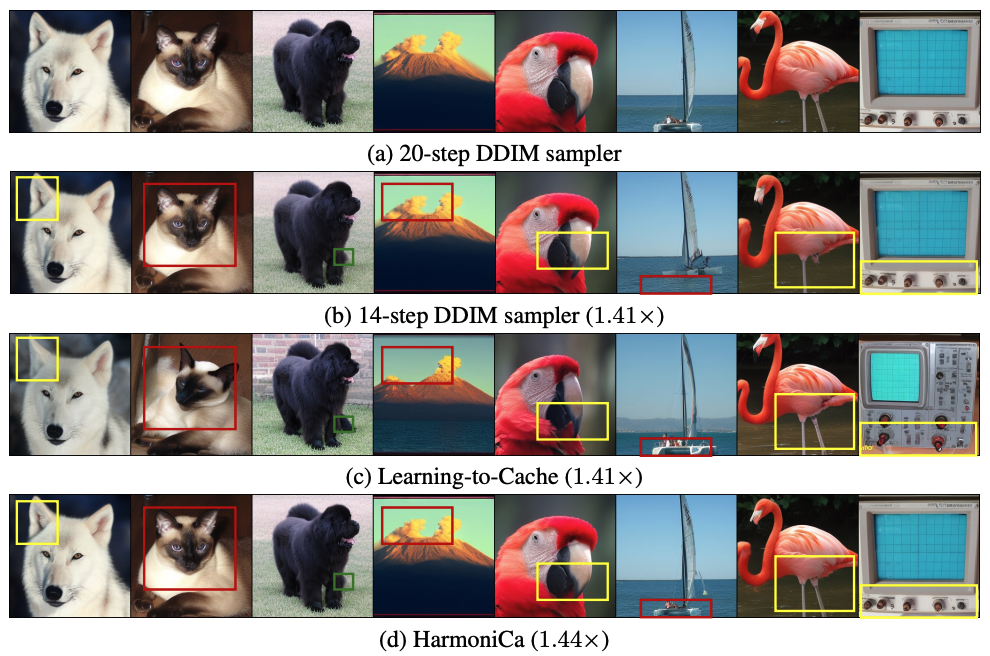
[ICML 2025] This is the official PyTorch implementation of "🎵 HarmoniCa: Harmonizing Training and Inference for Better Feature Caching in Diffusion Transformer Acceleration".
[ICML 2026 Spotlight] Latent Collaboration in Multi-Agent Systems
Run any open-source LLMs, such as DeepSeek and Llama, as OpenAI compatible API endpoint in the cloud.
The official GitHub page for the survey paper "A Survey of Large Language Models".
ICML 2025 Papers: Dive into cutting-edge research from the premier machine learning conference. Stay current with breakthroughs in deep learning, generative AI, optimization, reinforcement learning, and beyond. Code implementations included. ⭐ support the future of machine learning research!
Material for the series of seminars on Large Language Models