
cx
Privacy-compatible distributed contact tracing
- 10
- 2 y ago
Repo ipxe/cx, read from GitHub 1 min ago. ipxe has not joined Take My Repo.
In short
ipxe/cx is a public repo on GitHub by ipxe. Privacy-compatible distributed contact tracing. It declares no license on GitHub. Public does not mean open source: without a license, nobody is granted the right to reuse it. It is written mainly in C, has 10 stars and last changed on 2024-09-04. Nobody has reviewed it on Take My Repo yet, which says nothing about its quality. Read from GitHub on 2026-11-26.
CX: Privacy-compatible distributed contact tracing


Download the full architecture
specification

Overview
CX is an architecture for privacy-compatible distributed contact tracing, designed for use in pandemics such as Covid-19. It operates using a model of proximity-based contact detection over one or more local area broadcast media such as Bluetooth Low Energy (BLE). Pseudorandom contact identifiers are broadcast and recorded by all participating devices. A sequence of previously broadcast contact identifiers may be retroactively associated with a hazard (such as a positive Covid-19 diagnosis), and the sequence then made available to all other participating devices.
The architecture provides the following features:
-
Zero information leakage: for users who do not choose to disclose any information for contact tracing (e.g. because they are never diagnosed with the disease), the information broadcast by that user is indistinguishable from an ideal random bitstring.
-
Zero collection of location information: the devices running the protocol can choose to do so with no source of location information, and can therefore guarantee that no location history is collected.
-
Zero privilege: there is no third party, central authority, or software provider who has privileged access to any data.
-
Trusted diagnoses: governments and public health services provide trusted and digitally signed medical diagnoses, with the ability for users to distinguish between self-reported symptoms and medical test results.
-
Revocable diagnoses: a negative medical test result can supersede initial self-reported symptoms, allowing alerted users to minimise unnecessary time spent in isolation.
-
Distributed contact identification: users can identify only their own hazardous contacts, and no central authority has access to the information required to identify contacts.
-
Interoperability: the protocol may be implemented by any device and as part of any app, with all apps and all devices able to benefit equally from the same distributed data set.
-
Flexibility: multiple interoperating apps may exist to cover different user niches and preferences, with no restriction on development of new apps and no need for users to be running the same app.
-
International: the protocol allows for multiple healthcare providers in multiple jurisdictions, with support for distributed contact identification even for users travelling across national boundaries.
-
Low bandwidth: the protocol includes measures to reduce the bandwidth requirements to manageable levels even when dealing with billions of users and frequent requests.
-
Disconnected operation: the protocol will operate without a data connection, including in environments such as underground, at sea, or within an aircraft.
-
Low resource: the protocol may be implemented on embedded systems such as an ESP32 microcontroller, enabling it to be deployed even in environments where typical Android or iPhone mobile devices are unaffordable.
-
Ease of implementation: all cryptographic operations and data formats are chosen to be easily implemented using widely available and well-trusted existing libraries.

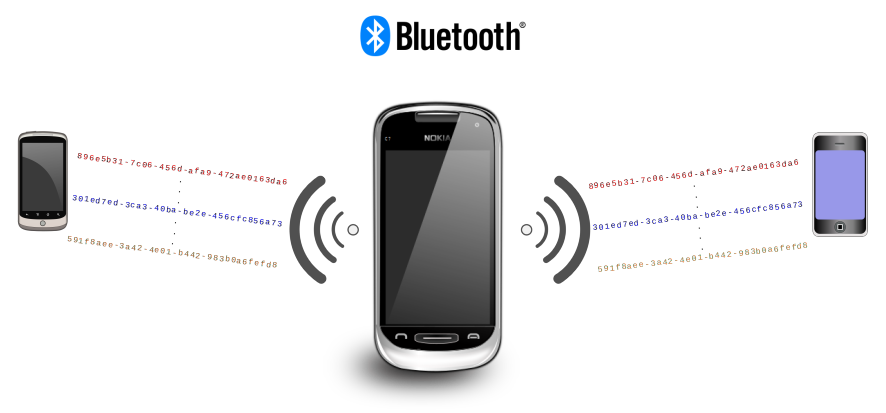
Each participating device broadcasts a regular stream of messages. Each
message contains a temporary unique contact identifier, which is a
random string of numbers and letters such as
896e5b31-7c06-456d-afa9-472ae0163da6.
Other devices that are nearby can observe the temporary unique contact identifier and can record it for future reference. The other devices do not receive any other information besides the contact identifier.
From the perspective of an observer, the contact identifier is completely meaningless: it is indistinguishable from random noise. The observer cannot use the contact identifier to deduce any information about the identity of the device.
The contact identifier changes frequently, making it impossible for unwanted observers (such as a stalker, or the owner of a shopping mall, or a government agency) to use it to track the device.

Each participating device also listens for messages broadcast by other nearby devices, and keeps a record of all the contact identifiers that it observes in these messages.
The contact identifiers are meaningless at the time they are observed. The only thing that the device can do is to record them for future reference.
The list of recorded contact identifiers is stored on the device and will never be shared with anyone.
The device may choose to record extra information, such as when or where the contact identifier was observed. This extra information is also stored on the device and will never be shared with anyone.

If the device owner becomes infected, the healthcare provider generates a confirmation code and communicates this confirmation code to the device owner. The device owner enters the confirmation code into the device.
The healthcare provider can choose how to communicate the confirmation code to the device owner. Some healthcare providers will find it easiest to simply read the number out in person. Other healthcare providers may choose to send confirmation codes via SMS messages, or through an existing online system.
The confirmation code allows the device to upload a list of the contact identifiers that it has recently broadcast. The list is uploaded to the healthcare provider’s servers.
To save bandwidth, the device uploads only a single piece of information (a secret seed value) that it had used to generate its sequence of apparently random contact identifiers. This reduces the bandwidth required by around 99.9% compared to uploading the complete list.
The device owner makes a deliberate choice to upload the seed value in order to help alert other people. There is no way for anyone else to find out the seed value unless the device owner chooses to do this.
The seed value is the only piece of information that is uploaded. The healthcare provider has no way to know where the device owner has been or who the device owner has contacted.

The healthcare provider publishes a notification list of hazardous seed values corresponding to positive diagnoses. Each participating device downloads this list and compares the hazardous contact identifiers against its own record of observed contact identifiers.
If an observer device finds a match, then it knows that it has recently been in close proximity to someone who has now been diagnosed and can raise an alert. The owner of the observer device can choose to take an appropriate action such as self-isolating.
The observer device can use any private information that it recorded at the time of observation to help assess the risk level. For example: if the observer device owner chose to record the time and location where the contact identifier was observed, then this could be used to determine that the contact took place while the owner was driving alone to work and so represents a harmless contact with another driver on the road.
The owner of a device has complete control over all the information associated with the contact. There is no way for anyone else to find out when or where a contact took place.
A healthcare provider can provide guidance or tools to assist in estimating the levels of risk and in suggesting the actions that should be taken by affected device owners.

The volume of notifications is potentially very large. There are several mechanisms in place to minimise the amount of data that each device needs to download, but it is fundamentally implausible for every device to be aware of every notification in the world.
Most people do not travel internationally on a frequent basis. Most notifications are therefore not relevant to most people.
Healthcare providers publish a comprehensive list of notifications that are relevant to people within their geographical subscription zone. For a national healthcare provider, this subscription zone is the whole country.
Everyone subscribes by default to receive notifications from the subscription zone of their own country.
People who travel internationally can choose to also receive notifications from the subscription zones of any country through which they have recently travelled. Devices may choose to manage these subscriptions automatically for convenience.
People who are diagnosed after recent international travel can inform the healthcare provider. The healthcare provider then publishes the notification for that diagnosis to a special worldwide subscription zone. Other healthcare providers see this and include that notification within the comprehensive list that they publish for their own subscription zone.
The volume of notifications for people who have been diagnosed shortly after international travel is relatively small, and so does not result in excessive amounts of data to be downloaded.
For healthcare providers in very large geographic areas, this same hierarchical approach can be used to break down subscription zones to state or county levels.
For healthcare providers in neighbouring or overlapping geographic areas, notifications may be exchanged directly to reduce the volume of notifications reaching the worldwide subscription zone.

This is an open standard. Any healthcare provider or app developer can deploy this technology. There are no licensing fees, patents, or other intellectual property barriers.
Any app will work with any healthcare provider. There is no need for each healthcare provider to create a dedicated app, although many healthcare providers may choose to do so. Users can choose the app that best fits their individual needs: for example, a niche app could be developed with a user interface designed for a particular visual impairment.
Healthcare providers can work independently or can choose to share notifications with selected other healthcare providers in order to maximise the worldwide effectiveness of contact tracing.
Details
For more information, see the architecture
specification

Questions
What is cx?
ipxe/cx is a public repo on GitHub by ipxe. Privacy-compatible distributed contact tracing.
Is cx open source?
It declares no license on GitHub. Public does not mean open source: without a license, nobody is granted the right to reuse it.
Does cx run on macOS, Windows or Linux?
Its maker has not tagged a system, so it is unknown here. Its README says what it needs.
How do I install cx?
Open "Take it" on its page: Take My Repo writes an install plan for your machine and hands it to your AI agent (Claude Code, Codex or Cursor), which asks you before each step. Take My Repo has not tested it on any machine.