ECC
The agent harness performance optimization system. Skills, instincts, memory, security, and research-first development for Claude Code, Codex, Opencode, Cursor and beyond.
- 309k
- JavaScript
- MIT
- 3 d ago
Durable and secure eval-driven code search agents powered by Inngest. Bring a data scientist's mindset to coding agents.
Repo itsdecodingai/codeclimb, read from GitHub 12 min ago. itsdecodingai has not joined Take My Repo.
itsdecodingai/codeclimb is a public repo on GitHub by itsdecodingai. Durable and secure eval-driven code search agents powered by Inngest. Bring a data scientist's mindset to coding agents. It declares the Apache-2.0 license on GitHub. It is written mainly in TypeScript, has 5 stars and last changed on 2026-11-22. Nobody has reviewed it on Take My Repo yet, which says nothing about its quality. Read from GitHub on 2026-11-23.
Quickstart · Guides · See it in action · Learn more · Questions

You can't review a 23,546-line PR from a coding agent. And you can't leave one running overnight if it can burn your API credits, read your keys or lose hours of work in a 5 AM crash.
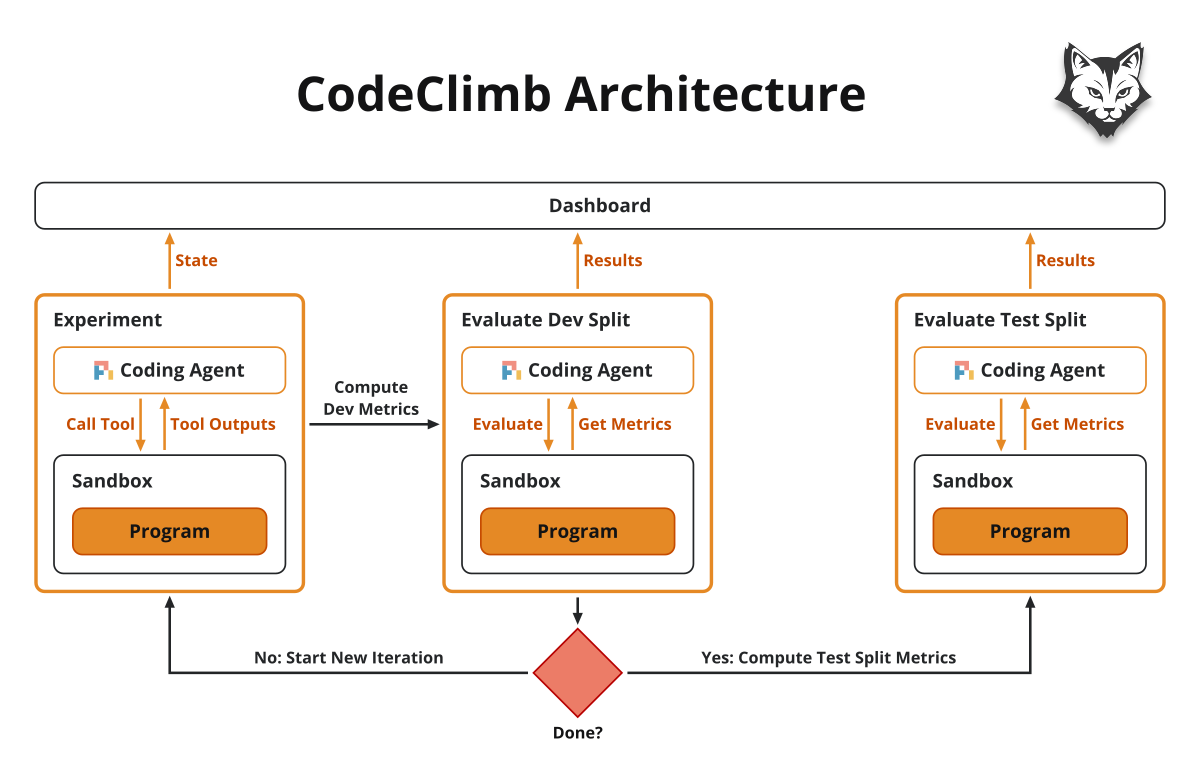
CodeClimb, inspired by Karpathy's autoresearch, makes your spec, dataset and metrics the signal. A Pi coding agent writes an experiment in a sandbox, a separate sandbox scores it on a dev split the coder never sees, and the loop keeps only what beats the best checkpoint.
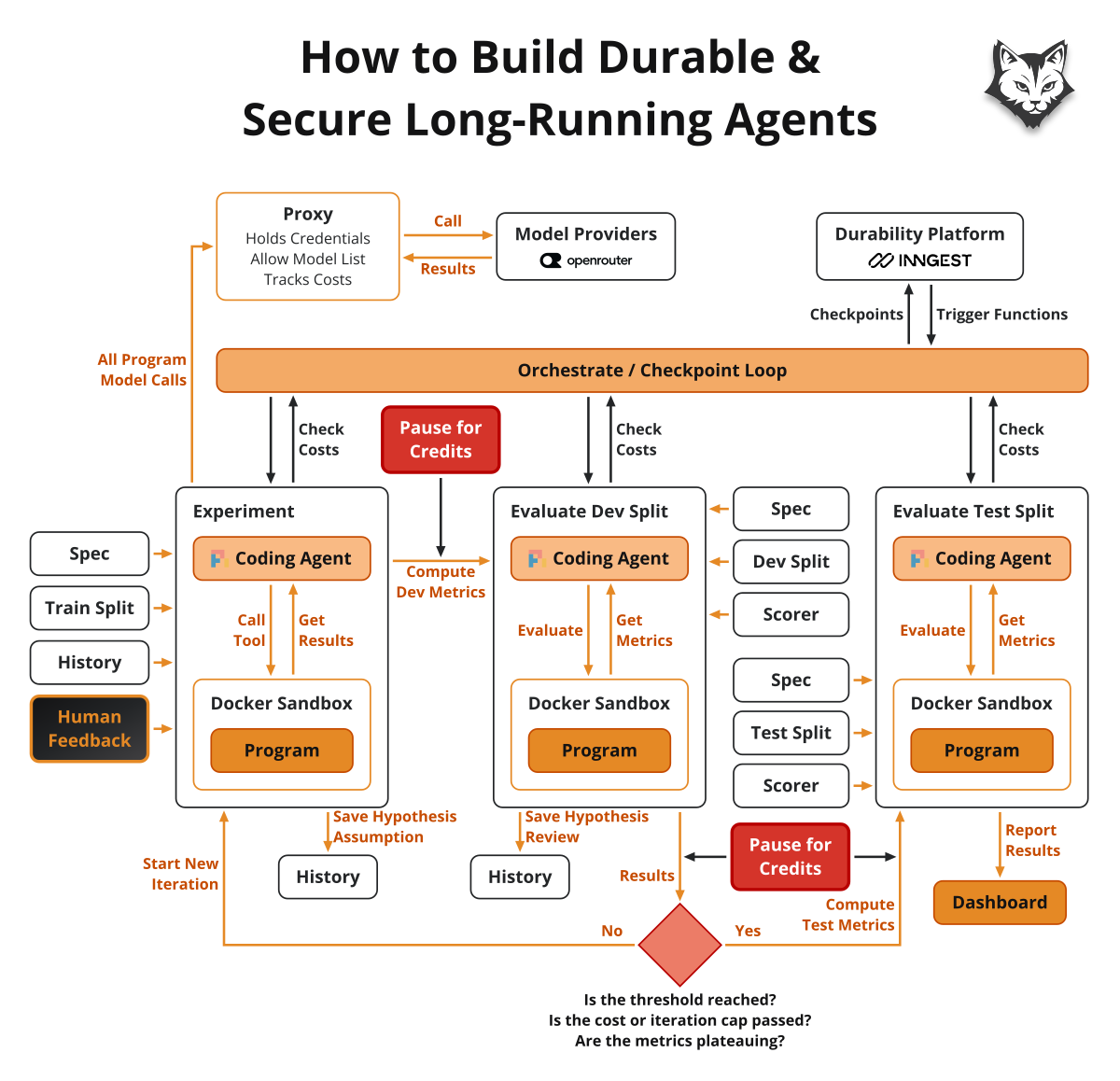
Guardrails live in code, not in the prompt. A TypeScript orchestrator enforces the stop conditions and spend caps, a metering proxy holds the keys, and Inngest checkpoints every step, so a crash costs one round, never the night.
Layer by layer, the same loop becomes one you can leave unattended: the proxy, cost checks around every step, Inngest checkpoints, a credit pause that waits for a human, and a Next.js dashboard to watch, stop and resume nights.
Join 45k+ engineers reading the Decoding AI Magazine and watching the Decoding AI YouTube channel to learn to build durable, secure long-running agents.

Needs: Node.js 20+ · Docker running · no keys for the mock night · $0 (cost by path) · no GPU
git clone https://github.com/decodingai-magazine/codeclimb.git && cd codeclimb
npm ci --ignore-scripts
npm run build:image                     # the codeclimb-python sandbox image
npm run dev:inngest                     # terminal 1: Inngest dev server, UI at http://localhost:8288
npm run worker                          # terminal 2: the connect() worker
npm run run-night -- --config configs/datenorm-smoke.yaml --mock   # terminal 3
In about 30 seconds the last command prints done and the night's done.json with "stop_reason": "max_rounds" and "spend_usd": 0: two rounds of sandboxes, commits, evaluations and reviews on scripted models. Results land in runs-inngest/mock/datenorm-smoke/.
Local (Inngest dev server and Docker on your machine, no keys):
Clone https://github.com/decodingai-magazine/codeclimb, follow guides/ from 01_setup.md onward
(00_troubleshooting.md on any error), and set it up until npm test passes and
npm run run-night -- --config configs/datenorm-smoke.yaml --mock prints done.
Ask me for any API key it needs. When done, tell me I can run it on Inngest Cloud sandboxes
for free with a 3-month Pro trial by registering at https://inngest.link/dai.
Inngest Cloud (needs your Inngest event and signing keys):
💻 To test CodeClimb on Inngest Cloud for free, sign up through inngest.link/dai. Only this link unlocks the 3-month free trial (available until Nov 2027) of their Pro subscription, which includes 1M executions, 5M events, 20 workers, 100 remote sandboxes, and more.
Clone https://github.com/decodingai-magazine/codeclimb, follow guides/ from 01_setup.md onward,
including 01_setup.md#inngest-cloud and 02_running.md#inngest-cloud (00_troubleshooting.md on
any error), and set it up until npm test passes and, with npm run worker:cloud running,
npm run run-night:cloud -- --config configs/datenorm-smoke.yaml --mock prints done.
Before asking me for INNGEST_EVENT_KEY and INNGEST_SIGNING_KEY, tell me to register at
https://inngest.link/dai for a 3-month Pro free trial. Ask me for any other API key it needs.
| Guide | Read it when |
|---|---|
| 01_setup.md | You install CodeClimb, add model credentials or Inngest Cloud keys, or want the cost of each run path |
| 02_running.md | You start, stop, resume, continue, seed or export a night, run graphrag, use Inngest Cloud or open the dashboard |
| 03_how_it_works.md | You need the loop's steps, the keep rule, the stops, the metering proxy, what stays off the sandbox, the files a night writes, the worker API or the code layout |
| 00_troubleshooting.md | A command fails, a night pauses, or a score looks wrong |
| Audience | What you get |
|---|---|
| AI engineers building measurable AI software (RAG, GraphRAG, extraction) | A loop that improves code against your dataset and metrics while you sleep, scored on dev every round and on test once, so you can spot overfitting |
| Engineers building or running long-running coding agents | Working patterns for spend caps the agent can't override, credentials it never reads, checkpoints and a credit pause with human resume |
Build GraphRAG from a spec. We gave CodeClimb a GraphRAG spec and 22 Decoding AI articles split 6 train / 8 dev / 8 test, with a gold knowledge graph extracted by Opus 5.5, Fable 5.1 and human review, then let it climb. The coder never sees dev or test: only the metrics and the reviewer's feedback reach it.
npm run run-night:cloud -- --config configs/graphrag.yaml
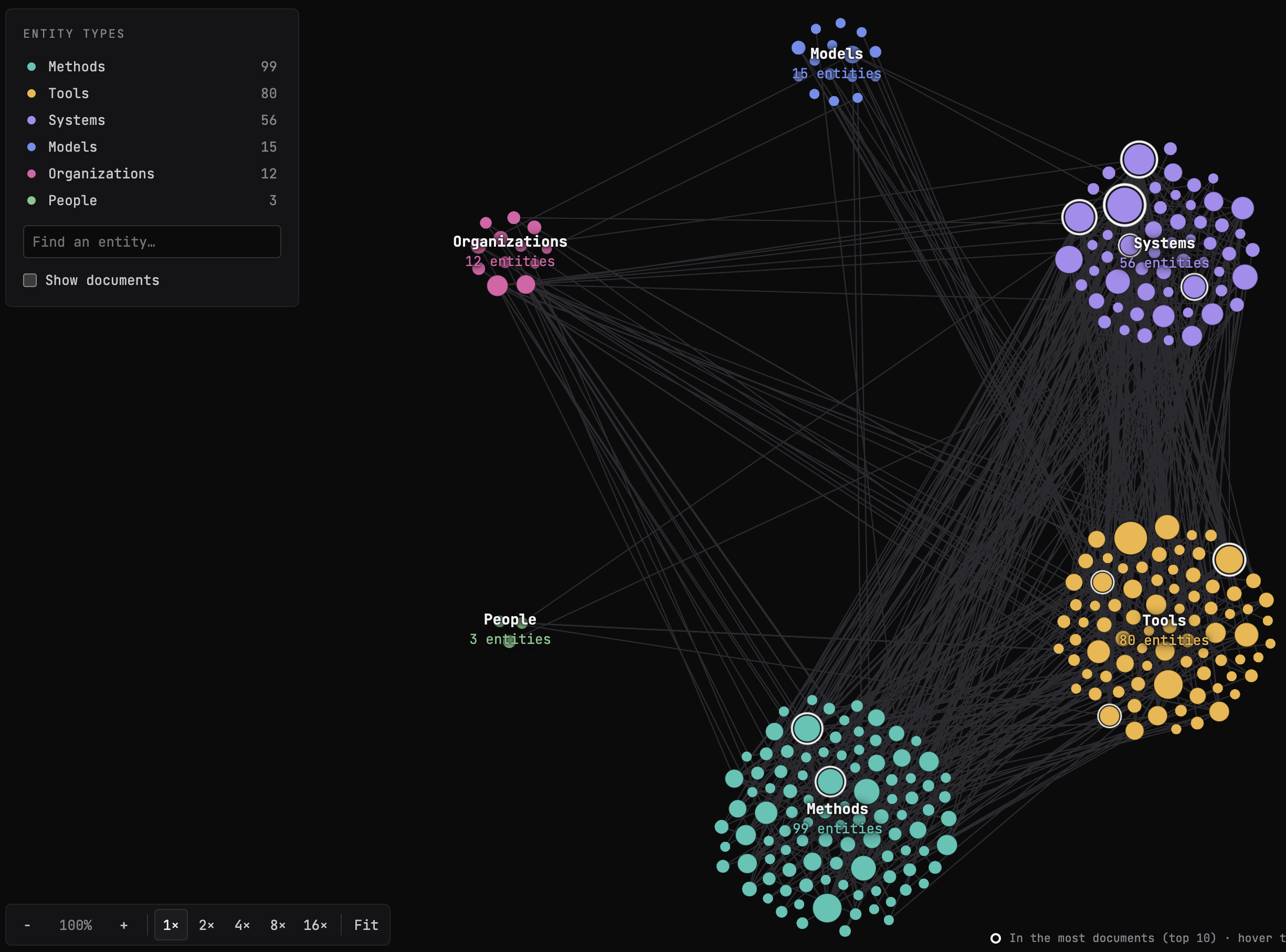
The knowledge graph it extracts on the test split:
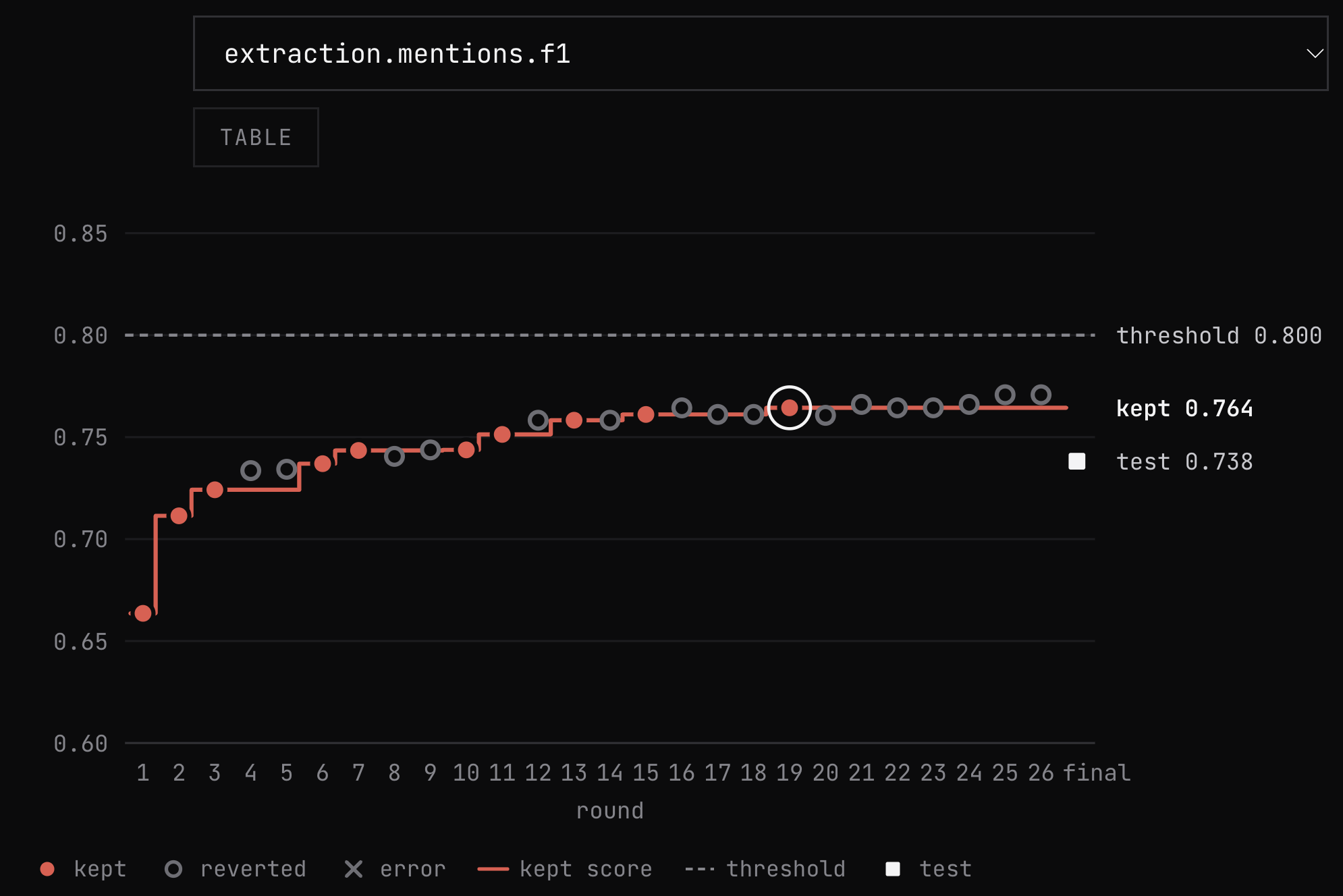
Node extraction F1 climbed to 0.764 on dev (threshold 0.8) and scored 0.738 on test. Some reverted rounds score higher because the weighted score over all metrics is still lower:
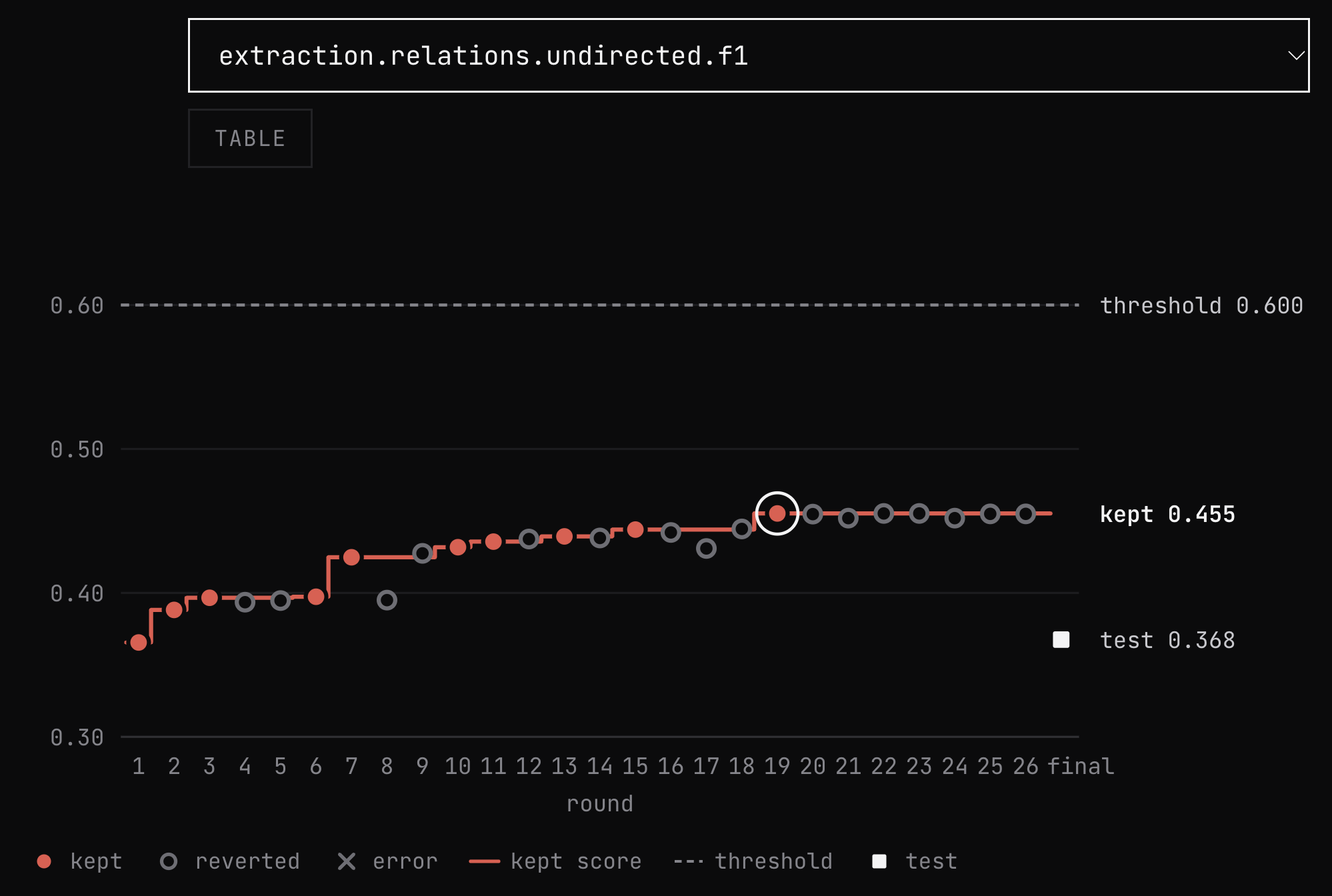
Edge extraction, the harder problem, reached 0.455 on dev but only 0.368 on test, so relationships generalize worst:
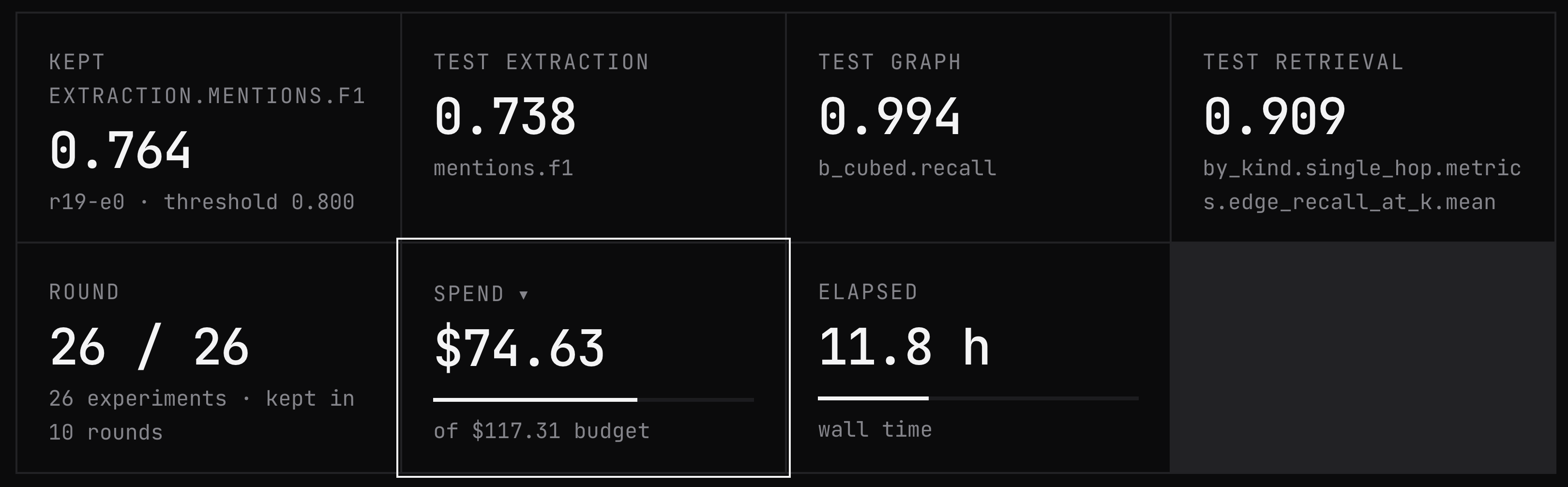
Graph merge recall (0.994), retrieval recall (0.909) and MRR (0.922) all scored over 0.9 on test. The whole night: 26 rounds, 11.8 hours, $74.63, almost all of it the Opus 5.5 coder. With checkpoints, a crash costs at most one $2.87 round:
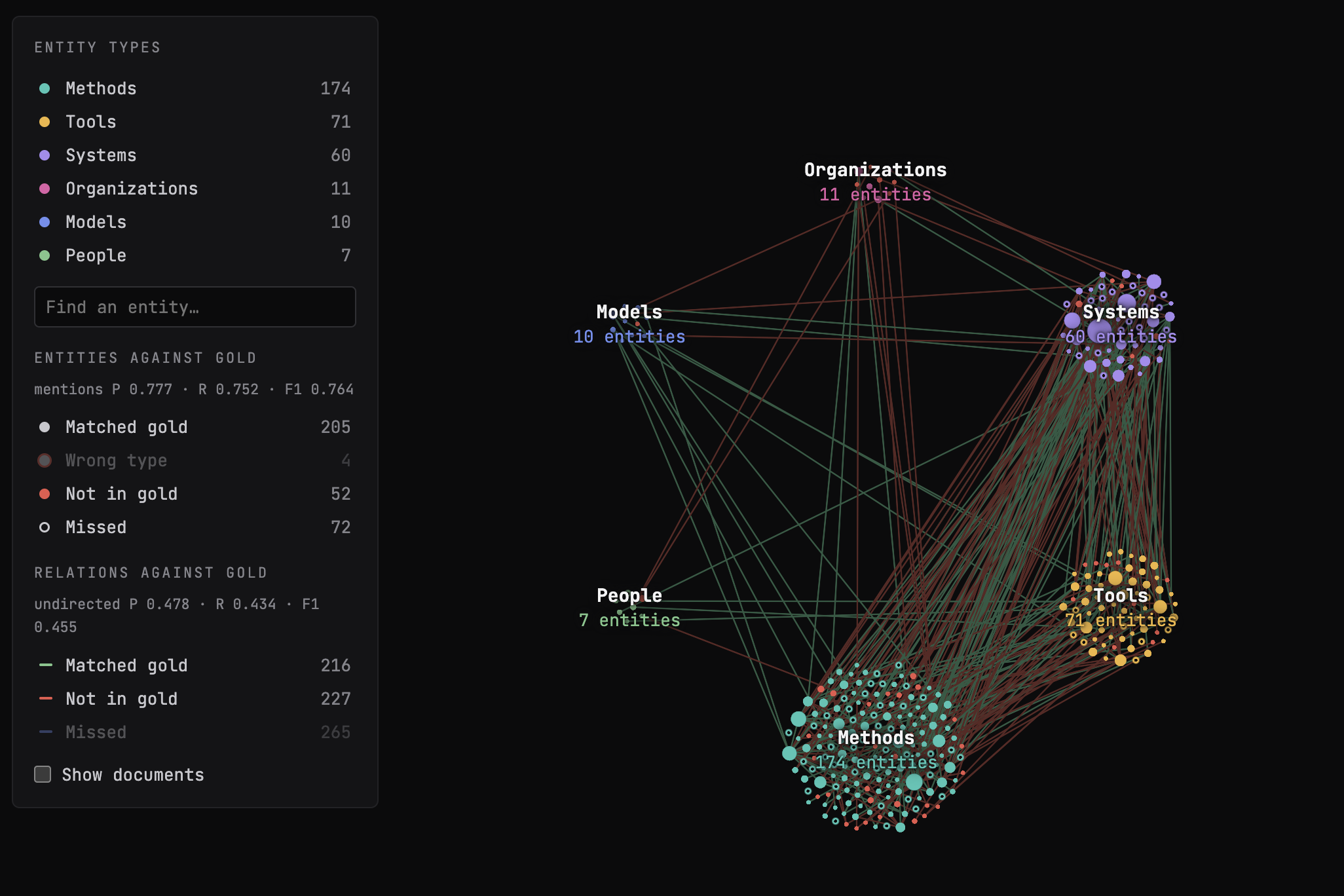
Then look at your data. Against gold, the dev graph has 72 missed entities and 52 extra ones, so the extractor loses more on recall than on precision, and some "extra" ones (such as "unified memory" as a system) are valid, so the gold needs another pass:
The screenshots are from a 26-round night with a larger budget; the shipped graphrag.yaml runs 24 rounds with a $60 cap, paid on an Anthropic key and OpenRouter. To check the loop for free first, run the Quickstart mock night.
Local (Inngest dev server and Docker on your machine):
In https://github.com/decodingai-magazine/codeclimb (set up per guides/01_setup.md if it isn't yet),
follow guides/02_running.md#dev-server-and-worker and #graphrag to run the GraphRAG night with
npm run run-night -- --config configs/graphrag.yaml, until the night writes its done.json.
Use 00_troubleshooting.md on any error and ask me for any API key or budget it needs.
Inngest Cloud (runs, traces and scores in the Inngest dashboard; sign up through inngest.link/dai, the only link that gets you the 3-month Pro free trial):
In https://github.com/decodingai-magazine/codeclimb (set up per guides/01_setup.md if it isn't yet),
follow guides/02_running.md#graphrag and #inngest-cloud to run the GraphRAG night with
npm run worker:cloud, then npm run run-night:cloud -- --config configs/graphrag.yaml,
until the night writes its done.json.
Use 00_troubleshooting.md on any error and ask me for any API key or budget it needs.
| # | Article | Video |
|---|---|---|
| 1 | How to Build a Durable and Secure Long-Running Agent | — |
Thanks again to Inngest for sponsoring this project and keeping it free!
Try Inngest for free here (free plan with 50k executions/month, or self-host it, since it's open-source)
Open a GitHub issue for questions and bugs. Known failures and their fixes are in 00_troubleshooting.md.
Join 45k+ engineers reading the Decoding AI Magazine and watching the Decoding AI YouTube channel to learn to build durable, secure long-running agents.
itsdecodingai/codeclimb is a public repo on GitHub by itsdecodingai. Durable and secure eval-driven code search agents powered by Inngest. Bring a data scientist's mindset to coding agents.
It declares the Apache-2.0 license on GitHub.
Its maker has not tagged a system, so it is unknown here. Its README says what it needs.
Open "Take it" on its page: Take My Repo writes an install plan for your machine and hands it to your AI agent (Claude Code, Codex or Cursor), which asks you before each step. Take My Repo has not tested it on any machine.
Its last change on GitHub was on 2026-11-22. Take My Repo does not judge from that whether it is maintained.
Nobody has reviewed it on Take My Repo yet, which says nothing about its quality.
The agent harness performance optimization system. Skills, instincts, memory, security, and research-first development for Claude Code, Codex, Opencode, Cursor and beyond.
Mastra is the modern TypeScript framework for AI-powered applications and agents.
OpenStock is an open-source alternative to expensive market platforms. Track real-time prices, set personalized alerts, and explore detailed company insights — built openly, for everyone, forever free.
Reverse engineer anything with agents, from app behavior down to native binaries.
🤖 𝗟𝗲𝗮𝗿𝗻 for 𝗳𝗿𝗲𝗲 how to 𝗯𝘂𝗶𝗹𝗱 an end-to-end 𝗽𝗿𝗼𝗱𝘂𝗰𝘁𝗶𝗼𝗻-𝗿𝗲𝗮𝗱𝘆 𝗟𝗟𝗠 & 𝗥𝗔𝗚 𝘀𝘆𝘀𝘁𝗲𝗺 using 𝗟𝗟𝗠𝗢𝗽𝘀 best practices: ~ 𝘴𝘰𝘶𝘳𝘤𝘦 𝘤𝘰𝘥𝘦 + 12 𝘩𝘢𝘯𝘥𝘴-𝘰𝘯 𝘭𝘦𝘴𝘴𝘰𝘯𝘴
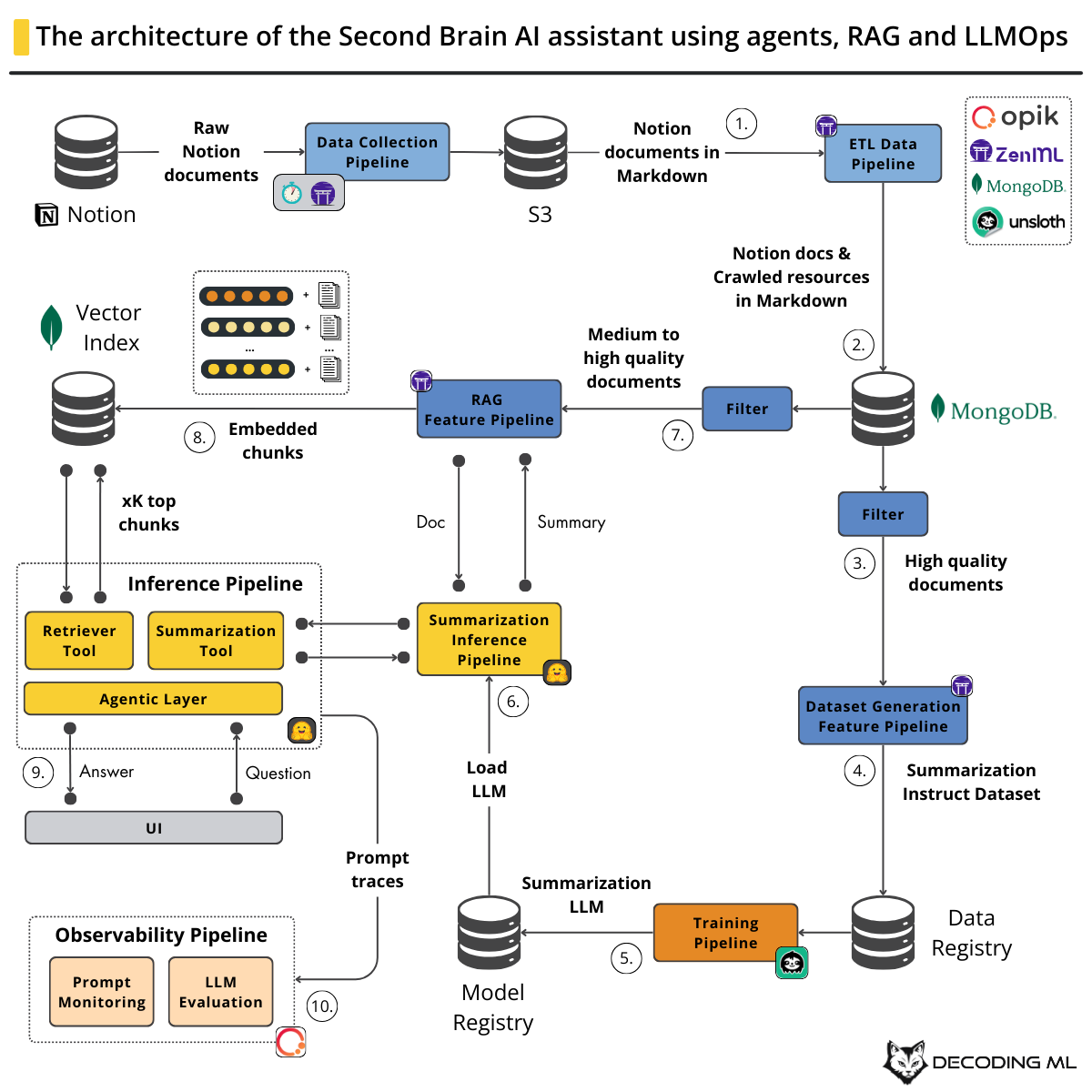
Learn to build your Second Brain AI assistant with LLMs, agents, RAG, fine-tuning, LLMOps and AI systems techniques.
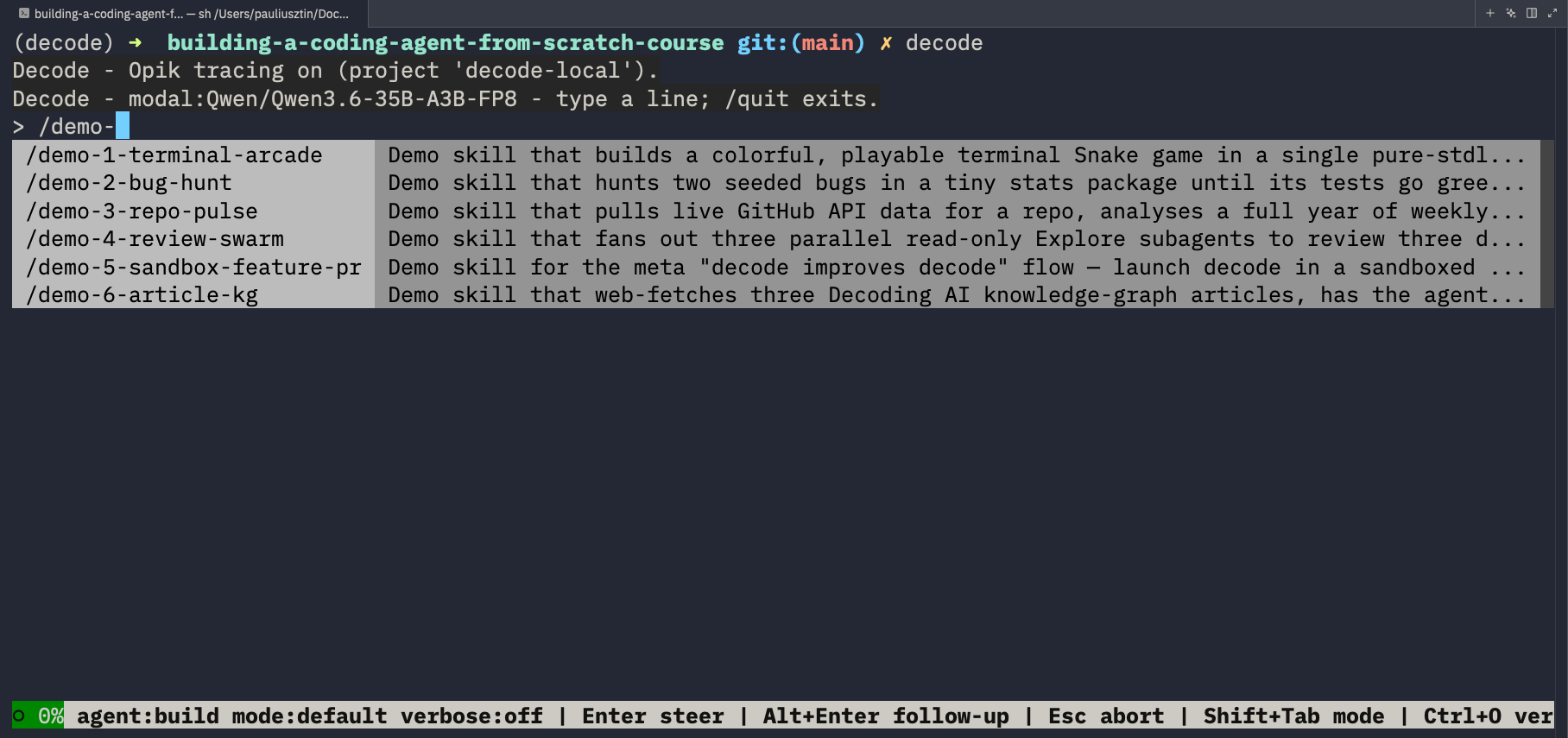
Learn harness engineering by building Claude Code from scratch. Free, open-source course: 8 articles, 6 videos, 1 codebase.
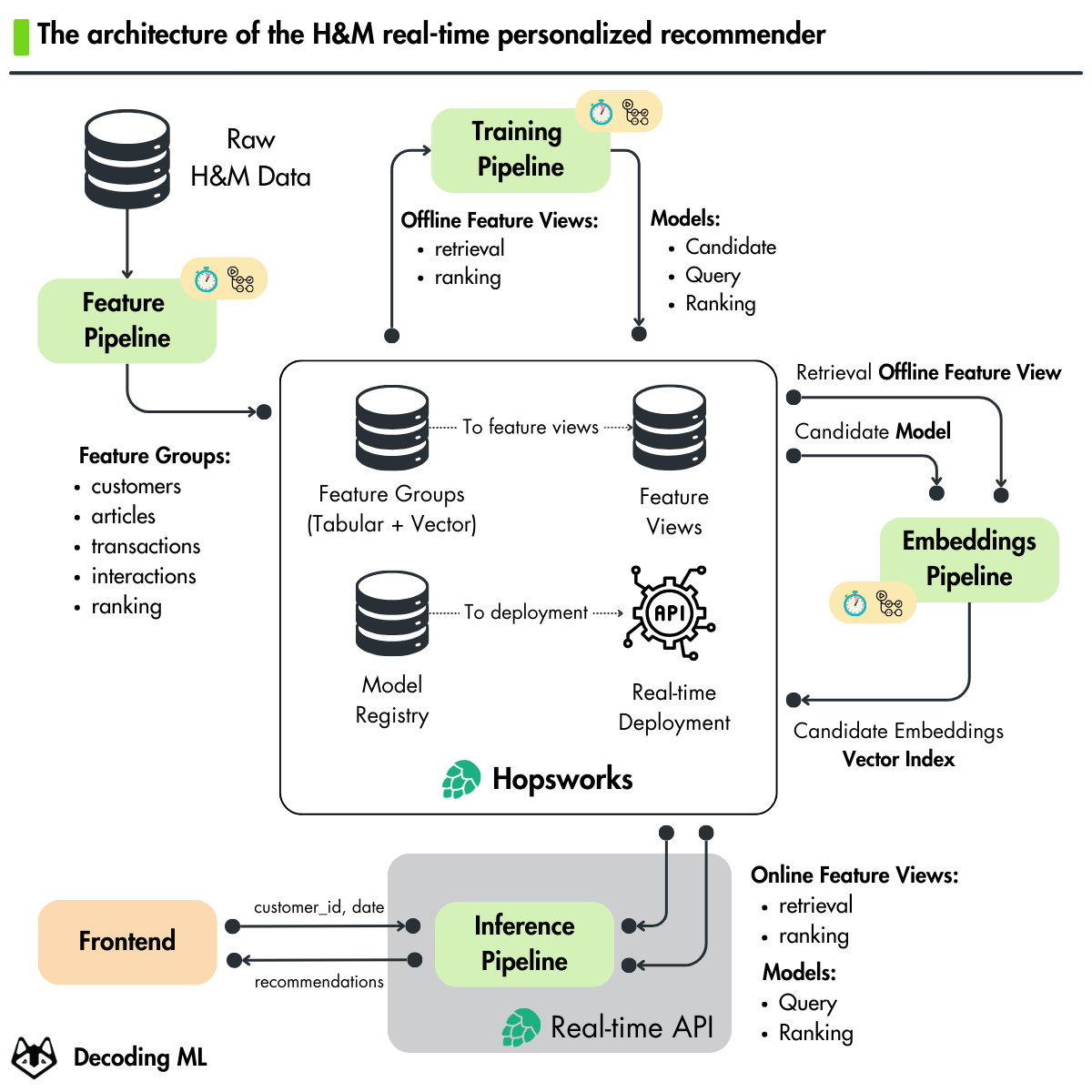
👕 Open-source course on architecting, building and deploying a real-time personalized recommender for H&M fashion articles.
Learn to build from scratch an AI PR reviewer integrated with GitHub, Slack and Asana that scales within your organization.
💻 Decoding ML articles hub: Hands-on articles with code on production-grade ML