ette
EVM-based Blockchain Indexer, with historical data query & real-time notification support 😎
- 274
- Go
- CC0-1.0
- 4 y ago
Constant-Time Comparison, Conditional Selection and Swapping of Unsigned Integer Values
Repo itzmeanjan/subtle, read from GitHub 11 h ago. itzmeanjan has not joined Take My Repo.
itzmeanjan/subtle is a public repo on GitHub by itzmeanjan. Constant-Time Comparison, Conditional Selection and Swapping of Unsigned Integer Values. It declares the MIT license on GitHub. It is written mainly in C++, has 12 stars and last changed on 2026-07-15. Nobody has reviewed it on Take My Repo yet, which says nothing about its quality. Read from GitHub on 2026-11-22.
Constant-time operations on both signed and unsigned integer values of 8, 16, 32, 64 bit widths — comparison, zero-testing, min/max, conditional selection/swap, memory compare, conditional copy/set, secure zeroization and secret-index table lookup. C++20, header-only, fully constexpr library.
[!NOTE]
constexpr? Yes, all functions can be evaluated at compile-time — useful forstatic_assertbased test cases.
Add subtle to your CMake project via FetchContent:
include(FetchContent)
FetchContent_Declare(
  subtle
  GIT_REPOSITORY https://github.com/itzmeanjan/subtle.git
  GIT_TAG master
  GIT_SHALLOW TRUE
)
FetchContent_MakeAvailable(subtle)

target_link_libraries(my_app PRIVATE subtle)
Compare two byte arrays in constant-time:
#include "subtle.hpp"
#include <algorithm>
#include <array>
#include <cstdint>
#include <span>

std::array<uint8_t, 16> a;
std::array<uint8_t, 16> b;

std::ranges::fill(a, 0xae);
std::ranges::fill(b, 0xde);

const uint32_t equal = subtle::ct_memcmp<uint8_t, uint32_t>(std::span(a), std::span(b));
std::memcmp would short-circuit its execution as early as possible. It is data-dependent. When comparing secret key material, we want comparison to always take same time. The secret material value must not affect timing of comparison. subtle::ct_memcmp guarantees this by AND-accumulating a per-byte constant-time equality check across the whole buffer — every byte is always inspected, with no early exit and no secret-dependent branch. Each per-byte check routes its result through a compiler barrier (an empty inline-asm that emits zero instructions), keeping the accumulator opaque so the compiler cannot recognize the pattern and reintroduce a short-circuit. The returned mask is all-bits-set (0xffffffff for this uint32_t result) on a full match and 0 otherwise.
See examples/ for complete standalone examples.
In cryptographic library implementations we care about how much information gets leaked when certain procedure, which deals with secret key, is executed in some environment. It can be key generation of public key encryption (PKE) or message signing using some digital signature algorithm (DSA). Based on what that specific environment is, various sorts of observation tactics an adversary can deploy for collecting leaked information. It can result in partial or full recovery of secret materials. We would like to write implementations which leaks as little secret information as possible. Simply put, we do not want to do following based on value of secret key material.
[!NOTE] Read more about need for constant-time implementations @ https://www.bearssl.org/constanttime.html.
We mostly write programs in some high-level language, say C++. That program is passed down to a compiler for producing machine executable instructions. The compiler is free to transform it to something totally different, as long as it produces intended observable side-effects. It may even produce some instructions that we're explicitly trying to avoid, by using this whole "constant-time" implementation. So achieving constant-timeness is not trivial. Read more @ https://www.chosenplaintext.ca/articles/beginners-guide-constant-time-cryptography.html.
I don't want to write same boilerplate code again and again for achieving constant-timeness. That's why I maintain this minimal, header-only, portable, fully constexpr C++ library which offers following functionalities.
==, !=), ordering (<, >, <=, >=), zero-testing and min/maxtable[secret])These operations work over both signed and unsigned integer operands of 8, 16, 32 and 64 bit width (branch/mask and result types are always unsigned). This is a best effort mechanism to achieve constant-timeness and it's not guaranteed that if you use this, your cryptographic implementation becomes constant-time. It's always good idea to target some specific architecture, compile with debug info and then disassemble object file, with interleaved source code lines, to inspect what the compiler generated.
[!NOTE] This library collects motivation from both https://github.com/dalek-cryptography/subtle and https://github.com/golang/go/blob/ddb423a7/src/crypto/subtle/constant_time.go.
clang++/ g++, with support for compiling C++20 programs.google-test is required. It can be installed globally or fetched automatically by setting -DSUBTLE_FETCH_DEPS=ON.google-benchmark is required. It can be installed globally or fetched automatically by setting -DSUBTLE_FETCH_DEPS=ON.clang-tidy.clang-format.| Option | Description | Default |
|---|---|---|
SUBTLE_BUILD_TESTS |
Build tests | OFF |
SUBTLE_BUILD_BENCHMARKS |
Build benchmarks | OFF |
SUBTLE_BUILD_EXAMPLES |
Build examples | OFF |
SUBTLE_FETCH_DEPS |
Fetch missing dependencies (GTest, Benchmark) | OFF |
SUBTLE_ASAN |
Enable AddressSanitizer | OFF |
SUBTLE_UBSAN |
Enable UndefinedBehaviorSanitizer | OFF |
SUBTLE_MSAN |
Enable MemorySanitizer for constant-time verification (Clang only) | OFF |
SUBTLE_VALGRIND |
Enable Valgrind constant-time verification (Linux only) | OFF |
SUBTLE_BINSEC |
Build binary for Binsec constant-time verification | OFF |
SUBTLE_NATIVE_OPT |
Enable -march=native (not suitable for cross-compilation) |
OFF |
SUBTLE_ENABLE_LTO |
Enable Interprocedural Optimization (LTO) | ON |
[!NOTE] The options above (except
SUBTLE_BUILD_*andSUBTLE_FETCH_DEPS) are only available when buildingsubtleas the top-level project. They are not exposed when consumed viaFetchContentoradd_subdirectory.
To build and run the tests, use the following CMake commands:
cmake -B build -DCMAKE_BUILD_TYPE=Release -DSUBTLE_BUILD_TESTS=ON -DSUBTLE_FETCH_DEPS=ON
cmake --build build -j

ctest --test-dir build -j --output-on-failure
To run tests with sanitizers, reconfigure the build with the desired sanitizer option:
# With AddressSanitizer, in Release mode
cmake -B build -DCMAKE_BUILD_TYPE=Release -DSUBTLE_BUILD_TESTS=ON -DSUBTLE_FETCH_DEPS=ON -DSUBTLE_ASAN=ON
cmake --build build -j
ctest --test-dir build -j --output-on-failure

# With UndefinedBehaviorSanitizer, in Release mode
cmake -B build -DCMAKE_BUILD_TYPE=Release -DSUBTLE_BUILD_TESTS=ON -DSUBTLE_FETCH_DEPS=ON -DSUBTLE_UBSAN=ON
cmake --build build -j
ctest --test-dir build -j --output-on-failure

# With Clang, explicitly set, in Debug mode
cmake -B build -DCMAKE_BUILD_TYPE=Debug -DSUBTLE_BUILD_TESTS=ON -DSUBTLE_FETCH_DEPS=ON -DSUBTLE_UBSAN=ON -DCMAKE_CXX_COMPILER=clang++
cmake --build build -j
ctest --test-dir build -j --output-on-failure
Correctness tests only check that the functions compute the right values — they do not check constant-timeness. For that, subtle ships three independent verification tools, each behind its own CMake option. They are mutually exclusive: enable exactly one at a time, and none of them link Google Test (so -DSUBTLE_FETCH_DEPS=ON is not needed).
The dynamic tools (MSan, Valgrind) mark secret inputs as poisoned and run the constant-time functions; any secret-dependent branch or memory access is reported as a use of poisoned data. Binsec goes further and formally proves constant-timeness over the emitted binary via symbolic execution. See CT_VERIFICATION_REPORT.md for the reasoning behind this layered approach.
Fast, CI-friendly taint tracking. Requires clang++ and libc++ (install libc++-dev libc++abi-dev on Debian/Ubuntu).
cmake -B build -DCMAKE_CXX_COMPILER=clang++ -DCMAKE_BUILD_TYPE=Release -DSUBTLE_BUILD_TESTS=ON -DSUBTLE_MSAN=ON -DSUBTLE_ENABLE_LTO=OFF
cmake --build build -j
ctest --test-dir build --output-on-failure -j
Complementary to MSan; works with either g++ or clang++. Requires valgrind on PATH. The ctest run drives the binary under Valgrind's memcheck automatically.
cmake -B build -DCMAKE_CXX_COMPILER=g++ -DCMAKE_BUILD_TYPE=Release -DSUBTLE_BUILD_TESTS=ON -DSUBTLE_VALGRIND=ON -DSUBTLE_ENABLE_LTO=OFF
cmake --build build -j
ctest --test-dir build --output-on-failure -j
Symbolic execution of the final statically-linked binary.
bash tests/scripts/run_docker_binsec.sh
If you already have binsec on your PATH, you can instead build the target and invoke the verifier directly:
cmake -B build -DCMAKE_CXX_COMPILER=g++ -DCMAKE_BUILD_TYPE=Release -DSUBTLE_BUILD_TESTS=ON -DSUBTLE_BINSEC=ON
cmake --build build -j
cmake --build build --target binsec_verify
[!NOTE] Binsec is not run at
Debug(-O0): without optimization the compiler doesn't lower the bitwise patterns into branchless code, so it reports branches that only exist at-O0. UseRelease,RelWithDebInfoorMinSizeRel.
To run the benchmarks (using Google Benchmark):
cmake -B build -DCMAKE_BUILD_TYPE=Release -DSUBTLE_BUILD_BENCHMARKS=ON -DSUBTLE_FETCH_DEPS=ON -DSUBTLE_NATIVE_OPT=ON
cmake --build build -j
[!CAUTION] When benchmarking, ensure that you've disabled CPU frequency scaling, by following guide @ https://github.com/google/benchmark/blob/main/docs/reducing_variance.md.
Each benchmark can be run individually using --benchmark_filter and results can be exported to JSON for comparison. For example, to benchmark memcmp:
./build/subtle_benchmarks \
  --benchmark_min_warmup_time=.05 \
  --benchmark_enable_random_interleaving=true \
  --benchmark_repetitions=10 \
  --benchmark_min_time=0.1s \
  --benchmark_display_aggregates_only=true \
  --benchmark_report_aggregates_only=true \
  --benchmark_out_format=json \
  --benchmark_out=memcmp.json \
  --benchmark_counters_tabular=true \
  --benchmark_filter='memcmp'
Replace memcmp with conditional_copy or conditional_swap (and the output filename) to benchmark the other operations.
To compare native vs. constant-time performance, use Google Benchmark's compare.py tool:
pushd /path/to/benchmark/tools/
python3 -m venv .venv                       # First time, setup virtual environment
source .venv/bin/activate                   # Once setup, just enable it
python -m pip install -r requirements.txt   # Also first time

python compare.py filters memcmp.json native_memcmp ct_memcmp

popd
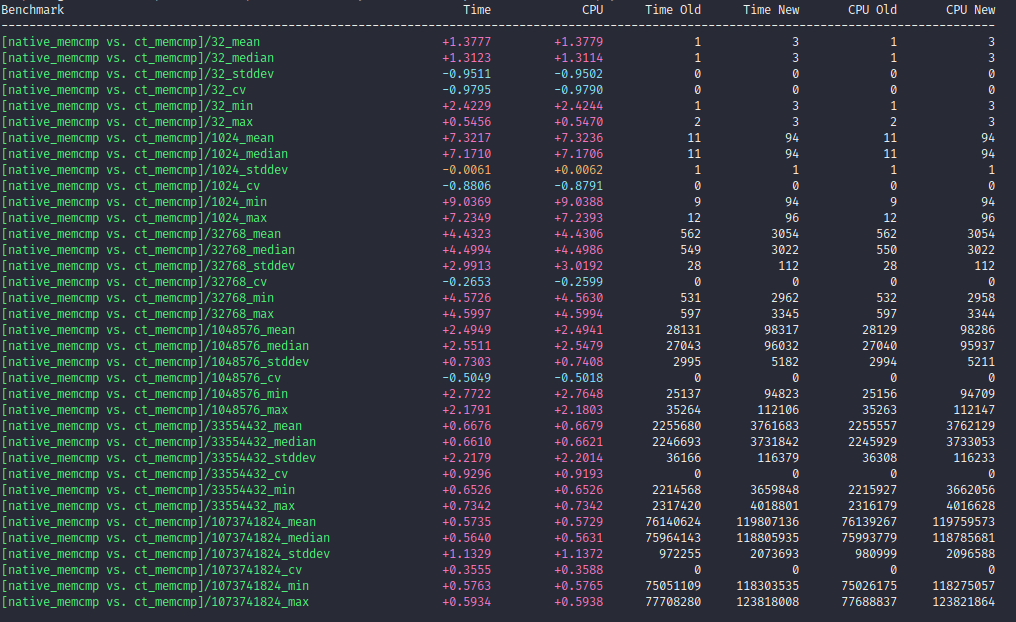
native std::memcmp vs. Constant-time memcmp — std::memcmp is heavily SIMD-optimized, so the constant-time byte-by-byte loop pays a significant overhead, especially at larger buffer sizes.
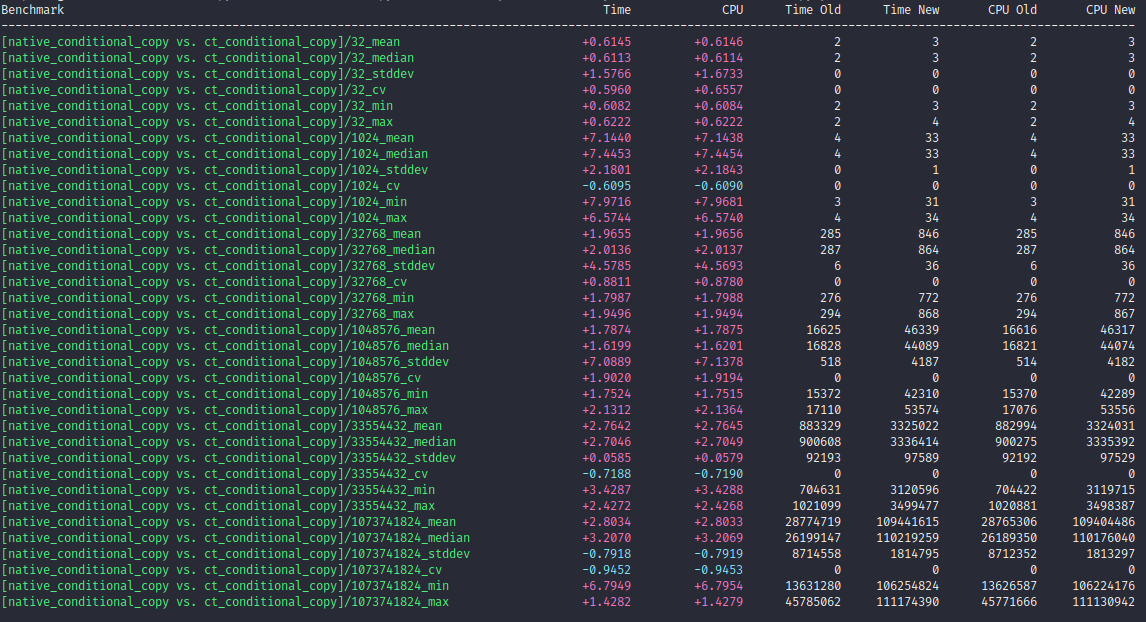
native branching copy vs. Constant-time conditional copy — the constant-time version always touches every byte via ct_select, while the native version skips the copy entirely when the branch is false.
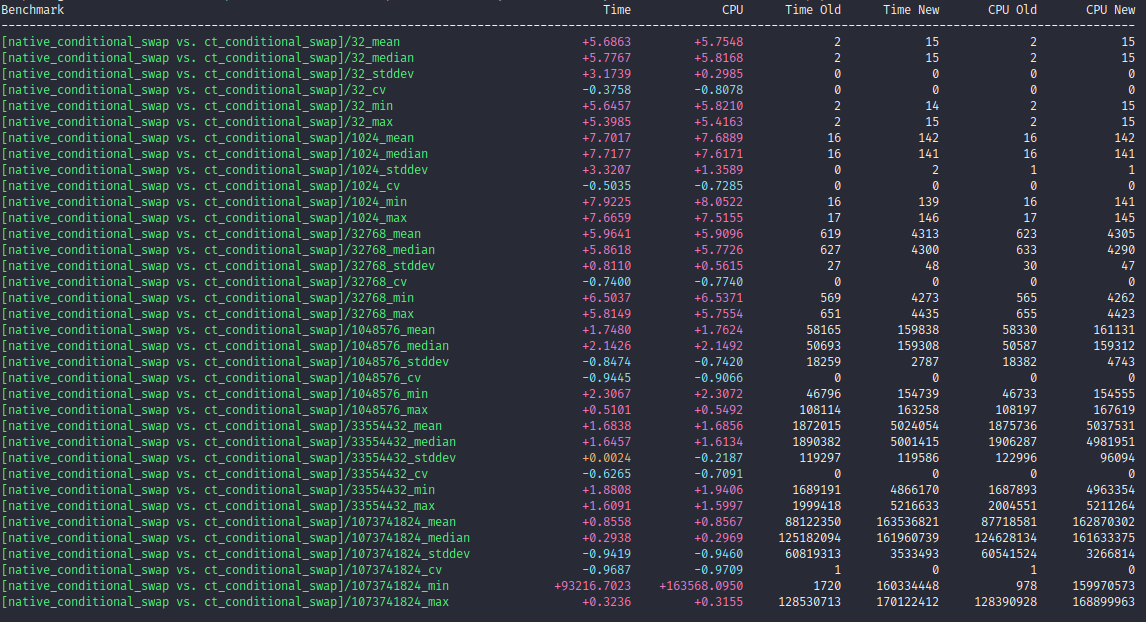
native branching swap vs. Constant-time conditional swap — similar to copy, the constant-time version always performs the swap work regardless of the condition, eliminating the branch but costing throughput.
You can easily integrate subtle into your project using CMake.
# Install system-wide (default prefix: /usr/local)
cmake -B build -DCMAKE_BUILD_TYPE=Release
cmake --build build
sudo cmake --install build

# Install to custom directory (e.g., ./dist)
cmake -B build -DCMAKE_BUILD_TYPE=Release -DCMAKE_INSTALL_PREFIX=./dist
cmake --build build
cmake --install build
Once installed, consume it from your CMakeLists.txt with find_package:
find_package(subtle REQUIRED)

add_executable(my_app main.cpp)
target_link_libraries(my_app PRIVATE subtle::subtle)
Or, without installing, pull it in at configure time using FetchContent:
include(FetchContent)
FetchContent_Declare(
  subtle
  GIT_REPOSITORY https://github.com/itzmeanjan/subtle.git
  GIT_TAG master
  GIT_SHALLOW TRUE
)
FetchContent_MakeAvailable(subtle)

add_executable(my_app main.cpp)
target_link_libraries(my_app PRIVATE subtle)
[!NOTE] The
tidyandformattargets are only registered ifclang-tidy/clang-formatare found at configure time. If you install them after configuring, re-run thecmake -B build ...step.
# Configure
cmake -B build -DCMAKE_CXX_COMPILER=clang++ -DCMAKE_BUILD_TYPE=Release -DSUBTLE_BUILD_TESTS=ON -DSUBTLE_BUILD_EXAMPLES=ON -DSUBTLE_FETCH_DEPS=ON

# Static analysis (requires clang-tidy)
cmake --build build --target tidy

# Format source code (requires clang-format)
cmake --build build --target format
subtle is a minimal, header-only, generic (templated over signed and unsigned integers of 8, 16, 32 and 64 bit width), fully constexpr C++ library offering constant-time building blocks for high-assurance cryptographic code:
==, !=), ordering (<, >, <=, >=), zero-testing, ct_min / ct_maxcond ? val0 : val1) and swapct_memcmp, ct_conditional_memcpy, ct_conditional_memset, ct_zeroize, ct_lookupEvery routine returns and consumes a mask, not a bool: truth is all bits set (0xff, 0xffffffff, …), false is all bits zero. That is what keeps the code branch-free — you combine and act on masks with bitwise operations instead of relational operators, so no secret value ever decides a code path or a memory address.
For a single pair of values, ct_eq yields such a mask, which feeds straight into a constant-time select — no if:
const uint8_t flag = subtle::ct_eq<uint8_t, uint8_t>(a, b); // 0xff if a == b, else 0x00
dst = subtle::ct_select<uint8_t, uint8_t>(flag, src, dst);  // dst = flag ? src : dst
The same pattern scales to buffers through the span helpers. The classic "overwrite dst with src iff two secret buffers are equal":
const uint32_t equal = subtle::ct_memcmp<uint8_t, uint32_t>(std::span(a), std::span(b));
subtle::ct_conditional_memcpy<uint32_t, uint8_t>(equal, std::span(dst), std::span(src));
Neither the code path nor the accessed addresses depend on the secret contents.
Every function is documented inline in subtle.hpp. Standalone examples/ and test cases exercise the full API.
All functions are constexpr, so they can be evaluated at compile time — handy for static_assert-based tests. The guarantee that matters for cryptography, though, is runtime constant-timeness; compile-time evaluation is a convenience on top.
itzmeanjan/subtle is a public repo on GitHub by itzmeanjan. Constant-Time Comparison, Conditional Selection and Swapping of Unsigned Integer Values.
It declares the MIT license on GitHub.
Its maker has not tagged a system, so it is unknown here. Its README says what it needs.
Open "Take it" on its page: Take My Repo writes an install plan for your machine and hands it to your AI agent (Claude Code, Codex or Cursor), which asks you before each step. Take My Repo has not tested it on any machine.
Its last change on GitHub was on 2026-07-15. Take My Repo does not judge from that whether it is maintained.
Nobody has reviewed it on Take My Repo yet, which says nothing about its quality.
EVM-based Blockchain Indexer, with historical data query & real-time notification support 😎
NIST FIPS 203 (ML-KEM) standard compliant, C++20, fully `constexpr`, header-only library
A simple Android Application built with :heart: using Flutter, for transferring files between devices.