

developer-handbook
An opinionated guide on how to become a professional Web/Mobile App Developer.
- 6k
- MIT
- 3 y ago
This roadmap's sole purpose is to remind myself/anyone of what is needed to learn in order to become a graphics engineer.
Repo j-2k/GraphicsProgrammingRoadmap, read from GitHub 1 min ago. j-2k has not joined Take My Repo.
j-2k/GraphicsProgrammingRoadmap is a public repo on GitHub by j-2k. This roadmap's sole purpose is to remind myself/anyone of what is needed to learn in order to become a graphics engineer. It declares the MIT license on GitHub. It has 178 stars and last changed on 2025-01-06. Nobody has reviewed it on Take My Repo yet, which says nothing about its quality. Read from GitHub on 2026-11-21.
This project's sole purpose is for me to remind myself of what I need to do in order to become a graphics engineer. If you plan to use this for yourself please take some time to read the sections of each stage in this graphics programming roadmap, to make sure it fits with what you want to do! I might also make the same roadmap on my Website WIP.
VERY IMPORTANT NOTE! Since this repository is gaining some stars, I feel the need to address the fact that this roadmap is how I plan to venture through graphics programming AS A LEARNER, I AM NOT an already established expert in the field! So for this reason you might actually prefer this over other roadmaps as we are both learners(?)! Anyways these graphics roadmaps are pretty much very close/the same.
In order to not waste your time, I want to say that graphics is heavy in mathematics & computer science, and is very punishing to people that dont bother with the math! If you are a person that hates & doesn't like math, then graphics engineering probably isn't for you, but if you like math but see it as difficult you can become a graphics engineer with enough effort! Additionally later on if you dont like graphics engineering anymore & want to do something still related but is more lenient in the math section, you can become a technical artist instead! (This role is still challenging but much more fun!) Technical Artist roadmap when? I will maybe make one later...
Finally, if I make a spelling/grammar mistake feel free to make a pull request.
If you are not interested in my personal advice before starting graphics engineering (I suggest you continue reading since I am a learner like you!), skip to the graphics advice of professionals by clicking here or start the graphics pre-requisites section by clicking here.
Advice from me after I did some graphics projects!
Jokes aside, here are some answers to the previous questions:
$$\large \sum_{sigma}^{im} | \prod_{product}^{im} | \int_{integral}^{im}$$
$$\large Rendering \ Equation\Rightarrow L_o(\mathbf{x}, \omega_o) = L_e(\mathbf{x}, \omega_o) + \int_\Omega f_r(\mathbf{x}, \omega_i, \omega_o) L_i(\mathbf{x}, \omega_i) (\omega_i \cdot \mathbf{n}) , d\omega_i$$
An example of what you will see on wikipedia! (Literally STOLEN from wikipedia btw!)
Try to guess what this is if you have done some game development previously! Spoilers below!
$$ \large R = R_{z}(\gamma) , R_{y}(\beta) , R_{x}(\alpha) = \begin{bmatrix} \cos \gamma & -\sin \gamma & 0 \\ \sin \gamma & \cos \gamma & 0 \\ 0 & 0 & 1 \\ \end{bmatrix} \begin{bmatrix} \cos \beta & 0 & \sin \beta \\ 0 & 1 & 0 \\ -\sin \beta & 0 & \cos \beta \\ \end{bmatrix} \begin{bmatrix} 1 & 0 & 0 \\ 0 & \cos \alpha & -\sin \alpha \\ 0 & \sin \alpha & \cos \alpha \\ \end{bmatrix} $$
$$ \large = \begin{bmatrix} \cos \beta \cos \gamma & \sin \alpha \sin \beta \cos \gamma - \cos \alpha \sin \gamma & \cos \alpha \sin \beta \cos \gamma + \sin \alpha \sin \gamma \\ \cos \beta \sin \gamma & \sin \alpha \sin \beta \sin \gamma + \cos \alpha \cos \gamma & \cos \alpha \sin \beta \sin \gamma - \sin \alpha \cos \gamma \\ -\sin \beta & \sin \alpha \cos \beta & \cos \alpha \cos \beta \\ \end{bmatrix} $$
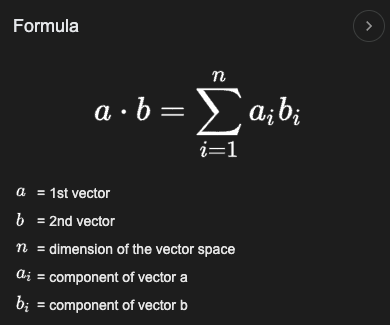
An example of Sigma being used, in a VERY popular math operation! (Literally STOLEN from Google btw!)
Again! Try to guess what this formula is being used in! Spoilers below!


$$ \large ? = \sum_{i=1}^{n} a_i b_i $$
START OF THE GRAPHICS ROADMAP, THE ORDER IS IMPORTANT & IT'S OKAY TO DEVIATE BUT NOT TOO FAR FROM EACH INDEX.
You can skip this as I list my resources in order according to many sources when it comes to learning CG
As I said previously, math is THE most important section of all graphics, Good Luck!
Learn these 3 topics > Linear Algebra, Trigonometry, C++.


First graphics project will be simple raytracing! (Basically 1 math formula, understand it!)
All resources below will cover the math & implementation, pick your poison.


IMPORTANT! THIS STEP IS SKIPPABLE BUT READ BEFORE DECIDING!
Diving directly into a GFX API while just previously writing just a raytracer is usually possible, however nothing related the the graphics pipeline & the foundations of graphics programming has been taught yet, usually at this stage if you skip that means you will be learning how the GFX Pipeline works AND a graphics specification. That is the main problem, & thats why this section exists and is heavily recommended to first learn how the graphics pipeline work because knowing this inside out will make everything easier in the future!
The point here is to teach you LITERALLY what a graphics specialization (API) is doing for you, which means you will do everything that the graphics specialization does for you in the back, this will help you understand most of the things in the future when you start & pick a graphics API to use.
This will serve as a starting point of learning what the graphics pipeline is and should be a light introduction that is fun to read for the user. I tried picking resources that I found funny and/or fun to read, before directly jumping into programming a software renderer (CPU Renderer).
Once you have a rough understanding of what goes on in the graphics pipeline it's time to try to implement one! GL!
Welcome to Hell! Pick your choice of pain!
Here you have 2 choices, I personally read from many engineers & even recruiters/interviewers that you should start with a modern graphics specification (graphics API) rather than old specifications. IMO, I think you should probably start with something easy FOR LEARNING PURPOSES & then progress to a harder graphics specification immediately!
Example of what I mean: Start with Modern OpenGL OR DirectX11 and once you are comfortable move on to either Vulkan OR DirectX12! (But if you have a death wish & unlimited free time you can just jump into Vulkan & become a gigachad GL 👑)
Important notes about some of the Graphics API:
Commonly when people see the features of GFXAPIs they just go with a crossplatform API, while that's fine it's important to also note that if you plan on targeting windows only DirectX "usually" (context is massive) outperforms cross-platform APIs, However I'm pretty sure Vulkan does have lower overhead than DX12!


Note even though this is web, WebGPU can actually run on JS/Rust/C++ etc, so choose the resource on what you enjoy programming in, if you want C++ go with Learn WebGPU, if JS/TS go with WebGPU Fundamentals!

This is the most difficult section usually as a beginner in GFX programming, take the time to have some fun with it, make fun projects, dont die out here! Watch people you enjoy do some graphics projects so you can have fun watching it & stay motivated or disciplined. Learn some things you didn't know, like Cherno covering how Bloom is implemented incorrectly in many areas! Cherno's Bloom Video where he talks about this.
So have some fun, the more you enjoy doing something the more you learn without even having to feel like you are trying. I'm writing this from experience, so take smart breaks, have fun, watch people you enjoy do things you enjoy! I listed some people I enjoy watching from time to time with their specialization within the graphics space.
Here the list will deviate, & you have to do whatever you enjoy and essentially use whatever API you used before & maybe make something for fun, or dive deeper in specific areas for example getting better at shaders (raymarching, FFT water, post processing shaders, GPU instancing etc.).


I will list each resource's main shader languague & specialization OR engine its on @ the end of the resource (GLSL/HLSL/CG/Unreal/Unity/OpenGL/DX3D/Vulkan... etc), but it should not matter! It's all translatable! Engine Choice or Graphics Specialization choice should not matter as shaders are literally just math garbage and is translatable everywhere! (yes some things are different but im talking about the big picture)
Shaders can get quite complex, but its all up to your creativity I will list a range of websites that help during all stages of shader development. I have not added specific shaders to do but I will leave that with you to explore with a few to begin with that are fun & kinda "simple" > Fresnel, Toon, Ray Marching & Shell Texturing (My shameless video plug :D).
Not really biased but I just want to say if you can understand everything in catlike coding's rendering section and the many articles from IQ (Inigo Quilez), you will master shaders easily (easier said than done lmfao GL).
Text Format
Video Format
Splash of random Unity Specific shader resources that I used in the past:
This advanced section is basically the core for end-game graphics, many people consider PBRT the end stage/industry standard & if you achieve physically based rendering and understand it properly you are in a very good place!
Extra Graphics Programming Resources In case some sections miss out on some resources, here is another post full of graphics programming resources!
Alternative really good graphics developer roadmap: https://github.com/prographon/graphics-developer-roadmap
General game programming roadmap with many additional specializations (graphics, multiplayer, etc):
Big Randy Resources (Not just Graphics) Big Randy's resources are actually pretty good too.
DirectX Tutorial Seem's a little old but still pretty good, can be subbed out for LearnDXD11, your choice.
Brian Will OpenGL Rants I personally like Brian, I think he does decent videos (some of it is really old but the concept is still valid). IMO I wouldn't follow it as a real tutorial but rather watch the video and try to understand the concept because hes explanations are whats important I feel like not the implementation as much if that makes sense.
Will probably add more stuff here, but I have to mention it's extremely important to find out what you want to do in life, specifically if it's graphics then what with graphics?
Games Industry? Positions that exist are:

Movies Industry? I don't really know/care about them, so I won't talk about it here. But I heard there are opportunities over there also for graphics people.
Emoji Keys = ✔️ Completed, ⌛ In Progress, ❌ Not Started
Example of an extremely good Minecraft Sim by Danol
j-2k/GraphicsProgrammingRoadmap is a public repo on GitHub by j-2k. This roadmap's sole purpose is to remind myself/anyone of what is needed to learn in order to become a graphics engineer.
It declares the MIT license on GitHub.
Its maker has not tagged a system, so it is unknown here. Its README says what it needs.
Open "Take it" on its page: Take My Repo writes an install plan for your machine and hands it to your AI agent (Claude Code, Codex or Cursor), which asks you before each step. Take My Repo has not tested it on any machine.
Its last change on GitHub was on 2025-01-06. Take My Repo does not judge from that whether it is maintained.
An opinionated guide on how to become a professional Web/Mobile App Developer.
Nobody has reviewed it on Take My Repo yet, which says nothing about its quality.

Community-built comprehensive 2D content creation appplication for graphic design, digital art, and interactive real-time motion graphics powered by a node-based procedural graphics engine
AI Infrastructure Engineer Learning Track - Production ML infrastructure curriculum (2-4 years experience)