opencode2-telegram
Feature rich Telegram Gateway for opencode v2.
- 4
- MIT
- 8 wk ago
Repo jaygupta17/opencode2-telegram, read from GitHub 2 d ago. jaygupta17 has not joined Take My Repo.
In short
jaygupta17/opencode2-telegram is a public repo on GitHub by jaygupta17. Feature rich Telegram Gateway for opencode v2. It declares the MIT license on GitHub. It is written mainly in TypeScript, has 4 stars and last changed on 2026-09-27. Nobody has reviewed it on Take My Repo yet, which says nothing about its quality. Read from GitHub on 2026-11-19.
opencode-telegram
Your coding agent, in your pocket. An OpenCode v2 plugin that turns a Telegram DM into a full remote control for the agent running on your machine — streamed like Telegram's native AI bots, with approvals, commands, and zero open ports.
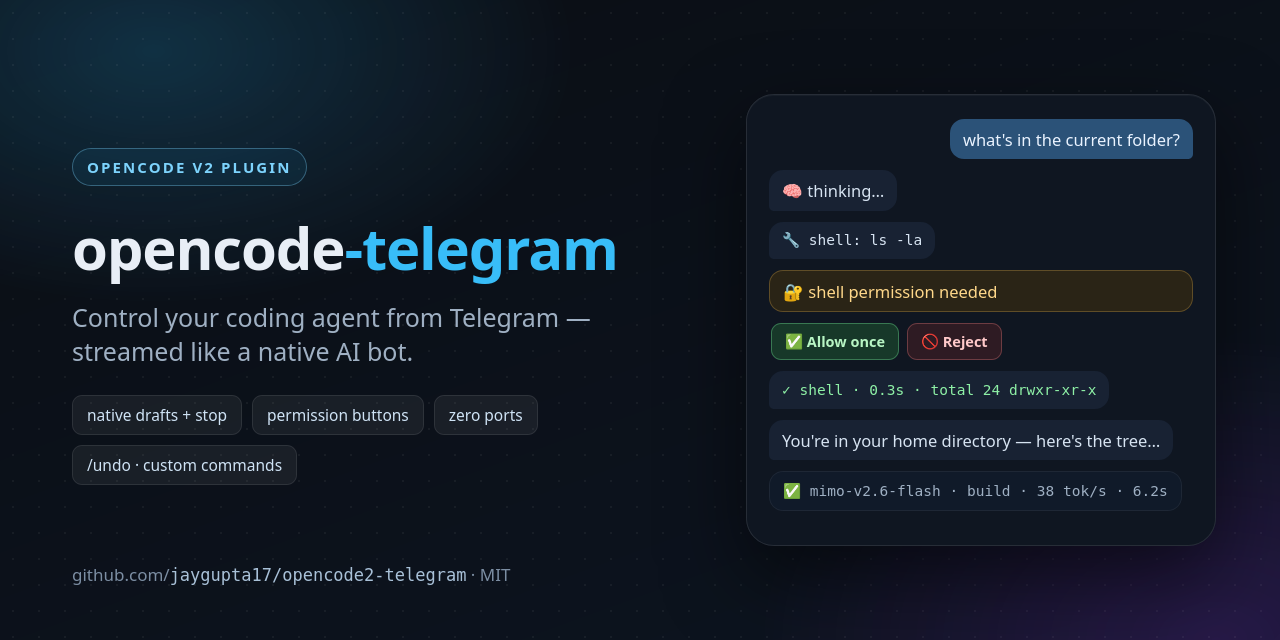
[you]  what's in the current folder?
▍       …thinking streams as a muted quote…
🔧      shell: ls -la
✓       shell · 0.3s · total 24 drwxr-xr-x …
💬      You're in your home directory — here's the tree…
✅      mimo-v2.6-flash · build · 38 tok/s · 6.2s · ctx 21.4k/128k (17%)
Why this one
- Native streaming, not message spam — output streams as an animated Telegram draft ("Thinking…" + real Stop button), then lands as final messages. Telegram built drafts for AI bots; this uses them.
- Strict block order — every block (thinking · tool call · tool result · answer) is its own message, frozen once complete. No merged walls of text, no scrambled ordering. Thinking renders as muted expandable quotes.
- Approvals from the couch — permission requests arrive as cards with Allow once / Allow always / Reject. You approve the agent's shell commands from your phone.
- Questions answered in chat — when the agent's
questiontool (or any MCP form) asks something, it renders as a Telegram card: option buttons, multi-select, ✍️ free-text answers, Submit/Cancel. The agent unblocks the moment you tap; pending questions survive plugin reloads. - The whole command surface —
/model/thinking/agentpickers,/undo(revert last turn's file changes, with confirm),/compact,/init,/sessions, plus your own command files become Telegram commands automatically. - Zero ports, zero extra RAM — runs in-process inside OpenCode, DM-only with a chat-ID allowlist, outbound long-polling only.
Install (60 seconds)
# 1. create a bot with @BotFather, copy the token, message the bot once
# 2. add the plugin
opencode plugin add github:jaygupta17/opencode2-telegram
# 3. point it at your bot in ~/.config/opencode/opencode.json → plugins[].options
Bootstrap mode: with an empty allowFrom, the bot replies to your first DM with your chat ID — paste it in and you're locked to it. Full config table below.
Features
- Native streaming drafts — text streams as an animated Telegram draft ("Thinking…" placeholder) with the built-in stop control; blocks land as real messages when complete
- Strict block model — one block = one message: thinking (expandable blockquote) · tool call · tool result (real output in an expandable quote) · text. A message is edited only while its own block streams, then frozen forever
- One-line tool summaries — tool calls render as
Edit <file> (a→b chars),Grep "pattern",Shell <cmd>— never raw JSON dumps - Render scope = your current session — only the session your chat points at streams into Telegram; sessions are never permanently glued (TUI work can't leak into your DM)
- Approvals on your phone —
🔐 permission neededcards with Allow once / Allow always / Reject (permission.reply) - Question cards — the
questiontool and MCP forms render as Telegram cards: option buttons, multi-select, ✍️ free-text input, Submit/Cancel; answers post straight back to the waiting tool call. Pending forms re-surface after a restart - Full command surface — core commands (
/new /status /stop /model /thinking /agent /history /sendfile) plus OpenCode built-ins (/init /compact /undo /sessions) and your own command files auto-exposed (~/.config/opencode/commands/*.md→/yourcommand), live-refreshed - Button pickers — model (paginated), agent, thinking variant
- Turn-end status line —
✅ model#variant · agent · 42 tok/s · 12.4s · $0.0031 · ctx 23.4k/128k (18%) - Images both ways — send photos to the agent (multimodal prompts); images referenced in answers are auto-sent, plus
/sendfile - Markdown rendering — LLM markdown → Telegram HTML (bold/italics/code blocks with syntax highlighting/blockquotes/links), entity-safe splitting past 4096 chars, automatic plain-text fallback
- Safety — DM-only, chat-ID allowlist, bootstrap mode (first message gets your chat_id), outbound-only polling (no ports), single-instance lease across opencode processes
- Ops-friendly —
/undowith confirm buttons (revert last turn's file changes), ✅ reaction on your prompt when a turn succeeds, typing indicator
Requirements
- OpenCode v2 (
@opencode/plugin2.0.x — tested against 2.0.16) - A Telegram bot token from @BotFather
- Platforms: macOS and Linux, wherever OpenCode v2 runs — the plugin uses only pid files, signals, and HTTP; no platform-specific dependencies
Install
Create a bot — talk to @BotFather →
/newbot→ copy the token. Message your new bot once (any text).Add the plugin (via GitHub, no npm needed):
opencode plugin add github:jaygupta17/opencode2-telegramor clone and point at the local directory in config.
Configure
~/.config/opencode/opencode.json:{ "plugins": [ { "package": "github:jaygupta17/opencode2-telegram", // or an absolute path "options": { "token": "<BotFather token>", // or set TELEGRAM_BOT_TOKEN "allowFrom": [] // empty = bootstrap: the bot replies with your chat_id } } ] }Restart/reload OpenCode (
systemctl --user restart opencode-servefor the serve unit). Message the bot — in bootstrap mode it replies with yourchat_id; put it intoallowFromand reload again.
Configuration reference
All options live under the plugin options object:
| Option | Default | Description |
|---|---|---|
token |
$TELEGRAM_BOT_TOKEN |
Bot token (env preferred for shared configs) |
allowFrom |
[] |
Allowed chat IDs; empty = bootstrap reply with the chat_id |
model |
opencode default | Default model for new sessions (provider/id or provider/id#variant) |
thinking |
model default | Default thinking variant for new sessions (low/medium/high/…) |
delivery |
queue |
How prompts enter a busy session (queue | steer) |
streaming |
drafts |
drafts (native animated preview + stop) or edits |
formatting |
html |
Markdown → Telegram HTML or plain |
activity |
per-action |
Tool call/result messages (per-action | off) |
showReasoning |
true |
Thinking blocks (expandable blockquotes) |
stats |
true |
Turn-end status line (model/agent/tok-s/time/cost/context) |
typing |
true |
Typing indicator while a turn runs (edits mode) |
stopButton |
true |
Stop control (inline button in edits mode, native in drafts) |
autoImages |
true |
Auto-send local images referenced in answers |
toolOutputChars |
3000 |
Max tool output shown in the expandable quote |
maxActivityMessages |
60 |
Per-turn cap on activity messages (raise it, e.g. 400, if you want full visibility on very long tool-heavy turns) |
throttleMs |
1500 |
Min ms between streamed edits of one message |
pollTimeoutSec |
30 |
Telegram long-poll timeout |
commands |
all on | { "builtins": true, "custom": true, "hidden": [] } |
localApi |
auto | { "port": 4096, "password": "…" } override for endpoints outside the plugin API (compact/undo/sessions) |
Commands
| Command | What it does |
|---|---|
/new /status /stop /history |
session control |
/model /thinking /agent |
button pickers (model · reasoning variant · agent) |
/sessions |
list & switch sessions |
/undo |
stage a revert of the last turn → Confirm/Cancel |
/init |
guided AGENTS.md setup (OpenCode built-in) |
/compact |
compact the session context |
/sendfile <path> |
send a local file to the chat |
/help |
generated command list |
/<your command> |
any file in ~/.config/opencode/commands/ — exposed automatically |
Architecture (short)
- Runs inside the OpenCode server process as a v2 plugin (zero extra RAM, no ports)
- Single-instance lease (
~/.cache/opencode-telegram/loop.lease, pid + heartbeat) so exactly one opencode process polls Telegram; offsets persist across plugin hot-reloads, the loop yields if another process takes over - Send queue per chat (250ms gap, 429/socket retry) to stay inside Telegram limits
- Endpoints outside the plugin domain (
session.compact,revert.*, session list,form.*) are reached through a local HTTP self-call with candidate discovery (local-api.ts)
Development
npm install
npm run typecheck
bash test/harness.sh both   # isolated-HOME plugin load tests (never touches a live server)
The harness spins throwaway OpenCode instances (separate HOME) and asserts plugin load/cleanup plus a plugin registry entry in both run --standalone and serve modes.
Security notes
- The bot is DM-only and rejects every chat not in
allowFrom - Polling is outbound-only — no inbound ports, no webhooks
- The bot token grants control of your agent: keep config files
chmod 600 - Prefer
TELEGRAM_BOT_TOKENin the environment over a token in config
License
MIT
Questions
What is opencode2-telegram?
jaygupta17/opencode2-telegram is a public repo on GitHub by jaygupta17. Feature rich Telegram Gateway for opencode v2.
Is opencode2-telegram open source?
It declares the MIT license on GitHub.
Does opencode2-telegram run on macOS, Windows or Linux?
Its maker has not tagged a system, so it is unknown here. Its README says what it needs.
How do I install opencode2-telegram?
Open "Take it" on its page: Take My Repo writes an install plan for your machine and hands it to your AI agent (Claude Code, Codex or Cursor), which asks you before each step. Take My Repo has not tested it on any machine.
Is opencode2-telegram still maintained?
Its last change on GitHub was on 2026-09-27. Take My Repo does not judge from that whether it is maintained.
What do people who ran opencode2-telegram say?
Nobody has reviewed it on Take My Repo yet, which says nothing about its quality.