
Lab4-FlowMatching
The maintainer has not written a description at the source.
- 3
- 13 mo ago
Repo jayin92/Lab4-FlowMatching, read from GitHub 1 min ago. jayin92 has not joined Take My Repo.
In short
jayin92/Lab4-FlowMatching is a public repo on GitHub by jayin92. It declares no license on GitHub. Public does not mean open source: without a license, nobody is granted the right to reuse it. It is written mainly in Jupyter Notebook, has 3 stars and last changed on 2025-11-15. Nobody has reviewed it on Take My Repo yet, which says nothing about its quality. Read from GitHub on 2026-11-24.
Flow Matching
NYCU: Image and Video Generation (2025 Fall)
Programming Assignment 4
Instructor: Yu-Lun Liu
TAs: Jie-Ying Lee, Ying-Huan Chen

📋 Overview
This assignment explores Flow Matching and its applications in generative modeling, consisting of 4 tasks (3 required + 1 bonus):
Grading Breakdown
| Component | Points | Description |
|---|---|---|
| Task 1 | 20 pts | 2D Flow Matching Implementation |
| Task 2 | 25 pts | Image Flow Matching with Classifier-Free Guidance |
| Task 3 | 25 pts | Rectified Flow for Faster Sampling |
| Task 4 | +10 pts | (Bonus) InstaFlow One-Step Generation |
| Report | 30 pts | Analysis, Visualizations, and Discussion |
| Total | 100 pts | + 10 pts Bonus |
📁 Project Structure
.
├── task1_2d_flow_matching/     # Task 1: 2D toy dataset visualization
├── task2_image_flow_matching/  # Task 2: Image generation with FM
├── task3_rectified_flow/       # Task 3: Rectified Flow implementation
├── task4_instaflow/            # Task 4 (Bonus): One-step distillation
├── image_common/               # Shared utilities for image tasks
├── fid/                        # FID evaluation tools
└── requirements.txt            # Python dependencies
🔧 Setup
Prerequisites
- Python 3.10 (required for compatibility)
- CUDA-capable GPU (recommended)
Installation
pip install -r requirements.txt
Optional Dependencies
For Task 4 (InstaFlow):
pip install lpips # For perceptual loss📚 Recommended Reading
Understanding these papers will help you complete the assignment:
Core Papers
-
Flow Matching (Tasks 1 & 2)
- Flow Matching for Generative Modeling (Lipman et al., 2022)
- Flow Matching: Visual Introduction
-
Rectified Flow (Task 3)
-
InstaFlow (Task 4)
Background
- DDPM (Reference for diffusion models)
- Denoising Diffusion Probabilistic Models (Ho et al., 2020)
🎯 Tasks
Task 1: 2D Flow Matching (20 points)
Objective: Implement and visualize Flow Matching on 2D toy datasets.
📝 Implementation Requirements
Complete the following in task1_2d_flow_matching/:
fm.py:
- ✏️
FMScheduler.compute_psi_t()- Conditional flow ψ_t(x|x_1) - ✏️
FMScheduler.step()- Euler ODE solver - ✏️
FlowMatching.get_loss()- CFM training objective - ✏️
FlowMatching.sample()- Sampling with CFG support
network.py:
- ✏️
SimpleNet- MLP velocity network (reuse from Assignment 1)
🚀 Execution
jupyter notebook task1_2d_flow_matching/fm_tutorial.ipynb
The notebook trains the model and visualizes flow trajectories on the Swiss-roll dataset.
📊 Deliverables
- Visualizations of learned trajectories
- Chamfer Distance metrics
💯 Grading Criteria
| Chamfer Distance | Points |
|---|---|
| < 40 | 20 pts |
| 40 ≤ CD < 60 | 10 pts |
| ≥ 60 | 0 pts |
Task 2: Image Flow Matching with CFG (25 points)
Objective: Implement Flow Matching for conditional image generation on AFHQ dataset.
📝 Implementation Requirements
Complete the following in image_common/fm.py (same TODOs as Task 1, adapted for images):
- ✏️
FMScheduler.compute_psi_t()- Conditional flow for images - ✏️
FMScheduler.step()- Euler ODE solver - ✏️
FlowMatching.get_loss()- CFM training loss - ✏️
FlowMatching.sample()- Sampling with Classifier-Free Guidance
🚀 Execution
Step 1: Download Dataset
python -m image_common.dataset
Step 2: Train Flow Matching Model
python -m task2_image_flow_matching.train --use_cfg
Training Configuration:
- Batch size: 16
- Training steps: 100,000
- Learning rate: 2e-4 (with warmup: 200 steps)
- CFG dropout: 0.1
Step 3: Generate Samples
python -m image_common.sampling \
  --use_cfg \
  --ckpt_path ${CKPT_PATH} \
  --save_dir ${SAVE_DIR} \
  --num_inference_steps 20
Step 4: Evaluate FID
python -m fid.measure_fid data/afhq/eval ${SAVE_DIR}📊 Deliverables
- Training loss curves
- FID scores with varying CFG scales (e.g., 1.0, 3.0, 7.5)
- Comparison across inference steps (10, 20, 50)
- Sample visualizations
💯 Grading Criteria
| FID Score (CFG=7.5) | Points |
|---|---|
| < 30 | 25 pts |
| 30 ≤ FID < 50 | 15 pts |
| ≥ 50 | 0 pts |
Task 3: Rectified Flow (25 points)
Objective: Straighten generation trajectories through reflow procedure to enable faster sampling.
📝 Implementation Requirements
Complete the following in task3_rectified_flow/generate_reflow_data.py:
- ✏️ Generate synthetic (x_0, x_1) pairs by following the ODE trajectory of the Task 2 model
🚀 Execution
Step 1: Generate Reflow Dataset
Create synthetic training pairs using your Task 2 model:
python -m task3_rectified_flow.generate_reflow_data \
  --ckpt_path ${TASK2_CKPT_PATH} \
  --num_samples 50000 \
  --save_dir data/afhq_reflow \
  --use_cfg \
  --num_inference_steps 20
Step 2: Train Rectified Flow Model
Train on synthetic pairs (same architecture/hyperparameters as Task 2):
python -m task3_rectified_flow.train_rectified \
  --reflow_data_path data/afhq_reflow \
  --use_cfg \
  --reflow_iteration 1
Training Configuration: Same as Task 2
Step 3: Generate with Fewer Steps
Test with reduced sampling steps:
# 5 steps
python -m image_common.sampling \
  --use_cfg \
  --ckpt_path ${RECTIFIED_CKPT_PATH} \
  --save_dir results/rectified_5steps \
  --num_inference_steps 5

# 10 steps
python -m image_common.sampling \
  --use_cfg \
  --ckpt_path ${RECTIFIED_CKPT_PATH} \
  --save_dir results/rectified_10steps \
  --num_inference_steps 10
Step 4: Evaluate FID
python -m fid.measure_fid data/afhq/eval results/rectified_5steps
python -m fid.measure_fid data/afhq/eval results/rectified_10steps
📊 Deliverables
- FID scores at different inference steps (5, 10, 20)
- Comparison with Task 2 baseline (same step counts)
- Speedup analysis (wall-clock time measurements)
- Discussion: Why does rectified flow enable faster sampling?
💯 Grading Criteria
| Performance (CFG=7.5) | Points |
|---|---|
| FID < 30 with 5 steps | 25 pts |
| 30 ≤ FID < 50 with 5 or 10 steps | 15 pts |
| Otherwise | 0 pts |
Task 4 (Bonus): InstaFlow One-Step Generation (+10 points)
Objective: Distill a rectified flow model into a one-step generator.
⚠️ Important Notice
This is a challenging bonus task requiring careful tuning. Attempt only after completing Tasks 1-3.
Key Challenges:
- Mode collapse risk: One-step distillation is highly sensitive
- Hyperparameter tuning: Extensive experimentation may be needed
- Data quality: Requires large, diverse teacher-generated dataset
- Training stability: May need multiple reflow iterations (2-3) before distillation
Recommendations:
- Use high-quality 2-3x rectified flow teacher
- Generate 10K-50K diverse training samples
- Enable LPIPS loss for better perceptual quality
- Monitor for collapse (blurry/similar outputs)
- Budget sufficient time for iteration
This task tests your understanding of distillation—don't be discouraged by initial failures!
📝 Implementation Requirements
Complete the following in image_common/instaflow.py:
InstaFlowModel.get_loss() - One-step distillation objective (Eq. 6):
- ✏️ Create t=0 tensor for batch
- ✏️ Predict velocity v(x_0, 0 | class_label)
- ✏️ Compute prediction: x1_pred = x_0 + v_pred
- ✏️ Calculate L2 loss: ||x1_pred - x1||²
- ✏️ Add optional LPIPS perceptual loss
InstaFlowModel.sample() - One-step inference:
- ✏️ Initialize x_0 with noise
- ✏️ Create t=0 tensor
- ✏️ Predict velocity (CFG is "baked in" during training)
- ✏️ Generate: x_1 = x_0 + v_pred
🎓 Conceptual Overview
Two-Phase Pipeline:
Flow Matching (CFG=7.5) → 1-Rectified Flow → InstaFlow (CFG=1.5) → ONE STEP
         Phase 1: Reflow          Phase 2: Distillation
Key Design Choices:
- Different CFG scales: α₁=7.5 (quality) → α₂=1.5 (prevents over-saturation)
- CFG effect embedded in model weights during training
- Optional LPIPS improves perceptual quality
🚀 Execution
Prerequisites:
pip install lpips # Optional, for perceptual lossStep 1: Generate Distillation Data
python -m task4_instaflow.generate_instaflow_data \
  --rf1_ckpt_path results/rectified_fm_XXX/last.ckpt \
  --num_samples 50000 \
  --save_dir data/afhq_instaflow \
  --use_cfg \
  --cfg_scale 1.5 \
  --save_images
Step 2: Train InstaFlow Student
python -m task4_instaflow.train_instaflow \
  --distill_data_path data/afhq_instaflow \
  --use_cfg \
  --use_lpips \
  --train_num_steps 100000
Training Configuration:
- Batch size: 16
- Steps: 100,000
- Learning rate: 2e-4 (warmup: 200)
- Optional:
--use_lpipsflag
Step 3: Evaluate
python -m task4_instaflow.evaluate_instaflow \
  --rf1_ckpt_path results/1rf_from_ddpm-XXX/last.ckpt \
  --instaflow_ckpt_path results/instaflow-XXX/last.ckpt \
  --save_dir results/instaflow_eval
Step 4: Sample (ONE STEP!)
python -m image_common.sampling \
  --use_cfg \
  --ckpt_path results/instaflow-XXX/last.ckpt \
  --save_dir results/instaflow_samples \
  --num_inference_steps 1
Step 5: Measure FID
python -m fid.measure_fid data/afhq/eval results/instaflow_samples
📊 Deliverables
Quantitative Results:
- FID scores for all pipeline stages
- Generation speed (samples/second)
- Speedup vs baselines (1-RF: 20 steps, base FM: 50 steps)
Qualitative Analysis:
- Sample images from each stage
- Visual quality comparison
Discussion Questions:
- Why is two-phase training necessary? (Why not distill FM directly?)
- Why not use LPIPS in Phase 1 (reflow)?
- Effect of LPIPS loss on visual quality in Phase 2
- Quality-speed tradeoff analysis
- Rationale for different CFG scales (α₁=7.5 vs α₂=1.5)
💯 Grading Criteria
| FID Score (1 step) | Points |
|---|---|
| < 30 | +10 pts |
| 30 ≤ FID < 50 | +5 pts |
| ≥ 50 | 0 pts |
📄 Report Requirements (30 points)
Your report should include:
Required Sections
-
Introduction (2 pts)
- Brief overview of Flow Matching
- Assignment objectives
-
Methodology (8 pts)
- Implementation details for each task
- Key equations and algorithms
- Architecture choices
-
Experiments & Results (12 pts)
- Task 1: Trajectory visualizations, Chamfer Distance
- Task 2: Loss curves, FID vs CFG scale, inference step analysis
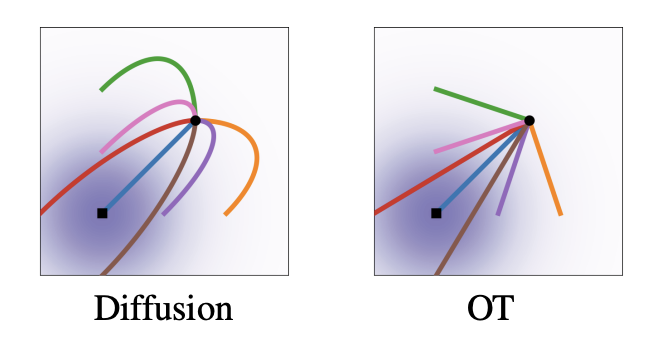
- Task 3: FID comparison, speedup analysis, trajectory straightness
- Task 4 (if attempted): Full pipeline results, ablation studies
Questions
What is Lab4-FlowMatching?
jayin92/Lab4-FlowMatching is a public repo on GitHub by jayin92. Its maker has not written a description.
Is Lab4-FlowMatching open source?
It declares no license on GitHub. Public does not mean open source: without a license, nobody is granted the right to reuse it.
Does Lab4-FlowMatching run on macOS, Windows or Linux?
Its maker has not tagged a system, so it is unknown here. Its README says what it needs.