lvgl
LVGL is a free, full-featured embedded UI library for devices from small MCUs to 3D-capable MPUs, enhanced by LVGL Pro, a professional editor and tooling.
- 25k
- C
- MIT
- 1 d ago
intro to electronics & robotics
Repo jfullstackdev/electronics-robotics-intro, read from GitHub 2 h ago. jfullstackdev has not joined Take My Repo.
jfullstackdev/electronics-robotics-intro is a public repo on GitHub by jfullstackdev. intro to electronics & robotics. It declares no license on GitHub. Public does not mean open source: without a license, nobody is granted the right to reuse it. It has 59 stars and last changed on 2024-08-03. Nobody has reviewed it on Take My Repo yet, which says nothing about its quality. Read from GitHub on 2026-11-20.
updated August 3, 2024
TOC
Electrical and electronics engineering, the branch of engineering concerned with the practical applications of electricity in all its forms, including those of the field of electronics. Electronics engineering is that branch of electrical engineering concerned with the uses of the electromagnetic spectrum and with the application of such electronic devices as integrated circuits and transistors.
In engineering practice, the distinction between electrical engineering and electronics is usually based on the comparative strength of the electric currents used. In this sense, electrical engineering is the branch dealing with “heavy current”—that is, electric light and power systems and apparatuses—whereas electronics engineering deals with such “light current” applications as telephone and radio communication, computers, radar, and automatic control systems.
source: https://www.britannica.com/technology/electrical-and-electronics-engineering
Here are some interesting points:
Microcontroller Integration:
Programming Electronic Devices:
Transition to Robotics:
Sensors and Actuators:
Applications of Robotics:
A microcontroller is a compact integrated circuit designed to govern a specific operation in an embedded system. A typical microcontroller includes a processor, memory and input/output (I/O) peripherals on a single chip.
Sometimes referred to as an embedded controller or microcontroller unit (MCU), microcontrollers are found in vehicles, robots, office machines, medical devices, mobile radio transceivers, vending machines and home appliances, among other devices. They are essentially simple miniature personal computers (PCs) designed to control small features of a larger component, without a complex front-end operating system (OS).
source: https://internetofthingsagenda.techtarget.com/definition/microcontroller
The Arduino UNO is a widely used microcontroller board designed for building digital devices and interactive objects. It features an ATmega328P microcontroller with 14 digital I/O pins (6 PWM outputs) and 6 analog inputs. Operating at 5V with a 16 MHz clock speed, it provides 32 KB flash memory, 2 KB SRAM, and 1 KB EEPROM. The board supports USB connectivity, a power jack, ICSP header, and a reset button.
The Arduino UNO is perfect for those starting with electronics and prototyping, offering a robust platform for learning and development.
image source: https://circuitdigest.com/sites/default/files/field/image/Arduino-UNO-Description.png
In electronics, a circuit is a closed path that allows electricity to flow from one point to another. It may include various electrical components, such as transistors, resistors, and capacitors, but the flow is unimpeded by a gap or break in the circuit.
source: https://techterms.com/definition/circuit
image source: https://cdn1.byjus.com/wp-content/uploads/2020/06/series-and-parallel-circuit.png
Series Circuit
a series circuit comprises a path along which the whole current flows through each component.
Parallel Circuit
a parallel circuit comprises branches so that the current divides and only part of it flows through any branch.
source: https://www.britannica.com/technology/electric-circuit#ref22644
Voltage Requirements:
Series circuits are used to achieve specific voltage drops across
components, while parallel circuits maintain consistent
voltage across all connected components.
Current Handling:
Parallel connections distribute current among multiple paths, making
them suitable for applications where multiple components need
to share the load. In contrast, series connections ensure that
the same current flows through all components.
Reliability and Redundancy:
Parallel circuits offer increased reliability and redundancy. If one
component fails, others continue to operate, which is essential for
applications needing high availability.
Design Goals:
The design choice is driven by the desired characteristics such as
stability, flexibility, and protection. It’s about meeting the
specific performance and functional requirements of the device or circuit.
open circuit - an electrical circuit that is not complete.
electric current - the rate at which electric
charge flows past a point on the electric circuit.
ground - In electronics and electrical engineering, it is
by convention, we define a point in a circuit as a reference
point. This reference point is known as ground (or GND) and
carries a voltage of 0V. Voltage measurements are relative
measurements. That is, a voltage measurement must be compared
to another point in the circuit. If it is not,
the measurement is meaningless.
source: https://www.allaboutcircuits.com/technical-articles/an-introduction-to-ground/
An earth ground is when a circuit has a physical connection to the earth, in order to sink electrons, thereby saving lives. When an electrical system has a direct connection to the earth ground (the 3-prong plug: one is positive, one is negative, one is the earth ground prong), instead of the flow of charge going to our bodies in some instances, it will go directly to earth ground.
source: http://www.learningaboutelectronics.com/Articles/Why-does-a-circuit-always-have-to-have-ground
FYI - Even though one side of the circuit is the live wire, you CANNOT simply touch it even there is no apparent neutral wire completing the circuit: you yourself is standing on the earth ground! A bird will not be shocked by landing on a live wire because it is not touching the ground, so even if there is the live wire, there is no return path completing the circuit and there is no electric shock.
source: https://www.ibiblio.org/kuphaldt/electricCircuits/DC/DC_3.html
image soure: https://www.ibiblio.org/kuphaldt/electricCircuits/DC/00056.png
hot wire (electrical term) - carries the electricity, also called live wire
terminal - is the point at which a conductor from a component, device or
network comes to an end. It is the point other components can be connected.
Voltage and amperage are two measures of electrical current or the flow of electrons.
voltage is a measure of the pressure that allows electrons to flow,
while amperage is a measure of the volume of electrons.
volt - The SI unit of electromotive force. It represents the potential
difference that would drive one ampere of current against one ohm of resistance.
ampere - The SI base unit of electrical current.
Arduino is a prototyping platform consisting of both
hardware and software. When we say prototyping,
we want to create a working model first before
we build the actual product, so that we can test
first whether our idea will work and to reduce the
cost of building the product.
TinkerCAD is an online simulator for our circuit designs. It's just like you are in a Robotics laboratory and there is the complete setup, but this time, it's just virtual. And since it is accessible through a browser, all you need is a device with a browser and an Internet connection and you are good to go: no further setup, no additional downloads.
jfullstackdev/electronics-robotics-intro is a public repo on GitHub by jfullstackdev. intro to electronics & robotics.
It declares no license on GitHub. Public does not mean open source: without a license, nobody is granted the right to reuse it.
Its maker has not tagged a system, so it is unknown here. Its README says what it needs.
Open "Take it" on its page: Take My Repo writes an install plan for your machine and hands it to your AI agent (Claude Code, Codex or Cursor), which asks you before each step. Take My Repo has not tested it on any machine.
Its last change on GitHub was on 2024-08-03. Take My Repo does not judge from that whether it is maintained.
LVGL is a free, full-featured embedded UI library for devices from small MCUs to 3D-capable MPUs, enhanced by LVGL Pro, a professional editor and tooling.
Nobody has reviewed it on Take My Repo yet, which says nothing about its quality.
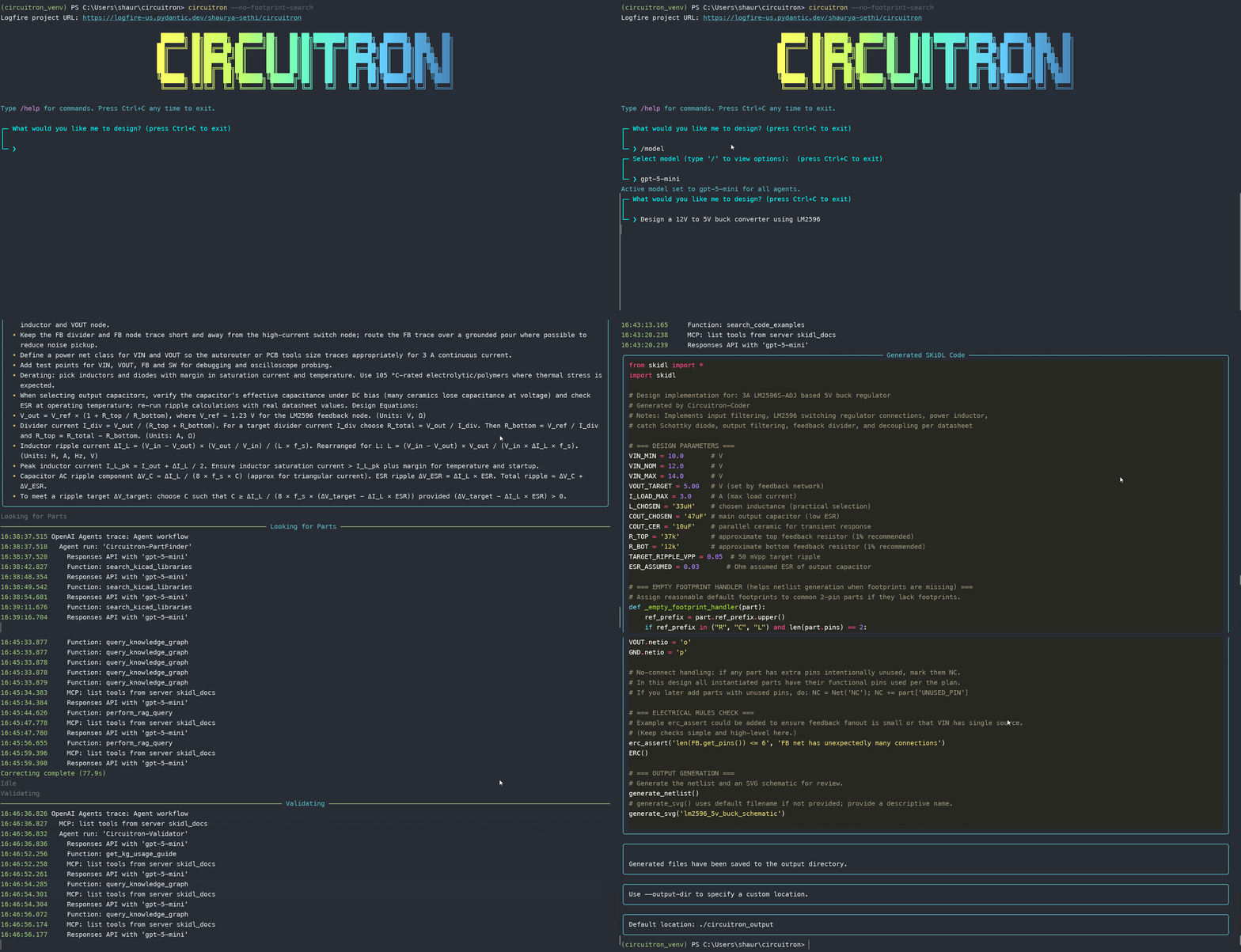
Circuitron: Agentic PCB Design Accelerator — Generate, plan, and layout circuits from natural language prompts.
A collection of (mostly) technical things every software developer should know about
:house_with_garden: Open source home automation that puts local control and privacy first.
π RuView turns commodity WiFi signals into real-time spatial intelligence, vital sign monitoring, and presence detection — all without a single pixel of video.
if you are new or you don't know this and if you just really want to get the A+ rank or higher, read this
GitHub Pages will enable you to simply turn your GitHub repo into a website
my Java projects ( with neat and testable code ), leave a star if you like it or fork a repo to collaborate