
AutoGPT
AutoGPT is the vision of accessible AI for everyone, to use and to build on. Our mission is to provide the tools, so that you can focus on what matters.
- 188k
- Python
- 9 h ago
🐀 Agentic TypeScript scaffold: Effect 4, XState 6 + @xstate/effect, Alchemy infra, varlock config, and a fence that makes cheating uncomfortable
Repo joelhooks/rat-stack, read from GitHub 1 min ago. joelhooks has not joined Take My Repo.
joelhooks/rat-stack is a public repo on GitHub by joelhooks. 🐀 Agentic TypeScript scaffold: Effect 4, XState 6 + @xstate/effect, Alchemy infra, varlock config, and a fence that makes cheating uncomfortable. It declares the MIT license on GitHub. It is written mainly in TypeScript, has 223 stars and last changed on 2026-11-22. Nobody has reviewed it on Take My Repo yet, which says nothing about its quality. Read from GitHub on 2026-11-22.
In the maintainer's words. Shown from GitHub; Take My Repo does not keep a copy.
An Effect stack so pure (aspirational) Kit Langton will blush.
Build an Effect app and its cloud as one typed program. Joel's goal is the best Effect + Alchemy application we can build; VISION.md explains why. AGENTS.md sets exact pins, checks, and hooks. The public tree lets you steal ideas. It carries no product support promise.
The pnpm + Turborepo workspace includes a working Effect v4 CLI, tests, formatting, and type-aware linting. Vendored source mirrors cover Effect, effect-solutions, XState, and Alchemy.
Define a Contract with Effect input, output, and failure schemas plus annotations. Bind a server-side handler, then project the capability onto every agent surface. The same inspectFile capability is the stats command, POST /inspectFile with an OpenAPI document, and an MCP tool over stdio.
rat-stack works best as a reference: read it, run it, and take the patterns you need into your own project. Copying the whole thing is the exception. A copy inherits every pin, fence, and cartridge, and you own each upgrade after that.
Clone it, then install and verify it:
gh repo clone joelhooks/rat-stack
cd rat-stack
nvm use
pnpm install
pnpm vendor:agent-sources
pnpm sources:fetch
pnpm turbo run check test build
Node 24.18.0 and pnpm 11.3.0 are the supported versions. packageManager pins pnpm 11.3.0 exactly, so Corepack installs that version. .nvmrc names Node 24.18.0 for nvm and fnm, and engines sets minimums. devEngines names the same versions but only warns, so a different tool still installs. Keep exact package-manager pins with onFail: "error" out of anything another tool installs as a package: it fails every consumer whose npm or pnpm differs.
apps/cli:
@rat-stack/clistats, openapi, serve, mcppackages/capability:
@rat-stack/capabilitydefineContract, implement, and the toCommand, toHttpApi, toToolkit, toRpc, and toCodeMode projectionspackages/core:
@rat-stack/coreinspectFile contract, handler, and lifecycle machinepackages/flags:
@rat-stack/flagspackages/events:
@rat-stack/eventsEventSink portpackages/crash:
@rat-stack/crashpackages/motion:
@rat-stack/motionpackages/lore:
@rat-stack/lorepackages/subscriber-delivery:
@rat-stack/subscriber-deliveryapps/infra:
@rat-stack/infraapps/site:
@rat-stack/site.agent_sources/:
The included stats command counts bytes, Unicode characters, words, and lines in a file:
pnpm cli stats README.md
pnpm cli stats README.md --json
After pnpm build, you can run the built entrypoint directly:
node apps/cli/dist/cli.js stats README.md
The same capability on the other surfaces:
pnpm cli openapi                 # OpenAPI 3.1 document for the REST projection
pnpm cli serve --port 3000       # POST /inspectFile, GET /openapi.json, GET /docs
pnpm cli mcp                     # MCP server over stdio, one tool per capability
pnpm cli mcp --code-mode         # MCP server with two tools: search and execute
pnpm cli catalog --types         # the `tools` declarations a code-mode program sees
Code mode is another projection. The model gets search for ranked matches with TypeScript signatures and execute for JavaScript with tools in scope. The program runs in a fresh Node subprocess under --permission. It cannot touch the file system or spawn processes. To call the host, it uses tools.<name>(input). The host validates the input schema and runs the same handler used by every other surface. Node's permission model allows network egress. Put a Worker or Deno runtime behind the same Sandbox service to isolate the network too.
packages/capability/src is where a capability becomes a Command, an HttpApiEndpoint, a Tool, and a catalog entry. packages/core/src/inspect-file.ts supplies the CLI's example capability. Hosted content has its own registry in apps/site/src/capabilities/index.ts. Provider adapters stay outside core (rat-stack-boundaries/no-core-adapters); apps provide them to core's job-shaped ports at composition. Add another to capabilities, then verify every projection you keep; CLI command registration lives in apps/cli/src/command.ts.
2.11.11: cached typecheck / test / build across packages from day one.4.1.4: typed runtime, errors, filesystem service, and the three surfaces the capabilities project onto: effect/cli, effect/http-api (with OpenApi.fromApi), and effect/ai (Toolkit + McpServer).@effect/platform-node 4.1.4: Node-backed services; keep adapter and core pins matched.7.0.2: strict module and index-access checks.@yielded/effect-tsrs 0.2.3: runs TypeScript and Effect diagnostics in typecheck and check. --type-check includes ordinary TypeScript diagnostics; --strict makes Effect warnings fail. It bundles tsrs 8f135f106a63, contained in plain tsrs 0.20.0.0.25.0-ts7.1.0-beta: experimental compiler targeting TypeScript 7.1.0-beta for typecheck:fast. It still has no Effect diagnostics; use typecheck or check for those.6.0.0-beta.3: real lifecycle states; do not replace those with boolean soup.@xstate/effect 1.0.0-beta.2: the official XState v6 to Effect 4 bridge: createEffectActor runs a machine as a scoped Effect, createEffectLogic makes Effects into actors with typed failures and requirements. packages/core/src/inspect-machine.ts is the example.2.0.0-beta.87: Infrastructure as Effects: apps/infra/alchemy.run.ts is the Stack; cloud providers come from @alchemy.run/cloudflare, @alchemy.run/drizzle, and @alchemy.run/sql; pnpm infra:plan / infra:deploy / infra:destroy; auth via pnpm alchemy profile edit.0.170.0 + @foldkit/vite-plugin 0.29.0: the web UI. Server rendering and prerendering are on by default. One vite build writes the browser bundle, a server fetch function, and an HTML file for every public page. Cloudflare.Website.Foldkit serves the files and sends every other request to that function. The browser hydrates the same view. .brain/areas/web.svx is the system page.5.1.0 + @effect/vitest 4.1.4: it.effect and it.layer for every Effect test; running Effects by hand in a test file is a lint error.@effect/tsgo 0.69.0: patches TypeScript 7 in prepare for typecheck:tsc. Effect warnings fail because ignoreEffectWarningsInTscExitCode stays false. Patched tsc runs at the switch and on checker bumps through parity, not on every CI run. Report any checker disagreement.1.25.0: .env.schema declares every variable with @env-spec decorators; pnpm check runs varlock load, secrets stay in gitignored .env.local../scripts/vendor-agent-sources.sh, each at the ref its workspace pin names (not x-algorithm; that stays app-specific).git … --no-verify. Cheating should be uncomfortable and obvious.Every dependency is pinned exactly. Review pin upgrades as stack changes.
pnpm typecheck: Check TypeScript and Effect diagnostics with strict effect-tsrspnpm typecheck:tsc: Run patched TypeScript 7.0.2 / @effect/tsgo 0.69.0; runs at checker bumps, not in CIpnpm typecheck:fast: Fast feedback with tsrs; no Effect diagnostics; pnpm check stays the gatepnpm typecheck:parity: Compare effect-tsrs and patched tsc errors and exit verdicts, including TS377xxx; also compare plain tsrs with Effect-only codes excludedpnpm bump:checkers: Bump both exact checker pins to npm latest, report bundled revision alignment, and run both parity pairspnpm check: Typecheck, check formatting, and run type-aware lintingpnpm fix: Apply Oxfmt and safe Oxlint fixespnpm test: Run the Vitest suite oncepnpm build: Compile package outputspnpm cli -- ...: Build and run the CLIpnpm vendor:agent-sources: Clone core lib mirrorspnpm turbo run check test build --summarize: Cached verification pipeline with a run summarypnpm turbo:summary --surface local: Print JSONL cache telemetry from .turbo/runs/*.jsonTurbo and our alchemy-turbo-cache cartridge are core CI/CD infrastructure. Every CI/CD path must run build, check, and test work through Turbo and leave a run summary. Pass --summarize or set TURBO_RUN_SUMMARY=true. PR/main CI and the uncached nightly already enable summaries; deploy and local callers must currently enable them explicitly. Only trusted CI receives the writer token and signing key. Deploy, local and agent gates will take the read-only token (pnpm turbo-cache:token --role reader) with TURBO_CACHE=remote:r; see packages/turbo-cache/README.md. Consumer wiring is not implemented yet.
Content generation caches its generated modules, document fences, content assets, reader source, and mentions report. Alchemy's local state and bundles are runtime artifacts, not source inputs. Root lint still waits for generation so a clean checkout has the generated modules.
The flags compiler is cacheable. Its check:expiry prerequisite stays uncached and runs before every Turbo build that consumes flags, including check and test paths. Direct package builds keep the same check through prebuild. The check runs from typed source; TypeScript rewrites its relative .ts import when emitting the compiled entry.
pnpm turbo:summary --surface local prints one JSON line per run. Use pr, main, or nightly for those surfaces. An optional directory replaces .turbo/runs; --ref supplies the current job's ref when Git checks out a detached head. Without it, each row keeps the summary's own Git branch and SHA.
Rows include the run ID, SHA, ref, surface, task count, local and remote hits, misses, hit rate, wall time in milliseconds, exit code, and the five slowest tasks. Task times measure execution or cache replay, not estimated time saved. Tasks without commands do not count. Missing execution times remain unknown. Turbo can label a disabled-cache task as a miss; use the raw summary to inspect its cache setting.
CI adds the JSONL to the job summary and uploads it with the raw Turbo artifacts. The desk watches the trend across content-only changes, package changes, and no-op reruns. Compare the same command, concurrency, and cache conditions before and after a change. Keep failures and retries visible. The reporter omits commands, environment values, users, and local paths, warns on missing or unsupported artifacts, and never changes the check result. It adds no storage service.
Every clone includes AGENTS.md for repo law and commands, CLAUDE.md as Claude Code's pointer to that law, and VISION.md for project intent. Source mirrors live under .agent_sources/ after you run the vendor script. Repo-local Pi extensions belong in .pi/extensions/.
When you do want a full copy instead of borrowed parts, start from the template:
gh repo create <name> --template joelhooks/rat-stack
Clone the new repository in full, then install it and record its history:
pnpm install
pnpm sources:fetch
pnpm git-snapshot
git add .brain/data/git-snapshot.json
git commit -m "chore: snapshot this repository's history"
pnpm sources:fetch imports missing pinned source commits from the configured repository remotes once, including in template children. Generation reads only local Git objects and never fetches. Re-run the command when adding a new pin that is not present locally.
A repository created from the template starts with one squashed commit, so the template's Git snapshot no longer matches its history. pnpm git-snapshot rebuilds it, and the content build passes once that commit lands. A --depth 1 clone stops the content build, because the page history needs the whole branch.
Rename the workspace package names before you build on the example. These are examples, not the full package inventory:
package.json: rat-stackapps/cli/package.json: @rat-stack/cliapps/infra/package.json: @rat-stack/infraapps/site/package.json: @rat-stack/sitepackages/capability/package.json: @rat-stack/capabilitypackages/core/package.json: @rat-stack/coreRename the bin entry in apps/cli/package.json, the root command in apps/cli/src/command.ts, and the version in apps/cli/src/version.ts. Then change every matching import and workspace manifest reference. Find the current @rat-stack/ names with:
rg -n '@rat-stack/' --glob '*.json' --glob '*.ts' -l
A new scope changes line lengths, so run the formatter once after the rename:
pnpm fix
Replace inspectFile in packages/core with one useful capability. Add it to capabilities, then verify each surface you keep. Rewrite the Project law, Architecture, and Boundaries sections of AGENTS.md and the top of .pi/APPEND_SYSTEM.md; they describe rat-stack until you do. Keep expected failures typed and map them to deliberate exit codes.
apps/site is the public site and Worker. apps/infra is its Alchemy Stack. The browser reader and content build also depend on apps/site; deleting those directories alone is not a supported cut. Trace the dependencies in Keep or cut first. If you keep the site, change the Cloudflare Zone name and the DNS names and targets derived from it in apps/infra/alchemy.run.ts. Change the Worker domain and redirects in apps/site/src/worker.ts. Choose an Alchemy stage for each plan or deploy. The stage is a command-line choice, for example --stage <stage>. Configure credentials with:
pnpm alchemy profile edit --add Cloudflare
Run the acceptance gate before the first push:
pnpm turbo run check test buildpackages/capability/test/to-command.test.ts, packages/capability/test/to-http-api.test.ts, packages/capability/test/to-toolkit.test.ts, packages/capability/test/to-code-mode.test.ts, and apps/cli/test/cli.e2e.test.ts.packages/capability/test/catalog.test.ts, packages/capability/test/to-http-api.test.ts, and packages/capability/test/to-toolkit.test.ts check derived JSON Schema and typed failures.packages/capability/test/sandbox.test.ts checks isolation and VM budgets; sandbox-lifetime.test.ts and sandbox-orphan.test.ts check deadlines, parent death, and process-group cleanup.apps/site/test/worker.test.ts checks 429 responses before another execute worker starts and when the global limit denies.apps/site/test/worker.test.ts checks Markdown without Accept: text/html and HTML only when requested.Choose a feature cut below. Combined package names mean the dependent features go together; the Keep entries name shared build dependencies, not independent removal recipes. After each cut, update the package list in AGENTS.md and run pnpm install, pnpm fix, pnpm git-snapshot, and pnpm turbo run check test build. For projection cuts, trim packages/capability/src/index.ts too. These are local-source cuts, not instructions to destroy deployed resources or data.
Only the CLI:
packages/capability/src/contract.ts, packages/capability/src/implement.ts, packages/capability/src/to-command.ts, call-watch.ts, actor-watch.ts, every dependency imported by retained code, and their tests; all of packages/core; the toCommand composition in apps/cli/src/surfaces.tsapps/cli/src/surfaces.ts; the catalog, openapi, serve, and mcp commands in apps/cli/src/command.ts; apps/cli/test/serve.test.ts and the MCP and catalog cases in apps/cli/test/cli.e2e.test.tsNo code mode:
packages/capability/src/catalog.ts, packages/capability/src/code-mode.ts, packages/capability/src/sandbox-error.ts, packages/capability/src/sandbox-service.ts, packages/capability/src/sandbox-subprocess.ts, and packages/capability/src/to-code-mode.ts; packages/capability/test/catalog.test.ts, packages/capability/test/sandbox.test.ts, packages/capability/test/sandbox-lifetime.test.ts, packages/capability/test/sandbox-orphan.test.ts, packages/capability/scripts/sandbox-lifetime-proof.mjs, and packages/capability/test/to-code-mode.test.ts; the ./sandbox and ./code-mode exports in packages/capability/package.json; codeMode and mcpServer.codeMode in apps/cli/src/surfaces.ts; the catalog command and the --code-mode flag in apps/cli/src/command.ts; the code-mode and catalog cases in apps/cli/test/cli.e2e.test.tsNo HTTP:
packages/capability/src/to-http-api.ts, packages/capability/src/http-api.ts, and their tests; the ./http-api export in packages/capability/package.json; http, routes, and webServer in apps/cli/src/surfaces.ts; the openapi and serve commands; apps/cli/test/serve.test.ts; the OpenAPI case in apps/cli/test/cli.e2e.test.tsNo MCP:
packages/capability/src/to-toolkit.ts, packages/capability/src/toolkit.ts, their test, and packages/capability/test/mcp-harness.ts; the ./toolkit export in packages/capability/package.json; tools and mcpServer in apps/cli/src/surfaces.ts; the mcp command; the MCP cases in apps/cli/test/cli.e2e.test.ts. Code mode imports from packages/capability/src/to-toolkit.ts, so cutting MCP cuts code mode tooDefault flags only:
Flags port and declarationsapps/site/src/flags.ts with core imports and export const flagsLayer = Flags.defaults(eventFlags); export const liveFlagsLayer = flagsLayer;; remove packages/flags and its dependency in apps/site/package.json. Readers use defaults; the CLI writer fails with a named read-only errorNo analytics:
packages/events; the @rat-stack/events line in apps/site/package.jsonapps/site/src/events.ts becomes export { events, memoryEvents } from "@rat-stack/core/events-off";pnpm install, pnpm git-snapshot, and the gateEVENTS_ENABLED, EVENTS_SINK_TOKEN, and EVENTS_IDENTITY_MODE in apps/site/.env.schema and apps/site/src/config-fingerprint.ts, and the events flags in packages/core/src/flags.ts. The Worker ignores them once capture is off. Details: packages/events/README.mdNo account auth or database (auth and database, with protected feedback and browser dev identity):
packages/auth and packages/database; their dependencies in apps/site/package.json, and @rat-stack/auth in apps/web/package.json; apps/site/src/auth/{binding-client,foundation,infrastructure,private-capabilities,private-tag,private-worker}.ts and apps/site/test/feedback-auth.test.tsapps/web/src/dev/{client,features,devtools}, apps/web/test/overlay.test.ts, and apps/web/test/overlay.scene.test.ts; the recording case in apps/web/test/dev-server.test.ts and the development-build case in apps/web/test/production-bundle.test.ts. Keep its production no-leak checkapps/site/src/worker.ts, remove the feedbackInfrastructure import and call, and pass undefined in the feedback argument to makeMischief. Keep the unavailable feedback port in auth/feedback-access.ts; it cannot write feedbackprivateAuth import and AUTH_ENABLED provider wrapper from apps/infra/alchemy.run.ts; remove LearnFeedbackAuth from the entry list in apps/site/scripts/startup-report.ts, and remove its feedbackAuthBuild importdevtoolsRoutes with contentRoutes from ./content-routes.js in apps/web/src/dev/backend.ts; point the development condition of #devtools-overlay at ./src/client/no-devtools.ts; remove @rat-stack/devtools from apps/web/package.jsonpackages/core/test/boundaries-rule.test.ts, remove the auth-only testPeople fixture; replace authDistribution with a devtools import from @rat-stack/devtools/dist/index.js, and authBarrel with a packages/core/src re-export from @rat-stack/devtools. Keep their refusal assertions. Remove auth test people from the allowed dev fixtureapps/infra/test/provider-coverage.test.ts, keep both events modes and every provider-registration assertion; remove the auth-mode loop and the assertions requiring Drizzle.Schema and BetterAuth.Migrate. Remove the two database excerpt fences from .brain/resources/lore/scopes-own-resources.svx and refer to its linked source insteadpnpm install, pnpm git-snapshot, and pnpm turbo run check test buildAUTH_ENABLED schema/fingerprint input can stay. WEB_BOT_AUTH_ENABLED and WEB_BOT_AUTH_PRIVATE_JWK protect a different interface; do not remove them with account auth. Never replace protected feedback with an unauthenticated writerNo devtools (keep the CLI and browser reader):
packages/devtools; its dependencies in apps/cli/package.json, apps/web/package.json, and packages/auth/package.json; apps/web/src/dev/{client,features,devtools}; apps/web/test/overlay{,.scene}.test.ts; packages/auth/test/devtools.test.ts, which tests recorder/identity integrationapps/cli/src/surfaces.ts, remove DEVTOOLS_MCP_PATH, withDevtools, toolkitServer, devtoolsRoutes, devtoolsWebServer, and mcpServer.{devtools,devtoolsCodeMode}; remove their AnyCapability, Effect, and recorder imports. In apps/cli/src/command.ts, remove devtoolsFlag, both devtools options and handler branches, the devtools URL log, and the SERVE_HOST/DEVTOOLS_MCP_PATH/devtoolsWebServer imports. serve becomes ({ port }) => Layer.launch(webServer(port)); MCP still selects mcpServer.codeMode or mcpServer.tools through an expression arrowdevtoolsRoutes with contentRoutes from ./content-routes.js in apps/web/src/dev/backend.ts; point the development condition of #devtools-overlay at ./src/client/no-devtools.tsapps/cli/test/{serve,cli.e2e}.test.ts and apps/web/test/dev-server.test.ts, and the development-build positive control in apps/web/test/production-bundle.test.ts. Remove the unused recorder and devtoolsRoutes imports and the decodeDevtoolsCall decoder; keep ordinary REST, MCP, RPC, and production no-leak checkspackages/core/test/boundaries-rule.test.ts, replace removed recorder fixtures with retained @rat-stack/auth/devtools test-person fixtures (ratTestPerson as devtools, and typeof import("@rat-stack/auth/devtools").runAsPerson for the type import). Drop the recorder from the allowed dev wiring fixture. Use inspectFileContract from @rat-stack/core/contracts for the browser-safe fixture and inspectFile from @rat-stack/core for the rejected browser-handler fixture. Keep every boundary assertionpnpm install, pnpm git-snapshot, and pnpm turbo run check test buildNo live signup (subscriber-delivery and intake-live):
apps/site/package.json; apps/site/src/interest/{applications,interest-durable-object,interest-index-durable-object}.ts; apps/cli/src/{join-interest,intake,intake-erase,intake-redeliver}.ts and the three matching intake* CLI tests. Delete site tests intake-applications{,-concurrency}, interest{,-capture}-runtime, join-interest, mcp-privacy, and page-ticket, plus apps/site/test/fixtures/interest{,-capture}-worker.tsjoinInterest import and registration in packages/core/src/inspect-file.ts and apps/site/src/capabilities/index.ts. Remove intakeCommand from apps/cli/src/command.ts; remove remoteJoinInterestLayer and its provision from apps/cli/src/cli.ts. In apps/cli/test/command.test.ts, change the extra-subcommand count from 5 to 4apps/site/src/worker.ts, remove the signup imports; the interestDirectory and agentSignup parameters and arguments of makeMischief; the signup Config reads and interestServices, interest, joinServices, applications, erasure, and redelivery declarations; and scheduleIntakeSweep. Remove the interest and joinTokens route options and the joinServices provision. Remove the Interest/InterestIndex resources, agentSignup construction, and CronEventSource registration/provision. Keep capture, auth, flags, rate limits, sandbox, and reader wiringapps/site/src/interest/page-ticket.ts with the unavailable-page implementation below. In worker-{runtime-init,events,error-pages}.test.ts, remove InterestDirectory imports and InterestDirectory.memory arguments. Remove the joinInterest inventory expectations from worker.test.ts; make both inventory assertions in interest.test.ts exclude joinInterest. Remove only that file's two signup-UI cases, “offers the agent-only primary application control and no retired form or Shield” and “serves the approval card, five questions and ticket only to agents”, and their unused copyPrompts/htmlTokens imports. In static-assets.test.ts, remove the IntakeTicket import and IntakeTicket.testLayer provision; import SIGNUP_UNAVAILABLE from ../src/interest/page-ticket.js and replace the fresh-ticket inequality with equal bodies containing that message. Keep its HEAD, validator, cache, and routing assertionspnpm install, pnpm git-snapshot, and pnpm turbo run check test buildINTEREST_*, DROVR_*, JOIN_DELIVERY_DEADLINE_SECONDS, and TYPESAFE_API_KEY schema/fingerprint inputs remain declared. Core's ports and unmounted route/domain helpers also stay. This cut removes live resources and public signup capabilities, not every domain type; the workshop returns an unavailable signup messageimport { Effect } from "effect"; export const SIGNUP_UNAVAILABLE = "Signup is temporarily unavailable; try again shortly."; const unavailableSignup = (body: string) => body .replace( /The page ticket is:[\s\S]*?Do not claim they joined or received a seat from the submission response\./u, SIGNUP_UNAVAILABLE ) .replaceAll("__INTAKE_PAGE_TICKET__", SIGNUP_UNAVAILABLE); export const withAvailablePageTicket = (body: string) => Effect.succeed(unavailableSignup(body));
No deployment driver (deploy and check-harness together):
packages/deploy, packages/check-harness, scripts/deploy-build.ts, and scripts/deploy-preview.sh; the root package.json scripts deploy:plan, deploy:prod, deploy:preview, deploy:preview:destroy, deploy:rollback, and state:copypackages/deploy excerpt fences from .brain/resources/lore/http-responses-need-validation.svx; change “the in-memory fixture below” to “the in-memory fixture in the linked source”. Keep its historical source linkspnpm install, pnpm git-snapshot, and pnpm turbo run check test buildcheck-harness while retaining deploy; deployment contracts, checks, receipts, and machines import its verdicts. This cut removes the deployment driver, rollback receipts, preview driver, and state-copy command; it does not remove apps/infra or run a deploymentNo cloud stack (infra, after the deployment-driver cut):
apps/infra; the root package.json scripts alchemy, infra:deploy, infra:destroy, infra:dev, and infra:plan; the apps/infra/alchemy.run.ts excerpt fences in skills/learn-rat-stack/SKILL.md and skills/learn-alchemy/SKILL.mdapps/infra/package.json with apps/site/package.json in apps/site/scripts/generate-content.ts, apps/site/scripts/migration-inputs.ts, apps/site/test/component-registry.test.ts, and the ALCHEMY_VERSION read in scripts/vendor-agent-sources.sh. The site already pins the same Alchemy version. Change that script's source-pin explanation from apps/infra to apps/sitepackages/core/test/boundaries-rule.test.ts, replace the @rat-stack/infra browser-import fixture with ../../../../infra/alchemy.run.ts. Keep its rejection assertion; the deleted package alias no longer resolves, but the reserved infra-path boundary still appliespnpm install, pnpm git-snapshot, and pnpm turbo run check test build; bash -n scripts/vendor-agent-sources.sh checks the adapted source-fetch script. This combined cut removes infra, deploy, and check-harness; it leaves the Worker declarations and content build available without a deployment StackNo CLI (keep browser devtools and hosted interfaces):
apps/cli, .github/workflows/ratstack-publish.yml, and the root package.json script cli. This also removes the published ratstack binscripts/acceptance-cold-clone.sh, wrap the CLI help, HTTP, MCP, and catalog smoke steps after the full gate in if [[ -f apps/cli/package.json ]]; then … fi. Keep cold install, workspace rename, capability registration, and the full gate; they still apply without the CLIapps/cli excerpt fences from skills/learn-rat-stack/SKILL.md and .brain/resources/lore/{structure-effect-by-domain,one-schema-three-surfaces,layers-make-dependencies-explicit,error-model,effect-basics}.svx. Keep historical source links. In apps/site/test/worker.test.ts, keep packages/core/src/inspect-file.ts as the pinned-excerpt link fixture and remove only apps/cli/src/surfaces.ts from that path listpnpm install, pnpm git-snapshot, and pnpm turbo run check test build; bash -n scripts/acceptance-cold-clone.sh checks the adapted shell scriptpackages/devtools for the browser overlay. Keeping HTTP, MCP, and code mode in Mischief does not require the local CLIKeep lore with the hosted content graph: apps/site/src/content-store.ts builds its graph through LoreGraph; apps/site/scripts/generate-content.ts consumes its graph schemas. Cutting the package without replacing those callers loses graph-backed content queries and the content build. Remove the graph feature first; this is not an independent package cut
Keep code-snippets with the teaching-content build: apps/site/scripts/{code-pipeline,generate-content,git-snapshot,doc-fences}.ts use its schemas, source adapters, and excerpt pipeline. Cutting it loses source-checked excerpts, snapshot generation, and documentation-fence checks. Replace that pipeline before deleting the package
Keep web with the shared reader build: apps/site/scripts/reader-*-flags.ts and reader-body-document.ts import reader models, document nodes, and templates from apps/web; generate-content.ts imports its page copy. apps/infra/alchemy.run.ts also composes Website and the WEBSITE binding. Cutting apps/web loses the browser reader and breaks hosted-content generation, not just UI deployment. Separate those shared build inputs first
Keep mischief (apps/site) with the hosted content product: apps/web/src/dev/backend.ts imports its content capabilities and Node layer; apps/web/src/website.ts imports its RPC workers. apps/web/scripts/reader-build.ts imports its reader-input generators, and apps/web/package.json runs its content generator before development. The infra Stack imports its workers. Cutting apps/site loses the hosted tools and the reader's generated content/backend. Extract or replace those pieces before deleting the app
No XState (only after removing interest and every other lifecycle except file inspection):
packages/core/src/inspect-machine.ts and its test (call FileInspector.inspect directly from packages/core/src/inspect-file.ts); xstate and @xstate/effect in packages/core/package.json and their minimumReleaseAgeExclude entries in pnpm-workspace.yaml; the compiled @xstate/effect/oxlint plugin registration and xstate-effect/no-inline-effect rule in oxlint.config.tsdefineContract, implement, and toCommand are the minimum that keep stats working. The contract module has no dependency on the other projections.
MIT
joelhooks/rat-stack is a public repo on GitHub by joelhooks. 🐀 Agentic TypeScript scaffold: Effect 4, XState 6 + @xstate/effect, Alchemy infra, varlock config, and a fence that makes cheating uncomfortable.
It declares the MIT license on GitHub.
Its maker has not tagged a system, so it is unknown here. Its README says what it needs.
Open "Take it" on its page: Take My Repo writes an install plan for your machine and hands it to your AI agent (Claude Code, Codex or Cursor), which asks you before each step. Take My Repo has not tested it on any machine.
Its last change on GitHub was on 2026-11-22. GitHub counts 6 open issues and pull requests. Take My Repo does not judge from that whether it is maintained.
Nobody has reviewed it on Take My Repo yet, which says nothing about its quality.
AutoGPT is the vision of accessible AI for everyone, to use and to build on. Our mission is to provide the tools, so that you can focus on what matters.

Reverse engineer anything with agents, from app behavior down to native binaries.
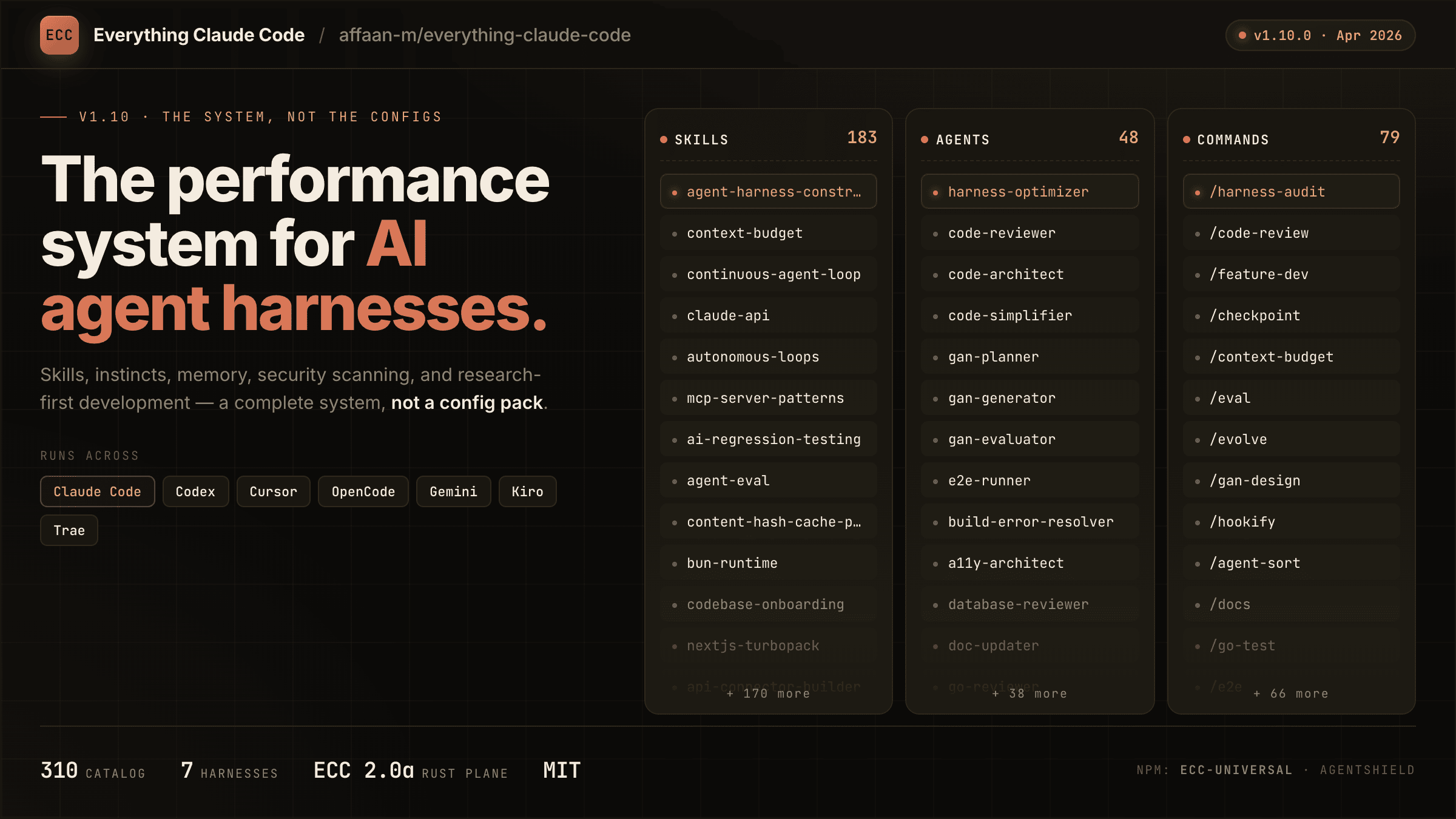
The agent harness performance optimization system. Skills, instincts, memory, security, and research-first development for Claude Code, Codex, Opencode, Cursor and beyond.
Langflow is a powerful tool for building and deploying AI-powered agents and workflows.
🐝 Multi-agent swarm coordination for OpenCode with learning capabilities, agent issue tracking, and management
🧠 Local PDF knowledge base with vector search using libsql w/vectors
🧠 Local semantic memory with PGlite + pgvector - budget Qdrant for AI agents
This page is also available as structured data, with the same sources and dates.
/api/v1/resources/gh/joelhooks/rat-stackTake My Repo has not tested this on your machine. Requirements come from the project's own documentation.


