
margin
A local, open-source workspace for legal document review, Word revisions and LaTeX typesetting.
- 0
- MIT
- 7 wk ago
Repo jonashertner/margin, read from GitHub 13 min ago. jonashertner has not joined Take My Repo.
In short
jonashertner/margin is a public repo on GitHub by jonashertner. A local, open-source workspace for legal document review, Word revisions and LaTeX typesetting. It declares the MIT license on GitHub. It is written mainly in JavaScript, has 0 stars and last changed on 2026-10-09. Nobody has reviewed it on Take My Repo yet, which says nothing about its quality. Read from GitHub on 2026-11-24.
Margin
A local workspace for reading, revising and comparing legal documents.
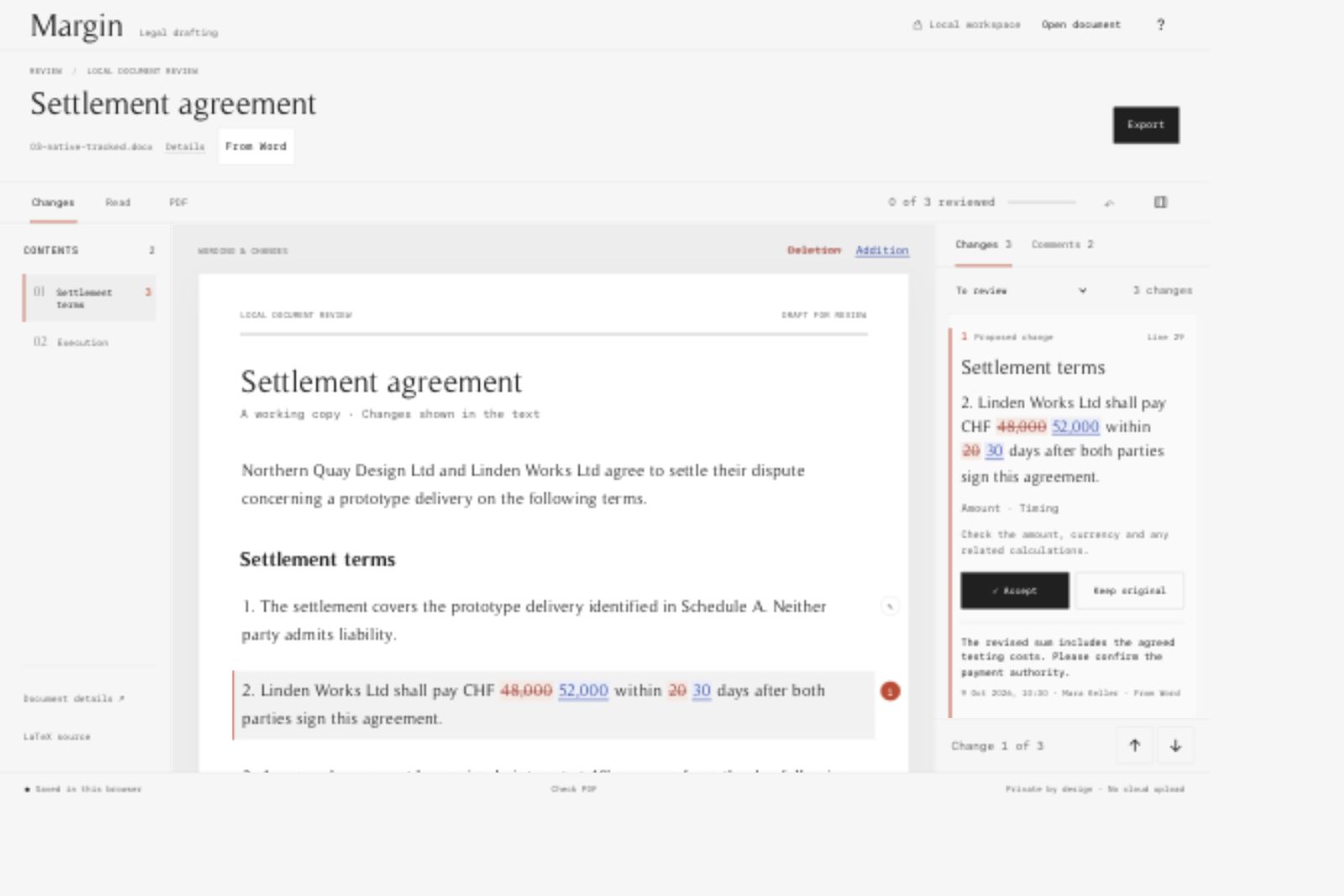
Open Word, LaTeX or plain text. Read changes in their paragraph, keep or accept the proposed wording, and carry comments into an editable Word document or a typeset PDF. LaTeX supplies the document source and PDF typesetting behind the reading interface.
Margin is an early, single-user prototype. Its document checks use fictional fixtures. Ease of use comparable to Word is a design objective, not a measured claim, and conversion is deliberately conservative where content cannot be preserved safely.
Start locally
Requirements: Node.js 22 or newer. The source-review interface can run without the optional conversion tools.
npm ci
npm start
Open http://127.0.0.1:4317. Keep the terminal open. On macOS, Start Margin.command is also available after dependencies are installed.
Word and PDF conversion on macOS
Conversion requires macOS sandbox-exec. There is no Linux or Windows conversion sandbox yet; unsupported platforms keep the source-review interface available and report conversion as unavailable.
Install Python 3.11 or newer, Pandoc 3.9 or newer, and Poppler (pdftoppm). Install MacTeX or a TeX Live distribution with XeLaTeX for PDF output. The generated document templates use fontspec, TeX Gyre Pagella, geometry, parskip, hyperref, longtable, booktabs, array, calc and multirow; redlines additionally need the packages requested by latexdiff, including ulem and xcolor. A full MacTeX installation supplies these.
Create the local Python environment:
python3 -m venv .venv
.venv/bin/python -m pip install -r requirements.txt
npm start
Margin discovers the project .venv, tools on PATH, standard Homebrew locations and MacTeX's /Library/TeX/texbin. These optional environment variables select trusted installations:
| Variable | Purpose |
|---|---|
MARGIN_WORD_PYTHON |
Python interpreter with lxml for Word conversion |
MARGIN_PYTHON |
Python interpreter with pypdf for PDF cleanup; also the default Word interpreter |
MARGIN_PANDOC |
Pandoc executable |
MARGIN_XELATEX |
XeLaTeX executable |
MARGIN_TEX_ROOT |
TeX Live installation root, if it is not discoverable from XeLaTeX |
MARGIN_PDFTOPPM |
PDF page renderer |
MARGIN_DATA_DIR |
Private original-file directory; defaults to .margin-data |
PORT |
Local HTTP port; defaults to 4317 |
The earlier FOLIO_* environment variable names remain accepted. Explicit paths take precedence over discovery. Python virtual-environment and XeLaTeX invocation paths are preserved rather than replaced with their symlink targets. The sandbox grants read access to the selected toolchain's dependency directories; unusual installations may require additional, narrowly scoped configuration.
Use Margin inside Word
Margin can also run as a Word task pane. Native review uses Word’s own tracked changes: show a revision in the document, accept or reject it, and reverse a decision with Word’s Undo. The pane covers the main text; Word remains the editor and the place to inspect other document areas.
npm run word:setup
npm run word:setup -- sideload
npm run word:start
A trusted localhost certificate is required. The status command reports whether one exists; certificate installation is an explicit separate step. Follow the Word add-in setup guide. This is a development installation, not yet a one-click consumer installer or Marketplace listing.
Open in Margin prepares a separate local snapshot of the open Word document and links to the browser workspace. It includes unsaved wording as exposed by Word, expires after five minutes if unopened, and does not live-sync the two documents. Existing browser reviews remain in the HTTP workspace. Native macOS Word checks have verified selection, acceptance, rejection, Undo and refusal of a stale decision against a fictional agreement; the snapshot handoff retained its two comments, revisions and footnote. This is bounded host verification, not general compatibility certification.
Working with a document
- Open document accepts one
.docxup to 4 MB, a standalone UTF-8.texfile up to 300 KB, or plain text up to 150 KB. Plain text is escaped into LaTeX. LaTeX imports retain their original source text, including BOM and line endings. - Compare versions accepts two clean Word or LaTeX documents. Open a Word file with existing tracked changes on its own first: those changes become decisions to review, rather than being silently accepted.
- Accept and Keep original apply to a balanced passage or clause. Several word edits within a paragraph can share one decision. Completed decisions can be reopened.
- Edit wording supports plain paragraphs and simple numbered clauses produced by Word import. It preserves source wrappers, other decisions and comment context. Formatted, footnoted, nested or otherwise unsupported passages remain read-only in this editor.
- Read shows the current wording, including pending proposals. PDF shows the compiled pages. Exact LaTeX is available from document details.
- Comments on changed and unchanged passages stay visible. Imported comments retain supplied authors and dates. Add a response without replacing the received comment.
- Use J/K to navigate, A/R to accept or keep original, N to comment, and ⌘Z / Ctrl+Z to undo a local decision, comment or wording edit.
The active review is saved in the browser. Opening another document keeps the previous one under Recent reviews. Save review creates a portable .margin.json file with sources, decisions, comments, conversion information and preserved original Word bytes. Earlier .folio.json review files remain readable. Browser storage is not a backup. If another tab changes the saved review, Margin pauses saving in the older tab so it cannot overwrite the newer work. Its in-memory review remains readable and can be saved as a portable file before reloading.
Context for people and other tools
For the next reader, available in Document details, holds an optional purpose, unresolved questions and next step. Comments keep clause-specific discussion beside the wording. The note travels with the saved review. Accepting wording is not a legal approval or authority to sign, send or act.
The export dialog also offers a versioned structured review record (.margin-record.json). It includes exact original/proposed LaTeX, source hashes, stable passage IDs, UTF-16 source offsets, wording decisions, comments, context, conversion limits and unauthenticated event history. Reading text is labelled as a simplified representation; exact source remains available. The read-only read_margin_review WebMCP tool exposes the same record in supporting browsers. There is no agent-facing decision or approval tool. This JSON is an inspection/interchange record; use .margin.json to resume a review, including its original Word binaries.
Export
Both Reviewed document and Redline of your review require every change to be decided. Each offers Word and PDF. The redline compares the same reviewed wording with the original.
Word redlines contain actual native Word revisions, attributed to Margin as a newly generated comparison. Incoming revision authors and dates remain in the original and conversion record. A clean Word document applies revision decisions and can still contain comments. Comment export is blocked when an anchor would be missing or ambiguous. Reviewed LaTeX source and a PDF redline of the complete incoming proposal are also available.
Preservation and limits
Margin saves imported Word bytes separately, verifies their SHA-256 hashes, and offers Save original in document details. It does not modify the source file. Conversions and exports use temporary copies.
Supported text, native numbering, footnotes, revision endpoints and comment provenance are preserved. The conversion screen provides notices and a wording comparison. Word output uses a consistent legal layout; original pagination, headers, typography and section layout are not reproduced. A comment may be attached to its containing paragraph instead of its original character range, with a notice. Mixed clause decisions can require a numbering check.
Known unsupported content receives specific notices, including text boxes, images, fields, content controls, headers, formatting revisions and tracked table rows. Field results can become plain text. Unanchored comments remain in the original and conversion record. Word export rejects unsupported LaTeX instead of silently dropping it and verifies the generated paragraph, numbering and footnote endpoints. These checks are bounded; they do not establish general Word round-trip fidelity.
The reading view simplifies LaTeX. Use the exact source and compiled PDF to inspect typography, maths, references and macro expansion. Multi-file LaTeX projects, bibliographies, graphics, private fonts and custom classes are not imported. Amount, timing and obligation tags are prompts for human review, not legal analysis.
Margin does not provide simultaneous editing, authenticated reviewer identities, formal approval, signing, sending or filing. The JSON review record is not a tamper-proof legal audit trail. Read SECURITY.md before using it with sensitive documents.
What “better” would have to mean
Margin aims to make a bounded review easier to understand and hand over. It does not claim to replace Word’s document fidelity, collaboration or editing coverage. Word already provides tracked changes, comments and legal blackline comparison. A local review package, an inspectable record for other tools and the LaTeX/PDF route are Margin’s current distinctions. Local processing alone is not unique to Margin.
The design follows the emphasis on understanding, explanation, challenge and correction in Rule & Reason, Book 1. The test is whether people miss fewer material changes, can explain their decisions, recover from mistakes and give the next reader a useful record. Speed and visual preference are secondary to correctness and comprehension.
Before claiming superior usability, compare Word alone, Word with Margin, and the local web app using matched fictional agreements and both lawyers and occasional reviewers. Include changed amounts and footnotes, repeated clauses, external edits, undo, a handover and clean/redline exports. Measure material omissions, unaided completion, understanding, correction/checking effort and total time including installation. Current automated fixtures do not establish those human outcomes. One-click installation, wider document coverage and an independent usability pilot remain release work.
LaTeX and machine access
LaTeX is a useful plain-text source and typesetting route, but its syntax is not itself legal meaning. DOCX also has an open, structured XML representation, including comments, footnotes and revision markup. Both formats need bounded parsing, source preservation and validation. Pandoc explicitly warns that format conversion can be lossy.
The current web prototype uses LaTeX as its central representation. The Word pane deliberately reviews native revisions without converting them. A future format-neutral document model would need stable clause identities, definitions, references, footnotes, provenance and preserved unsupported native content, with readable text and narrow proposed edits exposed to tools. That model is a development direction, not a capability claimed by this release. LaTeX would remain a supported source and output format.
Design and fonts
The interface uses a restrained monochrome palette, a document-first layout and a serif reading surface. Paper Mono is bundled for compact controls and technical detail under SIL Open Font License 1.1. Timeless Regular and Bold may be installed through your operating system’s font manager as an optional serif face; those binaries are not redistributed here. Without them, the interface uses Times New Roman or the platform serif font. See font setup.
Development
npm run check
npm test
npm test runs the platform-independent source, authoring, reading and local API checks. With the macOS Word dependencies installed:
npm run test:word
.venv/bin/python test/test_word_engine.py
The Node Word suite exercises the real sandbox, preserved originals, portable restoration, comments, revisions, footnotes, metadata and native export. The Python suite checks conversion semantics and unsafe inputs using fictional documents. Python engine tests are not themselves a secure route for processing untrusted files. PDF output and visual layout also need inspection after relevant changes.
| File | Responsibility |
|---|---|
lib/review.mjs |
Source comparison, review units, decisions and attention prompts |
lib/authoring.mjs |
Conservative prose editing and comment/decision remapping |
lib/word.mjs |
Word request bounds, sandbox execution, originals and comment mapping |
lib/word_engine.py |
DOCX inspection, conversion and native Word export |
lib/compile.mjs |
Isolated PDF compilation and rendering |
lib/runtime.mjs |
Portable tool discovery and sandbox runtime paths |
Questions
What is margin?
jonashertner/margin is a public repo on GitHub by jonashertner. A local, open-source workspace for legal document review, Word revisions and LaTeX typesetting.
Is margin open source?
It declares the MIT license on GitHub.
Does margin run on macOS, Windows or Linux?
Its maker has not tagged a system, so it is unknown here. Its README says what it needs.
How do I install margin?
Open "Take it" on its page: Take My Repo writes an install plan for your machine and hands it to your AI agent (Claude Code, Codex or Cursor), which asks you before each step. Take My Repo has not tested it on any machine.