ECC
The agent harness performance optimization system. Skills, instincts, memory, security, and research-first development for Claude Code, Codex, Opencode, Cursor and beyond.
- 309k
- JavaScript
- MIT
- 7 h ago
Local-first AI knowledge layer. Extract architecture, query from any AI tool via MCP. Private by architecture.
Repo josephgoksu/TaskWing, read from GitHub 13 h ago. josephgoksu has not joined Take My Repo.
josephgoksu/TaskWing is a public repo on GitHub by josephgoksu. Local-first AI knowledge layer. Extract architecture, query from any AI tool via MCP. Private by architecture. It declares the AGPL-3.0 license on GitHub. It is written mainly in Go, has 88 stars and last changed on 2026-11-22. Nobody has reviewed it on Take My Repo yet, which says nothing about its quality. Read from GitHub on 2026-11-22.

The open source harness for your coding agents.
TaskWing runs the coding agents you already use, many at once and each in its own sandbox.
It checks their joined work with a hidden exam and gives you one tested pull request.
Install · Quickstart · The harness · Status · Contributing · taskwing.app
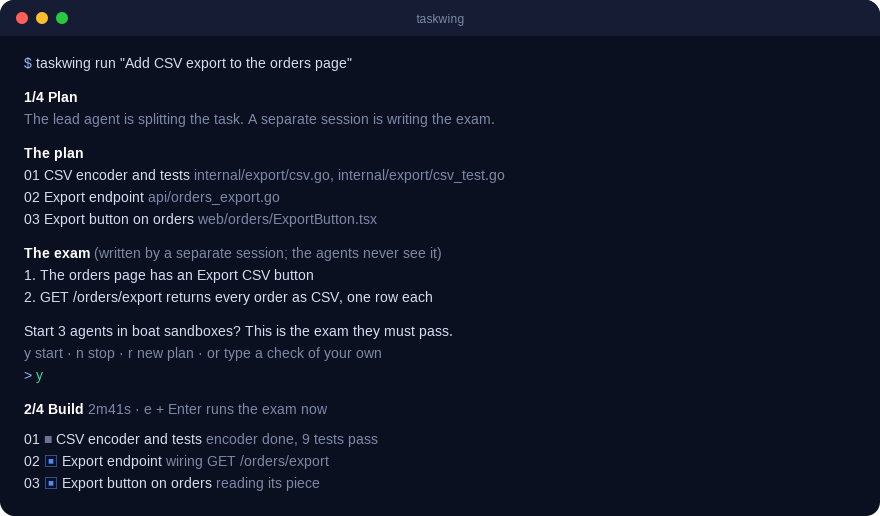
Early and moving fast. The CLI runs real tasks today with Claude Code agents in boat sandboxes. More agent runtimes, models and sandbox providers are next. See Status for exactly what works.
           ┌───────────────────────── TaskWing orchestrates ─────────────────────────┐
 your task │  your agent plans  →  N agent sessions, one per sandbox  →  hidden exam │ → one tested PR
           └─────────────────────────────────────────────────────────────────────────┘
                      ↑ the agents are yours: Claude Code today, Codex or OpenCode next
| TaskWing | What that means for you |
|---|---|
| Orchestrates your agents | Your coding agent plans the task. TaskWing starts one agent session per piece, then checks and joins their work |
| Runs on your machine | One Go binary, using the agent logins and subscriptions you already have |
| Plugs into your sandboxes | boat today; E2B, Docker and AWS next |
Running many coding agents is easy. What runs out is work that doesn't conflict, and your time to review it. TaskWing counts success in verified merges.
# macOS and Linux
brew install josephgoksu/tap/taskwing

# Anywhere with Go 1.24+
go install github.com/josephgoksu/TaskWing/v2/cmd/taskwing@latest
Until the first v2 tag ships, Homebrew still installs v1.23.2, which has none of these commands. Use
go install github.com/josephgoksu/TaskWing/v2/cmd/taskwing@latest(needs Go 1.24+) for now.
Linux packages (.deb, .rpm, .apk) and archives for macOS, Linux and Windows are on the releases page.
You also need: bash and git on your PATH (every run goes through bash, Windows included), the GitHub CLI (gh, logged in), Claude Code (claude, logged in) and, for sandboxes, the boat CLI.
cd your-repo                     # a clean working tree

# 1. See the flow in two minutes, on your machine: no sandboxes, no isolation
taskwing run "add a /health endpoint with a test" --provider local --no-pr

# 2. The real thing: every agent in its own sandbox, one draft pull request
taskwing config boat-base bx_abc123      # one setting for every repo; per repo use --boat-base (docs/guide.md)
taskwing run "add discount codes at checkout, with tests"

# 3. Hunt bugs: each one proven by a failing test, then fixed in parallel
taskwing hunt "the payment code"
1/4 Plan          lead splits the task  ·  a separate session writes the hidden exam
                  you read both: y to start, r for a new plan, or type a check of your own
2/4 Build         one sandbox and one agent per piece, one live line each (e + Enter: exam now)
3/4 Exam          pieces joined on one branch, exam runs in a clean sandbox
4/4 Pull request  pushed from your machine, draft pull request, sandboxes deleted
Every flag and environment variable, the boat setup, exit codes and what a run leaves behind: docs/guide.md.
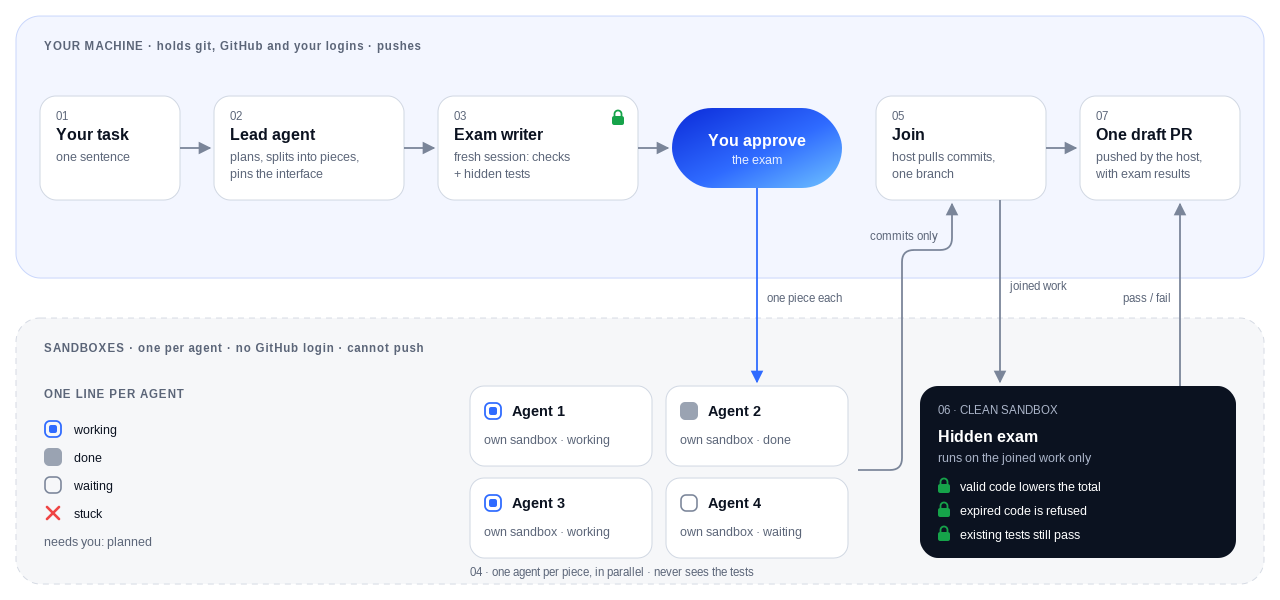
| Rule | What breaks without it |
|---|---|
| One agent per piece, each in its own sandbox | Agents trip over each other's files and processes |
| The engine refuses a plan where two pieces own the same path | Merge conflicts that eat the time parallel work saved |
| A fresh session writes the exam before the work; its tests stay hidden | Agents edit tests until they pass, so "verified" means nothing |
| The exam runs in a clean sandbox on the joined work | A pass that depends on one agent's leftover state |
| No GitHub login in any sandbox; the host pushes | One compromised agent pushes to main |
| You approve the exam and you merge. TaskWing never merges | A misread task burns a run, or lands unreviewed |
The full set of rules, each with its reason: PRINCIPLES.md.
┌ Control planes ─── GitHub Agent HQ, vendor cloud agents   (one task → one PR)
├ TaskWing ───────── one goal → N boxes → one verified PR   (headless, any vendor)
├ Agent interface ── ACP: Claude Code, Codex, Gemini CLI, Copilot CLI, ...
└ Sandboxes ──────── E2B, Daytona, Modal, Vercel, Cloudflare, Docker, any SSH host
One Go binary does all the work, from your terminal. The same runs (not hunts yet) are available as JSON lines (taskwing engine --json, see docs/engine-protocol.md), so scripts, CI and editors can drive them too.
| Part | What it does | What it never does |
|---|---|---|
Engine (internal/, Go) |
Runs, plan check, sandboxes, exam runner, git join, push, GitHub | Call a model itself |
CLI (cmd/taskwing) |
Every action, as a command, plus taskwing engine --json; draws the run as one line per agent |
Anything the engine can't do |
| Lead and exam writer | Your own coding agent, on your machine | See the hidden tests (lead) |
| Workers | Agent CLIs inside sandboxes, one piece each | Push, hold a GitHub login, see the exam |
Every concept and how they connect: docs/ARCHITECTURE.md.
✅ built · 🟡 partial · ⬜ planned. The full list of every feature is in docs/FEATURES.md.
| Area | Today | Next |
|---|---|---|
| Run | ✅ taskwing run, plan check, parallel agents, join, draft PR · ✅ taskwing hunt |
⬜ lead resolves join conflicts · ⬜ resume after a crash |
| Exam | ✅ fresh exam writer, hidden tests, clean exam sandbox · ✅ approve before dispatch · ✅ add your own check · ✅ new plan, exam now (CLI and JSON) | ⬜ rulings after a failure · ⬜ plain-words failure reports |
| Sandboxes | ✅ boat · ✅ local (no isolation, for trying it) | ⬜ E2B · ⬜ AWS · ⬜ Docker |
| Agents and models | ✅ Claude Code · 🟡 lead and exam writer on any command | ⬜ a second runtime (OpenCode or Codex) · ⬜ open-weight models · ⬜ per-step model routing |
| Safety | ✅ no GitHub login in any box · 🟡 refuse boxes with GitHub credentials · 🟡 secret scan before destroy (GitHub tokens, SSH keys) · ✅ host git runs with hooks off on agent commits | ⬜ key proxy |
| Clients | ✅ CLI with one live line per agent · ✅ JSON lines for scripts and CI (taskwing engine --json) |
⬜ start from a Claude Code skill |
TaskWing is early, so this is a good time to shape it. Good first areas:
Provider interface in internal/box.Read CONTRIBUTING.md first; it has the checks CI runs and the few house rules. Found a security problem? See SECURITY.md.
| Read | Why |
|---|---|
| PRINCIPLES.md | The rules every feature is built on |
| SPEC.md | Stages, engine interface, CLI and the first milestone |
| docs/ARCHITECTURE.md | Every concept and how they connect |
| docs/FEATURES.md | What is built and what is planned |
| AGENTS.md | Decisions so far, and how the repo is checked and released |
cmd/taskwing/     the CLI entry point
internal/engine/  runs, plan check, exam, join, pull request
internal/box/     sandbox providers (boat, local)
internal/proc/    child processes as a group, so a timeout or Ctrl-C stops them all
docs/             architecture, features, user guide, engine protocol, diagrams
context/          research behind the principles
AGPL-3.0, with a NOTICE. Copies must credit TaskWing and stay open, even when run as a hosted service. Earlier copies (up to v1.23.2 and the first v2-poc builds) keep their old licence; the v1 knowledge layer lives on at tag v1.23.2.
josephgoksu/TaskWing is a public repo on GitHub by josephgoksu. Local-first AI knowledge layer. Extract architecture, query from any AI tool via MCP. Private by architecture.
It declares the AGPL-3.0 license on GitHub.
Its maker tagged it for macOS, Windows and Linux, or as Docker or cross-platform. That is declared by the maker; Take My Repo has not tested it.
Open "Take it" on its page: Take My Repo writes an install plan for your machine and hands it to your AI agent (Claude Code, Codex or Cursor), which asks you before each step. Take My Repo has not tested it on any machine.
Its last change on GitHub was on 2026-11-22. GitHub counts 2 open issues and pull requests. Take My Repo does not judge from that whether it is maintained.
Nobody has reviewed it on Take My Repo yet, which says nothing about its quality.
The agent harness performance optimization system. Skills, instincts, memory, security, and research-first development for Claude Code, Codex, Opencode, Cursor and beyond.
Reverse engineer anything with agents, from app behavior down to native binaries.
3,000+ reusable AI agent skills for Claude Code, Codex, Cursor and Gemini CLI. AAS Core adds local catalog discovery, agent-owned selection and plan preview. CLI, MCP and plugins.
f.k.a. Awesome ChatGPT Prompts. Share, discover, and collect prompts from the community. Free and open source — self-host for your organization with complete privacy.
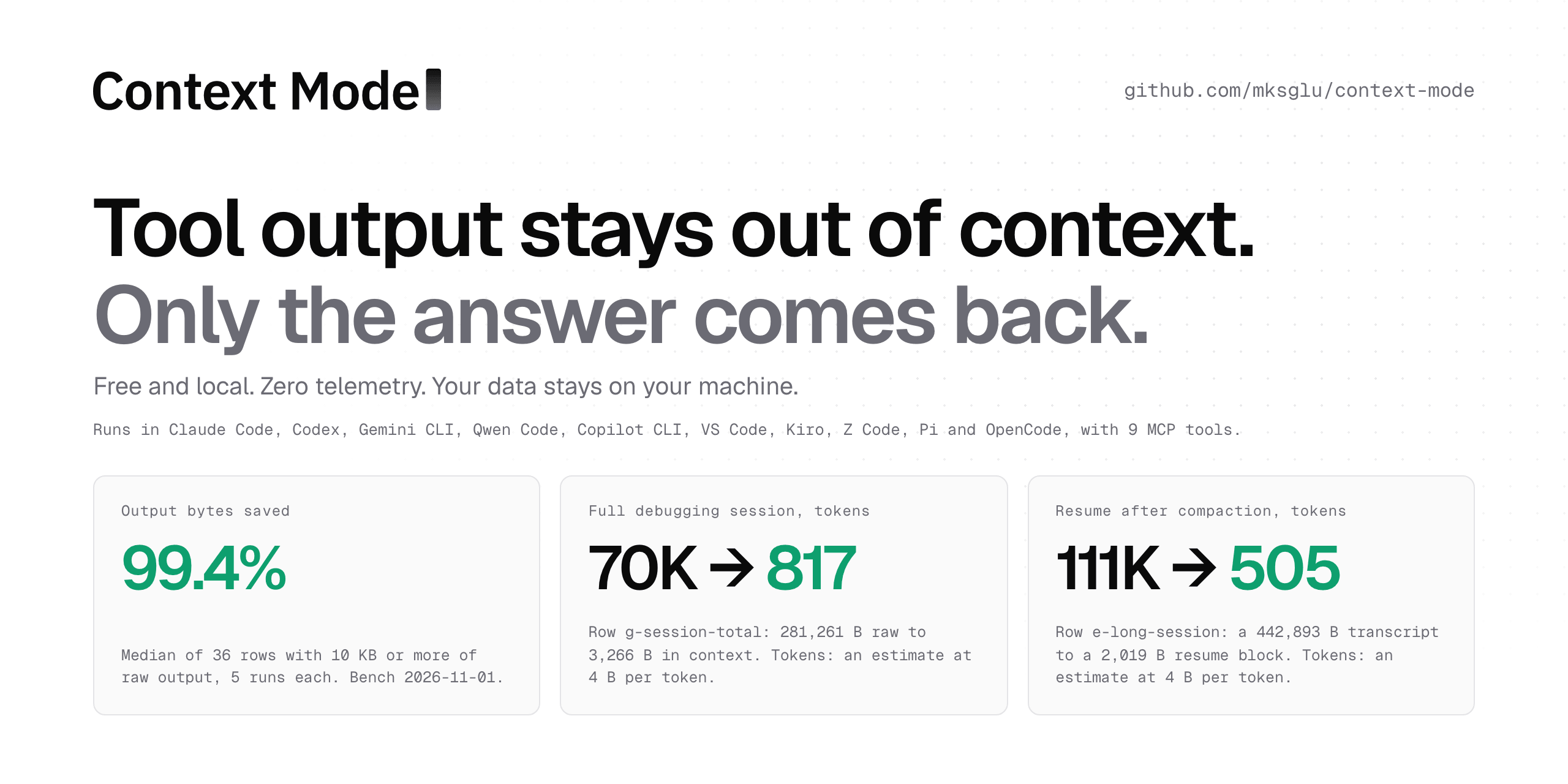
Free, local plugin that keeps tool output out of your coding agent's context window. Sandbox and SQLite FTS5 search, 99% fewer bytes in context. Works with Claude Code, Codex, Pi, OMP, OpenCode, Gemini CLI, Copilot CLI and 4 more agents. Zero telemetry.
Production-ready NestJS boilerplate featuring JWT authentication, TypeORM, RBAC, Swagger, and Docker support. Built for enterprise-grade Node.js applications
The ultimate collection of production-ready, flexible and accessible React Native Boilerplate.