Awesome-Multimodal-Large-Language-Models
:sparkles::sparkles:Latest Advances on Multimodal Large Language Models
- 18k
- 4 wk ago
LLM reasoning: improve small models with uncertainty-guided, trajectory-aware test-time model fusion.
Repo js-lee-AI/ThinkFuse, read from GitHub 3 h ago. js-lee-AI has not joined Take My Repo.
js-lee-AI/ThinkFuse is a public repo on GitHub by js-lee-AI. LLM reasoning: improve small models with uncertainty-guided, trajectory-aware test-time model fusion. It declares the MIT license on GitHub. It is written mainly in Python, has 2 stars and last changed on 2026-10-11. Nobody has reviewed it on Take My Repo yet, which says nothing about its quality. Read from GitHub on 2026-11-24.
:sparkles::sparkles:Latest Advances on Multimodal Large Language Models

Project Page · Paper · Quick start · Usage · Hyperparameters · Results · FAQ · Citation
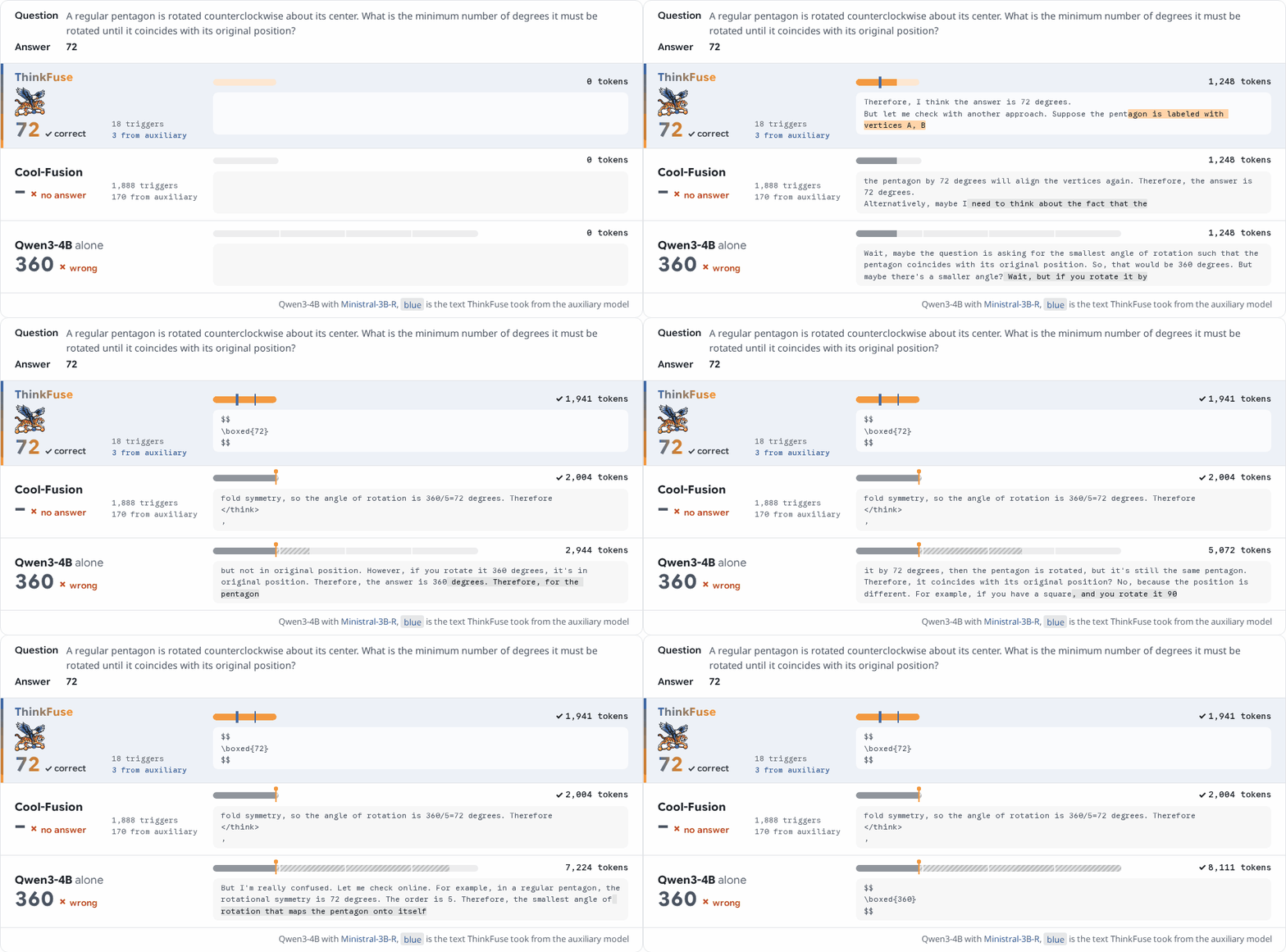
Qwen3-4B with Ministral-3B-R, blue is the text ThinkFuse took from the auxiliary model. The project page replays it live.
Small reasoning models solve hard problems by writing long chains of thought, but they rarely recover once the reasoning takes a wrong turn. Test-time fusion lets a second model step in. Existing fusion methods decide when to step in from local signals, so a brief fluctuation in uncertainty can trigger a fusion that overwrites a sound trajectory.
ThinkFuse is a training-free test-time fusion framework that intervenes only in unreliable reasoning segments. It rests on three parts.
T tokens, ThinkFuse reads the top-k log-probabilities of the primary model, turns each position into a normalized entropy, and aggregates the segment with Exponentially Weighted Causal Aggregation (EWCA), which weights later tokens more and carries the uncertainty accumulated by earlier ones.Monitoring and fusion run only while the model is thinking. Once </think> is written, the primary model finishes the answer alone.
With Qwen3-4B as the primary model and Ministral-3B-R as the auxiliary, ThinkFuse improves over standalone Qwen3-4B on all five benchmarks, by 20.0 points on AIME24 and 10.6 on GPQA. On the same pair, Cool-Fusion falls below the standalone model on all five benchmarks and AdaFuse on four.
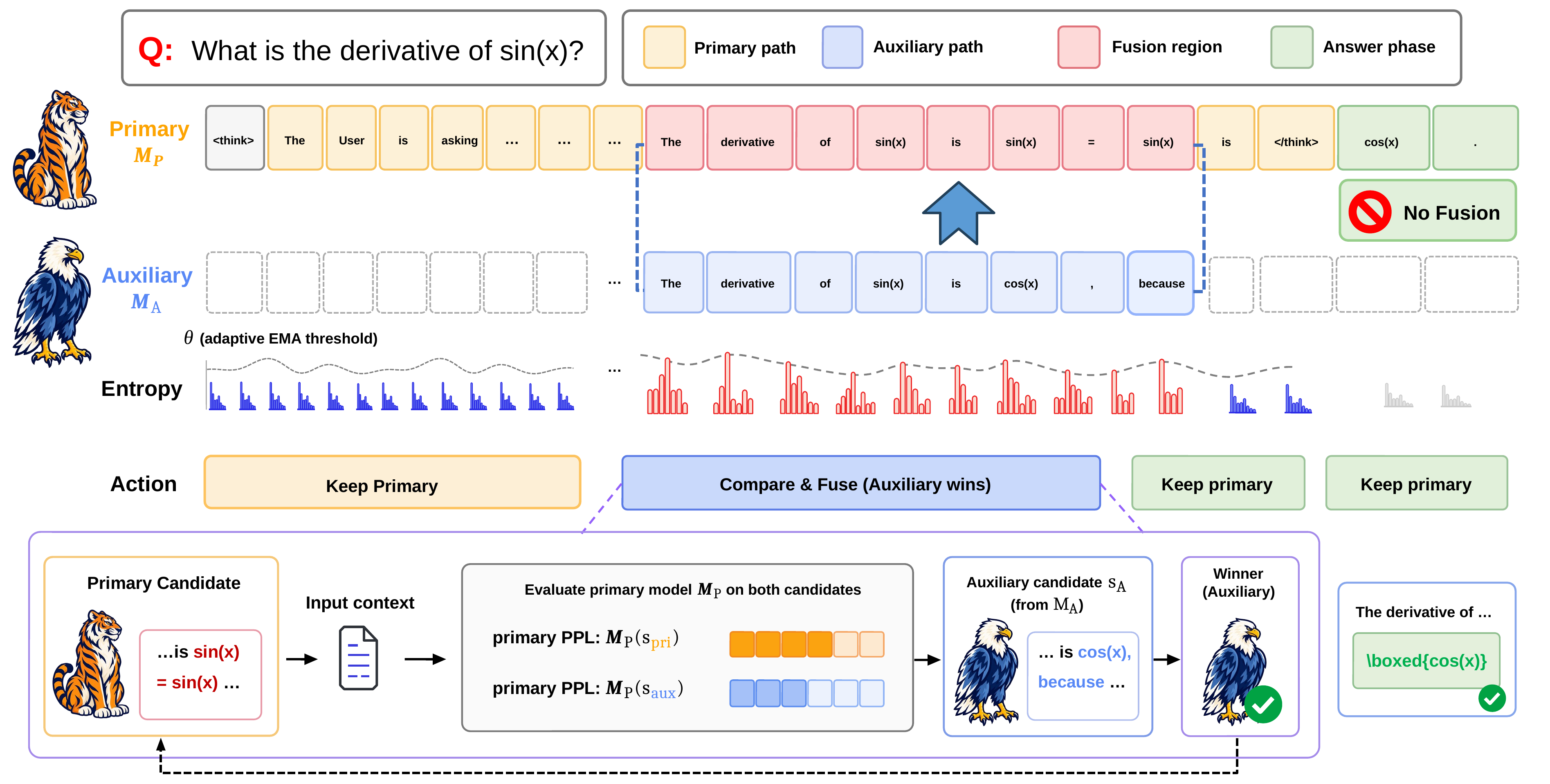
ThinkFuse monitors the segment-level uncertainty of the primary model MP with an adaptive threshold θ. When the uncertainty reaches the threshold, the auxiliary model MA writes an alternative segment, both candidates are scored by the perplexity of MP, and the more compatible one joins the context.
pip install "git+https://github.com/js-lee-AI/ThinkFuse.git"
import math
from thinkfuse import AdaptiveThreshold, UncertaintyCalculator

def segment(p_top, length=8, k=5):                  # 8 tokens, each with its top-5 log-probabilities
    rest = (1.0 - p_top) / (k - 1)
    return [{i: math.log(p) for i, p in enumerate([p_top] + [rest] * (k - 1))}] * length

calc, threshold = UncertaintyCalculator(), AdaptiveThreshold()
for name, p_top in [("confident", 0.90), ("uncertain", 0.30)]:
    u, _ = calc.compute(segment(p_top))             # EWCA over the normalized token entropies
    theta = threshold.get_threshold(fusion_ratio=0.0)
    print(f"{name:9s}  U {u:.2f}  theta {theta:.2f}  fuse {u >= theta}")
print(f"theta after fusing 10% of the segments  {threshold.get_threshold(fusion_ratio=0.1):.2f}")
# confident  U 0.29  theta 0.60  fuse False
# uncertain  U 0.98  theta 0.60  fuse True
# theta after fusing 10% of the segments  0.90
A segment whose tokens are confident stays under the threshold and the primary model continues alone. A segment with flat token distributions reaches it and triggers fusion. Each fusion raises the threshold for the segments that follow.
This runs on a CPU in well under a second and downloads nothing. The full loop with two mock models is example.py, and CI runs it on every push.
git clone https://github.com/js-lee-AI/ThinkFuse.git && cd ThinkFuse
pip install -e ".[test]"
python example.py
| install | adds | enough for |
|---|---|---|
pip install "git+https://github.com/js-lee-AI/ThinkFuse.git" |
numpy | the whole library and the mock client |
git clone and then pip install -e ".[test]" |
pytest | example.py and tests/ |
from thinkfuse import MockModelClient, ThinkFuse

primary = MockModelClient("qwen3-4b", script="<think> ... </think> answer")
auxiliary = MockModelClient("ministral-3b-reasoning")

engine = ThinkFuse(primary, auxiliary, preview_tokens=8)
result = engine.run("Question: ...\nAnswer:")

print(result.text)
print(result.total_segments, result.fused_segments, result.fusion_ratio)
MockModelClient is deterministic and needs no model weights, so the loop can be read and tested on a laptop. total_segments counts the segments monitored during the thinking phase, and fused_segments the ones where the auxiliary model was called.
Implement ModelClient for your backend. The engine needs token-level generation with top-k log-probabilities and a perplexity call.
from thinkfuse import ModelClient

class MyClient(ModelClient):
    name = "qwen3-4b"
    def encode(self, text): ...
    def decode(self, ids, skip_special=True): ...
    def batch_decode(self, id_lists): ...
    def generate(self, context_ids, n_tokens, top_k): ...   # -> (new_ids, eos, token_logprobs)
    def perplexity(self, context_ids, segment_text): ...     # -> float
A typical implementation wraps a vLLM or Transformers server. generate requests n_tokens with logprobs=top_k and returns one dictionary of log-probabilities for each new token. perplexity scores a candidate continuation against the current context.
| call | what it does |
|---|---|
ThinkFuse(primary, auxiliary, ...).run(prompt) |
the segment loop, returning FusionResult(text, total_segments, fused_segments, fusion_ratio) |
UncertaintyCalculator(...).compute(segment_logprobs) |
segment uncertainty by EWCA and the token uncertainties behind it |
AdaptiveThreshold(...).get_threshold(fusion_ratio) |
the threshold from the running mean, deviation and fusion ratio |
AdaptiveThreshold.should_fuse(u, fusion_ratio), .update(u) |
the trigger, and the moving-average update after each segment |
SoftFusionBudget() |
the cumulative fusion ratio |
select_aligned_prefix(base, others, new_token_ids, mode) |
the prefix of a segment that decodes identically under both tokenizers |
select_by_primary_ppl(client, context_ids, candidates) |
the candidate with the lowest primary-model perplexity |
normalize_think_tags, adapt_think_tags_for_model, PhaseDetector |
reasoning-tag normalization and the thinking or answer phase |
ModelClient, MockModelClient |
the backend interface and an offline mock |
Everything imports with NumPy alone.
The defaults of ThinkFuse(...) are the settings of the paper.
| Parameter | Symbol | Argument | Value |
|---|---|---|---|
| Segment length | T | preview_tokens |
8 |
| Top-k log-probabilities | r | top_k |
5 |
| EWCA position weight | α | ewca_alpha |
0.1 |
| EWCA accumulation | β | ewca_beta |
0.5 |
| Moving-average rate | η | ema_eta |
0.05 |
| Deviation margin | τ | tau |
1.0 |
| Soft-budget coefficient | λ | budget_lambda |
50 |
| Initial mean | μ0 | init_mu |
0.5 |
| Initial deviation | σ0 | init_sigma |
0.1 |
| Uncertainty signal | uncertainty_method |
"entropy" |
Fusion is triggered when Uk ≥ θk, with θk = (μk−1 + τ σk−1)(1 + λ Rk−12) and R the share of monitored segments that were fused so far.
Cool-Fusion fuses the most auxiliary tokens on every benchmark and ends with the shortest thinking stage on four of the five. ThinkFuse fuses far fewer auxiliary tokens, and on AIME24 it keeps the longest thinking stage of the three fusion methods.
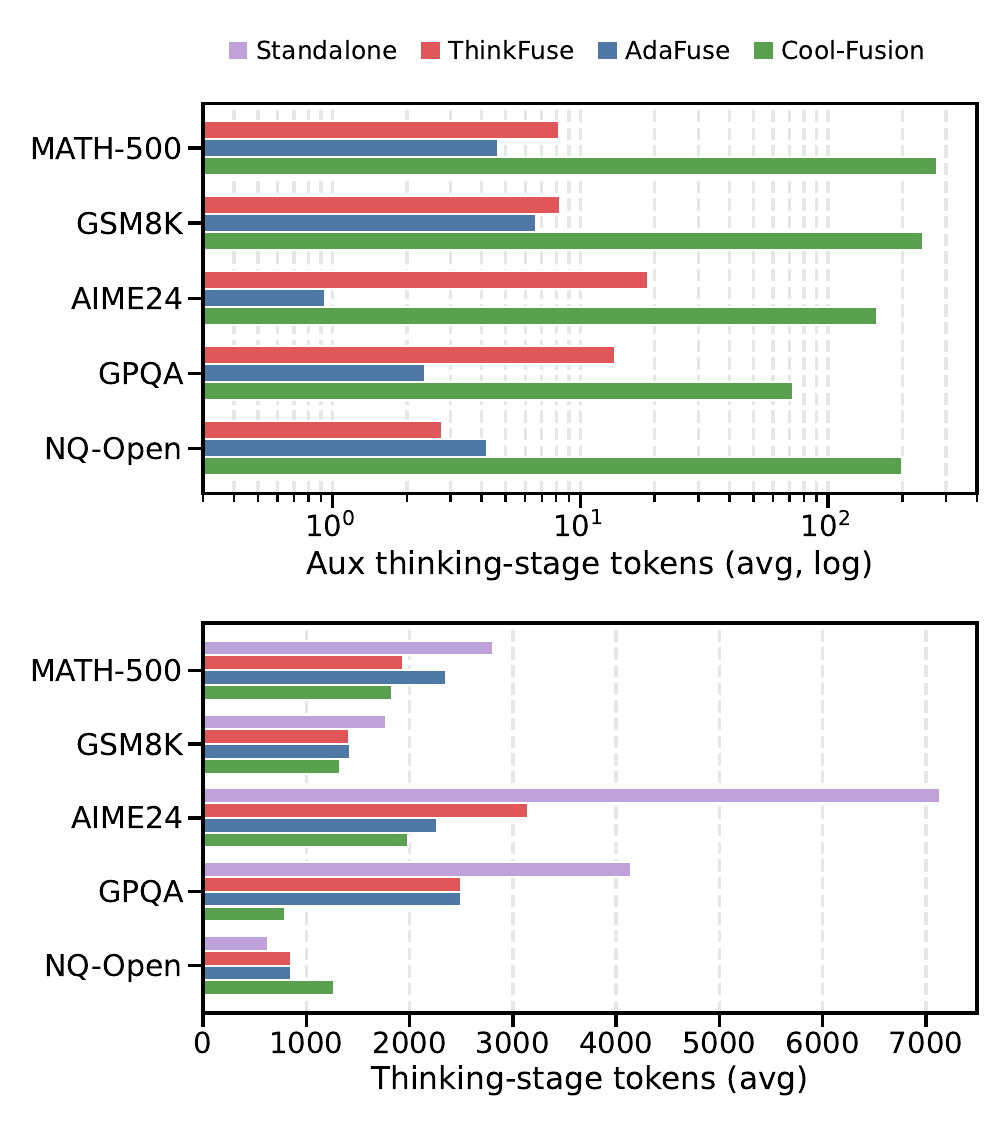
Figure 2 of the paper. Top, average fused auxiliary tokens in log scale. Bottom, average thinking-stage tokens. All fusion configurations use Qwen3-4B as the primary model and Ministral-3B-R as the auxiliary model.
Accuracy (%) under a 16K-token budget. Parentheses give the difference from the standalone primary model in percentage points.
| Method | MATH-500 | GSM8K | AIME24 | GPQA | NQ-Open |
|---|---|---|---|---|---|
| Standalone models | |||||
| Qwen3-4B | 89.0 | 92.0 | 53.3 | 54.0 | 29.5 |
| Qwen3-1.7B‡ | 83.0 | 90.0 | 33.3 | 39.4 | 28.0 |
| Ministral-3B-R | 32.5 | 67.0 | 0.0† | 25.8 | 24.0 |
| EXAONE-4.0-1.2B | 57.0 | 85.0 | 3.3† | 38.9 | 22.0 |
| Test-time compute baseline, Qwen3-4B | |||||
| Self-consistency (K=3) | 89.5 (+0.5) | 94.5 (+2.5) | 53.3 (+0.0) | 51.0 (−3.0) | 39.0 (+9.5) |
| Self-consistency (K=5) | 88.0 (−1.0) | 94.5 (+2.5) | 53.3 (+0.0) | 50.0 (−4.0) | 39.0 (+9.5) |
| Test-time fusion baselines, Qwen3-4B × Ministral-3B-R | |||||
| Cool-Fusion | 31.0 (−58.0) | 66.0 (−26.0) | 0.0† (−53.3) | 11.6 (−42.4) | 0.5 (−29.0) |
| AdaFuse | 45.5 (−43.5) | 72.6 (−19.4) | 33.3 (−20.0) | 28.8 (−25.2) | 38.5 (+9.0) |
| ThinkFuse | |||||
| Qwen3-4B × Ministral-3B-R | 90.0 (+1.0) | 96.9 (+4.9) | 73.3 (+20.0) | 64.6 (+10.6) | 39.5 (+10.0) |
| Qwen3-4B × Qwen3-1.7B | 91.0 (+2.0) | 94.0 (+2.0) | 70.0 (+16.7) | 55.1 (+1.1) | 37.0 (+7.5) |
| Qwen3-4B × Qwen3-4B | 75.0 (−14.0) | 90.0 (−2.0) | 40.0 (−13.3) | 28.3 (−25.7) | 38.0 (+8.5) |
| Qwen3-1.7B × EXAONE-4.0-1.2B | 85.0 (+2.0) | 90.5 (+0.5) | 30.0 (−3.3) | 53.5 (+14.1) | 28.0 (+0.0) |
† AIME24 results affected by length-limit or final-answer truncation. ‡ Standalone Qwen3-1.7B is evaluated with the Qwen3 recommended top-k of 20, and all other rows share one decoding setting.
| Method | MATH-500 | GSM8K | AIME24 | GPQA | NQ-Open |
|---|---|---|---|---|---|
| Qwen3-4B | 89.0 | 92.0 | 53.3 | 54.0 | 29.5 |
| EXAONE-Deep-2.4B | 83.5 | 90.5 | 43.3 | 57.1 | 17.5 |
| DeepSeek-R1-Distill-Qwen-1.5B | 13.0 | 30.5 | 0.0† | 21.2 | 14.5 |
| ThinkFuse, Qwen3-4B × EXAONE-Deep-2.4B | 91.0 (+2.0) | 99.0 (+7.0) | 73.3 (+20.0) | 55.1 (+1.1) | 38.5 (+9.0) |
js-lee-AI/ThinkFuse is a public repo on GitHub by js-lee-AI. LLM reasoning: improve small models with uncertainty-guided, trajectory-aware test-time model fusion.
It declares the MIT license on GitHub.
Its maker has not tagged a system, so it is unknown here. Its README says what it needs.
Open "Take it" on its page: Take My Repo writes an install plan for your machine and hands it to your AI agent (Claude Code, Codex or Cursor), which asks you before each step. Take My Repo has not tested it on any machine.
The RL Bridge for LLM-based Agent Applications. Made Simple & Flexible.
The is the official implementation of ICML 2023 paper "Revisiting Weighted Aggregation in Federated Learning with Neural Networks".
The official GitHub page for the survey paper "A Survey of Large Language Models".
Its last change on GitHub was on 2026-10-11. Take My Repo does not judge from that whether it is maintained.
Nobody has reviewed it on Take My Repo yet, which says nothing about its quality.
Take My Repo cannot say: it does not audit code and has not run ThinkFuse. What is known comes from GitHub. It declares the MIT license on GitHub. Its last change was on 2026-10-11. It has 2 stars, which measure popularity, not safety. Nobody has reviewed it on Take My Repo yet, which says nothing about its quality. Read the source before you run it. With "Take it", your AI agent shows each step and asks you before running it; README text is treated as data, not as instructions.