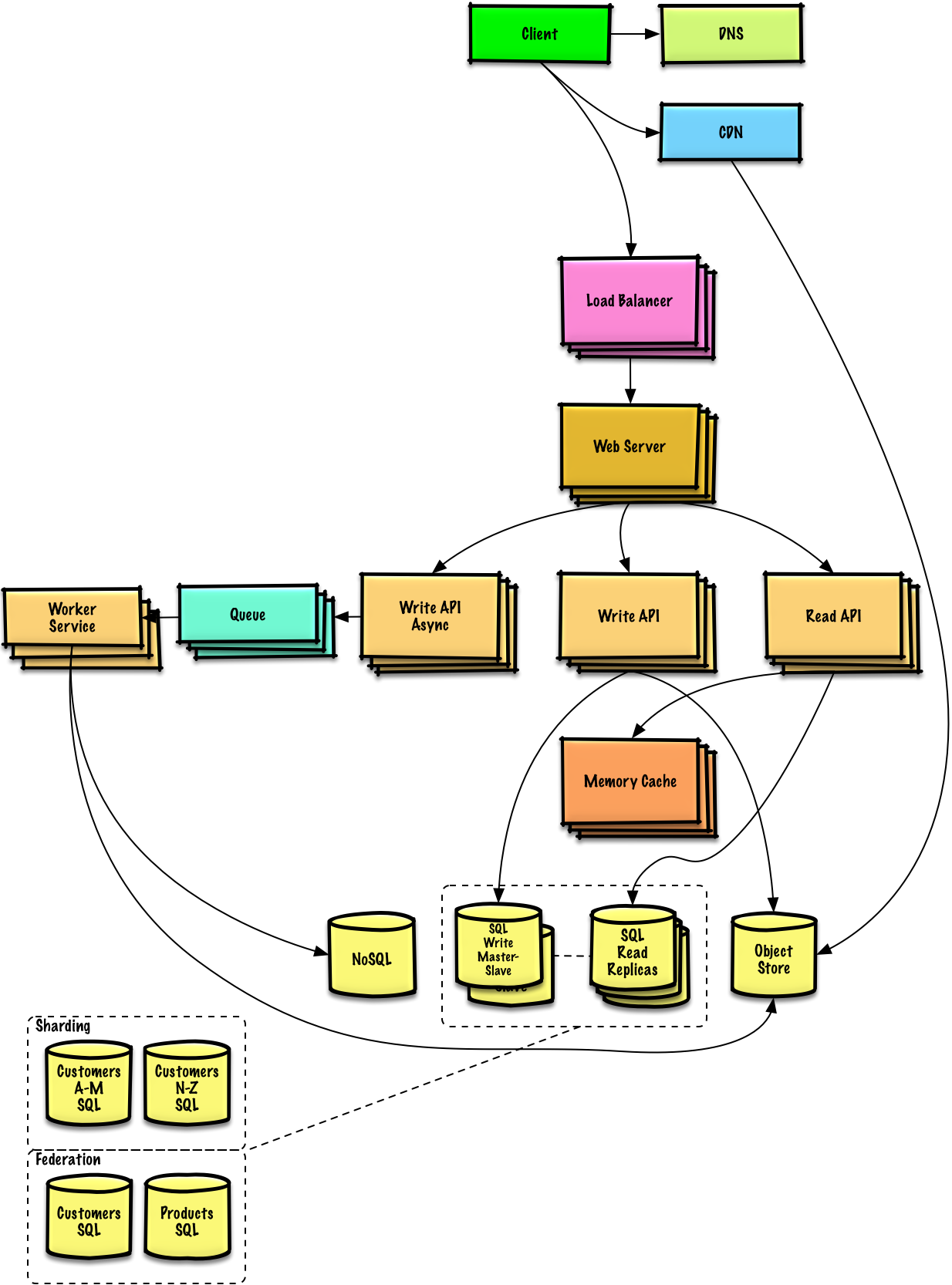
system-design-primer
Learn how to design large-scale systems. Prep for the system design interview. Includes Anki flashcards.
- 379k
- Python
- 2 mo ago
A standard library for the client-side Web
Repo koute/stdweb, read from GitHub 6 h ago. koute has not joined Take My Repo.
koute/stdweb is a public repo on GitHub by koute. A standard library for the client-side Web. It declares the Apache-2.0 license on GitHub. It is written mainly in Rust, has 3,450 stars and last changed on 2024-02-28. Nobody has reviewed it on Take My Repo yet, which says nothing about its quality. Read from GitHub on 2026-11-23.
Learn how to design large-scale systems. Prep for the system design interview. Includes Anki flashcards.


The goal of this crate is to provide Rust bindings to the Web APIs and to allow a high degree of interoperability between Rust and JavaScript.

This software was brought to you thanks to these wonderful people:
Thank you!
You can directly embed JavaScript code into Rust:
let message = "Hello, 世界!";
let result = js! {
    alert( @{message} );
    return 2 + 2 * 2;
};

println!( "2 + 2 * 2 = {:?}", result );
Closures are also supported:
let print_hello = |name: String| {
    println!( "Hello, {}!", name );
};

js! {
    var print_hello = @{print_hello};
    print_hello( "Bob" );
    print_hello.drop(); // Necessary to clean up the closure on Rust's side.
}
You can also pass arbitrary structures thanks to serde:
#[derive(Serialize)]
struct Person {
    name: String,
    age: i32
}

js_serializable!( Person );

js! {
    var person = @{person};
    console.log( person.name + " is " + person.age + " years old." );
};
This crate also exposes a number of Web APIs, for example:
let button = document().query_selector( "#hide-button" ).unwrap().unwrap();
button.add_event_listener( move |_: ClickEvent| {
    for anchor in document().query_selector_all( "#main a" ) {
        js!( @{anchor}.style = "display: none;"; );
    }
});
Exposing Rust functions to JavaScript is supported too:
#[js_export]
fn hash( string: String ) -> String {
    let mut hasher = Sha1::new();
    hasher.update( string.as_bytes() );
    hasher.digest().to_string()
}
Then you can do this from Node.js:
var hasher = require( "hasher.js" ); // Where `hasher.js` is generated from Rust code.
console.log( hasher.hash( "Hello world!" ) );
Or you can take the same .js file and use it in a web browser:
<script src="hasher.js"></script>
<script>
    Rust.hasher.then( function( hasher ) {
        console.log( hasher.hash( "Hello world!" ) );
    });
</script>
If you're using Parcel you can also use our experimental Parcel plugin; first do this in your existing Parcel project:
$ npm install --save parcel-plugin-cargo-web
And then simply:
import hasher from "./hasher/Cargo.toml";
console.log( hasher.hash( "Hello world!" ) );
Take a look at some of the examples:
examples/minimal - a totally minimal example which calls alertexamples/todomvc - a naively implemented TodoMVC application; shows how to call into the DOMexamples/hasher - shows how to export Rust functions to JavaScript and how to call them from
a vanilla web browser environment or from Nodejsexamples/hasher-parcel - shows how to import and call exported Rust functions in a Parcel projectpinky-web - an NES emulator; you can play with the precompiled version hereThe API documentation is also available for you to look at.
Install cargo-web:
$ cargo install -f cargo-web
Go into examples/todomvc and start the example using one of these commands:
Compile to WebAssembly using Rust's native WebAssembly backend:
$ cargo web start --target=wasm32-unknown-unknown
Compile to asm.js using Emscripten:
$ cargo web start --target=asmjs-unknown-emscripten
Compile to WebAssembly using Emscripten:
$ cargo web start --target=wasm32-unknown-emscripten
Visit http://localhost:8000 with your browser.
For the *-emscripten targets cargo-web is not necessary, however
the native wasm32-unknown-unknown which doesn't need Emscripten
requires cargo-web to work!
stdweb 0.4.20
wasm-bindgenFullscreenChangeEventstdweb 0.4.19
Document::fullscreen_enabledDocument::fullscreen_elementInputElement::selection_startInputElement::selection_endInputElement::set_selection_startInputElement::set_selection_endObject::to_iterWindow::confirm&Arrays can now be converted to Vecs through TryFromfutures-related APIs were updated to work with the latest nightliessyn dependency was updated to version 1stdweb 0.4.18
js! macro can now be imported with an useBeforeUnloadEventUnloadEventIBlob::sliceIBlob::slice_with_content_typeIWindowOrWorker::set_clearable_timeoutstdweb 0.4.17
futures-related APIs were updated to work with the latest nightliesstdweb 0.4.16
wasm-bindgen compatibility; you can now use stdweb in projects
using wasm-bindgencargo-web version is now 0.6.24stdweb 0.4.15
futures-related APIs were updated to work with the latest nightliesFormDataFormDataEntryMouseButtonsStateBlob::newstdweb 0.4.14
js! macro now generates slightly more efficient code
if you're not returning anything from your JS snippet. This makes
it unnecessary to add the @(no_return) annotation in the vast
majority of cases.Filestdweb 0.4.13
js! macro's whitespace handlingITouchEventTouchTouchTypeTouchEventTouchMoveTouchLeaveTouchEnterTouchEndTouchCancelTouchStartXmlHttpRequest::set_response_typestdweb 0.4.12
wasm32-unknown-unknown target without cargo-webstdweb 0.4.11
cargo-web version is now 0.6.22wasm32-unknown-unknown is now officially supported on stable Rustwasm32-unknown-unknown are now supportedjs! macro is now partially implemented using a procedural macroDocument::import_nodeIElement::slotIElement::attach_shadowIElement::shadow_rootISlotableShadowRootShadowRootModeTemplateElementSlotElementSlotChangeEventIParentNode::query_selector and IParentNode::query_selector_all now return a proper error typestdweb 0.4.10, stdweb-derive 0.5.1
IElement::insert_adjacent_htmlIElement::insert_html_beforeIElement::insert_html_afterIElement::prepend_htmlIElement::append_htmlIElement::namespace_uriIElement::closestDocument::create_element_nsWindow::get_selectionAbortErrorSelectionTypeSelectionRange.try_into()/.try_from()) is now convertible into a TypeErrorDrawImageError) are now serializable through the js! macroTypeError is now fixed (it was incorrectly treated as a DOMException)Number can now be converted into f64 with .into()/.from()Mut, which is a new wrapper type for safely passing FnMut closures into the js! macro;
it is optional for now, however the usage of this wrapper type will be mandatory in the future!FnMut closures cannot be called recursively anymore#[derive(ReferenceType)] now supports a limited subset of generic types#[async_test] attribute macro (nightly only)futures 0.3 (nightly only)stdweb 0.4.9, stdweb-derive 0.5.0
ScrollEventDragRelatedEventDragEventDragStartEventDragEndEventDragEnterEventDragLeaveEventDragOverEventDragExitEventDragDropEventDataTransferEffectAllowedDropEffectDataTransferItemListDataTransferItemDataTransferItemKindIDragEventValues can now be converted to Option< Serde< T > > with try_intoi32 and f64 to be usedkeyup event
as a KeyDownEvent since only the event's JS type was checked
and both keyup and keydown share the same JS type (KeyboardEvent).
From now on the type field of the event is also checked, so
such conversions are not allowed anymore.0.4.8
koute/stdweb is a public repo on GitHub by koute. A standard library for the client-side Web.
It declares the Apache-2.0 license on GitHub.
Its maker tagged it for macOS, Windows and Linux, or as Docker or cross-platform. That is declared by the maker; Take My Repo has not tested it.
Open "Take it" on its page: Take My Repo writes an install plan for your machine and hands it to your AI agent (Claude Code, Codex or Cursor), which asks you before each step. Take My Repo has not tested it on any machine.
Build smaller, faster, and more secure desktop and mobile applications with a web frontend.
Rust / Wasm framework for creating reliable and efficient web applications
Flutter makes it easy and fast to build beautiful apps for mobile and beyond
Dear ImGui: Bloat-free Graphical User interface for C++ with minimal dependencies
Its last change on GitHub was on 2024-02-28. GitHub counts 134 open issues and pull requests. Take My Repo does not judge from that whether it is maintained.
Nobody has reviewed it on Take My Repo yet, which says nothing about its quality.
Take My Repo cannot say: it does not audit code and has not run stdweb. What is known comes from GitHub. It declares the Apache-2.0 license on GitHub. Its last change was on 2024-02-28. It has 3,450 stars, which measure popularity, not safety. Nobody has reviewed it on Take My Repo yet, which says nothing about its quality. Read the source before you run it. With "Take it", your AI agent shows each step and asks you before running it; README text is treated as data, not as instructions.