PreciseNumber
A high-precision numeric type for .NET that provides arbitrary precision arithmetic with a focus on accuracy.
- 0
- MIT
- 8 d ago
Repo ktsu-dev/PreciseNumber, read from GitHub 1 h ago. ktsu-dev has not joined Take My Repo.
In short
ktsu-dev/PreciseNumber is a public repo on GitHub by ktsu-dev. A high-precision numeric type for .NET that provides arbitrary precision arithmetic with a focus on accuracy. It declares the MIT license on GitHub. It is written mainly in C#, has 0 stars and last changed on 2026-11-13. Nobody has reviewed it on Take My Repo yet, which says nothing about its quality. Read from GitHub on 2026-11-21.
ktsu.PreciseNumber
A high-precision numeric type for .NET that provides arbitrary precision arithmetic with a focus on accuracy. By combining the scale benefits of scientific notation with the precision of BigInteger, this library offers reliable and accurate mathematical operations where standard floating point types fall short.
Table of Contents
Features
Arbitrary Precision: Based on
BigIntegerfor the significand, allowing numbers of unlimited size.Scientific Notation: Uses an exponent and significand (the coefficient or mantissa in scientific notation) model similar to scientific notation.
Lossless Arithmetic: Preserves precision during calculations with no rounding errors.
Full .NET Integration: Implements
INumber<T>, includingCreateChecked,CreateSaturating, andCreateTruncatingin both directions, so generic math code can create and convert values.Value Type: A
readonly record structwhosedefaultvalue is zero. Adding, subtracting, multiplying, and comparing allocate nothing when the operands and every intermediate and final significand fit in anint. Exponent alignment counts, so1 + 0.0000000001allocates because it scales 1 by 10^10, and99999 * 99999allocates because its product is 9,999,800,001.Comprehensive Mathematical Support: Includes advanced mathematical functions like exponential operations (Pow, Exp, Squared, Cubed), roots (Sqrt, Cbrt, RootN, Hypot) through
IRootFunctions<T>, trigonometry (Sin, Cos, Tan, Asin, Acos, Atan, Atan2, and the half-turn family) throughITrigonometricFunctions<T>, constant values (Pi, E, Tau) with high precision, absolute value operations, and specialized numerical checks (isOdd, isEven, etc.)—all with arbitrary precision.Balanced Performance: The design prioritizes accuracy and precision while maintaining reasonable performance. For calculations where extreme precision matters more than raw speed, PreciseNumber delivers excellent results, though built-in numeric types remain faster for standard precision needs.
Performance
Values are immutable value types. Every operation returns a new value, but that value lives inline
in its variable, field, or array element, so the only heap allocation is the BigInteger digit
array, and a significand that fits in an int doesn't need one. Cost therefore tracks the number
of significant digits rather than the magnitude of the value, and allocation matters as much as
raw speed.
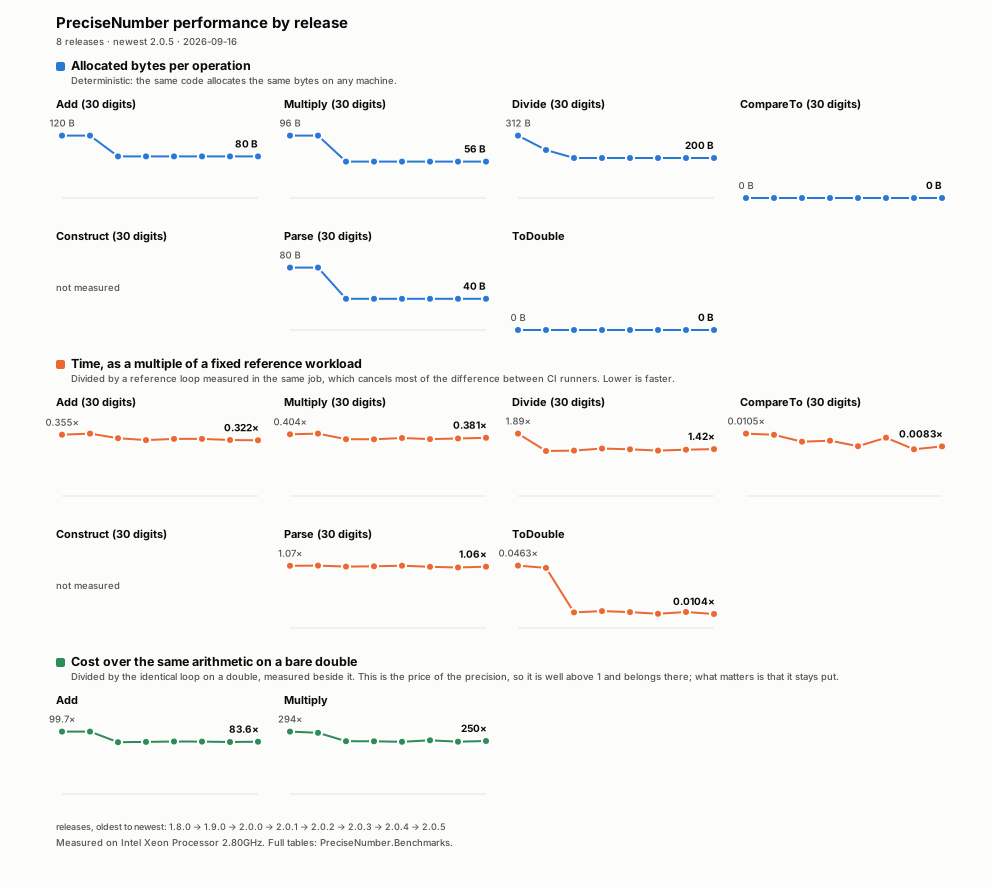
Every release measures a fixed set of benchmarks and adds a point to the chart above; the numbers
behind it are in docs/benchmarks/history.json.
Read the two halves differently. Allocation is exact — the same code allocates the same bytes on any machine, so a step in the top row is always a real change. Time is measured on shared CI runners, where the host a job happens to land on varies more than most releases do, so each time is divided by a reference workload measured in the same job. That cancels most of the difference between machines; what is left is indicative rather than precise, and a small wobble between two releases is more likely the runner than the library.
The repository carries a BenchmarkDotNet suite covering construction, comparison, arithmetic, rounding, text conversion and primitive conversion, each parameterised across 8, 30 and 200 significant digits:
dotnet run -c Release --project PreciseNumber.Benchmarks -- --filter '*ArithmeticBenchmarks*'
Run it before and after any change to the library's internals. A full run can also be started from the Benchmarks workflow in GitHub Actions, which archives the reports against the commit that produced them.
Getting Started
Installation
To install PreciseNumber, you can use the .NET CLI:
dotnet add package ktsu.PreciseNumber
Or you can use the NuGet Package Manager in Visual Studio by searching for ktsu.PreciseNumber.
Requirements
This library requires .NET 8.0 or later.
Quick Usage
Basic Example
using System.Numerics;
using ktsu.PreciseNumber;

// Create PreciseNumber from various types
var precise1 = 123.456.ToPreciseNumber();
var precise2 = BigInteger.Parse("1234567890").ToPreciseNumber();

// Perform calculation with high precision
var result = precise1 * precise2 / 7.89.ToPreciseNumber();

Console.WriteLine(result); // Displays accurate result with no floating point errors
Common Operations
Create and perform operations with precise numbers:
using ktsu.PreciseNumber;

// Create PreciseNumbers from various numeric types
var a = 123.456.ToPreciseNumber();
var b = 2.ToPreciseNumber();

// Basic arithmetic operations
var sum = a + b;        // 125.456

var difference = a - b; // 121.456

var product = a * b;    // 246.912

var quotient = a / b;   // 61.728

// Comparison
bool isGreater = a > b; // true
When to Use PreciseNumber
PreciseNumber is ideal for:
Financial calculations where exact precision is required beyond what decimal offers
Scientific computing involving very large or small numbers with many significant digits
Cryptography applications requiring arbitrary precision arithmetic
Mathematical algorithms where rounding errors would accumulate and affect results
For everyday calculations where standard precision is sufficient, built-in types like int, double, or decimal will offer better performance.
Advanced Usage
Type Conversions
The library provides seamless round-trip conversions between standard numeric types and PreciseNumber using extension methods:
using System.Numerics;
using ktsu.PreciseNumber;

// Convert FROM standard types TO PreciseNumber
int originalInt = 42;
double originalDouble = 3.14159;
decimal originalDecimal = 1234.5678m;
BigInteger originalBigInt = BigInteger.Parse("123456789012345678901234567890");

// Convert using the ToPreciseNumber() extension method
var preciseInt = originalInt.ToPreciseNumber();
var preciseDouble = originalDouble.ToPreciseNumber();
var preciseDecimal = originalDecimal.ToPreciseNumber();
var preciseBigInt = originalBigInt.ToPreciseNumber();

// Perform precise calculations if needed
preciseInt *= 10;
preciseDouble += PreciseNumber.Pi;

// Convert back FROM PreciseNumber TO standard types using To<T>()
int roundTripInt = preciseInt.To<int>();                  // 420
double roundTripDouble = preciseDouble.To<double>();      // ~6.28318
decimal roundTripDecimal = preciseDecimal.To<decimal>();  // 1234.5678
BigInteger roundTripBigInt = preciseBigInt.To<BigInteger>(); // 123456789012345678901234567890

// Verify round-trip conversion (for values that weren't modified)
Console.WriteLine(originalDecimal == roundTripDecimal);   // True
Console.WriteLine(originalBigInt == roundTripBigInt);     // True
Generic math conversions
Code written against INumber<T> reaches PreciseNumber through CreateChecked, CreateSaturating, and CreateTruncating. They work in both directions for every built-in numeric type and BigInteger:
using System.Numerics;
using ktsu.PreciseNumber;

static T ToMeters<T>(T feet) where T : INumber<T> => feet * T.CreateChecked(0.3048);

PreciseNumber meters = ToMeters(10.ToPreciseNumber()); // exactly 3.048
double asDouble = double.CreateChecked(meters);        // 3.048
int whole = int.CreateChecked(meters);                 // 3, truncated toward zero
- Integers,
BigInteger, anddecimalconvert in exactly.double,float, andHalfconvert through their decimal text, so0.3048arrives as exactly 0.3048. - NaN throws in a checked conversion and becomes zero otherwise. An infinity always throws. Both match
BigInteger. - Integer destinations keep the integral part. Checked throws when it's out of range, saturating clamps, and truncating wraps the way
BigIntegerdoes. double,float, andHalfdestinations are correctly rounded however many digits the number has.decimaldestinations round to the digitsdecimalholds. Checked throws when the value is out of range, and saturating and truncating clamp.
To<T>() uses the same conversions.
Mathematical Functions
PreciseNumber supports a wide range of mathematical operations:
using ktsu.PreciseNumber;

var number = 2.5.ToPreciseNumber();

// Exponentiation
var squared = number.Squared();  // 6.25
var cubed = number.Cubed();      // 15.625
var toThe4th = number.Pow(4.ToPreciseNumber());  // 39.0625

// Constants
var pi = PreciseNumber.Pi;
var e = PreciseNumber.E;

// Exponential function
var expValue = PreciseNumber.Exp(1.ToPreciseNumber()); // e^1 = e

// Roots. A value whose root is exact gets it exactly, whatever precision was asked for
var root = PreciseNumber.Sqrt(2.ToPreciseNumber());        // 1.4142135623730950488016887242096980785696718753769
var exactRoot = PreciseNumber.Sqrt(144.ToPreciseNumber()); // 12
var cubeRoot = PreciseNumber.Cbrt((-8).ToPreciseNumber()); // -2, an odd root of a negative value being real
var fifthRoot = PreciseNumber.RootN(7.ToPreciseNumber(), 5);
var hypotenuse = PreciseNumber.Hypot(3.ToPreciseNumber(), 4.ToPreciseNumber()); // 5

// Or choose the precision, the same way Divide does
var shortRoot = PreciseNumber.Sqrt(2.ToPreciseNumber(), 10); // 1.414213562

// Rounding and precision control
var roundedValue = number.Round(1);  // 2.5 (already at 1 decimal place)
var reducedValue = number.ReduceSignificance(1); // 3 (reduced to 1 significant digit)

// Min, Max, Abs, and Clamp
var absValue = (-5).ToPreciseNumber().Abs();  // 5
var maxValue = PreciseNumber.Max(2.ToPreciseNumber(), 3.ToPreciseNumber()); // 3
var minValue = PreciseNumber.Min(2.ToPreciseNumber(), 3.ToPreciseNumber()); // 2
var clampedValue = 10.ToPreciseNumber().Clamp(0, 5); // 5 (clamped to maximum)
Parsing and Formatting
Parsing from Strings
using System.Globalization;
using System.Numerics;
using ktsu.PreciseNumber;

// Parse from string using various formats
var number1 = PreciseNumber.Parse("123.456", CultureInfo.InvariantCulture);
var number2 = PreciseNumber.Parse("1.23E4", NumberStyles.Any, CultureInfo.InvariantCulture);

// Try parsing with error handling
if (PreciseNumber.TryParse("456.789", out var result))
{
    Console.WriteLine($"Parsed successfully: {result}");
}
String Formatting
Convert PreciseNumber to string:
using System.Globalization;
using ktsu.PreciseNumber;

var number = 123.456.ToPreciseNumber();
string formatted = number.ToString(); // "123.456"

// Standard format strings, rounded half away from zero
number.ToString("F2", CultureInfo.InvariantCulture); // "123.46"
number.ToString("N1", CultureInfo.InvariantCulture); // "123.5"
number.ToString("E3", CultureInfo.InvariantCulture); // "1.235E+002"
number.ToString("G4", CultureInfo.InvariantCulture); // "123.5"
G (or empty) and R write the exact value. F, N, E and G take an optional precision, and N uses the culture's group separator and negative pattern. Custom format strings such as 0.00 throw a FormatException that names the supported formats.
Comparison with Built-in Types
PreciseNumber vs. double/float
- Advantages of PreciseNumber:*
No Rounding Errors: Unlike floating-point types, PreciseNumber doesn't suffer from binary representation issues (e.g., 0.1 + 0.2 ≠ 0.3 in floating point)
Arbitrary Precision: Not limited to 15-17 significant digits (double) or 6-9 significant digits (float)
Consistent Results: Mathematical operations produce identical results regardless of magnitude
No Special Values: PreciseNumber doesn't have NaN or Infinity values that can propagate through calculations
// Double arithmetic issue
double a = 0.1;
double b = 0.2;
Console.WriteLine(a + b == 0.3);  // False (equals 0.30000000000000004)

// PreciseNumber solves this
var pa = 0.1.ToPreciseNumber();
var pb = 0.2.ToPreciseNumber();
Console.WriteLine((pa + pb) == 0.3.ToPreciseNumber());  // True (exactly 0.3)
PreciseNumber vs. decimal
- Advantages of PreciseNumber:*
Unlimited Range: Not constrained by decimal's ±7.9E±28 range
Unlimited Precision: Decimal is limited to 28-29 significant digits
Scientific Operations: Better suited for scientific calculations requiring extreme precision
More Flexible Format: Exponent-significand model makes it suitable for both very large and very small numbers
// Decimal range/precision limitations
decimal largeDecimal = 1.0m;
for (int i = 0; i < 30; i++)
    largeDecimal *= 10; // Will throw OverflowException

// PreciseNumber handles this easily
var largePrecise = PreciseNumber.One;
for (int i = 0; i < 1000; i++)
    largePrecise *= 10; // Works fine with arbitrary large values
PreciseNumber vs. BigInteger
- Advantages of PreciseNumber:*
Decimal Point Support: Represents both integer and fractional parts while BigInteger only handles integers
Scientific Notation: More convenient for very large or small numbers with fraction components
Mathematical Constants: Built-in support for constants like Pi and E with high precision
Technical Details
Internal Representation
PreciseNumber stores values in the form: significand × 10^exponent
Significand: A
BigIntegerthat contains all the significant digitsExponent: An
intthat determines the decimal place
This representation allows for:
Exact representation of integers of any size
High precision for decimal values
Accurate arithmetic without floating-point errors
A
defaultvalue that is exactly zero, since PreciseNumber is a value type
Precision Control
You can control precision using:
Round(): Rounds to a specific number of decimal places, half away from zero
ReduceSignificance(): Reduces to a specific number of significant digits, half away from zero
Divide(left, right, significantDigits): Chooses the precision of a quotient
Sqrt(value, significantDigits), and the same overload on
Cbrt,RootNandHypot: Chooses the precision of a root
Division produces a terminating quotient exactly, however many digits that takes — 1 / 8 is
0.125, and 1 / 2^64 keeps all 64 decimal places. A repeating quotient is produced to the
precision of the wider operand, never fewer than MinimumDivisionPrecision (50) significant
digits, with the last digit rounded half away from zero. Pass an explicit precision to the
three-argument overload when you want something other than that.
Pi, Tau, E, Ln2 and Ln10 are each carried to ConstantPrecision (150) significant
digits, correctly rounded, and each is its own literal rather than being computed from a sibling.
150 matches what ktsu.Semantics standardises on for the factors it derives from pi, and leaves
room for argument reduction, which cannot be more accurate than the constant it reduces by.
Multiplication is exact, so any product involving one of them carries at least 150 digits; a
caller that only needs fifteen should ask for fifteen with PiTo(15) and its siblings, which
round half away from zero and cache per requested precision.
Sqrt, Cbrt, RootN and Hypot follow the same rule as division: a value whose root is exact
gets that root exactly whatever precision was asked for, and anything else is produced to the
significant digits of the operand, never fewer than MinimumDivisionPrecision. None of them goes
through double, so a value outside its range — 1e400, or 1e-400 — roots as accurately as any
other.
Exp, Log, Pow and their base-2 and base-10 siblings follow that rule too, and none of them
goes through double either. The representation carries most of the work: ln(m · 10^k) splits
into ln m + k · ln 10 against a stored constant, and an exponential factors its whole power of
ten into the exponent field, so only a mantissa centred on one ever reaches a series. Log10 of a
power of ten, and Exp10 of an integer, are exact and run no series at all, and an integer Pow
is still exact by repeated squaring.
The …M1 and …P1 variants — ExpM1, LogP1 and their siblings — are computed directly rather
than as Exp(x) - 1 and Log(1 + x), so they keep the digits of a small argument instead of
cancelling them away: ExpM1(1e-30) is 1e-30, not zero.
Sin, Cos, Tan, their inverses, and Atan2 follow the same rule again, and the accuracy of
each is the accuracy of the π it reduces by: reducing an angle of magnitude 10^d to n correct
digits reads π to roughly d + n digits, so a large angle stays meaningful — Sin(1000000) is
correct to far more digits than a double holds. SinCos does that reduction once for a caller
that needs both. The half-turn family — SinPi, CosPi, TanPi and the inverses — reduces on the
argument before multiplying by π, so SinPi(1e20) is well-defined where Sin(1e20 · π) is not.
Atan2 is a bespoke static rather than an interface member, because PreciseNumber has no NaN or
infinity to give IFloatingPointIeee754<T>'s edge cases meaning.
Limitations
There is no NaN, so
Sqrt()of a negative value,RootN()of a negative value at an even degree,Log()of a value that is not positive,Pow()of a negative value with a fractional exponent, andAsin()orAcos()of a value outside[-1, 1], throwArgumentOutOfRangeExceptionwhere adoublewould return NaN and carry on.Tan()andTanPi()throwDivideByZeroExceptionwhere the cosine is exactly zeroThere is no infinity, so an exponential whose result needs a decimal exponent outside the range of an
intthrowsOverflowExceptionrather than saturatingA checked conversion to an integer type or
decimalthrowsOverflowExceptionwhen the value is out of range. Conversion todouble,float, orHalfoverflows to infinity instead, as it does for every built-in typeConverting from
double,float, orHalfkeeps the shortest digits that round-trip, so converting back gives the original value, and0.3048stays exactly 0.3048. The result of0.1 + 0.2indoublearrives as 0.30000000000000004, because that's the value thedoubleholds
API Reference
PreciseNumber Class
Constants:
Zero,One,NegativeOne,Pi,E,Tau,Ln2,Ln10Constants at a chosen precision:
PiTo(),ETo(),TauTo(),Ln2To(),Ln10To()Arithmetic:
+,-,*,/,%,++,--Comparison:
==,!=,<,>,<=,>=Functions:
Abs(),Round(),Clamp(),Squared(),Cubed(),Pow(),Exp()Roots:
Sqrt(),Cbrt(),RootN(),Hypot(), each with an overload taking the significant digits to produceTrigonometry:
Sin(),Cos(),SinCos(),Tan(),Asin(),Acos(),Atan(),Atan2(), the half-turn family (SinPi(),CosPi(),SinCosPi(),TanPi(),AsinPi(),AcosPi(),AtanPi()), andDegreesToRadians()/RadiansToDegrees(), each with an overload taking the significant digits to produceUtility:
ToString(),Parse(),TryParse(),To<T>()Generic Conversion:
TryConvertFromChecked,TryConvertFromSaturating,TryConvertFromTruncating,TryConvertToChecked,TryConvertToSaturating, andTryConvertToTruncating, reached throughCreateChecked,CreateSaturating, andCreateTruncating
Upgrading from 1.x? See the 2.0 migration guide.
PreciseNumberExtensions Class
- Conversion:
ToPreciseNumber<T>()extension method for anyINumber<T>
License
This project is licensed under the MIT License. See the LICENSE file for details.
Contributing
Contributions are welcome! Please open an issue or submit a pull request for any improvements or bug fixes.
Acknowledgements
Thanks to the .NET community and ktsu.dev contributors for their support.
Questions
What is PreciseNumber?
ktsu-dev/PreciseNumber is a public repo on GitHub by ktsu-dev. A high-precision numeric type for .NET that provides arbitrary precision arithmetic with a focus on accuracy.
Is PreciseNumber open source?
It declares the MIT license on GitHub.
Does PreciseNumber run on macOS, Windows or Linux?
Its maker has not tagged a system, so it is unknown here. Its README says what it needs.
How do I install PreciseNumber?
Open "Take it" on its page: Take My Repo writes an install plan for your machine and hands it to your AI agent (Claude Code, Codex or Cursor), which asks you before each step. Take My Repo has not tested it on any machine.
Is PreciseNumber still maintained?
Its last change on GitHub was on 2026-11-13. Take My Repo does not judge from that whether it is maintained.
What do people who ran PreciseNumber say?
Nobody has reviewed it on Take My Repo yet, which says nothing about its quality.