
KIP
🧬 KIP (Knowledge Interaction Protocol) is an open protocol for durable AI agent memory and learning. It connects experience, evidence, knowledge, and skills in a portable, auditable cognitive state, helping agents revise beliefs and improve future decisions through feedback from real outcomes.
- 92
- MIT
- 7 d ago
Repo ldclabs/KIP, read from GitHub 6 h ago. ldclabs has not joined Take My Repo.
In short
ldclabs/KIP is a public repo on GitHub by ldclabs. 🧬 KIP (Knowledge Interaction Protocol) is an open protocol for durable AI agent memory and learning. It connects experience, evidence, knowledge, and skills in a portable, auditable cognitive state, helping agents revise beliefs and improve future decisions through feedback from real outcomes. It declares the MIT license on GitHub. It is written mainly in HTML, has 92 stars and last changed on 2026-11-18. Nobody has reviewed it on Take My Repo yet, which says nothing about its quality. Read from GitHub on 2026-11-24.
Similar repos
JavaGuide
Java 面试 & 后端通用面试指南,覆盖计算机基础、数据库、分布式、高并发、系统设计与 AI 应用开发


KIP 2.0 — Cognitive State Protocol for Agent Memory
Status
Default development version: KIP 2.0 — normative draft. The repository root contains the current protocol and tooling. KIP v1.0-RC11 is frozen for historical reference and migration; changing the default does not upgrade existing deployments or declare the 2.0 protocol stable.
- The scope is frozen. A new contract enters the draft only together with engine evidence; corrections, simplifications and new evidence do not need that gate (Specification Status).
- Names are stable; revisions are digests. There is one memory package,
kip://profiles/cognitive-memory@2.0.0, one general domain package,kip://domains/general@1.0.0, one standard projection policy,kip:memory-default, one standard strength policy,kip:strength-half-life-30d, and schema IDsurn:kip:2.0:schema:*. A draft revision is identified by its content digest; earlier draft packages are not retained. - Both reference engines pass the whole engine suite — 434 cases in 26 fixtures, none pending. The suite manifest records the verified engine revision.
- No learning result is claimed. Engine runs, bounded models and structural tests are separate evidence from measured Brain behavior, which stays
not_rununtil a Brain evaluation measures it.
What the latest revision changed, and how it was validated, is in the revision record.
Start here
- Agent integration: Memory Interface and the Agent memory card.
- Protocol implementation: Specification, syntax reference, and conformance checks.
- Running a Brain: Anda Brain, a memory service that serves the Memory Interface; see Implementations.
- Developer tools: TypeScript language toolkit (
@ldclabs/kip-lang) and VS Code extension, both targeting KIP 2.0. - Existing v1 users: frozen archive, deployment migration, and repository path changes.
The archived MCP server and Skill implement v1 interfaces; native v2 integration starts with the current Interface and wire contracts above.
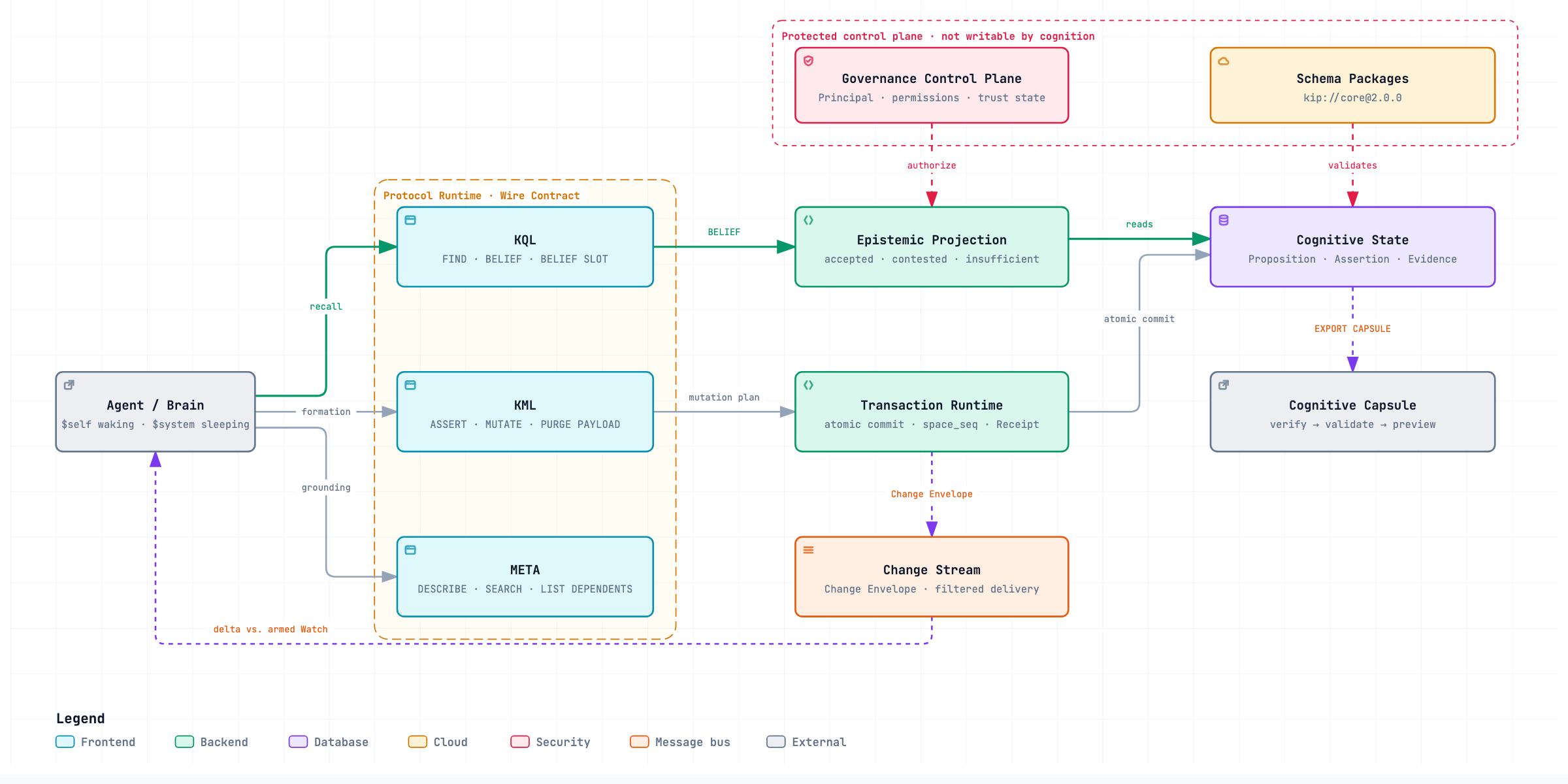
An interactive version — pan, zoom, relationship tracing, five guided views — is a self-contained file: download it and open it in a browser.
The one idea
A memory that cannot separate what was said from what is true will eventually lie to its owner with total confidence. KIP 2.0 refuses to collapse three questions:
Meaning      what can be represented at all
Belief       what the Brain currently accepts
Authority    who may read, write, project, or elevate
So a stored Proposition is truth-neutral. An Assertion carries one actor's stance toward it, with mode, confidence, validity and evidence. Belief is not a stored field but an Epistemic Projection computed at read time over the eligible assertions:
Proposition exists ≠ Proposition is true ≠ Brain accepts Proposition
Change never rewrites the past. Three kinds of change keep three different histories:
- The world changed. One new Assertion from the time of the change. Temporal succession closes the actor's older value at that point, so a formerly true claim is ended rather than declared wrong, and historical queries still answer with it. An inference participates in succession only when it specifies a start in
valid_time.from. - A claim was wrong. A new Assertion supersedes the old one, which stays on record.
- The Brain misrecorded it. Recording repair invalidates the wrong extraction; the source bytes and everyone's stance stay as they were.
Time is stated as honestly as it is known: asserted_at is when a claim was made, not when it was recorded; a claim with no stated start began no later than that; and a coarse date is a time bound, not an invented instant. A preference is an ordinary claim that changes within its kind — there is no Preference type. Where claims of one slot still conflict, the standard memory policy kip:memory-default resolves them the same way on every engine: context specificity first, then first-person testimony, then recency.
Evidence, provenance and schema get the same treatment: Evidence and Activity are first-class elements rather than metadata bags, and schema lives in versioned, digest-pinned packages. A Brain that meets a relation the Profile lacks drafts it into the Space's draft vocabulary with DEFINE, which only adds; promoting a draft onto an installed symbol is a Schema migration that only a Principal holding manage_schema performs. Retrieval composes with belief in one query through the Search Pattern: search finds candidates, and BELIEF decides what is accepted.
The proactivity layer
A memory that only answers when asked is half a memory. The other half is what the Brain does when nobody is talking to it — and it must not be a cron job. KIP 2.0 gives that half four mechanisms, none of which decides policy on the Brain's behalf:
| Mechanism | What it is |
|---|---|
Watch |
Durable attention state. A declared condition under which a change — or the absence of one — deserves attention. Armed watches are evaluated against committed Change Envelopes: a delta watch fires on a matching committed change; a silence watch fires once due_at has passed and the evaluator has consumed the change stream through that deadline without a match — the clock alone proves nothing. Proactivity becomes a state differential rather than a blind schedule. A fired Watch grants nothing: it creates attention, never an action, and reaches the business Agent through the Memory Interface's attention recall. |
action_gate |
An Activity class recording what the gate decided — act, ask, defer, or silence — with the inputs it weighed. Restraint is the hardest thing to justify after the fact, so deliberate silence is written down like any other outcome. |
LIST DEPENDENTS |
Bounded reverse traversal of provenance. Revise a root and the cognition compiled from it — insights, preference summaries, skills, the self-model — becomes discoverable in one operation instead of quietly stale. §57.5 makes the rule explicit: a revised root must not auto-retract its dependents, and must leave them reviewable. Whether one survives is a review decision, not a protocol rule. |
PURGE PAYLOAD |
Destroy an Evidence element's observed bytes while keeping the record: its digest, class, observation time, source, and the citations that depend on it. Data minimization that costs no provenance — corroboration and independence counting keep working on the surviving digest. Distinct from element purge, which destroys the record itself. |
Supporting state lives in the Cognitive Memory Profile: WorkingState is the consolidated resume digest stamped with its basis_seq, so a Brain wakes from compiled state plus a delta rather than re-reading scrollback; computed dependency validity makes a revised root visible at the next read; and MnemonicState.utility holds the admission bet — how useful this memory is expected to be — kept deliberately separate from salience, from memory_strength, and from epistemic confidence. Strength itself is computed at read time from a base, an anchor and a pinned decay policy; nothing sweeps it, and reading never reinforces it.
The consequence channel
Everything above makes the system watch the world better. The consequence channel is how the world watches back.
Outcome Evidence records what actually happened after a decision, action, or trialed procedure — written by instrumentation (telemetry, verifiers, test harnesses, human review), never by the actor whose action it grades. An actor's own account is agent_statement, citable as context only; the separation is a conformance invariant, enforced as auditability — engine origin always records who wrote what, and Governance can restrict who may write outcomes — because an open protocol can make self-grading visible even where it cannot make it impossible.
Each outcome carries a task family that selects candidate consequences. Sharing the family establishes neither attribution nor baseline membership: under the optional Validated Learning companion
Questions
What is KIP?
ldclabs/KIP is a public repo on GitHub by ldclabs. 🧬 KIP (Knowledge Interaction Protocol) is an open protocol for durable AI agent memory and learning. It connects experience, evidence, knowledge, and skills in a portable, auditable cognitive state, helping agents revise beliefs and improve future decisions through feedback from real outcomes.
Is KIP open source?
It declares the MIT license on GitHub.
Does KIP run on macOS, Windows or Linux?
Its maker has not tagged a system, so it is unknown here. Its README says what it needs.