
Advanced-Computer-Architecture
Advanced Computer Architecture laboratory_1 using gem5
- 0
- 6 y ago
Repo lkmeta/Advanced-Computer-Architecture, read from GitHub 16 h ago. lkmeta has not joined Take My Repo.
In short
lkmeta/Advanced-Computer-Architecture is a public repo on GitHub by lkmeta. Advanced Computer Architecture laboratory_1 using gem5. It declares no license on GitHub. Public does not mean open source: without a license, nobody is granted the right to reuse it. It is written mainly in C, has 0 stars and last changed on 2020-11-23. Nobody has reviewed it on Take My Repo yet, which says nothing about its quality. Read from GitHub on 2026-11-23.
Advanced Computer Architecture
Meta Louis-Kosmas
AEM : 9390
Εργαστήριο νο1
1) Ανάλυση του αρχείου starter_se.py και άντληση πληροφοριών.
Υπάρχουν τρία είδη CPUs και είναι:
- atomic
- minor
- hpi
αυτά προκύπτουν από το ακόλουθο σημείο:
cpu_types = {
    "atomic" : ( AtomicSimpleCPU, None, None, None, None),
    "minor" : (MinorCPU,
               devices.L1I, devices.L1D,
               devices.WalkCache,
               devices.L2),
    "hpi" : ( HPI.HPI,
              HPI.HPI_ICache, HPI.HPI_DCache,
              HPI.HPI_WalkCache,
              HPI.HPI_L2)
}
- Η συχνότητα λειτουργίας είναι 1 GHz και η τάση είναι στα 3.3V τα οποία φαίνονται παρακάτω:
# Create a voltage and clock domain for system components
        self.voltage_domain = VoltageDomain(voltage="3.3V")
        self.clk_domain = SrcClockDomain(clock="1GHz",
                                         voltage_domain=self.voltage_domain)
- Επιπλέον, η δημιουργία του memory bus και του memory mode που παίρνει την τιμή "timing" προκύπτουν από εδώ:
# Create the off-chip memory bus.
        self.membus = SystemXBar()

# Create a cache hierarchy (unless we are simulating a
        # functional CPU in atomic memory mode) for the CPU cluster
        # and connect it to the shared memory bus.
        if self.cpu_cluster.memoryMode() == "timing":
            self.cpu_cluster.addL1()
            self.cpu_cluster.addL2(self.cpu_cluster.clk_domain)
        self.cpu_cluster.connectMemSide(self.membus)
- Όσον αφορά τον cluster συμπεραίνουμε ότι έχουμε τάση 1.2V.
# Add CPUs to the system. A cluster of CPUs typically have
# private L1 caches and a shared L2 cache.
self.cpu_cluster = devices.CpuCluster(self,
                                      args.num_cores,
                                      args.cpu_freq, "1.2V",
                                      *cpu_types[args.cpu])
- Η μνήμη cache έχει τιμή 64 bytes.
# Use a fixed cache line size of 64 bytes
    cache_line_size = 64
- Η default τιμή της mem_type είναι DDR3_1600_8x8.
    parser.add_argument("--mem-type", default="DDR3_1600_8x8",
                        choices=ObjectList.mem_list.get_names(),
                        help = "type of memory to use")
- Η default τιμή της mem_size είναι 2GB.
    parser.add_argument("--mem-size", action="store", type=str,
                        default="2GB",
                        help="Specify the physical memory size")
- Στο αρχείο hello που βρίσκεται στον φάκελο hello_res που ουσιαστικά είναι και η πρώτη προσομοίωση που τρέχουμε, χρησιμοποιούμε όλες τις default τιμές εκτός από το cpu-type την οποία επιλέγουμε "minor".
Οι υπόλοιπες default τιμές φαίνονται παρακάτω.
    parser = argparse.ArgumentParser(epilog=__doc__)

    parser.add_argument("commands_to_run", metavar="command(s)", nargs='*',
                        help="Command(s) to run")
    parser.add_argument("--cpu", type=str, choices=list(cpu_types.keys()),
                        default="atomic",
                        help="CPU model to use")
    parser.add_argument("--cpu-freq", type=str, default="4GHz")
    parser.add_argument("--num-cores", type=int, default=1,
                        help="Number of CPU cores")
    parser.add_argument("--mem-channels", type=int, default=2,
                        help = "number of memory channels")
    parser.add_argument("--mem-ranks", type=int, default=None,
                        help = "number of memory ranks per channel")
2) Ανάλυση των αρχείων stats.txt,config.ini και config.json.
a) Αρχικά, από το config.ini αρχείο συμπεραίνουμε τα εξής:
- το είδος CPU που χρησιμοποιήθηκε στην προσομοίωση είναι τύπου minor
- η τάση του επεξεργαστή είναι 3.3V και η συχνότητα είναι 1GHz (διότι έχουμε 1000 ticks)
- η τάση του cluster είναι 1.2V και η συχνότητα είναι 4GHz (διότι έχουμε 250 ticks)
- η μνήμη cache έχει μέγεθος 64 bytes
- το mem_mode παίρνει την τιμή "timing"
Παρατήρηση: αναμενόμενες τιμές όπως αναφέρθηκαν στην ανάλυση του starter_se.py αρχείου.
Αυτά προκύπτουν από τα ακόλουθα σημεία:
[system.cpu_cluster.cpus]
type=MinorCPU
...
time_sync_period=100000000000
...
cache_line_size=64
...
mem_mode=timing
...
[system.clk_domain]
type=SrcClockDomain
clock=1000
...
[system.cpu_cluster.clk_domain]
type=SrcClockDomain
clock=250
...
[system.voltage_domain]
type=VoltageDomain
voltage=3.3
...
[system.cpu_cluster.voltage_domain]
type=VoltageDomain
voltage=1.2
Συνεχίζοντας, από το config.json αρχείο επαληθεύονται όσα είπαμε για το config.ini από τα παρακάτω σημεία:
"cpus": [
             {
                 "type": "MinorCPU",
                 "cxx_class": "MinorCPU",
                 "name": "cpus",
...
"time_sync_period": 100000000000,
...
"cache_line_size": 64
...
"mem_mode": "timing"
...
clk_domain": {
         "type": "SrcClockDomain",
         "cxx_class": "SrcClockDomain",
         "name": "clk_domain",
         "path": "system.clk_domain",
         "clock": [
             1000
         ]
...
"clk_domain": {
             "type": "SrcClockDomain",
             "cxx_class": "SrcClockDomain",
             "name": "clk_domain",
             "path": "system.cpu_cluster.clk_domain",
             "clock": [
                 250
             ]
         }
...
"voltage_domain": {
         "type": "VoltageDomain",
         "cxx_class": "VoltageDomain",
         "name": "voltage_domain",
         "path": "system.voltage_domain",
         "eventq_index": 0,
         "voltage": [
             3.3
         ]
     }
...
"voltage_domain": {
             "type": "VoltageDomain",
             "cxx_class": "VoltageDomain",
             "name": "voltage_domain",
             "path": "system.cpu_cluster.voltage_domain",
             "eventq_index": 0,
             "voltage": [
                 1.2
             ]
         }
Aπό το stats.txt αρχείο έχουμε επιπλέον πληροφορίες που επαληθεύουν κάποια από τα πρηγούμενα:
- η τάση του επεξεργαστή είναι 3.3V και η συχνότητα είναι 1GHz (διότι έχουμε 1000 ticks)
- η τάση του cluster είναι 1.2V και η συχνότητα είναι 4GHz (διότι έχουμε 250 ticks)
Αυτά προκύπτουν από τα ακόλουθα σημεία:
| stats.txt | ||
|---|---|---|
| sim_freq | 1000000000000 | # Frequency of simulated ticks |
| system.clk_domain.clock | 1000 | # Clock period in ticks |
| system.cpu_cluster.clk_domain.clock | 250 | # Clock period in ticks |
| system.cpu_cluster.voltage_domain.voltage | 1.200000 | # Voltage in Volts |
| system.voltage_domain.voltage | 3.300000 | # Voltage in Volts |
b) Aπό το stats.txt αρχείο βρήκαμε το σύνολο των "committed" εντολών όπως φαίνεται παρακάτω:
- έχουμε συνολικά 5028 εντολές σε 0.000024 δευτερόλεπτα που προσομοιώθηκαν
Παρατήρηση: δεν υπάρχει διαφορά στα committed insts με τα simulated insts.
Αυτά προκύπτουν από τα ακόλουθα σημεία:
| stats.txt | ||
|---|---|---|
| sim_insts | 5028 | # Number of instructions simulated |
| system.cpu_cluster.cpus.committedInsts | 5028 | # Number of instructions committed |
| sim_seconds | 0.000024 | # Number of seconds simulated |
c) Aπό το stats.txt αρχείο βρήκαμε τον ζητούμενο αριθμό προσπελάσεων της l2 όπως φαίνεται παρακάτω:
- συγκεκριμένα, η l2 προσπελάστηκε συνολικά 479 φορές
| stats.txt | ||
|---|---|---|
| system.cpu_cluster.l2.overall_accesses::.cpu_cluster.cpus.inst | 332 | # number of overall (read+write) accesses |
| system.cpu_cluster.l2.overall_accesses::.cpu_cluster.cpus.data | 147 | # number of overall (read+write) accesses |
| system.cpu_cluster.l2.overall_accesses::total | 479 | # number of overall (read+write) accesses |
3) Πληροφορίες για μοντέλα in-order CPUs και ανάπτυξη προγράμματος με gem5.
Υπάρχουν τρία μοντέλα in-orders SimpleCPUs και είναι τα εξής:
- BaseSimpleCPU
- AtomicSimpleCPU
- TimingSimpleCPU
Αναλυτικότερα:
+ BaseSimpleCPU
The BaseSimpleCPU serves several purposes:
- Holds architected state, stats common across the SimpleCPU models.
- Defines functions for checking for interrupts, setting up a fetch request, handling pre-execute setup, handling post-execute actions, and advancing the PC to the next instruction. These functions are also common across the SimpleCPU models.
- Implements the ExecContext interface. The BaseSimpleCPU can not be run on its own. You must use one of the classes that inherits from BaseSimpleCPU, either AtomicSimpleCPU or TimingSimpleCPU.
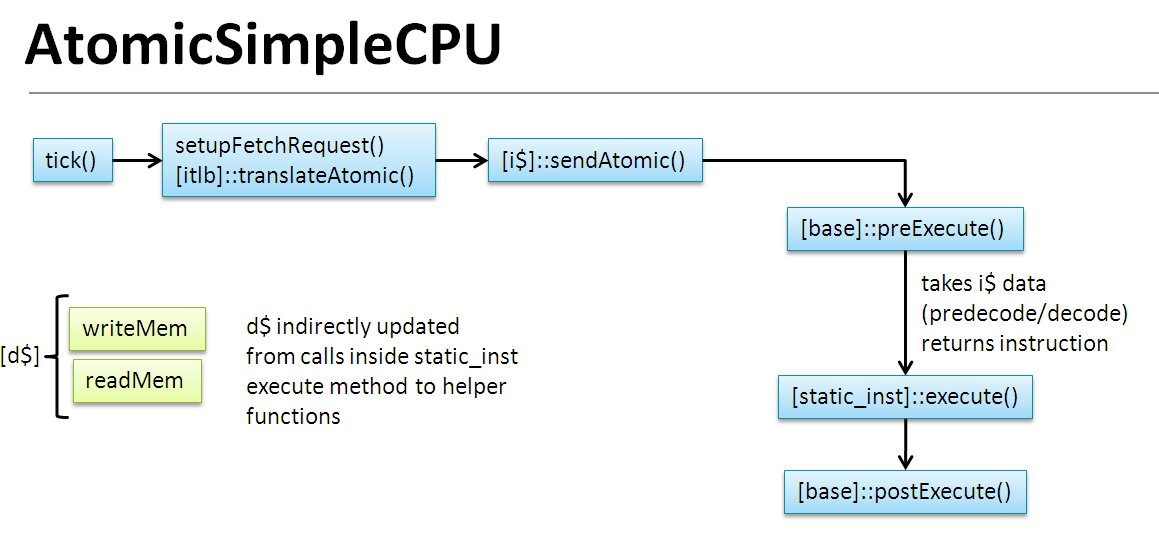
+ AtomicSimpleCPU
The AtomicSimpleCPU is the version of SimpleCPU that uses atomic memory accesses. It uses the latency estimates from the atomic accesses to estimate overall cache access time. The AtomicSimpleCPU is derived from BaseSimpleCPU, and implements functions to read and write memory, and also to tick, which defines what happens every CPU cycle. It defines the port that is used to hook up to memory, and connects the CPU to the cache.
+ TimingSimpleCPU
The TimingSimpleCPU is the version of SimpleCPU that uses timing memory accesses (see Memory systems for details). It stalls on cache accesses and waits for the memory system to respond prior to proceeding. Like the AtomicSimpleCPU, the TimingSimpleCPU is also derived from BaseSimpleCPU, and implements the same set of functions. It defines the port that is used to hook up to memory, and connects the CPU to the cache. It also defines the necessary functions for handling the response from memory to the accesses sent out.
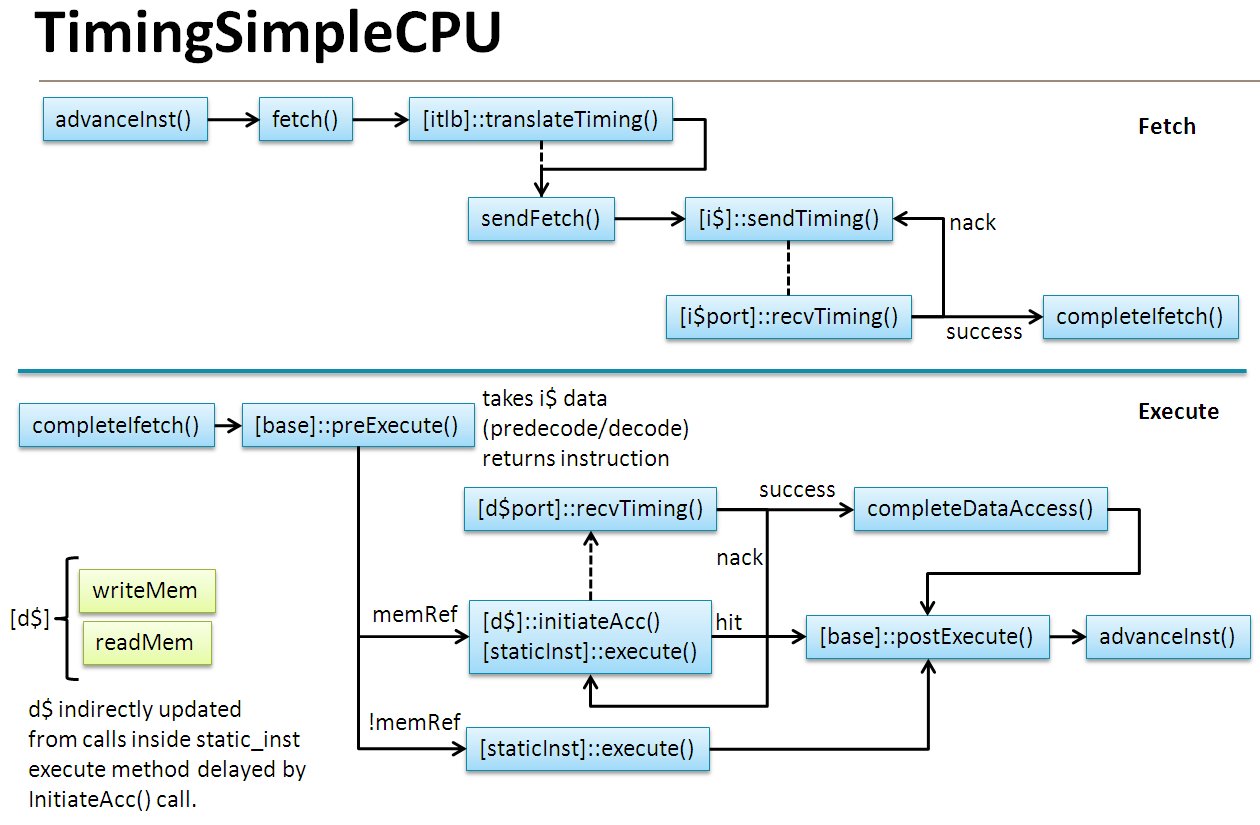
Source: https://www.gem5.org/documentation/general_docs/cpu_models/SimpleCPU
Εκτός από in-orders SimpleCPUs μοντέλα έχουμε και άλλα είδη όπως τα ακόλουθο:
- Minor CPU Model
Minor is an in-order processor model with a fixed pipeline but configurable data structures and execute behaviour. It is intended to be used to model processors with strict in-order execution behaviour and allows visualisation of an instruction’s position in the pipeline through the MinorTrace/minorview.py format/tool. The intention is to provide a framework for micro-architecturally correlating the model with a particular, chosen processor with similar capabilities.
Source: https://www.gem5.org/documentation/general_docs/cpu_models/minor_cpu
a) Ο κώδικας που έγραψα για να δοκιμάσω την προσομοίωση κάνει το εξής:
- υπολογίζει τον fibonacci αριθμό του 46 με δυναμικό προγραμματισμό
Το πρόγραμμα γράφτηκε σε C και στην συνέχεια με χρήση της παρακάτω εντολής κάναμε compile για να μπορούμε να το τρέξουμε με τον gem5.
arm-linux-gnueabihf-gcc --static fib.c -o fib_arm
Εκτελώντας τις παρακάτω εντολές διαδοχικά, δημιουργήσαμε τις απαιτούμενες προσομοιώσεις για το πρόγραμμα μας.
Αναλυτικότερα, υλοποιούν το πρόγραμμα με χρήση δύο διαφορετικών CPUs με default επιλογή για όλα τα υπόλοιπα.
./build/ARM/gem5.opt -d fib_res_MinorCPU configs/example/se.py --cpu-type=MinorCPU --caches -c my_tests/fib_with_dynamic_programming/fib_arm
./build/ARM/gem5.opt -d fib_res_TimingSimpleCPU configs/example/se.py --cpu-type=TimingSimpleCPU --caches -c my_tests/fib_with_dynamic_programming/fib_arm
- Χρόνοι εκτέλεσης προγράμματος
- Βρίσκονται στο αρχείο stats.txt
| CPU model | sim_seconds |
|---|---|
| Minor CPU | 0.000039 |
| TimingSimpleCPU | 0.000047 |
b) Παρατηρώντας τα προηγούμενα, προκύπτει πως υπάρχει διαφορά χρόνων στα δυο διαφορετικά μοντέλα CPUs.
Η διαφορά αυτή στους χρόνους που προέκυψαν οφείλεται στο γεγονός ότι ο TimingSimpleCPU περιμένει την προσπέλαση μνήμης να ολοκληρωθεί προτού συνεχίσει. Αντίθετα, στον MinorCPU δεν συμβαίνει αυτό με αποτέλεσμα να έχουμε ταχύτερη προσομοίωση.
c) Αλλαγή μνήμης και συχνότητα λειτουργίας του προγράμματος.
Στο συγκεκριμένο ερώτημα έγιναν δύο αλλαγές που αφορούν την τεχνολογία της μνήμης και την συχνότητα ως εξής:
Αλλαγή μνήμης
Τρέχοντας την παρακάτω εντολή,./build/ARM/gem5.opt configs/example/se.py --list-mem-typeπροκύπτει η λίστα που ακολουθεί στην οποία φαίνονται όλες οι διαθέσιμες μνήμες που μπορούμε να χρησιμοποιήσουμε.

Εμείς χρησιμοποιήσαμε την DDR4_2400_16X4 για το παράδειγμα μας.
Αλλαγή συχνότητας
Η default συχνότητα που δοκιμάσαμε τo πρόγραμμα μας προηγουμένως ήταν 1GHz. Για το συγκεκριμένο ερώτημα ωστόσο, επιλέξαμε να τροποποιήσουμε την συχνότητα και να τρέξουμε δύο προσομοιώσεις με συχνότητες 0.8GHz και 1.4GHz. Αυτό υλοποιήθηκε με την προσθήκη των παρακάτω εντολών διαδοχικά.--sys-clock="0.8GHz" --sys-clock="1.4GHz"Στις παρακάτω εικόνες φαίνονται οι εντολές που χρησιμοποιήθηκαν για το MinorCPU μοντέλο, αντίστοιχα έγιναν και για το TimingSimpleCPU.

Questions
What is Advanced-Computer-Architecture?
lkmeta/Advanced-Computer-Architecture is a public repo on GitHub by lkmeta. Advanced Computer Architecture laboratory_1 using gem5.
Is Advanced-Computer-Architecture open source?
It declares no license on GitHub. Public does not mean open source: without a license, nobody is granted the right to reuse it.