LogitOS
A standalone x86_64 operating system, not a Linux distribution: its own BIOS/UEFI loaders, kernel, filesystem, network stack, window system and browser engine, with an AI agent service running as an ordinary ring-3 process. 独立的 x86_64 操作系统,内置 AI 智能体服务
- 4
- 3 wk ago
Repo logitcai/LogitOS, read from GitHub 13 min ago. logitcai has not joined Take My Repo.
In short
logitcai/LogitOS is a public repo on GitHub by logitcai. A standalone x86_64 operating system, not a Linux distribution: its own BIOS/UEFI loaders, kernel, filesystem, network stack, window system and browser engine, with an AI agent service running as an ordinary ring-3 process. 独立的 x86_64 操作系统,内置 AI 智能体服务. It declares no license on GitHub. Public does not mean open source: without a license, nobody is granted the right to reuse it. It is written mainly in C, has 4 stars and last changed on 2026-11-02. Nobody has reviewed it on Take My Repo yet, which says nothing about its quality. Read from GitHub on 2026-11-24.
Similar repos
LLMs-from-scratch
Implement a ChatGPT-like LLM in PyTorch from scratch, step by step


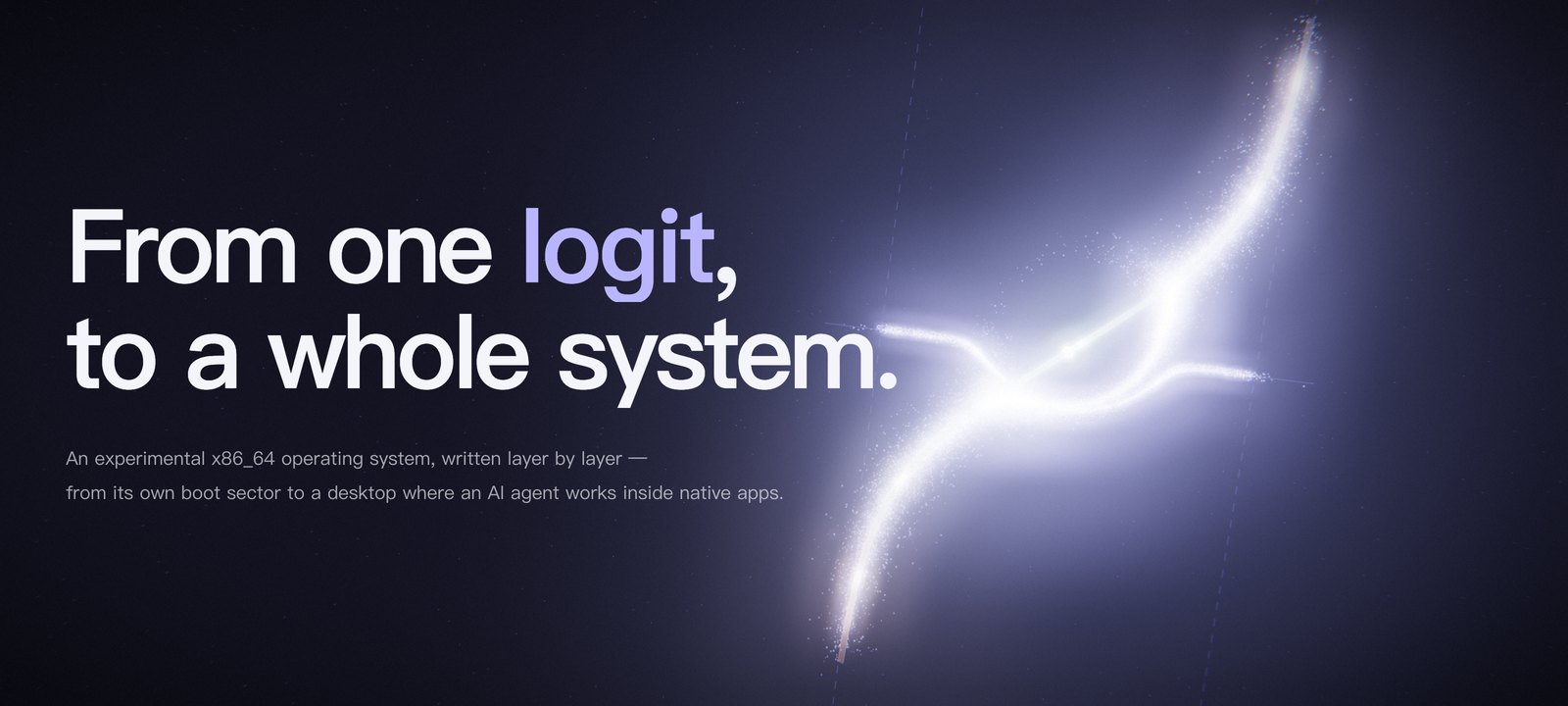
Build & run · What it can do · The agent · What does not work · Numbers · Transparency
LogitOS is a standalone operating system for x86_64. It is not a Linux distribution, a Linux fork or a skin over a host OS: it boots through its own BIOS and UEFI loaders and its own boot protocol, and the kernel, drivers, filesystem, network stack, TLS, graphics stack, window system, browser engine, programming language and applications are maintained in this repository — alongside clearly identified ports such as QuickJS and NetSurf LibCSS (see THIRD_PARTY.md).
The name is the point. A logit is the raw score a model produces before it becomes a choice. LogitOS asks
what an operating system looks like when those scores have to land on a real machine: an agent service
(agentd) runs as an ordinary ring-3 process, sees only the files you hand it, and returns its work to native
applications as a reviewable proposal — never as a silent edit.
How it is made. LogitOS is human-directed and its first-party production code is written by AI coding agents, as a matter of policy. Humans set goals, design the architecture, review, test, verify and integrate. Every test is expected to carry a negative control — a deliberately broken build that the test must catch — and user-interface work is checked screen by screen in QEMU against the previous image. See CONTRIBUTING.md and TRANSPARENCY.md.
Status: experimental. LogitOS is a research and learning system. There is no security support and no SLA. Do not use it to protect real credentials, personal data, keys or production workloads, and do not treat its browser, TLS, isolation, filesystem or drivers as a security boundary. See SECURITY.md.
At a glance
Lines of code in git-tracked files on main (2026-10-29, comments and blank lines included):
| Layer | Where | Lines |
|---|---|---|
| Boot (BIOS + UEFI loaders, long-mode entry) | c/boot/ |
3,948 |
| Kernel (window compositor, processes & loader, memory, CPU/ACPI, scheduler, …) | c/kernel/ |
66,547 |
| Drivers (USB, GPU, NICs, block, audio, virtio, power, timers) | c/drivers/ |
35,200 |
| Filesystem (LogitFS, VFS, procfs, ramfs, caches) | c/fs/ |
9,366 |
| Network and cryptography (IP, TCP, DNS, TLS, HTTP/1.1 + HTTP/2, SSH) | c/net/, c/crypto/ |
55,975 |
| Graphics, text and media libraries | c/lib/ |
84,942 |
| Browser engine | c/apps/gui/browser/ |
131,650 |
| AetherScript language | c/apps/as/ |
23,649 |
| C library | c/apps/libc/ |
19,545 |
In total git ls-files tracks about 1.14 million lines of code, across more than 1,690 commits since 2026-05-30.
 |
 |
 |
 |
 |
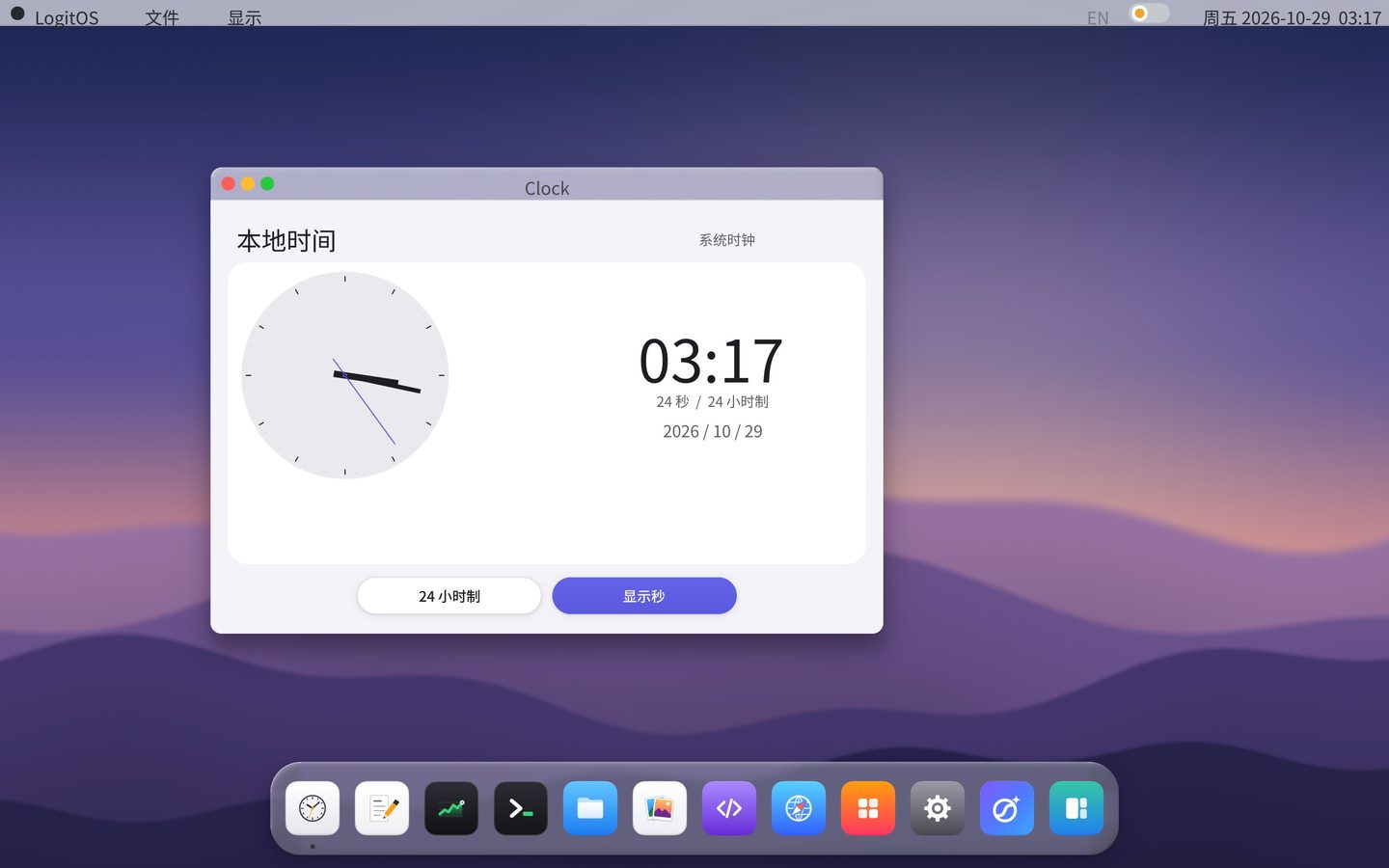 |
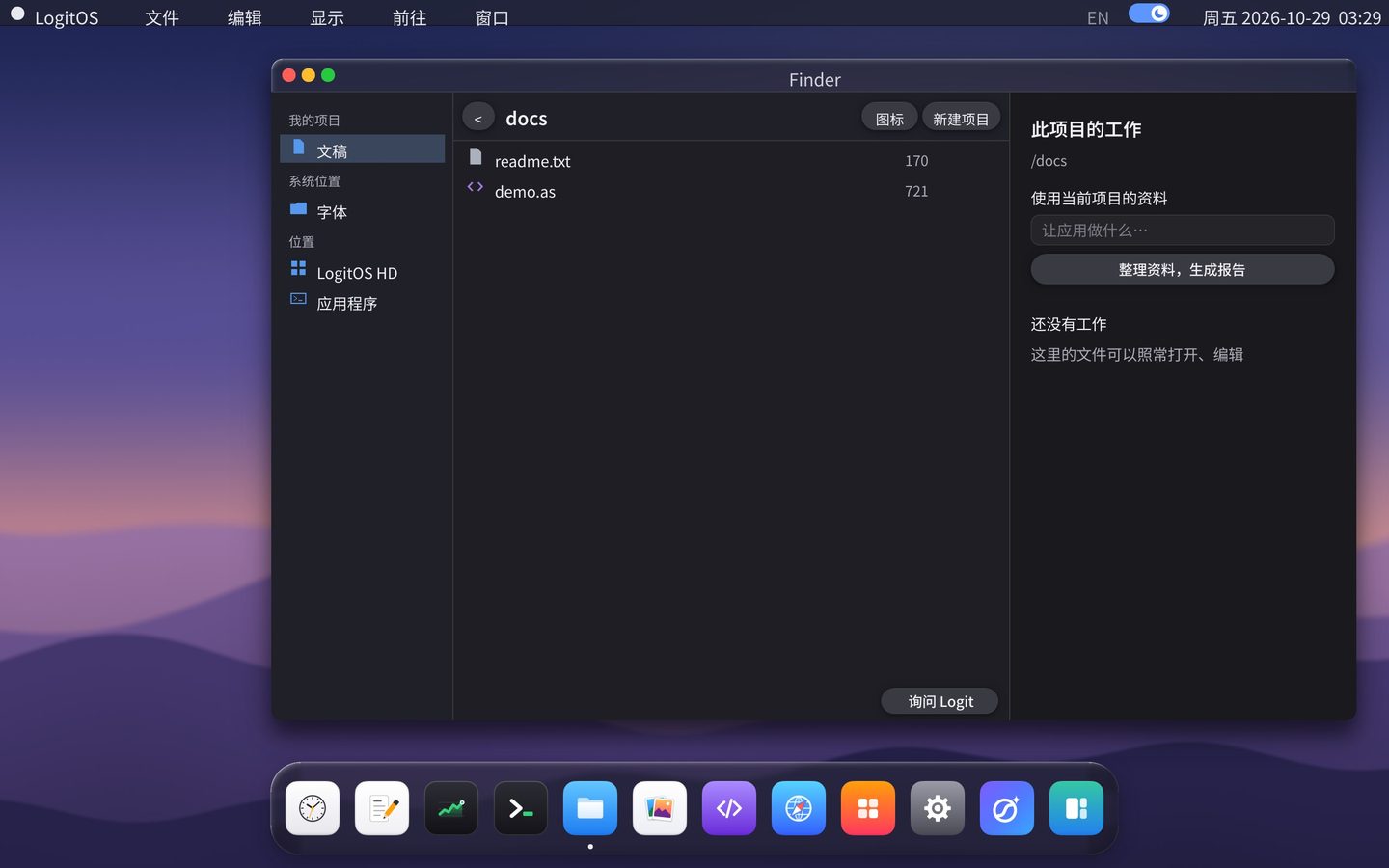
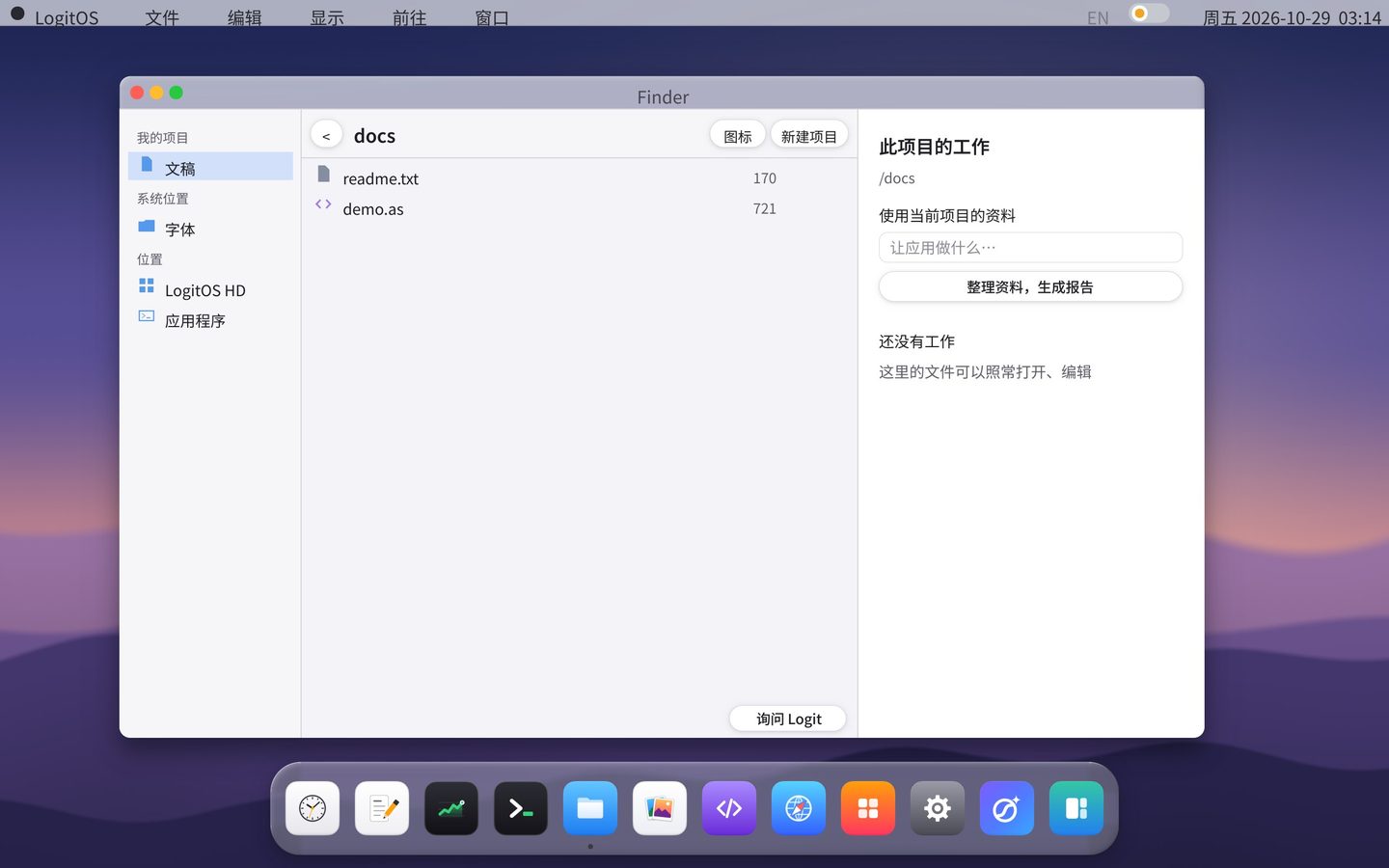
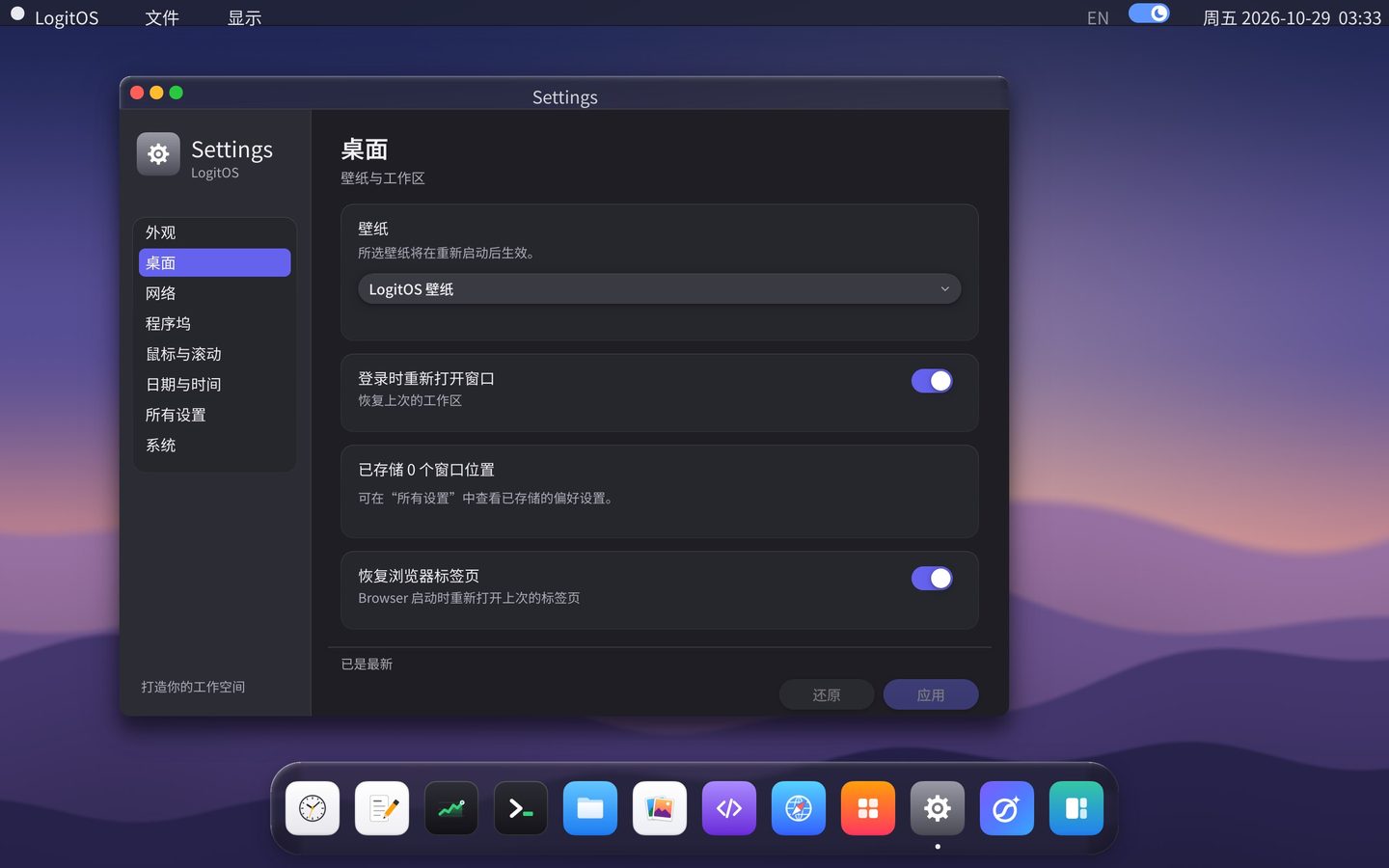
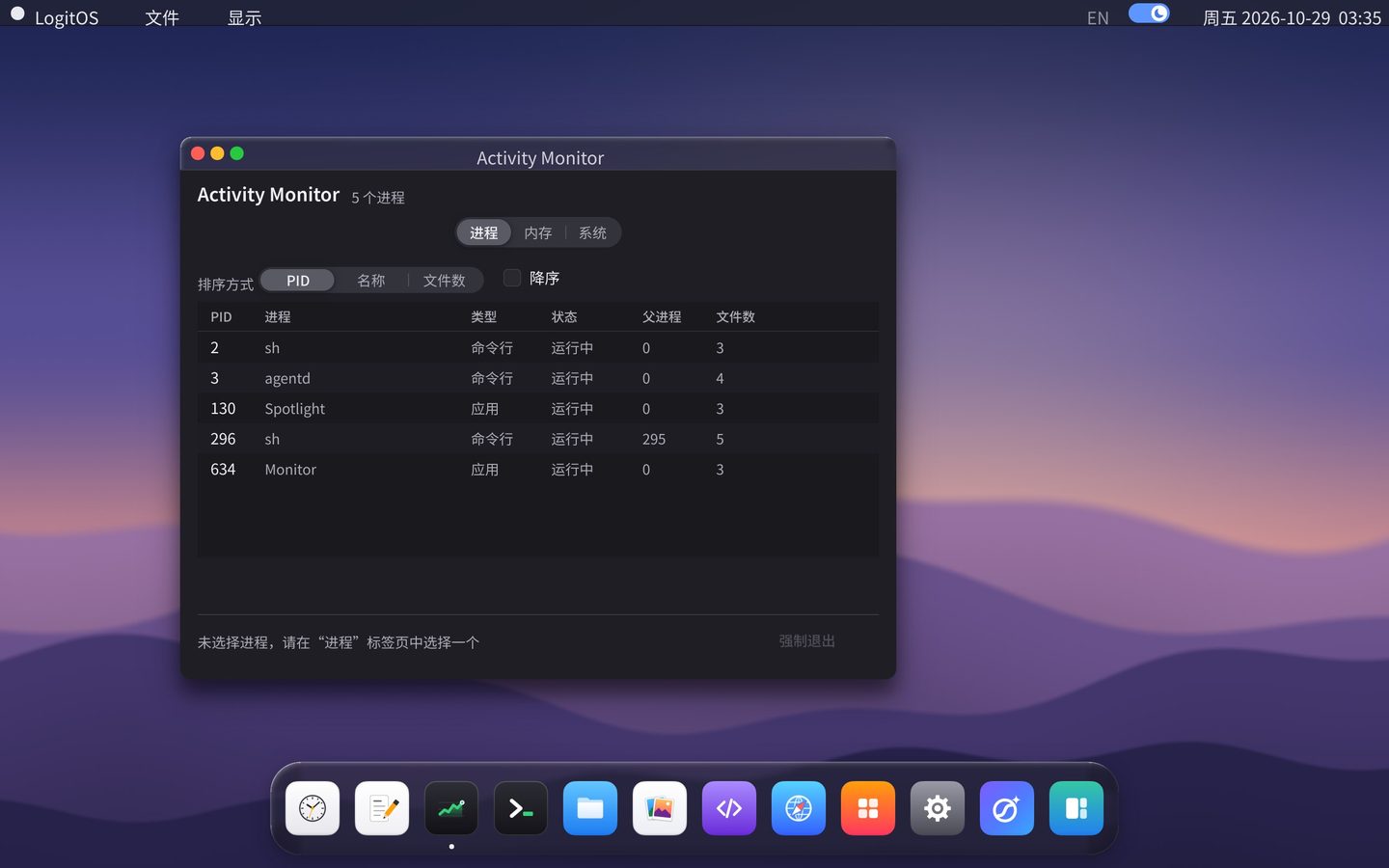
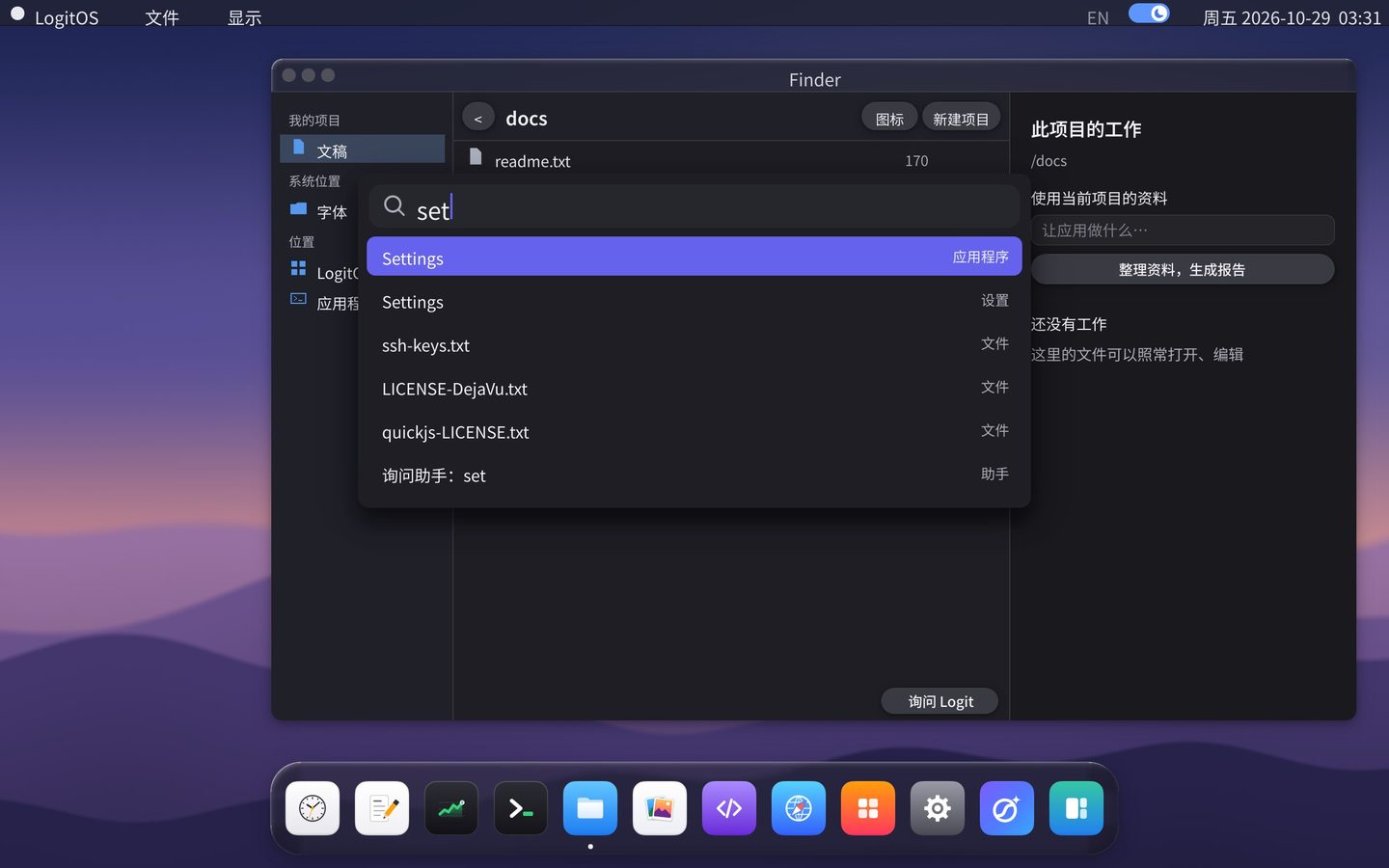
Real screenshots from QEMU, captured at 2560 × 1600 by the project's own UI tour (tools/ui_tour.py).
How the layers fit
flowchart TB
  subgraph R3["Ring 3"]
    direction LR
    APPS["Native apps<br/>Finder · TextEdit · Terminal · Code Studio · Settings · …"]
    BR["Browser<br/>HTML5 · CSS (LibCSS) · layout · paint · QuickJS"]
    AG["agentd<br/>scoped tasks · reviewable proposals"]
    AS["AetherScript<br/>/bin/as · LLVM AOT"]
  end
  subgraph LIB["Shared libraries"]
    direction LR
    AUI["aui toolkit"] --- GFX["gfx · gfx3d · OpenLogit"] --- TXT["text · image · video · audio · nn"] --- LIBC["libc · musl libm"]
  end
  subgraph K["Kernel"]
    direction LR
    WM["Compositor + GUI ABI v2"] --- SCH["Scheduler (weighted vtime, SMP)"] --- MM["Memory (physmap, rmap, reclaim, swap)"] --- FS["VFS · LogitFS · page cache"] --- NET["TCP/IP · TLS · HTTP/2"]
  end
  subgraph HW["Drivers and boot"]
    direction LR
    DRV["virtio · NVMe · AHCI · xHCI · HDA · e1000 · RTL8169"] --- BOOT["BIOS + UEFI loaders · long-mode entry"]
  end
  R3 --> LIB --> K --> HW
  classDef app fill:#1b1430,stroke:#c27bff,color:#f4f4fb
  classDef lib fill:#0f1d26,stroke:#3cc4ff,color:#f4f4fb
  classDef ker fill:#241809,stroke:#ff9a4a,color:#f4f4fb
  classDef hw fill:#2a1015,stroke:#ff5a6a,color:#f4f4fb
  class APPS,BR,AG,AS app
  class AUI,GFX,TXT,LIBC lib
  class WM,SCH,MM,FS,NET ker
  class DRV,BOOT hw
  style R3 fill:#0d0a18,stroke:#7b78ff,color:#c9c7ff
  style LIB fill:#0a1318,stroke:#38e6a8,color:#bff5e2
  style K fill:#170f07,stroke:#ffd35c,color:#ffe9b0
  style HW fill:#170a0d,stroke:#ff7a5a,color:#ffc9bd
A real boot, as it prints
Selected lines from one boot's serial output (QEMU, 4 vCPUs, 512 MiB)
LOADER ENTER KERNEL
LOGIT_BOOT_NATIVE_OK version=0001
[logitos] long mode, C kernel running
[prot] bsp: nx sup/ON  wxsplit ON  smep sup/ON  smap sup/off
[time] source=tsc 1000.005 MHz res=1ns  (invariant-tsc=no hypervisor=yes calib=pit-ch2)
[mm] boot: 131037 frames total (511 MiB), 118514 free, 12523 used, 0 shared, 12523 refs, 0 pinned, 0 bugs
[rmap] 131037 frames, 196555 nodes (3599 KiB total: 511 KiB heads + 3071 KiB nodes)
[logitos] interrupts + memory + gdt/tss online
[pcache] up: 65518 page slots (262072 KiB ceiling), 32 file slots, 16384 buckets
[blk] 1 disk, 0 partitions; root = vblk0 (LogitFS superblock)
[fs] mounted
[tls] trust store: 130 roots, 0 skipped
[dhcp] bound 10.0.2.15/24 gw 10.0.2.2 dns 10.0.2.3
[ime] /ime/pinyin-qwen.dat: 1983418 bytes, 49000 pinyin keys -- Shift+Space toggles pinyin input
[logitos] desktop up; mouse + keyboard armed
[smp] 4/4 CPUs online
[smp] parallel present on 4 cores (IPI 241)
LOGIT_BOOT_OK
[wm] launched Finder
[sched] first-run tid 11 (Finder)
[sched] first-run tid 14 (agentd)
What it can do
Boot, kernel and memory
- Its own boot path, BIOS and UEFI.
tools/mkiso.pywrites the ISO,c/boot/bios/brings the machine up from the El Torito boot sector andc/boot/efi/loader.cdoes the same under UEFI. A real boot under QEMU reports, in order: loader → long mode → CPU and protection setup → memory accounting → interrupts and devices → LogitFS mounted → TLS trust store → network → desktop → SMP bring-up →LOGIT_BOOT_OK→ the first ring-3 apps. - SMP. Application processors are brought up through ACPI, the LAPIC and a trampoline (
[smp] 4/4 CPUs online). The big kernel lock is gone: synchronisation follows object ownership (docs/BKL_REMOVAL_2026-09-10.md). - A weighted scheduler. On every 100 Hz tick each core runs the runnable thread with the smallest weighted
virtual time, where
weight = round(1024 · 2^(−nice/10))— a decade of nice is exactly a factor of two, and the table spans 4096:274. A waking thread is placed at the run ring's virtual "now", so it runs soon but banks no credit for having slept (c/kernel/sched/sched.c). - Memory. Per-process address spaces, a physical map backed by 2 MiB pages, per-frame metadata (bitmap, poison map, 2-byte reference counts), reverse mapping, page reclaim, swap and a page cache. On a deliberately small 192 MiB machine running the desktop plus a program mapping more memory than exists, thousands of frames are evicted per run with no allocation failures.
- A boundary between ring 3 and the kernel. NX, SMEP and W^X are enabled at boot; every pointer crossing the
syscall boundary is validated with the user bit required at every level of the page walk, and
make test-secruns one attack per process from/bin/secprobe. SMAP is not enabled yet.
Storage, devices and networking
- LogitFS — a journalled (write-ahead log,
data=ordered) read-write filesystem with record checksums, barriers that actually reach the device, and a read-onlyfsckat every mount.make test-durabilityboots one image five times without-snapshot, and 1,744 host checks cut power at every single device write. - Devices — virtio 1.0 (blk, gpu, net), AHCI and NVMe, xHCI with USB HID and storage, Intel HDA audio, Intel e1000 and Realtek RTL8169/8139, plus ATA, PS/2 and VGA fallbacks.
- Networking — project implementations of Ethernet/ARP, IPv4 and IPv6 with neighbour discovery, DHCP, TCP,
UDP, DNS, HTTP/1.1 and HTTP/2 (frames and HPACK), a connection pool and a cookie jar. TLS 1.3 and 1.2
with x25519 and P-256/384/521, HelloRetryRequest and PSK resumption (
psk_dhe_keonly), a limited X.509 verifier and a 130-root trust store; interop is checked against a realopenssl s_serveracross 48 cases. See the network support matrix.
Graphics, text and the desktop
- A graphics stack of its own (
c/lib/gfx,c/lib/gfx3d): vector paths and strokes, arcs and squircles, linear, radial and conic gradients, Porter–Duff blending, filtered image blits, clip stacks and opacity groups, analytic shadows, four tiers of glass material with backdrop blur and adaptive tint, easing curves and fixed-point springs — and a software 3D pipeline with raster state, depth, culling, mipmapped textures, and a shading language (LSL) compiled to a small IR and VM. Applications reach the compositor through a validated GUI ABI v2 (SYS_GUI_PATH,GLASS2,SHADOW2,BLIT2,BACKDROP,TEXT_RUN2). - Text — TrueType and CFF outlines, colour fonts, OpenType shaping, bidi, UAX #14 line breaking, paragraph layout with head/middle/tail ellipsis, medium and semibold UI faces, and quarter-pixel glyph placement. A pinyin input method is built in (Shift+Space).
- The desktop — a compositor with damage tracking, a menu bar, a Dock, Spotlight, notifications, zoomed
windows and a toolkit (
aui) shared by the native apps: Finder, TextEdit, Terminal, Code Studio, Clock, Activity Monitor, Preview, Settings, the Browser and more. A new interface language, 「澄」 Clarity, is being rolled out; its first three waves (tokens, the widget toolkit, the window-manager split, generated app icons) are merged.
The browser
- A spec HTML5 parser — tokenizer 7032/7032 and tree construction 1723/1818 on the shared html5lib corpus (data only; the runner and the parser are ours), including the adoption agency algorithm and foster parenting.
- Live pages — a persistent QuickJS runtime with timers,
requestAnimationFrame, a drained microtask queue, full capture/target/bubble event dispatch and real default actions; a CSSOM with scoped invalidation;fetchwith streaming bodies,XMLHttpRequest, storage, observers,structuredClone,Intl, ES modules and more. - Media — H.264 High profile and H.265 Main/Main 10 decoders held to byte identity with ffmpeg (a real 1080p stream decodes byte for byte across 254 frames); MPEG-1/2, MPEG-4 Part 2 and MJPEG; WAV, FLAC, MP3, AAC, Vorbis and Opus; MP4/fMP4 and Matroska/WebM demuxing; PNG, JPEG, GIF (animated), WebP, APNG, ICO, BMP and EXIF.
The agent, inside the system
agentdis a ring-3 broker. A task sees only the files you select; its output comes back to the app that owns the document as a candidate, shown in TextEdit's work panel next to the text. Nothing changes until you apply it, a pending review survives a reboot, stale decisions are refused, and you can always keep the current version.- Models are reached through a host gateway (
tools/agent_gateway.py) so provider credentials never enter the guest; the guest gets a one-time capability for a single bounded endpoint. A local inference path for GGUF models lives inc/lib/nn. - A real run on 2026-10-29 (DeepSeek, BIOS, 512 MiB): 21 checks passed in 72 seconds, six model calls, all HTTP 200 — drafting a cited report, preserving a hand-written sentence, holding the proposal for review across a power cycle, applying and saving it, and keeping the document unchanged when asked.
Questions
What is LogitOS?
logitcai/LogitOS is a public repo on GitHub by logitcai. A standalone x86_64 operating system, not a Linux distribution: its own BIOS/UEFI loaders, kernel, filesystem, network stack, window system and browser engine, with an AI agent service running as an ordinary ring-3 process. 独立的 x86_64 操作系统,内置 AI 智能体服务.
Is LogitOS open source?
It declares no license on GitHub. Public does not mean open source: without a license, nobody is granted the right to reuse it.