awesome-scalability
The Patterns of Scalable, Reliable, and Performant Large-Scale Systems
- 76k
- MIT
- 11 mo ago
Experimental compiled language for backend development. No garbage collector. Native binaries via C. Ownership-based memory. Structured concurrency.
Repo loreste/mako, read from GitHub 7 h ago. loreste has not joined Take My Repo.
loreste/mako is a public repo on GitHub by loreste. Experimental compiled language for backend development. No garbage collector. Native binaries via C. Ownership-based memory. Structured concurrency. It declares the MIT license on GitHub. It is written mainly in Rust, has 6 stars and last changed on 2026-11-12. Nobody has reviewed it on Take My Repo yet, which says nothing about its quality. Read from GitHub on 2026-11-24.
The Patterns of Scalable, Reliable, and Performant Large-Scale Systems
Makori is a compiled language for backend and systems work. You write .mko
files; Makori turns them into standalone native binaries — no garbage collector,
no VM, nothing extra to install next to them at runtime.
Renamed from Mako. The original name conflicted with Python's Mako templating engine, which has been around since 2006. To avoid confusion between the two projects, the language is now called Makori. The
makocommand still works as a backward-compatible alias, and the.mkofile extension is unchanged — existing code requires zero modifications.
Status: alpha (v0.7.3). It works, it compiles real programs, people have built things with it. It is not stable. APIs will change, features are missing, and there are bugs. If that's fine with you, read on.
mako-lang.com · Changelog · Roadmap · Status
Linux
curl -fsSL https://github.com/loreste/mako/releases/latest/download/install-linux.sh | bash
source "$HOME/.local/share/mako/env.sh"
makori version
macOS
curl -fsSL https://github.com/loreste/mako/releases/latest/download/install-release.sh | bash
source "$HOME/.local/share/mako/env.sh"
Windows (PowerShell)
irm https://github.com/loreste/mako/releases/latest/download/install-windows.ps1 | iex
From source (needs Rust):
make install
makori version
You do not need Rust on the machine that runs Makori. The installer downloads a prebuilt binary bundle.
macOS release binaries ship with a bundled linker (LLD) — no Xcode, clang,
or any external C toolchain is required. Install and build native binaries
out of the box. Linux currently requires gcc or clang for linking.
fn main() {
    let ch = make(chan[string], 4)
    crew t {
        let p = t.kick(produce(ch))
        for msg in range ch {
            print(msg)
        }
        let _ = p.join()
    }
}

fn produce(ch: chan[string]) -> int {
    let _ = ch.send("hello")
    let _ = ch.send("world")
    ch.close()
    return 0
}
makori init hello && cd hello
makori run main.mko
makori build --release main.mko -o hello
Language. Static types with local inference. Result[T, E] and Option[T]
with ? propagation. Pattern matching with exhaustive checking and match guards.
Concise if let single-arm matching (if let Some(v) = opt { ... } else { ... }).
Enums with payloads. Generics (monomorphized). Interfaces (structural, like Go).
Closures with mutable captures. Tuples and multi-return. Integer literals in
decimal, hex (0xFF), binary (0b1010), and octal (0o77) with _ separators.
defer. Labeled loops. F-strings with stack builders. Struct update syntax.
Iterator combinators (xs.map(fn), xs.filter(fn), xs.reduce(init, fn) on slices)
with zero-allocation inline loop codegen. Variadic parameters (fn f(args: ...T)).
Compile-time file embedding (embed("file.txt") and embed_bytes("file.bin")).
Conditional compilation (#[cfg(os = "...")] / #[cfg(arch = "...")]).
Pipe operator (|>). prove contracts. live fn hot-reload foundation.
Contextual raw keyword and raw []T non-COW arrays for zero-atomic-overhead
hot paths (while allowing raw as an ordinary struct field or variable name).
Memory. Ownership tracking with compile-time move checks and position-aware
last-use move optimization. Multi-mention statement move safety: multiple accesses
in a single statement borrow or clone cleanly without premature zeroing.
Unconditional zero-initialization of struct and tuple stack temporaries, preventing
uninitialized padding bytes from leaking. Arenas for bulk allocation (arena
freed on scope exit). Bounds checks in debug and release. Escape analysis.
Deterministic cleanup with copy-on-write slices — no GC. The C backend shares
owned heap backing through atomic reference counts and detaches before
mutation; borrowed views and pool-backed buffers never enter that release
path. The native backend tracks owned and borrowed values explicitly across
calls and returns. Raw arrays (raw []T) opt out of COW entirely — plain
malloc backing, no refcount header, no atomic ops, single-owner move
semantics with unconditional free at scope exit. The ownership and runtime
safety model was introduced in 0.2.4 and continues to be hardened through
adversarial tests, sanitizers, leak checks, and regression gates. It is not
formally proven complete. unsafe and FFI are outside the model.
Concurrency & Parallelism. Structured concurrency with crew / kick / join
where ordinary crew jobs cannot outlive their scope (no orphan tasks).
Structured nursery cancellation policies: crew:all (wait all), crew:race / crew:any
(first to finish cancels remaining siblings), crew:fail_fast (child error cancels
siblings immediately), and crew(fail_fast=true). Zero-allocation small channels
via inline 4-slot ring buffers (inline_buf[4]) in MakoChan. Guaranteed blocking
client sockets on accept (tcp_accept, tcp_accept_nb, and unix_accept clear
inherited nonblocking flags from nonblocking listeners so worker threads do not
spin or hang on EAGAIN/EWOULDBLOCK). Typed channels (chan[int], chan[string],
chan[T]), select with timeouts and defaults, fan for parallel map.
Actors with mailboxes. No free go keyword — every spawned task has an owner.
Stdlib. HTTP/1.1 and HTTP/2 servers and clients with ALPN and chunked streaming.
TLS (OpenSSL) with multi-certificate SNI. WebSocket. JSON encoding and decoding
with streaming builders. SQLite and Postgres connection pools with transactions.
SIP parsing and building. HEP (Homer) ingest. UDP/TCP/Unix domain sockets.
Direct I/O (mako_dio) and memory-mapped files (MMap). File I/O. Regex (with RE2
backrefs and Unicode \p{L/N}). UUID and ULID. Base64. Binary buffers (Buf).
Prometheus metrics. Crypto (SHA-256, HMAC, PBKDF2, AEAD, DTLS 1.2 / SRTP, P-256).
Protobuf wire codec. gRPC unary frames and service registry. Application packs have
Go-equivalent surfaces (strings, bytes, io, os/env, net/netip, math/bits,
hash/crc32, crypto/rand, image, … — Makori names, not a syntax clone).
Coverage is detailed in STDLIB.md.
Backends. Native object code default (Cranelift). C backend
remains available via explicit --backend c as the oracle for sanitizers,
cross-compilation, and emit-c; unsupported native/LLVM modes hard-error instead
of silently falling back. Both backends produce standalone binaries. LLVM
release builds available with --backend llvm --release.
On macOS, the native backend ships with a bundled linker (LLD) — no clang or
Xcode required. On Linux, gcc or clang is needed for linking.
Packages. makori pkg manages dependencies with a lockfile, SHA-256 content
hashes, and SemVer resolution. Supports path deps, git deps, local registry,
and remote HTTPS registry. The default public registry is
https://loreste.github.io/mako-packages — makori pkg get <name> fetches
from it automatically. Packages can be signed with ed25519 and verified
on fetch.
Tooling & Observability. makori fmt, makori lint (including --identity),
makori test (with JSON reports and --coverage), makori check (with --json=v1
for IDE diagnostics), makori doc (API docs and search index), makori profile.
Deep developer tracing: hierarchical call trees (MAKO_TRACE=tree), Chrome Trace /
Perfetto timeline export (MAKO_TRACE_JSON=<path>), and channel operation telemetry
(MAKO_TRACE_CHAN=1), strictly zero-cost under release -DNDEBUG.
Interactive debugger integration with makori debug (LLDB with custom Mako formatters)
and makori dap (VS Code DAP protocol adapter). LSP server with completions,
go-to-def, references, rename, diagnostics, and inlay hints. VS Code extension.
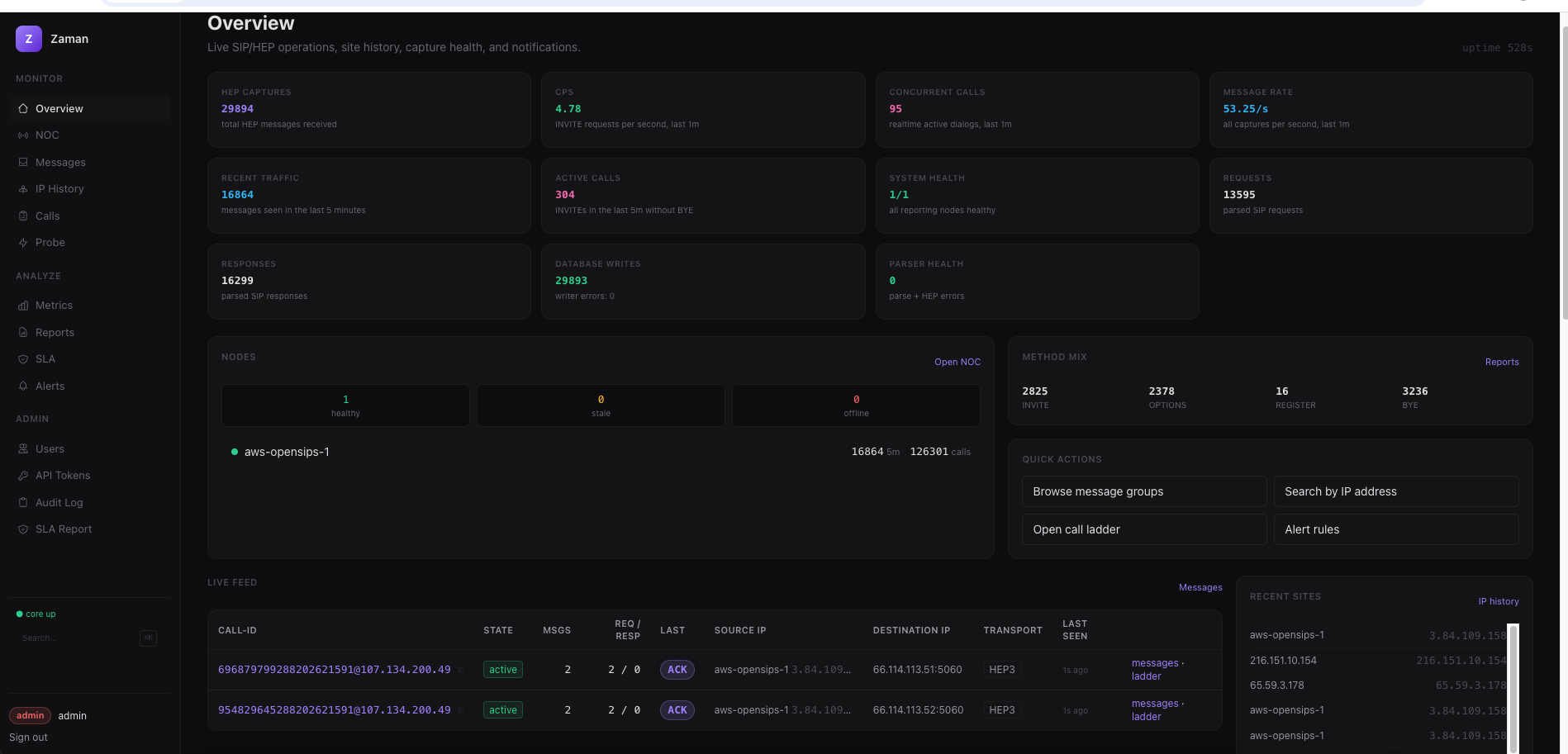
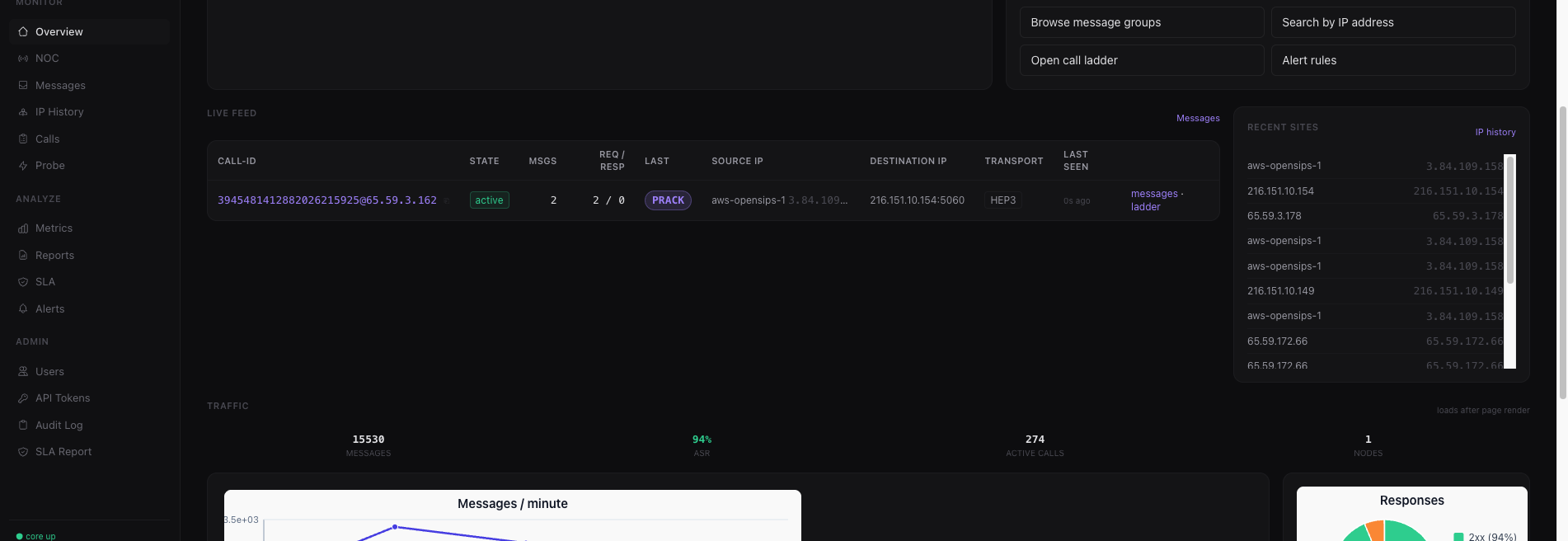
Zaman — live SIP/HEP operations with capture health, active-call state, message inspection, site history, reports, alerts, and traffic metrics.
gcc or clang for linking (installer handles this)--backend cmakori debug and makori dap provide command-line and DAP foundations)STATUS.md has the full honest list.
Generics parity — Mako's generics now match Rust's core feature set:
fn f[T: Reader + Closer](x: T)struct Repo[T: Storable] { ... }interface Printable: Describable { ... }fn describe(self) -> string { return "unknown" }on Pair[T] { fn first(self) -> T { ... } }fn f[T](x: T) where T: A + B { ... }interface Iterator { type Item; fn next(self) -> Option[Item] }on Direction { fn name(self) -> string { ... } }let buf: [int; 8192] — const generic array typesSystems programming:
thread_local let conn_id: int = 0#[packed] struct PageHeader { ... } — exact byte layoutprocess_fork, process_exec, process_wait, process_pipe, process_dup2, process_setsidioctl, mmap_anon, munmap, mprotect, mem_read/write_i64/i32/bytewritev, sendmsg, sendfile — zero-copy block transferssimd_f32x4_dot, simd_fma, clz, ctz, popcount, bswap64, rotl64#[no_alloc] — compiler rejects heap allocation in annotated functionsMemory safety:
json_merge, json_b, json_object_str now free intermediate temporaries_of array helper call sitesmako_str_clone is O(1) — atomic refcount bump instead of malloc + memcpy. FayDB-class workloads see major read throughput improvements.__mako_sp_* element pointers properly scoped in while loops; struct array literals with variable elements use move-or-clone to prevent double-free and leaks._rc=0; taken strings copy RC data into plain buffers for native ownership.return inside a receiveloreste/mako is a public repo on GitHub by loreste. Experimental compiled language for backend development. No garbage collector. Native binaries via C. Ownership-based memory. Structured concurrency.
It declares the MIT license on GitHub.
Its maker has not tagged a system, so it is unknown here. Its README says what it needs.
Open "Take it" on its page: Take My Repo writes an install plan for your machine and hands it to your AI agent (Claude Code, Codex or Cursor), which asks you before each step. Take My Repo has not tested it on any machine.
The React Framework
Community-built comprehensive 2D content creation appplication for graphic design, digital art, and interactive real-time motion graphics powered by a node-based procedural graphics engine
The open-source cloud for agents & devs. Including Auth, Databases, Storage, Functions, Messaging, Hosting, Realtime, WAF and more
Its last change on GitHub was on 2026-11-12. Take My Repo does not judge from that whether it is maintained.
Nobody has reviewed it on Take My Repo yet, which says nothing about its quality.
Take My Repo cannot say: it does not audit code and has not run mako. What is known comes from GitHub. It declares the MIT license on GitHub. Its last change was on 2026-11-12. It has 6 stars, which measure popularity, not safety. Nobody has reviewed it on Take My Repo yet, which says nothing about its quality. Read the source before you run it. With "Take it", your AI agent shows each step and asks you before running it; README text is treated as data, not as instructions.