
ml-class
Machine learning lessons and teaching projects designed for engineers
- 2.6k
- Jupyter Notebook
- GPL-2.0
- 2 y ago
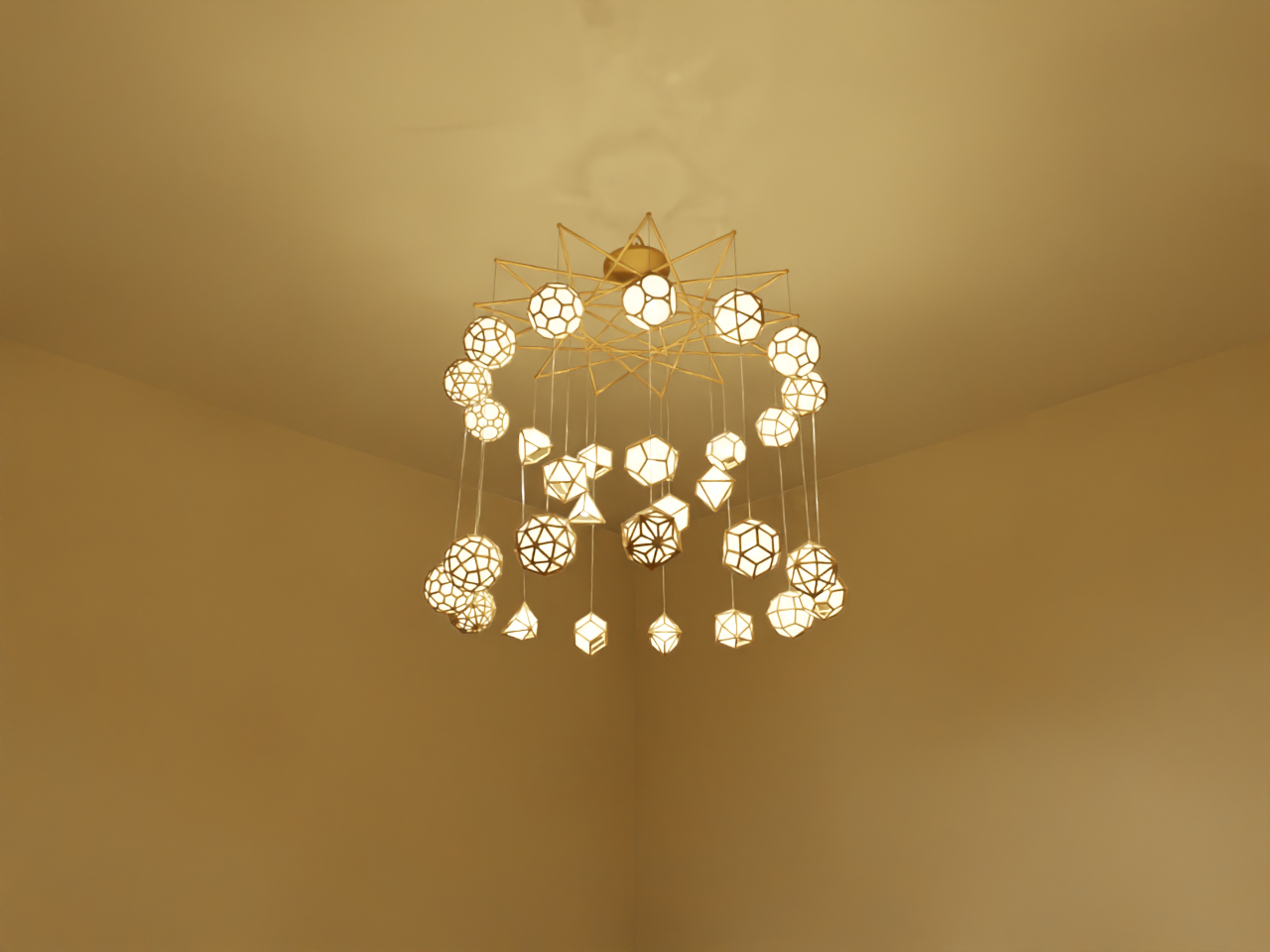
Experiments in geometric / mathematical 3D objects: a 31-polyhedron cast-aluminium chandelier, a starfield-projecting tealight lantern, gyroid spheres, an icosahedron-cell ice tray, and more
Repo lukas/weird_objects, read from GitHub 1 min ago. lukas has not joined Take My Repo.
lukas/weird_objects is a public repo on GitHub by lukas. Experiments in geometric / mathematical 3D objects: a 31-polyhedron cast-aluminium chandelier, a starfield-projecting tealight lantern, gyroid spheres, an icosahedron-cell ice tray, and more. It declares no license on GitHub. Public does not mean open source: without a license, nobody is granted the right to reuse it. It is written mainly in Python, has 0 stars and last changed on 2026-08-29. Nobody has reviewed it on Take My Repo yet, which says nothing about its quality. Read from GitHub on 2026-11-22.
Experiments in geometric / mathematical 3D objects and their physical
manufacture. Each subfolder is a self-contained little project; they
share a single Python .venv and a shared polyhedra.py library at
the repo root.
The headline project is the 31-polyhedron chandelier designed for cast aluminium + frosted acrylic + LED COB modules.

| Folder | What it is |
|---|---|
chandelier/ |
All five Platonic + 13 Archimedean + 13 Catalan solids on three concentric rings, fused into one watertight cast-aluminium STL with frosted-acrylic panels and 31 interior LEDs |
starlight_lantern/ |
Investment-cast tealight lantern that projects a starfield on the floor when lit, with a Monte-Carlo shadow validator |
candle_holder/ |
Spiral-shadow candle holder design |
gyroid_sphere/ |
Graded-density gyroid spheres extracted via marching cubes |
ice_tray/ |
Parametric icosahedron-cell ice tray |
nesting_dolls/ |
Printable Russian nesting (matryoshka) dolls for Bambu H2D — classic split halves, nestability sizing |
constellation/ |
14-node polyhedral constellation (Platonic + Archimedean + Catalan icosahedral family) |
hexapod_walker/ |
Family of six-legged walker designs: full-size human-carrying vehicle (fullsize_v1/), tabletop 3D-printed prototypes (prototype_v1/, prototype_sts3215/), and a rideable redesign study (rideable_v1/) |
infill_lattices/ |
16 cube specimens of mathematically interesting infill: six TPMS (gyroid, Schwarz P/D, Neovius, I-WP, Lidinoid), four strut lattices (BCC/FCC/octet/diamond cubic), three atomic crystals (NaCl rock salt, CaF₂ fluorite, C diamond ball-and-stick), two icosahedral quasicrystals (density-wave + cut-and-project ball-and-stick), and a Menger sponge — plus a free-standing rhombic-triacontahedron of the cut-and-project quasicrystal (icosahedral envelope, no chopped struts) |
Each project's folder has its own README.md with usage details and
images. Top-level shared infrastructure:
weird_objects/
├── polyhedra.py          shared geometry library (verts/edges/faces of
│                         every Platonic, Archimedean, and Catalan solid)
├── test_polyhedra.py     pytest unit tests for `polyhedra.py`
├── requirements.txt      Python dependencies
├── run.sh                venv-managed script runner; resolves
│                         <project>/<script>.py paths and sets PYTHONPATH
├── run_tests.sh          pytest runner using the same shared venv
└── .gitignore            ignores all generated *.stl / *.ply / *.dxf
                          plus .venv / panels.json / blender_assets / etc.
# 1. Build the chandelier STL (~ 1 minute, ~ 800 K faces, watertight)
./run.sh chandelier/all_polyhedra.py

# 2. Generate the 1029 panel outlines for laser-cutting acrylic
./run.sh chandelier/make_panel_outlines.py

# 3. Photoreal Cycles render of the chandelier in a room
./chandelier/render_blender.sh                    # daylit showroom default
./chandelier/render_blender.sh --projection       # moody dark-room with wall projection

# 4. Quick interactive PyVista preview (no Blender needed)
./run.sh chandelier/simulate_chandelier.py
./run.sh creates a single .venv/ at the repo root, installs
requirements.txt once, then forwards arguments to whichever script you
hand it. It accepts paths relative to the repo root (chandelier/foo.py),
absolute paths, or bare script names (e.g. ./run.sh shadow_preview.py).
The chandelier is designed end-to-end to be manufacturable as cast aluminium (A356-T6, investment cast) with laser-cut 1.6 mm (1/16″) cast-acrylic panels held in 2 mm × 2 mm slots cut into the edge rods. Approximate spec:
See chandelier/ASSEMBLY.md for the full
process from foundry quote to final hanging.
Python 3.10+, plus the requirements.txt packages. For Blender renders
you also need Blender 4.x or 5.x:
brew install --cask blender
Personal exploration — no license declared yet. Open an issue if you'd like to use any of this.
lukas/weird_objects is a public repo on GitHub by lukas. Experiments in geometric / mathematical 3D objects: a 31-polyhedron cast-aluminium chandelier, a starfield-projecting tealight lantern, gyroid spheres, an icosahedron-cell ice tray, and more.
It declares no license on GitHub. Public does not mean open source: without a license, nobody is granted the right to reuse it.
Its maker has not tagged a system, so it is unknown here. Its README says what it needs.
Open "Take it" on its page: Take My Repo writes an install plan for your machine and hands it to your AI agent (Claude Code, Codex or Cursor), which asks you before each step. Take My Repo has not tested it on any machine.
Its last change on GitHub was on 2026-08-29. GitHub counts 0 open issues and pull requests. Take My Repo does not judge from that whether it is maintained.
Machine learning lessons and teaching projects designed for engineers
Nobody has reviewed it on Take My Repo yet, which says nothing about its quality.
