hoppscotch
Open-Source API Development Ecosystem • https://hoppscotch.io • Offline, On-Prem & Cloud • Web, Desktop & CLI • Open-Source Alternative to Postman, Insomnia
- 81k
- TypeScript
- MIT
- 16 h ago
REST Api Documentation Library
Repo mam-dev/neberus, read from GitHub 20 h ago. mam-dev has not joined Take My Repo.
mam-dev/neberus is a public repo on GitHub by mam-dev. REST Api Documentation Library. It declares the MIT license on GitHub. It is written mainly in Java, has 3 stars and last changed on 2026-04-09. Nobody has reviewed it on Take My Repo yet, which says nothing about its quality. Read from GitHub on 2026-11-24.
Open-Source API Development Ecosystem • https://hoppscotch.io • Offline, On-Prem & Cloud • Web, Desktop & CLI • Open-Source Alternative to Postman, Insomnia
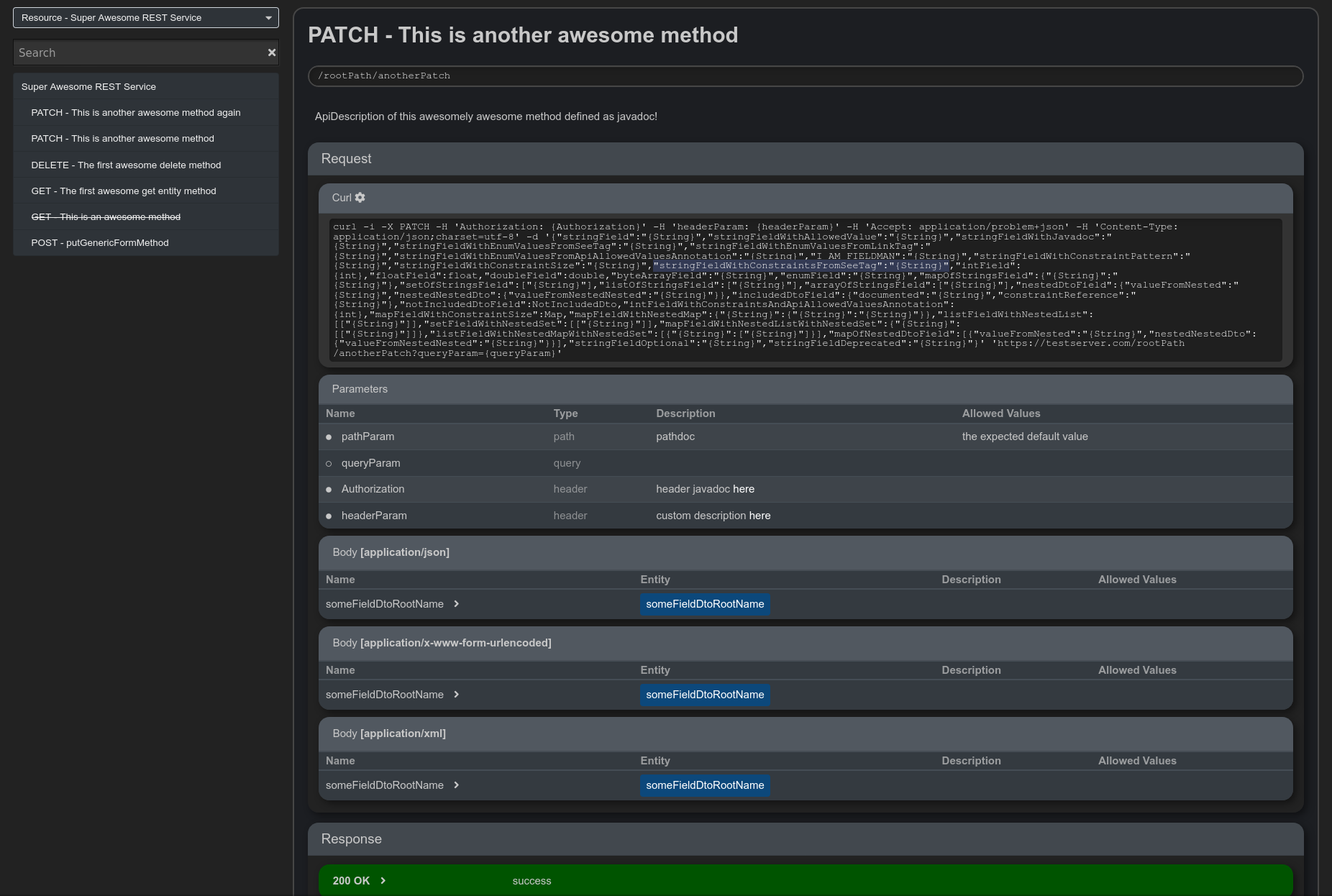
JavaDoc Doclet that automatically generates REST Documentation from your code! Out of the box compatibility with javax.ws.rs and spring-webmvc.
Java 8 is only supported with version 1.x.
Java 11 is only supported with version 2.x and 3.x.
All newer versions require Java 17+.
neberus-core to get access to Neberus annotations in your code.pom.xml
<dependencies>
    ...
    <dependency>
        <groupId>net.oneandone.neberus</groupId>
        <artifactId>neberus-core</artifactId>
        <version>${neberus.version}</version>
    </dependency>
    ...
</dependencies>

 <build>
    <plugins>
        ...
        <plugin>
            <groupId>org.apache.maven.plugins</groupId>
            <artifactId>maven-javadoc-plugin</artifactId>
            <executions>
                <execution>
                    <id>generate-service-docs</id>
                    <phase>generate-resources</phase>
                    <configuration>
                        <doclet>net.oneandone.neberus.Neberus</doclet>
                        <docletArtifact>
                            <groupId>net.oneandone.neberus</groupId>
                            <artifactId>neberus-doclet</artifactId>
                            <version>${neberus.version}</version>
                        </docletArtifact>
						<!-- ATTENTION: <reportOutputDirectory> is not supported anymore by maven-javadoc-plugin since version 3.10.0 -->
                        <outputDirectory>
                        <!-- recommended path for traditional '*.war' services -->
                        ${project.build.directory}/${project.build.finalName}
                        <!-- recommended path for spring boot services -->
                        ${project.build.directory}/classes/resources/
                        </outputDirectory>
                        <useStandardDocletOptions>false</useStandardDocletOptions>
                        <additionalOptions><!-- ATTENTION: this has been renamed from 'additionalparam' with maven-javadoc-plugin version 3.0.0 -->
                            --apiVersion ${project.version}
                            --apiTitle "${project.name}" <!-- remember to put enclosing quotes when the name contains blanks -->
                            --docBasePath .
                            --apiBasePath ${apiBasePath}
                            --apiHosts http://yourhost.com <!-- the leading 'http://' can be omitted, but it must be provided for 'https://' -->
                            --scanPackages net.oneandone <!-- semicolon separated list of packages to be included -->
                        </additionalOptions>
                    </configuration>
                    <goals>
                        <goal>javadoc</goal>
                    </goals>
                </execution>
            </executions>
        </plugin>
        ...
    </plugins>
</build>
Provided by the Neberus doclet:
    --apiBasePath <path>
                  Root path of the Api on the server (e.g. '/rest').
    --apiHosts <host[description]>(;<host[description]>)*
                  List of hosts where the Api can be accessed, separated by semicolon (;). Description for each host can be provided inside optional trailing brackets. Example: "https://testserver.com[the default testserver];https://otherserver.com[the other testserver]"
    --apiTitle <title>
                  Api Title.
    --apiVersion <version>
                  Api version.
    -d <string>   outputDirectory
    --docBasePath <path>
                  Root path where the generated documentation is placed inside outputDirectory.
    -ignoreErrors
                  Ignore generation errors.
    --scanPackages <package>(;<package>)*
                  List of packages that include classes relevant for the apidoc
    --markup [HTML|MARKDOWN|ASCIIDOC]
    			  Global markup option. Valid for all descriptions and used javadoc. Default: HTML.
    --scanSecurityAnnotations
    			  Enable automatic parsing of security annotations for allowed roles like @Secured & @RolesAllowed.
Per default the normal javadoc style HTML tags are supported and will be converted.
With the --markup option it is possible to use Markdown (see CommonMark) or AsciiDoc (see AsciiDoctor) instead.
The chosen markup can also be used for the package.html file inside the <body> tag.
If classes from dependencies are used as entities of parameters or response values of some methods, it is required to include those dependencies in the configuration of the maven-javadoc-plugin. Otherwise it is not possible to properly generate the templates for these classes.
More information about how the inclusion works can be found here.
Neberus generates html files and adds some json, css and js files. This means that the docs can be served from many places and viewed in any browser.
The apidocs can be deployed to an external server, accessed over the repository or included within the webapp.
If a package.html file is found in the same package as classes/interfaces annotated with @ApiDocumentation, the content of this file is included on the index site.
Headings should start with h2, since Neberus generates a h1 heading with the service name.
REST methods can be documented either directly on the method or in a separate interface (recommended) that is implemented by the class containing the methods.
Definitions in the REST-class will be used as fallback in case the interface does not provide sufficient Documentation.
| Name | Description | Target |
|---|---|---|
| @ApiDocumentation | Enables Neberus documentation for a class containing REST methods. | Type |
| @ApiCurl | Generate an example curl. | Method |
| @ApiAllowedValue | Define the allowed values for a parameter. | Method, Parameter, Field, TypeArgument |
| @ApiDescription | If provided, the value of this will be used as description of the method instead of the javadoc comment. If defined on a class, this will be used as short description of the resource on the service overview page. | Method, Type |
| @ApiHeader | Define a response Header within a @ApiResponse. | - |
| @ApiHeaderDefinition | Define a Header on class level, this can be used to provided descriptions of headers that are reused many times. The header name will be used for reference. | Type |
| @ApiLabel | Defines the name of a REST class or method. | Method, Type |
| @ApiParameter | Defines a custom parameter for a REST method. Most likely used to document fields inside the body. | Method |
| @ApiResponse | Document a Response. | Method |
| @ApiCommonResponse | Document a common Response on class level, the response will be added to every method inside that class. An @ApiResponse defined on the method with the same status will be favoured. | Type |
| @ApiEntity | Define a response entity. | - |
| @ApiRequestEntity | Define a request entity for a specific content-type. | Method |
| @ApiExample | Define a example for a specific value. | - |
| @ApiType | Define the type that should be displayed instead of the actual type. This can be used to hide internal wrapper DTOs. | Parameter |
| @ApiOptional | Declare a parameter as optional. This will have precedence over framework declarations. | Method, Parameter, Field |
| @ApiRequired | Declare a parameter as required. This will have precedence over framework declarations. | Method, Parameter, Field |
| @ApiIgnore | Exclude a request parameter, DTO field or a whole REST method from documentation. | Method, Parameter, Field |
| @ApiFormParam | Declare a @RequestParam annotated parameter as form parameter instead of query parameter. | Parameter |
| @ApiAllowedRoles | Define roles/authorities required to access. | Method |
/*
 * REST Class Documentation
 */
@ApiDocumentation
@RequestMapping(path = "/rootPath", name = "Super Awesome REST Service")
@ApiHeaderDefinition(name = "header1", description = "description1")
@ApiHeaderDefinition(name = "header2", description = "description2")
@ApiHeaderDefinition(name = "Predefined", description = "one description to rule them all")
@ApiCommonResponse(status = ApiStatus.INTERNAL_SERVER_ERROR, description = "internal server error defined on class")
public class RestService {

	/**
	 * ApiDescription of this awesomely awesome method defined as javadoc!
	 *
	 * @param pathParam description of the pathParam
	 */
	@RequestMapping(method = RequestMethod.GET,
					path = "/anotherGet/{pathParam}/anotherPathParam/{anotherPathParam}/{wrappedPathParam}",
					produces = MediaType.APPLICATION_JSON_VALUE)
	@ApiLabel("This is an awesome method")
	@ApiDescription("Description of this awesomely awesome method defined in annotation!")
	@ApiResponse(status = ApiStatus.OK, description = "success",
				 headers = {
						 @ApiHeader(name = "header2", allowedValues = {
								 @ApiAllowedValue(value = "this one value", valueHint = "only that one"),
								 @ApiAllowedValue(value = "this other value", valueHint = "or only that one")
						 }) },
				 entities = {
						 @ApiEntity(entityClass = SomeDto.class, examples = {
								 @ApiExample(title = "example response", value = "{\"string1\":\"some value example\"}"),
								 @ApiExample(title = "other example response", value = "{\"string1\":\"some other value example\"}")
						 }),
						 @ApiEntity(entityClass = SomeDtoList.class, contentType = "application/list+json", examples = {
								 @ApiExample(title = "list example response", value = "[{\"string1\":\"some value example\"}]")
						 }),
						 @ApiEntity(entityClass = SomeDto[].class, contentType = "application/array+json", examples = {
								 @ApiExample(title = "array example response", value = "[{\"string1\":\"some value example\"}]")
						 })
				 })
	@ApiResponse(status = ApiStatus.BAD_REQUEST, description = "success", headers = {
			@ApiHeader(name = "header2", allowedValues = {
					@ApiAllowedValue(value = "this second value", valueHint = "only that one"),
					@ApiAllowedValue(value = "this second other value", valueHint = "or only that one")
			})
	})
	@ApiParameter(name = "anotherQueryParam", type = ApiParameter.Type.QUERY, deprecated = true, deprecatedDescription = "use queryParam instead",
				  optional = true)
	@ApiCurl
	public String justAnotherGetMethod(@PathVariable @ApiAllowedValue("default") String pathParam,
									   @PathVariable("anotherPathParam") String anotherPathParam,
									   @PathVariable("wrappedPathParam") @ApiType(String.class) WrappedString wrappedPathParam,
									   @Deprecated @RequestParam("queryParam") String queryParam) {
	}

	public static class SomeDto {
		/**
		 * Parameter can be placed here.
		 * {@link SomeEnum} <- this will place the enum values as 'allowed values'
		 * @see SomeEnum <- this will do the same
		 */
		public String string1;

		/**
		 * @see SomeWrapperClass#value <- can be used to reference the javax.validation constraints of another field
         */
		public String string2;

		/**
		 * If the fields are private, the doc can be placed on the getter
		 */
		public String getString1() {}

		/**
		 * @param string1 or it can be placed on the ctor if all fields are private and no getters are found
		 *                {@link SomeEnum} <- can also be used here
		 */
		public SomeDto(String string1) {}
	}

	/**
	 * A custom interface like this can be used when the entity should be a list of SomeDto.
	 * Alternatively just use SomeDto[].class in @ApiEntity.
	 */
	public static interface SomeDtoList extends List<SomeDto> {}
}
/*
 * REST Class Documentation
 */
@Path("/rootPath")
public class RestService implements RestDoc {

	/**
	 * Internal JavaDoc not visible in the ApiDocumentation because it is overwritten in the interface
         * @param pathParam this will be visible in the apidocs
	 */
	@GET
	@Path("/anotherGet/{pathParam}/anotherPathParam/{anotherPathParam}")
	@Consumes(MediaType.APPLICATION_JSON)
	@Produces(MediaType.APPLICATION_JSON)
	public void justAnotherGetMethod(
		@PathParam("pathParam") String pathParam,
		@PathParam("anotherPathParam") String anotherPathParam,
		@QueryParam("queryParam") String queryParam) {
	}
}
mam-dev/neberus is a public repo on GitHub by mam-dev. REST Api Documentation Library.
It declares the MIT license on GitHub.
Its maker has not tagged a system, so it is unknown here. Its README says what it needs.
Open "Take it" on its page: Take My Repo writes an install plan for your machine and hands it to your AI agent (Claude Code, Codex or Cursor), which asks you before each step. Take My Repo has not tested it on any machine.
Its last change on GitHub was on 2026-04-09. Take My Repo does not judge from that whether it is maintained.
The world’s fastest framework for building websites.
Opensource IDE For Exploring and Testing API's (lightweight alternative to Postman/Insomnia)
Nobody has reviewed it on Take My Repo yet, which says nothing about its quality.
Take My Repo cannot say: it does not audit code and has not run neberus. What is known comes from GitHub. It declares the MIT license on GitHub. Its last change was on 2026-04-09. It has 3 stars, which measure popularity, not safety. Nobody has reviewed it on Take My Repo yet, which says nothing about its quality. Read the source before you run it. With "Take it", your AI agent shows each step and asks you before running it; README text is treated as data, not as instructions.