
meridian
Zero-config Claude Code setup with enforced task scaffolding, structured memory, persistent context after compaction, plug-in code standards, optional TDD mode, and zero behavior changes for developers.
- 188
- Python
- 9 mo ago
The maintainer has not written a description at the source.
Repo markmdev/lingput, read from GitHub 1 min ago. markmdev has not joined Take My Repo.
markmdev/lingput is a public repo on GitHub by markmdev. It declares no license on GitHub. Public does not mean open source: without a license, nobody is granted the right to reuse it. It is written mainly in TypeScript, has 2 stars and last changed on 2025-09-10. Nobody has reviewed it on Take My Repo yet, which says nothing about its quality. Read from GitHub on 2026-11-21.
🚀 Live Demo: https://lingput.dev/ | 📚 API Docs: https://docs.lingput.dev/

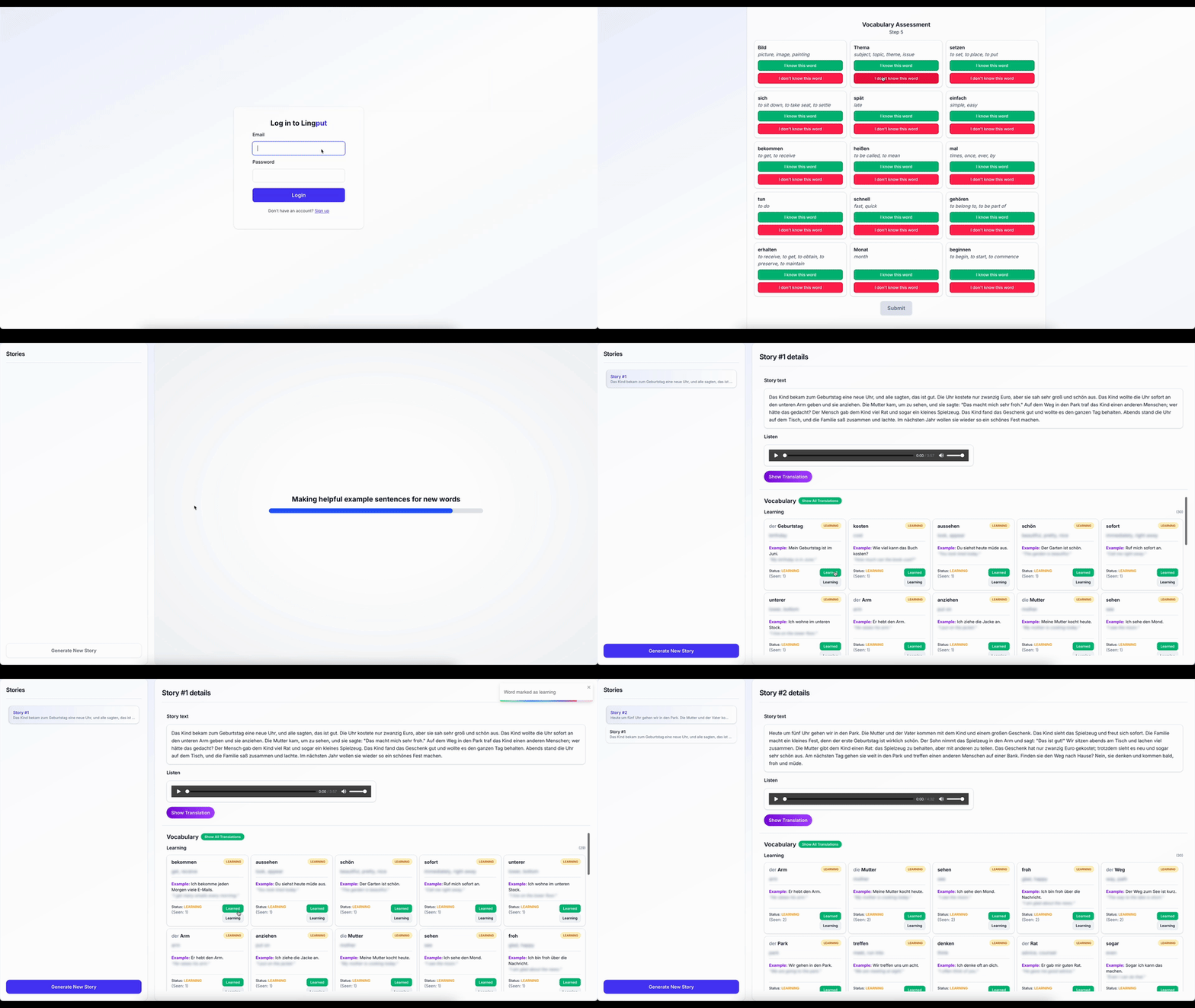
Traditional language learning apps rely on flashcards and repetitive drills. Lingput solves the real problem: providing learners with comprehensible input - personalized stories at exactly their vocabulary level, complete with audio and smart word tracking.


User Request → Job Queue → Background Worker Pipeline:
├── Vocabulary Analysis (PostgreSQL)
├── AI Story Generation (OpenAI)
├── Chunk Translation (OpenAI)
├── Lemmatization & Translation
├── Audio Synthesis (TTS + FFmpeg)
├── Asset Upload (Supabase)
└── Database Persistence
Frontend receives real-time progress updates throughout the entire pipeline.
Backend & Infrastructure
Frontend & User Experience
External Services
# Clone repository
git clone https://github.com/markmdev/lingput
cd lingput

# Configure environment
cp apps/backend/.env.example apps/backend/.env
cp apps/frontend/.env.example apps/frontend/.env
# Edit .env files with your API keys

# Start all services
docker compose -f docker-compose-dev.yml up -d
Access the app: http://localhost:3050
Note: Account creation takes 2 seconds with no email verification required for easy testing.
Backend (apps/backend/.env):
OPENAI_API_KEY=sk-...
JWT_SECRET=your-secure-jwt-secret
SUPABASE_URL=https://YOUR_PROJECT_ID.supabase.co
SUPABASE_SERVICE_API_KEY=eyJ......
Frontend (apps/frontend/.env):
NEXT_PUBLIC_AUDIO_BUCKET_URL=https://YOUR_PROJECT_ID.supabase.co/storage/v1/object/public/YOUR_BUCKET/
main branch: All changes via Pull RequestsPhase 1: Core Learning Experience ✅
Phase 2: Enhanced Features 🚧
Phase 3: Gamification & Social 📋
| Metric | Before Optimization | After Optimization | Improvement |
|---|---|---|---|
| Story Fetch API | 600ms | 85ms | 85% faster |
| Database Queries | N/A | Cached | Reduced load |
| Deployment Time | 25 minutes | 5 minutes | 80% faster |
| Dev Environment Setup | 2 minutes | 20 seconds | 83% faster |
We welcome contributions! Here's how to get started:
npm run test before submittingCode Style Guidelines:
Licensed under the ISC License.
Built by Mark - Backend-focused Full-stack Developer
🌐 Portfolio: https://markmdev.com/
💼 LinkedIn: Connect with me
📧 Contact: Open to backend and full-stack opportunities!
markmdev/lingput is a public repo on GitHub by markmdev. Its maker has not written a description.
It declares no license on GitHub. Public does not mean open source: without a license, nobody is granted the right to reuse it.
Its maker has not tagged a system, so it is unknown here. Its README says what it needs.
Open "Take it" on its page: Take My Repo writes an install plan for your machine and hands it to your AI agent (Claude Code, Codex or Cursor), which asks you before each step. Take My Repo has not tested it on any machine.
Its last change on GitHub was on 2025-09-10. Take My Repo does not judge from that whether it is maintained.
Nobody has reviewed it on Take My Repo yet, which says nothing about its quality.
Zero-config Claude Code setup with enforced task scaffolding, structured memory, persistent context after compaction, plug-in code standards, optional TDD mode, and zero behavior changes for developers.