
modern-cpp-tutorial
📚 Modern C++ Tutorial: C++11 to C++26 On the Fly | https://changkun.de/modern-cpp/
- 26k
- C++
- MIT
- 2 wk ago
Compact SVO optimized vector for C++17 or higher
Repo martinus/svector, read from GitHub 3 h ago. martinus has not joined Take My Repo.
martinus/svector is a public repo on GitHub by martinus. Compact SVO optimized vector for C++17 or higher. It declares the MIT license on GitHub. It is written mainly in C++, has 126 stars and last changed on 2026-09-02. Nobody has reviewed it on Take My Repo yet, which says nothing about its quality. Read from GitHub on 2026-11-24.
📚 Modern C++ Tutorial: C++11 to C++26 On the Fly | https://changkun.de/modern-cpp/
ankerl::svector is an std::vector-like container that keeps a few elements inline, without allocating.
There are lots of small vector implementations (absl,
boost,
folly,
llvm, ...); this one is unusual in how little space it
spends on bookkeeping, and it stays competitive on the benchmarks anyway.
It is a single header, C++17, MIT licensed:
#include <ankerl/svector.h>

auto v = ankerl::svector<int, 7>(); // 7 int inline, heap only if it outgrows them
v.push_back(42);
Copying that one header into your project is a perfectly good way to use it. If you would rather a build system did it, take your pick:
add_subdirectory(svector)            # a submodule, or FetchContent
target_link_libraries(you PRIVATE svector::svector)

find_package(svector 1 REQUIRED)     # after cmake --install, or from a package
target_link_libraries(you PRIVATE svector::svector)
svector_dep = dependency('svector') # with subprojects/svector.wrap
A pkg-config file is installed as well, for builds that use neither.
What is the smallest each implementation can be made, how many uint8_t fit inline at that size, and what does
the rest of the object cost?
| sizeof | inline capacity | overhead | |
|---|---|---|---|
std::vector<uint8_t> |
24 | 0 | 24 |
boost::container::small_vector |
32 | 8 | 24 |
absl::InlinedVector |
24 | 16 | 8 |
ankerl::svector 🚚 |
8 | 7 | 1 |
ankerl::svector fits in a single 8 byte word and still keeps 7 bytes of payload in it. absl needs at least 24
bytes, boost at least 32. The overhead — everything that is not element storage — is one byte here, 8 for absl,
24 for boost.
Asking for more uint8_t, as sizeof / inline capacity:
| asked for | boost |
absl |
ankerl::svector |
|---|---|---|---|
| 1 | 32 / 1 | 24 / 16 | 8 / 7 |
| 8 | 32 / 8 | 24 / 16 | 16 / 15 |
| 16 | 40 / 16 | 24 / 16 | 24 / 23 |
| 32 | 56 / 32 | 40 / 32 | 40 / 39 |
| 64 | 88 / 64 | 72 / 64 | 72 / 71 |
None of the three ever hands back less than was asked for. Below 16 elements svector is in a different size
class entirely — a quarter of boost's object for one element. From 16 up it ties absl on size but keeps more in
it, because the overhead stays at one byte while absl's stays at eight. Boost is 16 bytes larger than svector
throughout.
Measured against boost 1.90.0 and abseil 20260107.1 on x86-64. test/unit/show_comparison.cpp prints this table
for whichever versions you have installed:
builddir/test/test-svector -ns -tc=show_comparison
ankerl::svector is a tagged pointer. The lowest bit of the first
byte says which of two modes the container is in.
In direct mode that first byte is the whole control structure: bit 0 is 1, and the remaining 7 bits are the size. Everything after it, starting at the first correctly aligned offset, is element storage. Seven bits of size is where the 127 element limit on inline capacity comes from.
In indirect mode the first sizeof(void*) bytes are a pointer to a heap block holding size, capacity and the
elements. Alignment guarantees bit 0 of that pointer is 0, which is what distinguishes the two modes.
Because the size lives in a byte that would otherwise be padding, the inline capacity is rounded up to whatever
fits in sizeof(svector) for free — svector<uint8_t, 1> really holds 7, and asking for 1 or for 7 gives you the
same type size.
The price is that every operation has to ask which mode it is in before it can find the data or the size. That is a predictable branch, but it is not free, and the benchmarks below show where it lands.
Compared against std::vector, absl::InlinedVector and boost::container::small_vector, using
nanobench.
-std=c++17 -O3 -DNDEBUG, boost 1.90.0, abseil 20260107.1tasksetstd::string workloads, which allocate on every iteration and land
around 7%. Differences smaller than that are not differences, and the tables below only mark a winner where
the gap is larger than the spreadThat one-container-per-process bit is not fussiness. Benchmarking four containers one after the other inside a
single process measures the wrong thing as soon as the workload allocates: glibc adapts its mmap threshold the
first time a large block is freed, so whoever runs first pays for mmap/munmap on every iteration and trains
the allocator for everyone behind them. On emplace_back of 10000 std::string that is worth a factor of
three, and it follows the position in the list rather than the container — put svector first and svector is
the slow one. Two of the results below reverse completely when measured that way. test/bench/solo.cpp runs one
workload against one container and exits, which is also what a program that uses one of them looks like.
The instruction counts quoted below come from perf and are deterministic, so they are the numbers to compare if your machine is busier than a benchmark machine should be.
Reproduce with:
meson setup builddir --buildtype=release -Dcpp_args="-isystem /path/to/abseil-cpp"
meson compile -C builddir
./scripts/bench/render_charts.py builddir/test/bench-solo doc --runs 9
absl and boost join in only if their headers are visible at compile time, see test/app/boost_absl.h.
The case a small vector exists for: it stays inside its inline storage, so it never reaches the allocator.
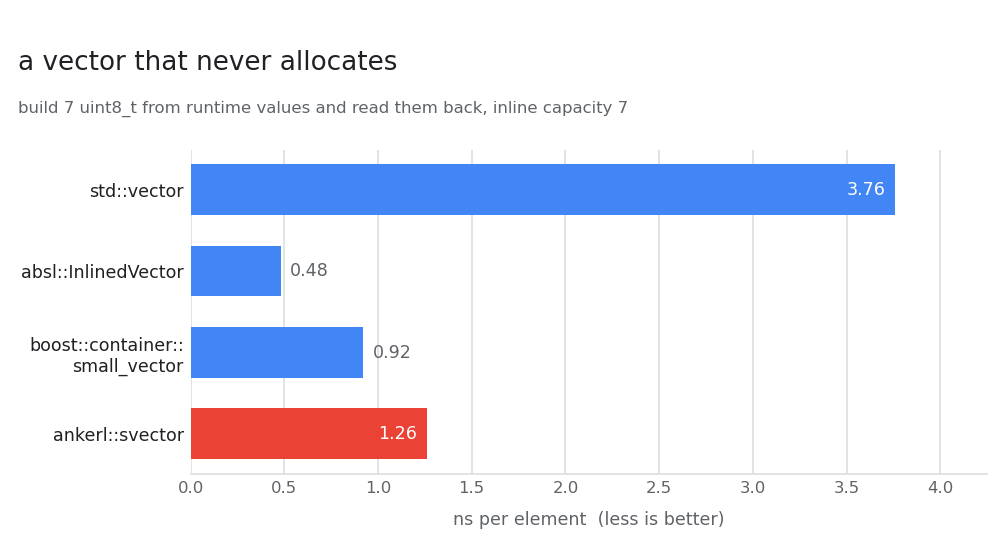
Everything with inline storage beats std::vector by a wide margin here, because std::vector has to
allocate for the first element and free at the end. Among the three, svector is the slowest — it packs its
size into a byte it shares with the mode flag, so every append unpacks it and packs it back, where absl keeps a
plain size_t next to a plain pointer and pays 8 bytes for the privilege.
Growing past the inline storage, one uint8_t at a time.
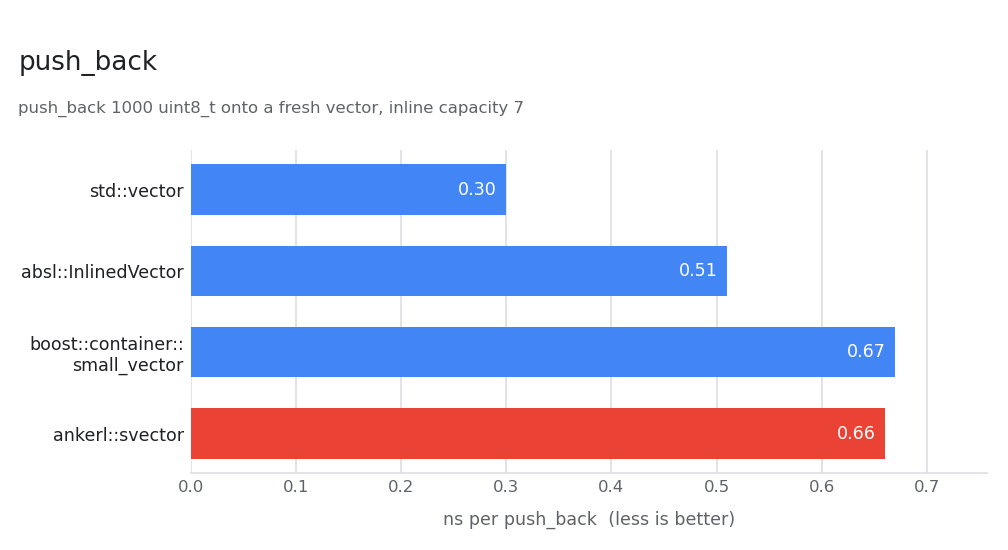
This is where the tagged pointer costs the most. std::vector bumps a pointer and compares it against another
pointer; svector works out which mode it is in, then reads the size from either a byte or a heap header. 15.3
instructions per push_back against 8.5, and it ends up 2.2x behind — level with boost, a shade behind absl.
Give the element some weight and that overhead stops being visible:
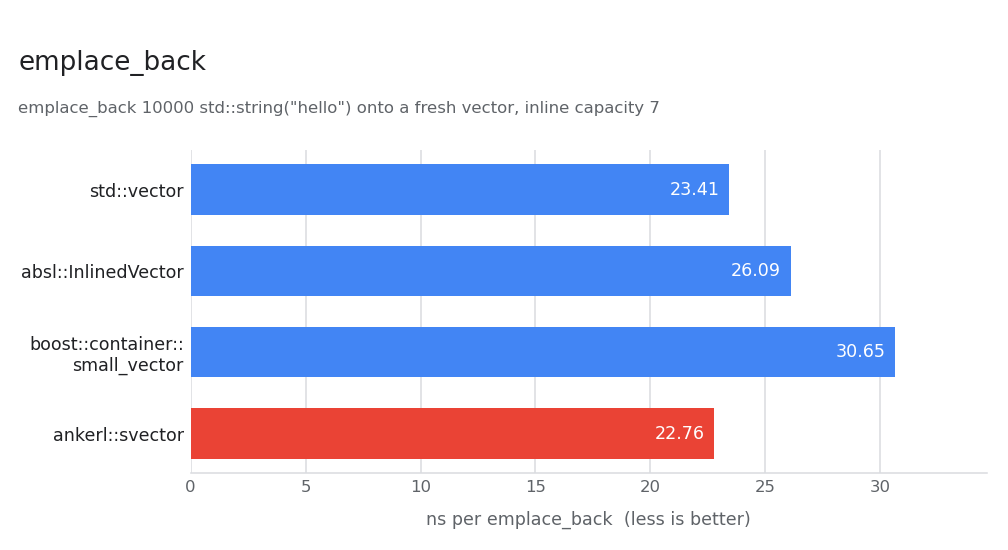
svector is fastest of the four here, and the smallest object of the four while doing it.
1000 int, summed through operator[] at random indices.
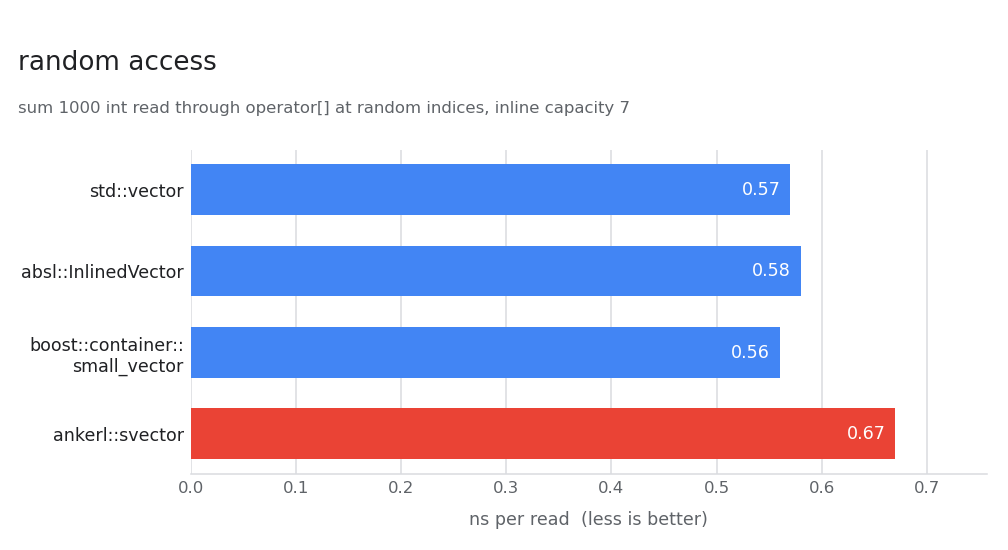
std::vector and boost compile the subscript to a load from a stored pointer, 10.0 instructions per read. absl
and svector have to pick the pointer first: 15.8 and 16.8. svector lands about 18% behind. absl gets closer
than its instruction count suggests, because its extra work does not depend on the load and overlaps with it.
Growing to 1000 elements, each emplaced at a random index, so most of the cost is moving the tail out of the way.
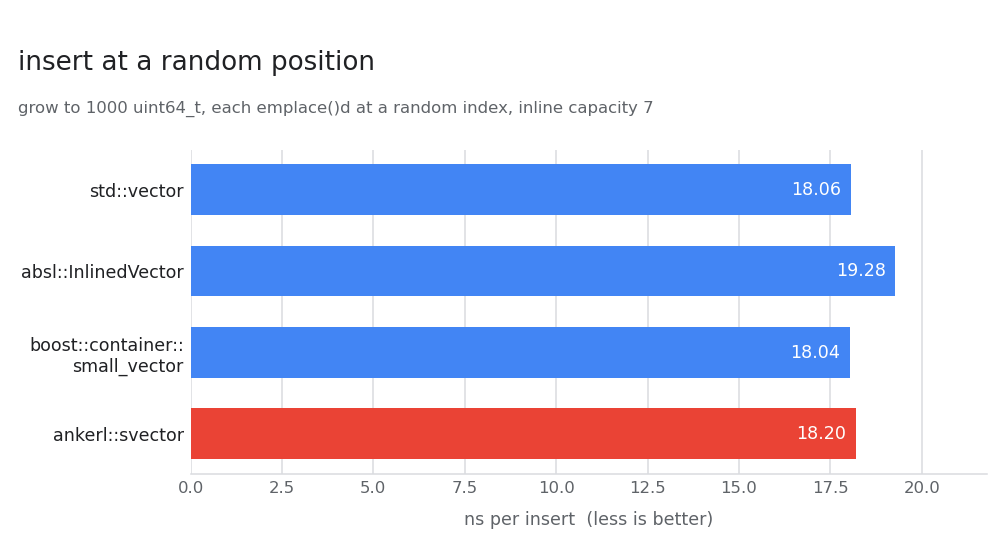
For a trivially copyable element the shift is a memmove, and std::vector, boost and svector are within
0.5% of each other. absl is 8% back.
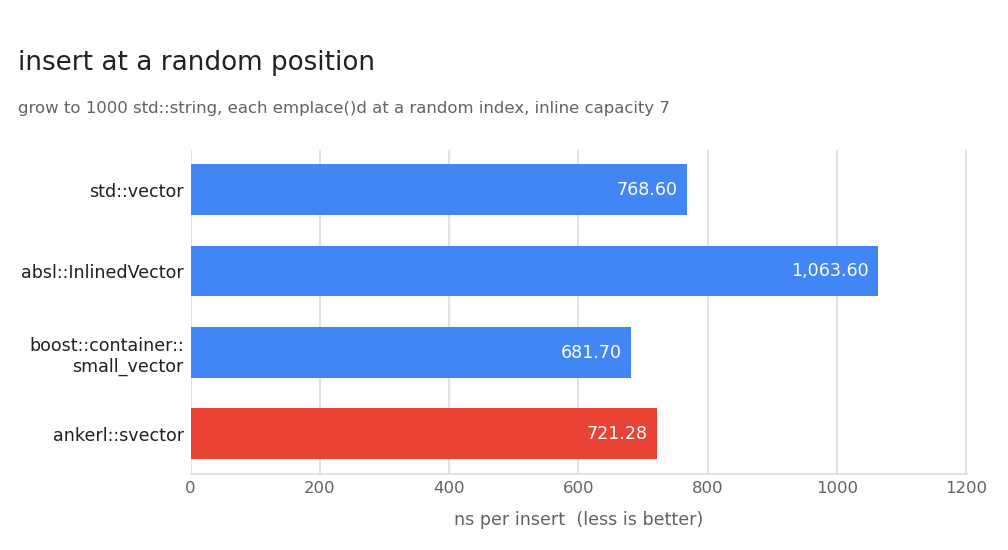
For std::string, boost, svector and std::vector are within 13% of each other with a run-to-run spread of
6%, so read those three as a group; absl is the outlier, 38% to 56% behind them. Always inserting at the front instead —
the worst case for the shift — svector is the fastest of the four at 1320 ns against 1415 and 1417, with absl
again last at 2074.
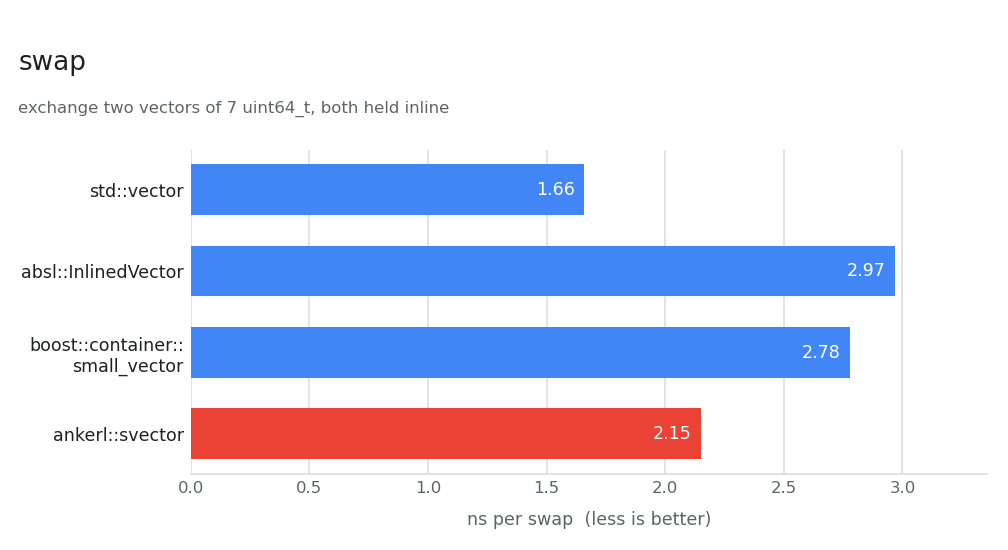
std::vector wins this one by construction and always will: its whole state is three pointers, so a swap is
three exchanges no matter how many elements it holds. Anything with inline storage has to deal with the
elements themselves. Among the three that do, svector is the fastest.
Element type decides how much that costs. Two vectors of seven std::string that each own a heap buffer swap
in 15.7 ns; seven short strings that live inside themselves take 35.6 ns, because std::swap finds
std::string::swap, and for a short string that is three copies of the internal buffer where a longer string
would have exchanged one pointer. On the short strings absl and boost are within 1% of svector; on the heap
ones absl is 2% behind and boost 9%.
Once you are past the container and into the elements, the differences disappear. std::accumulate over 100
uint64_t is 0.10 ns per element and under 3 instructions for all four — the compiler vectorizes it and the
container is not in the way.
Shuffling and sorting 1000 std::string:
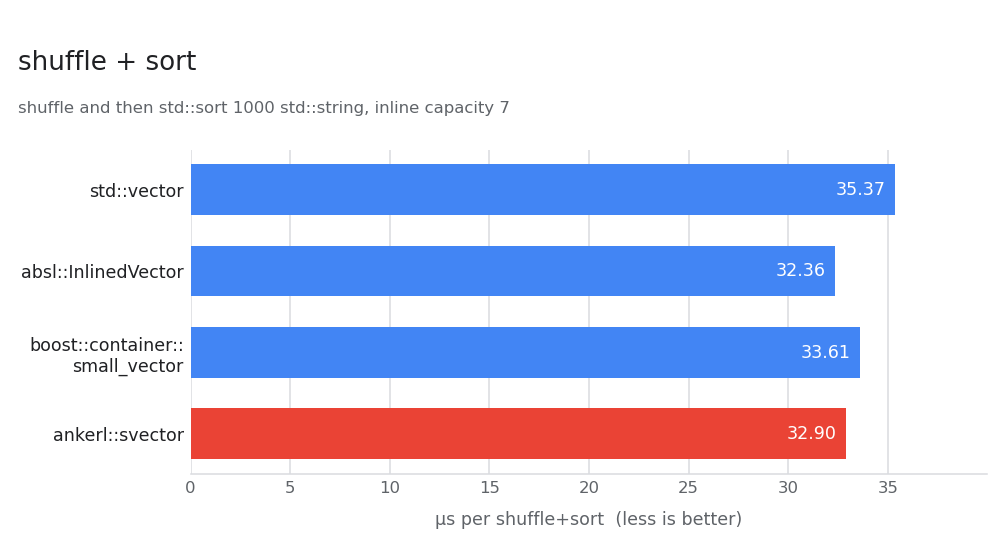
svector comes out ahead — 12% on std::vector, 5% on absl, 7% on boost — but the run-to-run spread here is
7%, so only the gap to std::vector is bigger than the noise.
ns per operation, median of 9 processes, less is better. Bold is the best of the four, marked only where the gap is bigger than the run-to-run spread.
| benchmark | std::vector |
absl |
boost |
ankerl::svector |
|---|---|---|---|---|
| build 7 inline, per element | 3.85 | 0.48 | 0.92 | 1.26 |
push_back uint8_t |
0.30 | 0.51 | 0.67 | 0.66 |
emplace_back std::string |
23.52 | 26.13 | 30.54 | 22.64 |
martinus/svector is a public repo on GitHub by martinus. Compact SVO optimized vector for C++17 or higher.
It declares the MIT license on GitHub.
Its maker has not tagged a system, so it is unknown here. Its README says what it needs.
Open "Take it" on its page: Take My Repo writes an install plan for your machine and hands it to your AI agent (Claude Code, Codex or Cursor), which asks you before each step. Take My Repo has not tested it on any machine.
Its last change on GitHub was on 2026-09-02. Take My Repo does not judge from that whether it is maintained.
Run macOS VM in a Docker! Run near native OSX-KVM in Docker! X11 Forwarding! CI/CD for OS X Security Research! Docker mac Containers.
A modern, C++-native, test framework for unit-tests, TDD and BDD - using C++14, C++17 and later (C++11 support is in v2.x branch, and C++03 on the Catch1.x branch)
Nobody has reviewed it on Take My Repo yet, which says nothing about its quality.
Take My Repo cannot say: it does not audit code and has not run svector. What is known comes from GitHub. It declares the MIT license on GitHub. Its last change was on 2026-09-02. It has 126 stars, which measure popularity, not safety. Nobody has reviewed it on Take My Repo yet, which says nothing about its quality. Read the source before you run it. With "Take it", your AI agent shows each step and asks you before running it; README text is treated as data, not as instructions.


