margarethamilton.dev
A scroll-driven tribute to Margaret Hamilton (1936–2026), who led the Apollo 11 flight software and gave software engineering its name.
- 88
- MIT
- 5 wk ago
Repo midudev/margarethamilton.dev, read from GitHub 1 d ago. midudev has not joined Take My Repo.
In short
midudev/margarethamilton.dev is a public repo on GitHub by midudev. A scroll-driven tribute to Margaret Hamilton (1936–2026), who led the Apollo 11 flight software and gave software engineering its name. It declares the MIT license on GitHub. It is written mainly in Astro, has 88 stars and last changed on 2026-10-23. Nobody has reviewed it on Take My Repo yet, which says nothing about its quality. Read from GitHub on 2026-11-24.

margarethamilton.dev
A scroll-driven tribute to Margaret Hamilton (1936–2026), who led the Apollo 11 flight software and gave software engineering its name.
Visit the site → · Español · English
Documentation available in: 🌐 English | 🇪🇸 Español
About
“There was no choice but to be pioneers. No time to be beginners.” — Margaret Hamilton
This site tells her story as one continuous scroll, from Paoli, Indiana, in 1936 to the Presidential Medal of Freedom in 2016. Every chapter is a full-screen scene animated by the scroll: punch cards, a working DSKY, the tower of printed listings, the 1202 alarm, hand-woven rope memory and the real Apollo 11 source code.
Scenes
| # | Scene | What happens |
|---|---|---|
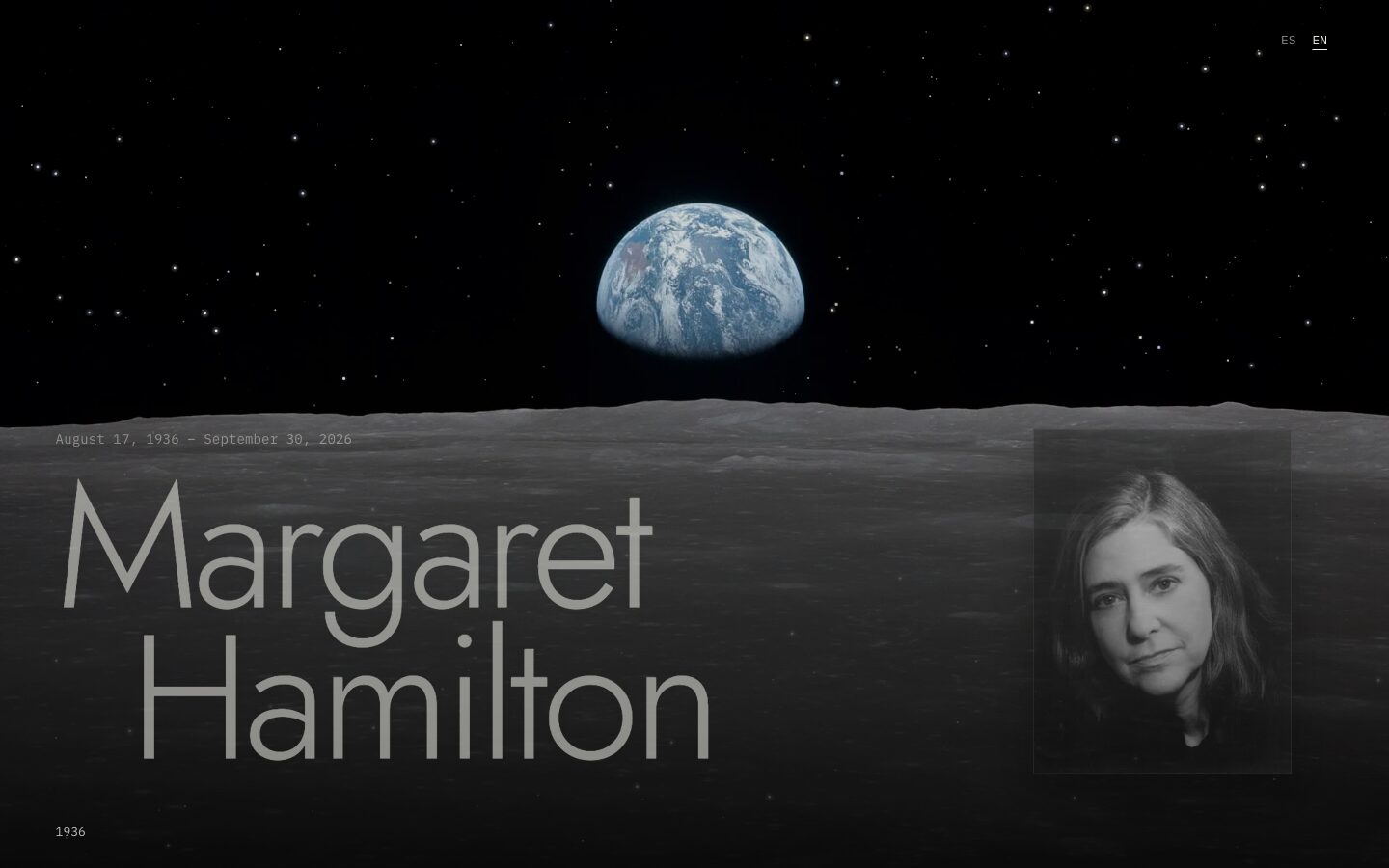
| 1 | Opening | Stars over the Earthrise fly into place and become the letters of her quote. |
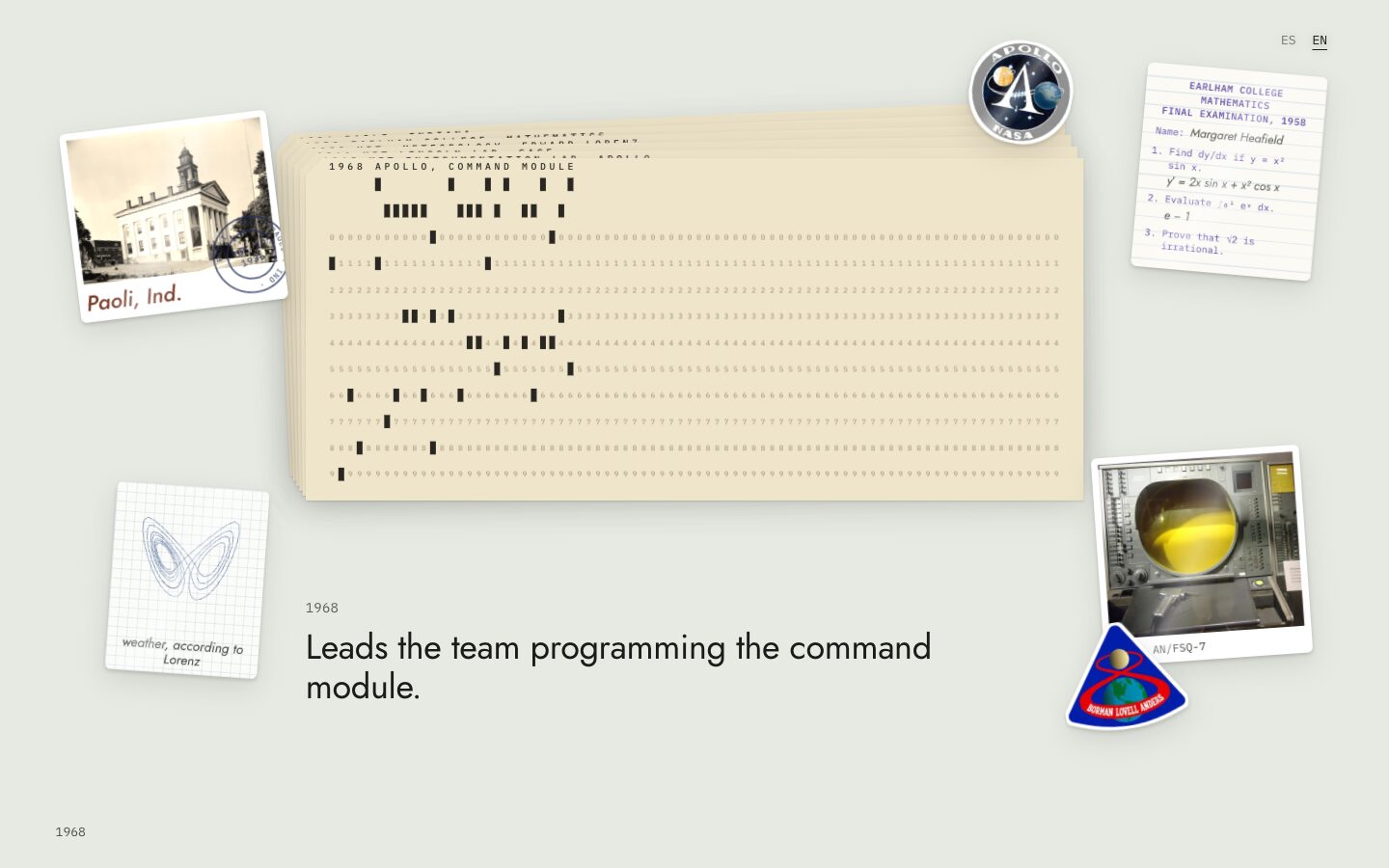
| 2 | Milestones | Her early years (Earlham, Edward Lorenz, SAGE, Apollo) punched as real Hollerith code on 80-column cards, like the ones used at MIT. |
| 3 | Lauren | A working DSKY replays the story of her daughter crashing the simulator with P01, the mistake Jim Lovell repeated on Apollo 8, and the birth of defensive programming. |
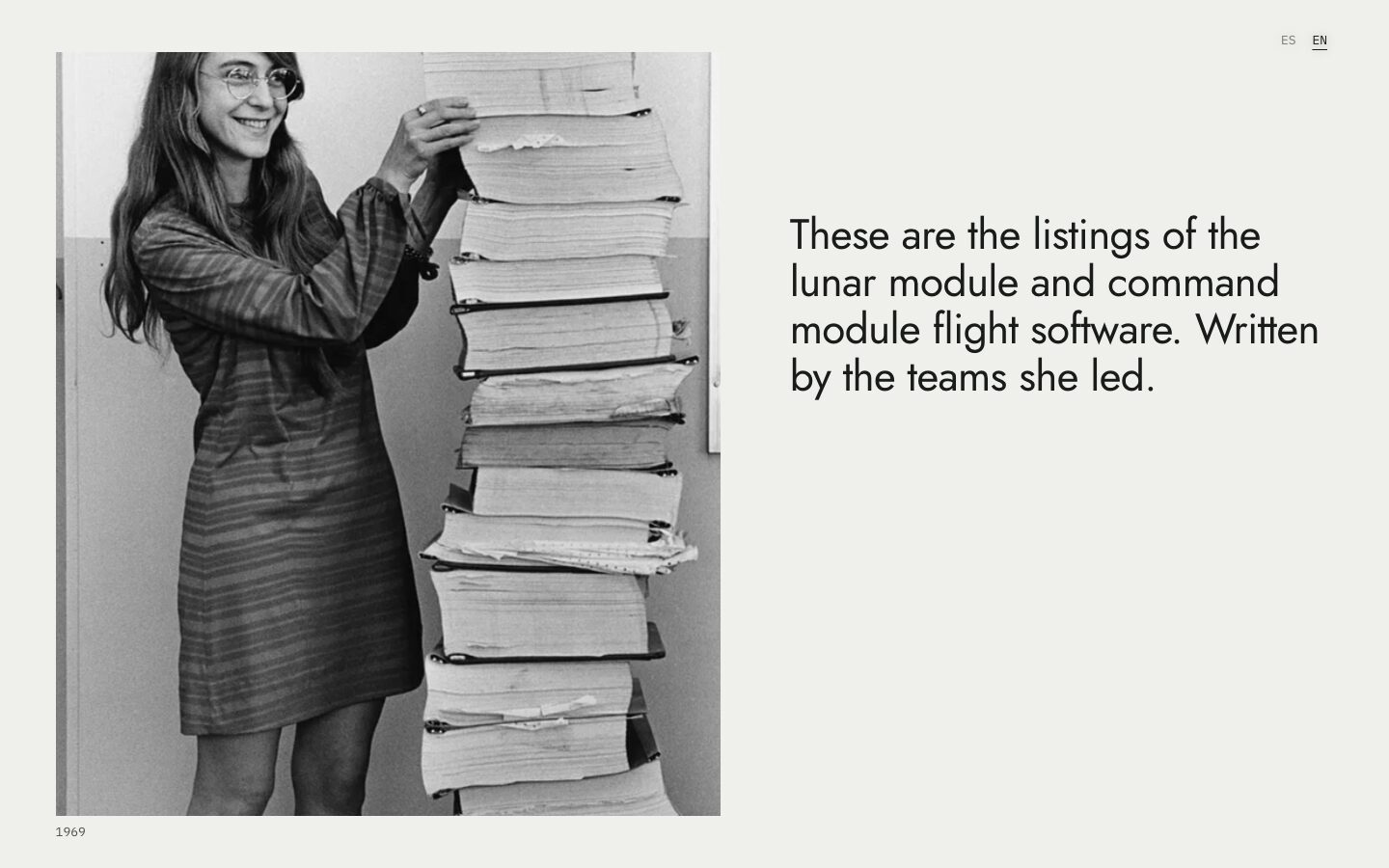
| 4 | The tower | The famous 1969 photo next to the listings, stacked binder by binder with real Luminary 099 and Comanche 055 module names. |
| 5 | The 1202 alarm | The Apollo 11 descent: the program alarms on the DSKY, “We’re Go on that alarm” and “The Eagle has landed.” |
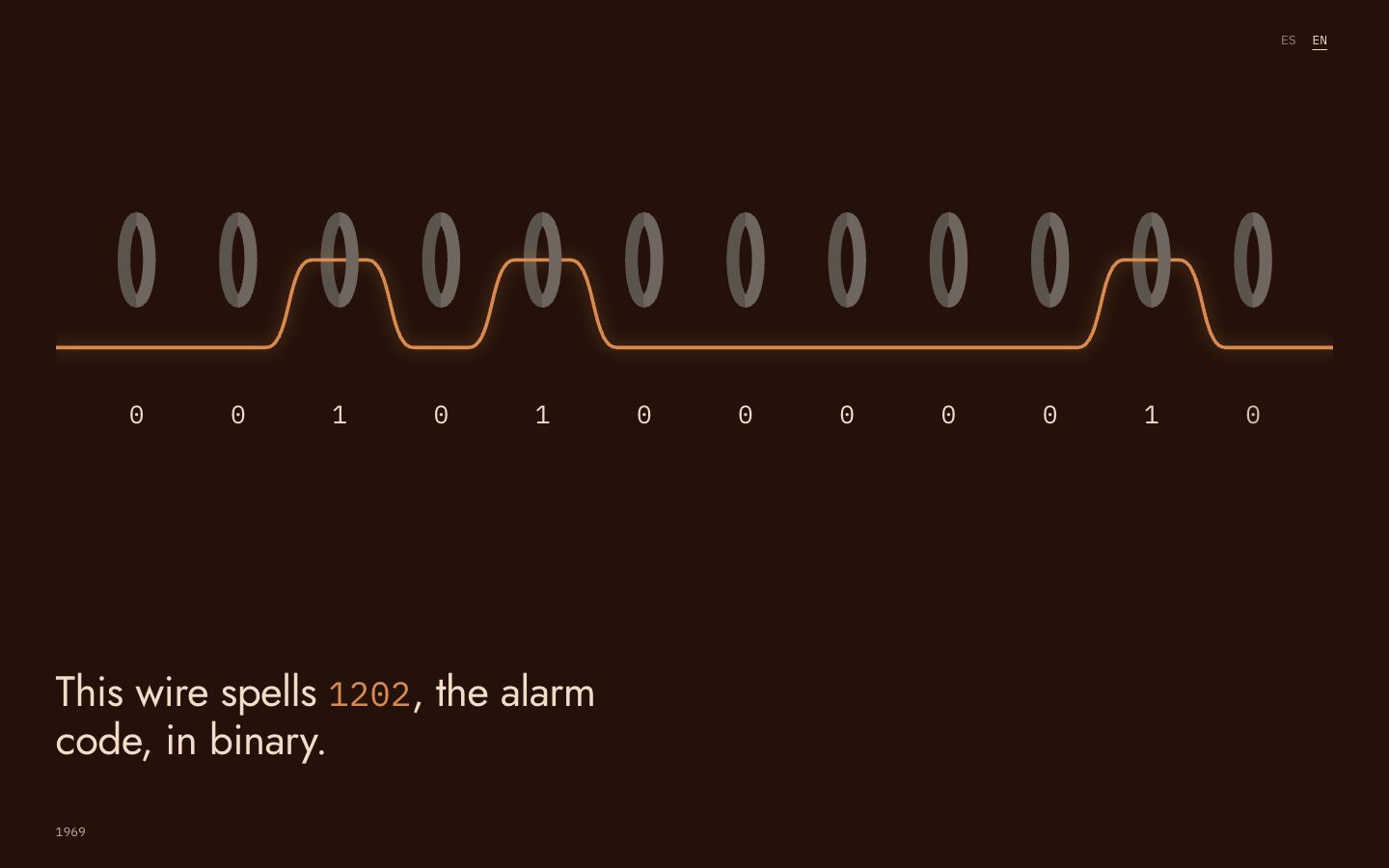
| 6 | Rope memory | A wire threads through magnetic cores to spell 1202 in binary: software that was literally woven by hand. |
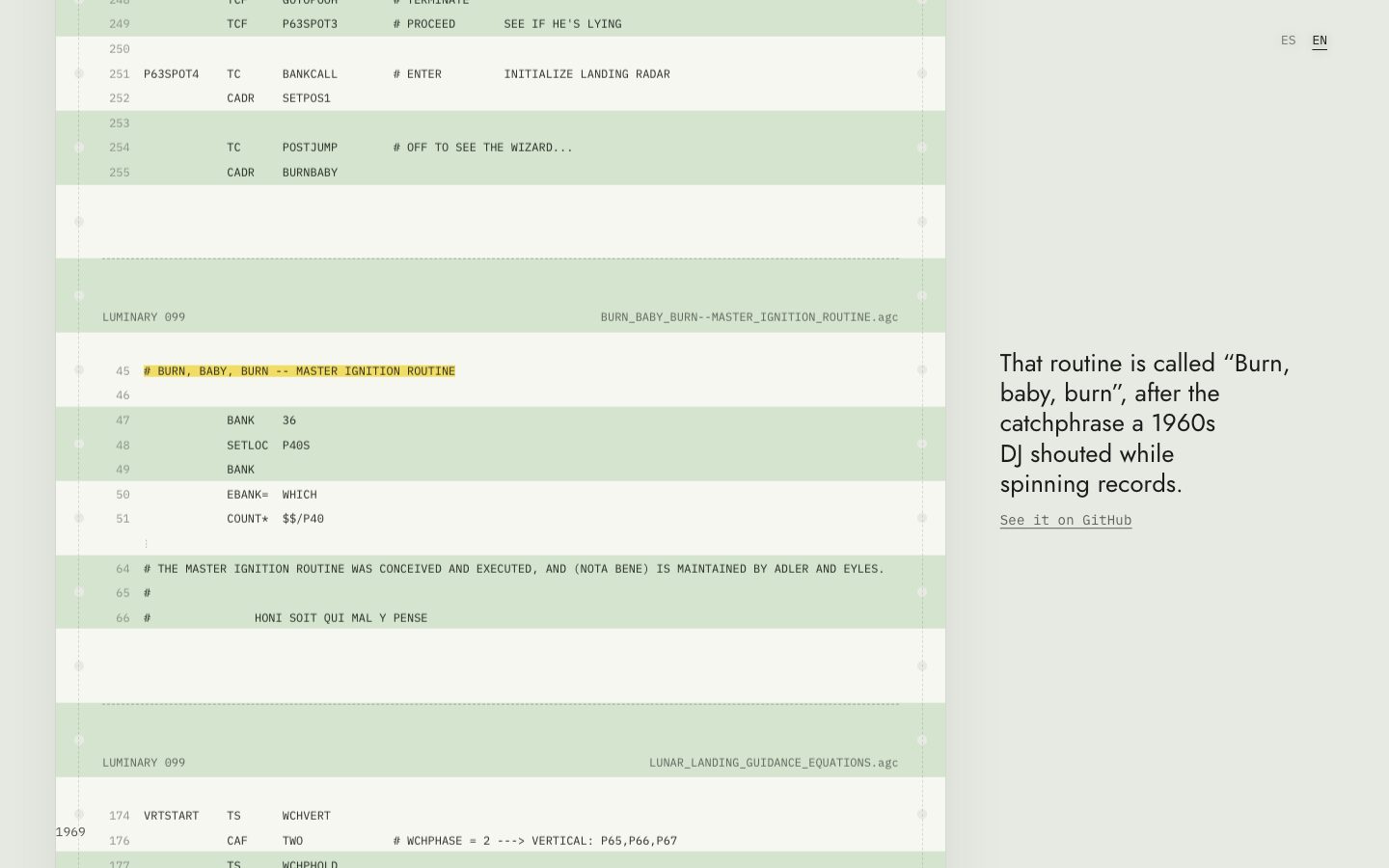
| 7 | The code | Real excerpts from Luminary 099 (BURN_BABY_BURN, PINBALL_GAME_BUTTONS_AND_LIGHTS, “PLEASE CRANK THE SILLY THING AROUND”) linked to their exact lines on GitHub, ending with her signature in the README. |
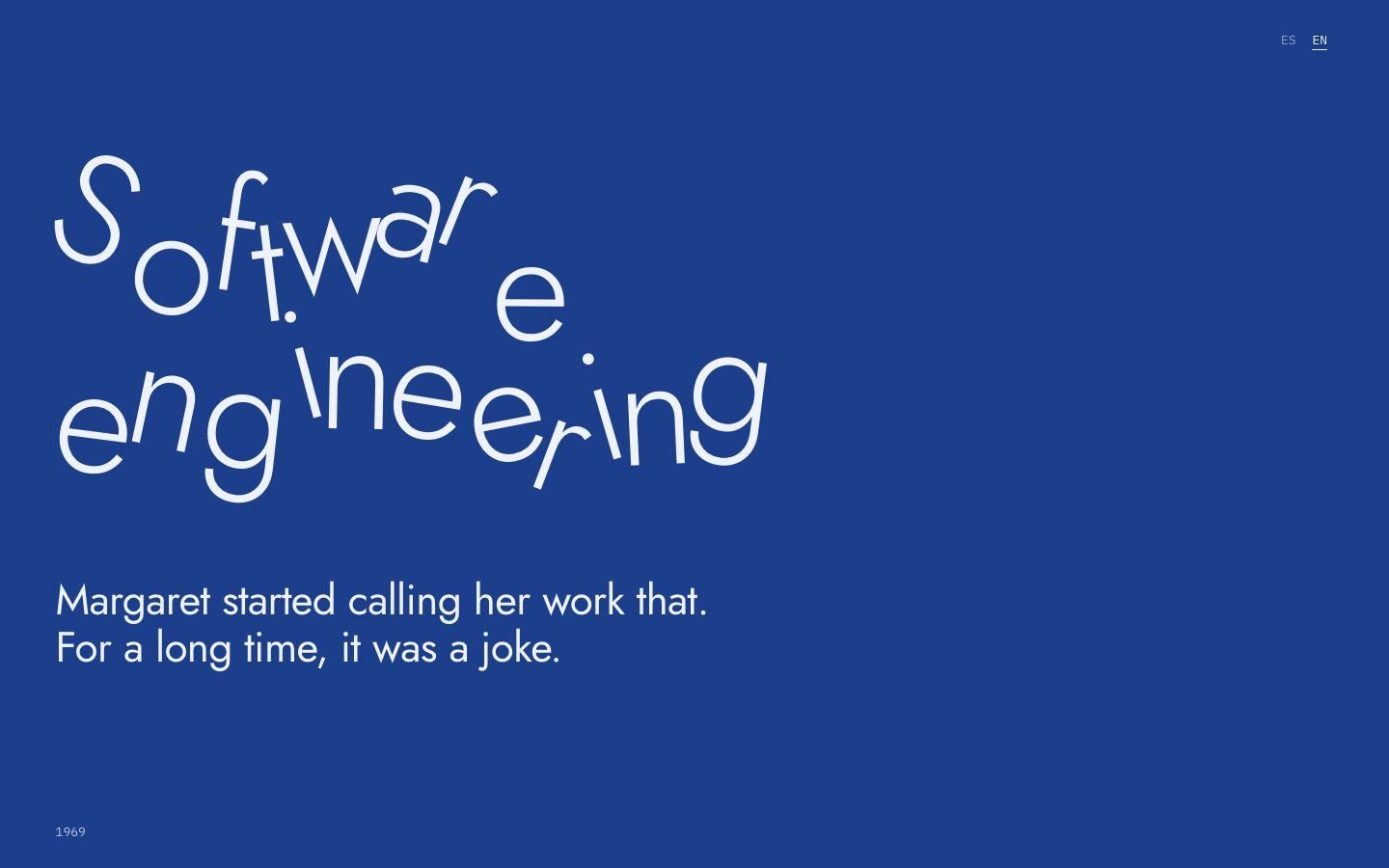
| 8 | Software engineering | The two words wobble like the joke they once were, then straighten and gain weight as you scroll, until they name a profession. |
| 9 | Legacy | Higher Order Software, Hamilton Technologies, the NASA Exceptional Space Act Award and the Presidential Medal of Freedom. |
| 10 | Closing | “Thank you, Margaret.” |
Screenshots
 |
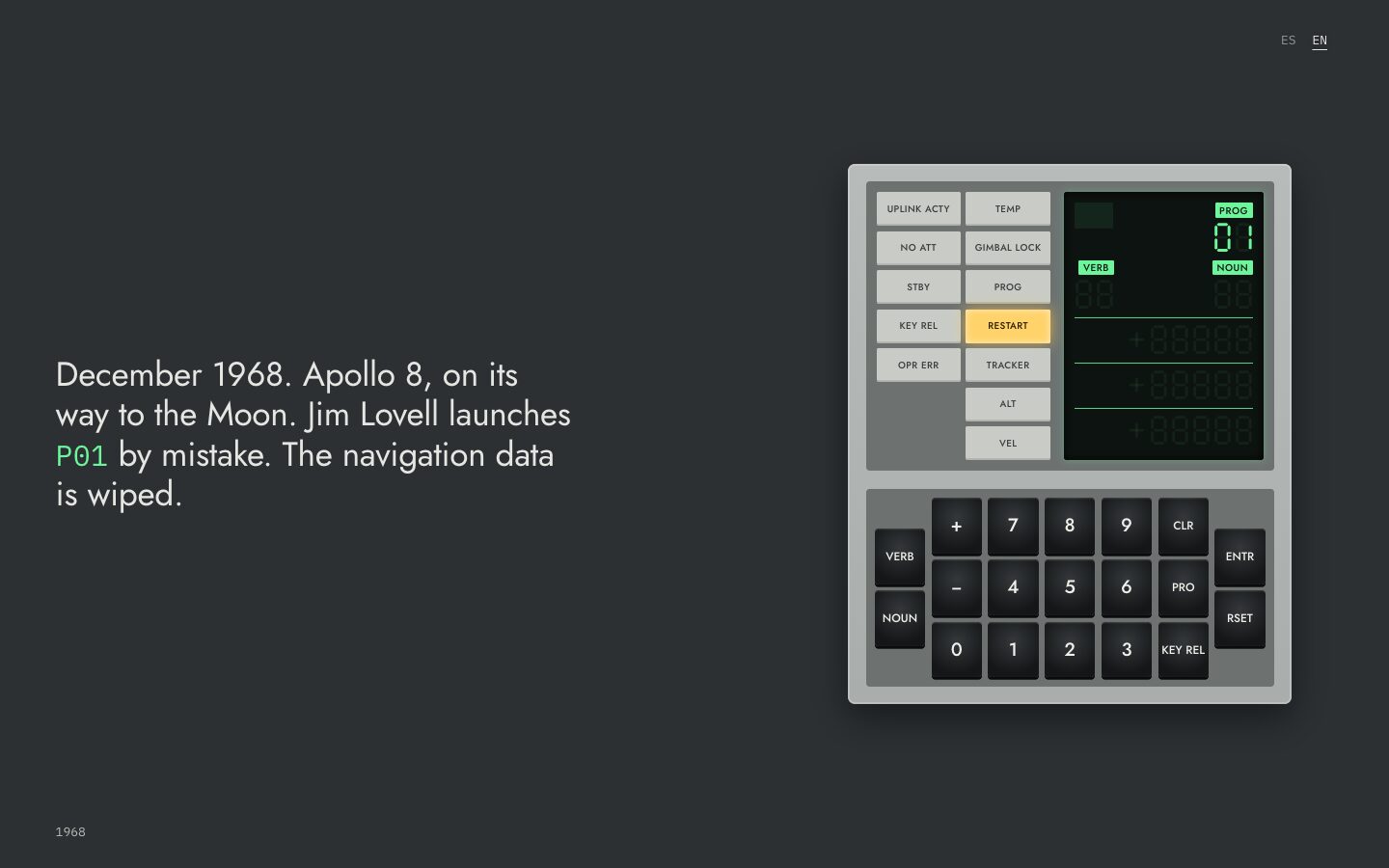 |
| Milestones on 80-column punch cards | A working DSKY and the P01 incident |
 |
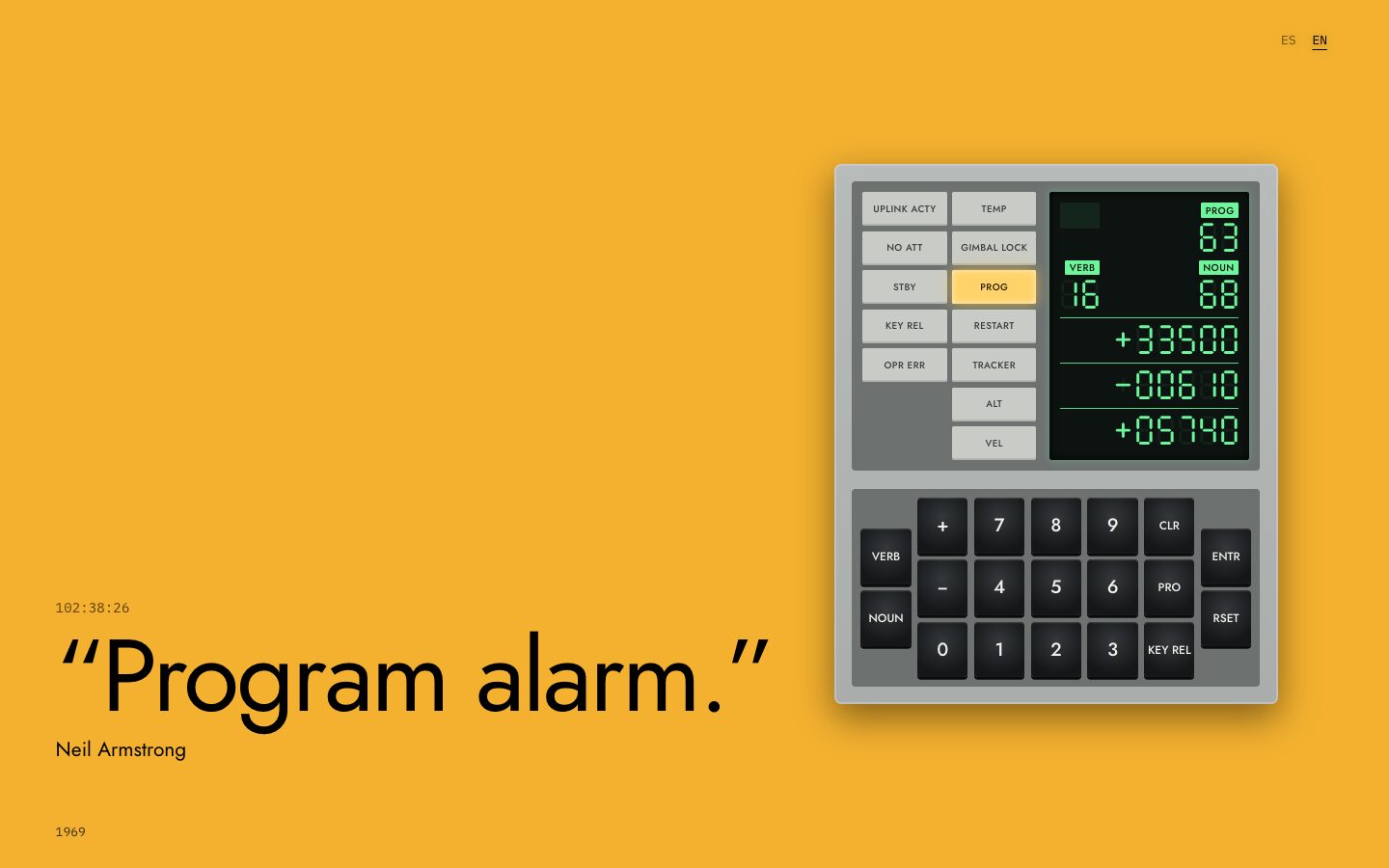 |
| MIT, 1969: the tower of listings | “Program alarm.” |
 |
 |
Rope memory spelling 1202 |
The real Apollo 11 source code |
 |
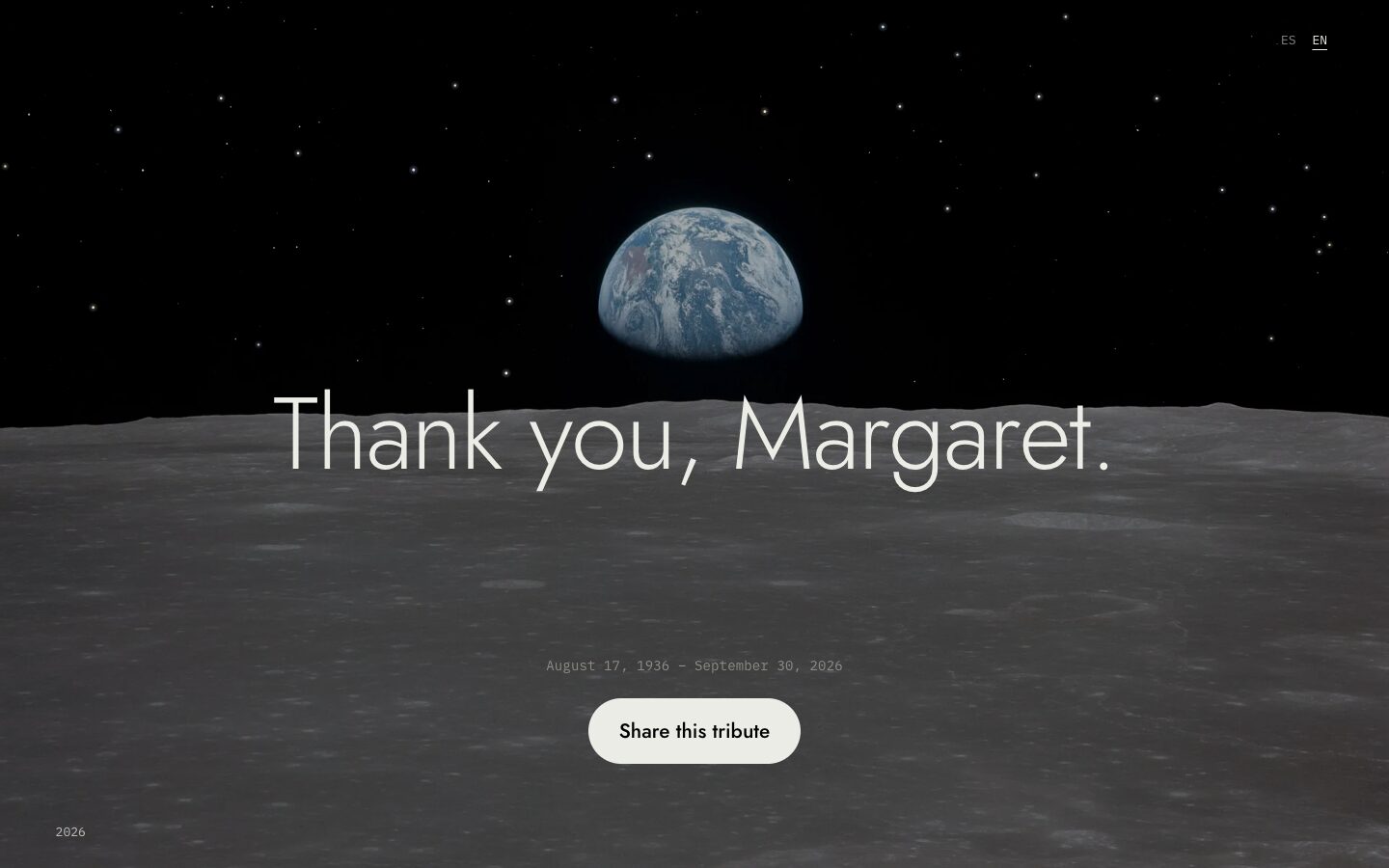 |
| “Software engineering”, once a joke | Thank you, Margaret. |
Under the hood
- Astro with zero UI frameworks. The site is fully static: Astro components, scoped CSS and a few small TypeScript modules.
- Scroll-driven scenes. Each
[data-scene]is a tall container with a sticky stage.src/scripts/scroll.tscomputes its progress (0 → 1) and exposes it as the--pcustom property, so most animations are plain CSS. Texts appear at their moment throughdata-beat, and the page theme and year indicator follow the active scene. - Stars that become letters.
src/scripts/stars.tsscatters candidate stars across the sky of the photo and pairs each glyph with a star using an optimal assignment, so the trajectories never cross. - A DSKY in HTML and CSS.
Dsky.astroandsrc/scripts/dsky.tsrecreate the Apollo Guidance Computer display and keyboard, with segmented electroluminescent digits. - The real source code.
src/data/listing.tsholds verbatim fragments of Luminary 099, the lunar module software, with their original line numbers. The GitHub star count of chrislgarry/Apollo-11 is fetched at build time. - Bilingual. Spanish (default,
/) and English (/en/) with Astro’s i18n routing and a tinyt({ es, en })helper. The first visit follows the browser language and the choice is remembered. - Typography with a story. Jost, a revival of Futura, the typeface on the plaque Apollo 11 left on the Moon, paired with IBM Plex Mono. Both are self-hosted through the Astro Fonts API.
- Details. Responsive images optimized with
astro:assets,prefers-reduced-motionsupport, descriptive alt texts, Open Graph image, JSON-LD,hreflangalternates and a sitemap.
Project structure
/
├── public/                 # favicon, Open Graph image, robots.txt, sitemap.xml
└── src/
    ├── assets/             # photos and stickers, optimized at build time
    ├── components/
    │   ├── scenes/         # one component per chapter of the story
    │   ├── Dsky.astro      # Apollo Guidance Computer display and keyboard
    │   ├── Home.astro      # composes all the scenes
    │   ├── StarText.astro  # text whose letters are born from stars
    │   └── Starfield.astro
    ├── data/listing.ts     # real fragments of the Luminary 099 source code
    ├── layouts/Layout.astro
    ├── pages/              # / (Spanish) and /en/ (English)
    ├── scripts/            # scroll engine, starfield and DSKY logic
    └── i18n.ts
Getting started
Requirements: Node.js >=22.12.0 and pnpm.
git clone https://github.com/midudev/margarethamilton.dev.git
cd margarethamilton.dev
pnpm install
pnpm dev
| Command | Action |
|---|---|
pnpm dev |
Start the dev server at localhost:4321 |
pnpm build |
Build the production site to ./dist/ |
pnpm preview |
Preview the production build locally |
Credits
- Photos. NASA (Apollo 11, command module simulator, 1989 portrait). Draper Laboratory, 1969, restored by Adam Cuerden. The White House, 2016. Rope memory: Wikimedia Commons. All public domain. LEGO figure: Maia Weinstock, CC BY-NC-ND 2.0. 1995 portrait: Daphne Weld Nichols, CC BY-SA 3.0, converted to black and white.
- Code. Luminary 099, transcribed by the Virtual AGC project from the MIT Museum listings, at github.com/chrislgarry/Apollo-11.
- Sources. MIT News and the Apollo Lunar Surface Journal.
License
The source code is released under the MIT License. Photos and other third-party media keep their original licenses, listed in Credits, and are not covered by it.
Thank you, Margaret.
Questions
What is margarethamilton.dev?
midudev/margarethamilton.dev is a public repo on GitHub by midudev. A scroll-driven tribute to Margaret Hamilton (1936–2026), who led the Apollo 11 flight software and gave software engineering its name.
Is margarethamilton.dev open source?
It declares the MIT license on GitHub.
Does margarethamilton.dev run on macOS, Windows or Linux?
Its maker has not tagged a system, so it is unknown here. Its README says what it needs.
How do I install margarethamilton.dev?
Open "Take it" on its page: Take My Repo writes an install plan for your machine and hands it to your AI agent (Claude Code, Codex or Cursor), which asks you before each step. Take My Repo has not tested it on any machine.