
build-your-own-x
Master programming by recreating your favorite technologies from scratch.
- 564k
- Markdown
- 1 d ago
Computer Vision Guide
Repo mikeroyal/Computer-Vision-Guide, read from GitHub 1 min ago. mikeroyal has not joined Take My Repo.
mikeroyal/Computer-Vision-Guide is a public repo on GitHub by mikeroyal. Computer Vision Guide. It declares no license on GitHub. Public does not mean open source: without a license, nobody is granted the right to reuse it. It is written mainly in Python, has 40 stars and last changed on 2022-01-09. Nobody has reviewed it on Take My Repo yet, which says nothing about its quality. Read from GitHub on 2026-11-20.

Note: You can easily convert this markdown file to a PDF in VSCode using this handy extension Markdown PDF.

Computer Vision is a field of Artificial Intelligence (AI) that focuses on enabling computers to identify and understand objects and people in images and videos.
Exploring Computer Vision in Microsoft Azure
Top Computer Vision Courses Online | Coursera
Top Computer Vision Courses Online | Udemy
Learn Computer Vision with Online Courses and Lessons | edX
Computer Vision and Image Processing Fundamentals | edX
Introduction to Computer Vision Courses | Udacity
Computer Vision Nanodegree program | Udacity
Machine Vision Course |MIT Open Courseware
Computer Vision Training Courses | NobleProg
Visual Computing Graduate Program | Stanford Online
OpenCV is a highly optimized library with focus on real-time computer vision applications. The C++, Python, and Java interfaces support Linux, MacOS, Windows, iOS, and Android.
Microsoft Cognitive Toolkit (CNTK) is an open-source toolkit for commercial-grade distributed deep learning. It describes neural networks as a series of computational steps via a directed graph. CNTK allows the user to easily realize and combine popular model types such as feed-forward DNNs, convolutional neural networks (CNNs) and recurrent neural networks (RNNs/LSTMs). CNTK implements stochastic gradient descent (SGD, error backpropagation) learning with automatic differentiation and parallelization across multiple GPUs and servers.
Scikit-Learn is a Python module for machine learning built on top of SciPy, NumPy, and matplotlib, making it easier to apply robust and simple implementations of many popular machine learning algorithms.
NVIDIA cuDNN is a GPU-accelerated library of primitives for deep neural networks. cuDNN provides highly tuned implementations for standard routines such as forward and backward convolution, pooling, normalization, and activation layers. cuDNN accelerates widely used deep learning frameworks, including Caffe2, Chainer, Keras, MATLAB, MxNet, PyTorch, and TensorFlow.
Automated Driving Toolbox™ is a MATLAB tool that provides algorithms and tools for designing, simulating, and testing ADAS and autonomous driving systems. You can design and test vision and lidar perception systems, as well as sensor fusion, path planning, and vehicle controllers. Visualization tools include a bird’s-eye-view plot and scope for sensor coverage, detections and tracks, and displays for video, lidar, and maps. The toolbox lets you import and work with HERE HD Live Map data and OpenDRIVE® road networks. It also provides reference application examples for common ADAS and automated driving features, including FCW, AEB, ACC, LKA, and parking valet. The toolbox supports C/C++ code generation for rapid prototyping and HIL testing, with support for sensor fusion, tracking, path planning, and vehicle controller algorithms.
LRSLibrary is a Low-Rank and Sparse Tools for Background Modeling and Subtraction in Videos. The library was designed for moving object detection in videos, but it can be also used for other computer vision and machine learning problems.
Image Processing Toolbox™ is a tool that provides a comprehensive set of reference-standard algorithms and workflow apps for image processing, analysis, visualization, and algorithm development. You can perform image segmentation, image enhancement, noise reduction, geometric transformations, image registration, and 3D image processing.
Computer Vision Toolbox™ is a tool that provides algorithms, functions, and apps for designing and testing computer vision, 3D vision, and video processing systems. You can perform object detection and tracking, as well as feature detection, extraction, and matching. You can automate calibration workflows for single, stereo, and fisheye cameras. For 3D vision, the toolbox supports visual and point cloud SLAM, stereo vision, structure from motion, and point cloud processing.
Statistics and Machine Learning Toolbox™ is a tool that provides functions and apps to describe, analyze, and model data. You can use descriptive statistics, visualizations, and clustering for exploratory data analysis; fit probability distributions to data; generate random numbers for Monte Carlo simulations, and perform hypothesis tests. Regression and classification algorithms let you draw inferences from data and build predictive models either interactively, using the Classification and Regression Learner apps, or programmatically, using AutoML.
Lidar Toolbox™ is a tool that provides algorithms, functions, and apps for designing, analyzing, and testing lidar processing systems. You can perform object detection and tracking, semantic segmentation, shape fitting, lidar registration, and obstacle detection. Lidar Toolbox supports lidar-camera cross calibration for workflows that combine computer vision and lidar processing.
Mapping Toolbox™ is a tool that provides algorithms and functions for transforming geographic data and creating map displays. You can visualize your data in a geographic context, build map displays from more than 60 map projections, and transform data from a variety of sources into a consistent geographic coordinate system.
UAV Toolbox is an application that provides tools and reference applications for designing, simulating, testing, and deploying unmanned aerial vehicle (UAV) and drone applications. You can design autonomous flight algorithms, UAV missions, and flight controllers. The Flight Log Analyzer app lets you interactively analyze 3D flight paths, telemetry information, and sensor readings from common flight log formats.
Parallel Computing Toolbox™ is a tool that lets you solve computationally and data-intensive problems using multicore processors, GPUs, and computer clusters. High-level constructs such as parallel for-loops, special array types, and parallelized numerical algorithms enable you to parallelize MATLAB® applications without CUDA or MPI programming. The toolbox lets you use parallel-enabled functions in MATLAB and other toolboxes. You can use the toolbox with Simulink® to run multiple simulations of a model in parallel. Programs and models can run in both interactive and batch modes.
Partial Differential Equation Toolbox™ is a tool that provides functions for solving structural mechanics, heat transfer, and general partial differential equations (PDEs) using finite element analysis.
ROS Toolbox is a tool that provides an interface connecting MATLAB® and Simulink® with the Robot Operating System (ROS and ROS 2), enabling you to create a network of ROS nodes. The toolbox includes MATLAB functions and Simulink blocks to import, analyze, and play back ROS data recorded in rosbag files. You can also connect to a live ROS network to access ROS messages.
Robotics Toolbox™ provides a toolbox that brings robotics specific functionality(designing, simulating, and testing manipulators, mobile robots, and humanoid robots) to MATLAB, exploiting the native capabilities of MATLAB (linear algebra, portability, graphics). The toolbox also supports mobile robots with functions for robot motion models (bicycle), path planning algorithms (bug, distance transform, D*, PRM), kinodynamic planning (lattice, RRT), localization (EKF, particle filter), map building (EKF) and simultaneous localization and mapping (EKF), and a Simulink model a of non-holonomic vehicle. The Toolbox also including a detailed Simulink model for a quadrotor flying robot.
Deep Learning Toolbox™ is a tool that provides a framework for designing and implementing deep neural networks with algorithms, pretrained models, and apps. You can use convolutional neural networks (ConvNets, CNNs) and long short-term memory (LSTM) networks to perform classification and regression on image, time-series, and text data. You can build network architectures such as generative adversarial networks (GANs) and Siamese networks using automatic differentiation, custom training loops, and shared weights. With the Deep Network Designer app, you can design, analyze, and train networks graphically. It can exchange models with TensorFlow™ and PyTorch through the ONNX format and import models from TensorFlow-Keras and Caffe. The toolbox supports transfer learning with DarkNet-53, ResNet-50, NASNet, SqueezeNet and many other pretrained models.
Reinforcement Learning Toolbox™ is a tool that provides an app, functions, and a Simulink® block for training policies using reinforcement learning algorithms, including DQN, PPO, SAC, and DDPG. You can use these policies to implement controllers and decision-making algorithms for complex applications such as resource allocation, robotics, and autonomous systems.
Deep Learning HDL Toolbox™ is a tool that provides functions and tools to prototype and implement deep learning networks on FPGAs and SoCs. It provides pre-built bitstreams for running a variety of deep learning networks on supported Xilinx® and Intel® FPGA and SoC devices. Profiling and estimation tools let you customize a deep learning network by exploring design, performance, and resource utilization tradeoffs.
Model Predictive Control Toolbox™ is a tool that provides functions, an app, and Simulink® blocks for designing and simulating controllers using linear and nonlinear model predictive control (MPC). The toolbox lets you specify plant and disturbance models, horizons, constraints, and weights. By running closed-loop simulations, you can evaluate controller performance.
Vision HDL Toolbox™ is a tool that provides pixel-streaming algorithms for the design and implementation of vision systems on FPGAs and ASICs. It provides a design framework that supports a diverse set of interface types, frame sizes, and frame rates. The image processing, video, and computer vision algorithms in the toolbox use an architecture appropriate for HDL implementations.
Microsoft AirSim is a simulator for drones, cars and more, built on Unreal Engine (with an experimental Unity release). AirSim is open-source, cross platform, and supports software-in-the-loop simulation with popular flight controllers such as PX4 & ArduPilot and hardware-in-loop with PX4 for physically and visually realistic simulations. It is developed as an Unreal plugin that can simply be dropped into any Unreal environment. AirSim is being developed as a platform for AI research to experiment with deep learning, computer vision and reinforcement learning algorithms for autonomous vehicles.
Photogrammetry is the art and science of extracting 3D information from photographs. The process involves taking overlapping photographs of an object, structure, or space, and converting them into 2D or 3D digital models. Photogrammetry is often used by surveyors, architects, engineers, and contractors to create topographic maps, meshes, point clouds, or drawings based on the real-world.
Aerial photogrammetry is process of utilizing aircrafts to produce aerial photography that can be turned into a 3D model or mapped digitally. Now, it is possible to do the same work with a drone.
Terrestrial(Close-range) photogrammetry is when images are captured using a handheld camera or with a camera mounted to a tripod. The output of this method is not to create topographic maps, but rather to make 3D models of a smaller object.
Top Photogrammetry Courses Online | Udemy
Photogrammetry With Drones: In Mapping Technology | Udemy
Introduction to Photogrammetry Course | Coursera
Photogrammetry Online Classes and Training | Linkedin Learning
Pix4D training and certification for mapping professionals
Drone mapping and photogrammetry workshops with Pix4D
Digital Photogrammetric Systems Course | Purdue Online Learning
Photogrammetry Training | Deep3D Photogrammetry
Autodesk® ReCap™ is a software tool that converts reality captured from laser scans or photos into a 3D model or 2D drawing that's ready to be used in your design built for UAV and drone processes.
Autodesk® ReCap™ Photo is a cloud-connected solution tailored for drone/UAV photo capturing workflows. Using ReCap Photo, you can create textured meshes, point clouds with geolocation, and high-resolution orthographic views with elevation maps.
Pix4D is a unique suite of photogrammetry software for drone mapping. Capture images with our app, process on desktop or cloud and create maps and 3D models.
PIX4Dmapper is the leading photogrammetry software for professional drone mapping.
RealityCapture is a state-of-the-art photogrammetry software solution that creates virtual reality scenes, textured 3D meshes, orthographic projections, geo-referenced maps and much more from images and/or laser scans completely automatically.
Adobe Scantastic is a tool that makes the creation of 3D assets accessible to everyone. It can be used with just a mobile device (combined with Adobe's server-based photogrammetry pipeline), users can easily scan objects in their physical environment and turn them into 3D models which can then be imported into tools like Adobe Dimension and Adobe Aero.
Adobe Aero is a tool that helps you build, view, and share immersive AR experiences. Simply build a scene by bringing in 2D images from Adobe Photoshop and Illustrator, or 3D models from Adobe Dimension, Substance, third-party apps like Cinema 4D, or asset libraries like Adobe Stock and TurboSquid. Aero optimizes a wide array of assets, including OBJ, GLB, and glTF files, for AR, so you can visualize them in real time.
Agisoft Metashape is a stand-alone software product that performs photogrammetric processing of digital images and generates 3D spatial data to be used in GIS applications, cultural heritage documentation, and visual effects production as well as for indirect measurements of objects of various scales.
MicroStation is a CAD software platform for 2D and 3D dimensional design and drafting, developed and sold by Bentley Systems. It generates 2D/3D vector graphics objects and elements and includes building information modeling (BIM) features.
Leica Photogrammetry Suite (LPS) is a powerful photogrammetry system that delivers full analytical triangulation, the generation of digital terrain models, orthophoto production, mosaicking, and 3D feature extraction in a user-friendly environment that guarantees results even for photogrammetry novices.
Terramodel is a powerful software package for the surveyor, civil engineer or contractor who requires a CAD and design package with integrated support for raw survey data.
MicMac is a free and open-source photogrammetry software tools for 3D reconstruction.
[3DF Zephyr] (https://www.3dflow.net/3df-zephyr-photogrammetry-software/) is a photogrammetry software solution by 3Dflow. It allows you automatically reconstruct 3D models from photos and deal with any 3D reconstruction and scanning challenge. No matter what camera sensor, drone or laser scanner device you are going to use.
COLMAP is a general-purpose Structure-from-Motion (SfM) and Multi-View Stereo (MVS) pipeline with a graphical and command-line interface. It offers a wide range of features for reconstruction of ordered and unordered image collections.
Multi-View Environment (MVE) is an effort to ease the work with multi-view datasets and to support the development of algorithms based on multiple views. It features Structure from Motion, Multi-View Stereo and Surface Reconstruction. MVE is developed at the TU Darmstadt.
AliceVision is a Photogrammetric Computer Vision Framework which provides 3D Reconstruction and Camera Tracking algorithms. AliceVision comes up with strong software basis and state-of-the-art computer vision algorithms that can be tested, analyzed and reused.
Meshroom is a free, open-source 3D Reconstruction Software based on the AliceVision framework.
PhotoModeler is a software extracts Measurements and Models from photographs taken with an ordinary camera. A cost-effective way for accurate 2D or 3D measurement, photo-digitizing, surveying, 3D scanning, and reality capture.
ODM is an open source command line toolkit to generate maps, point clouds, 3D models and DEMs from drone, balloon or kite images.
WebODM is a user-friendly, commercial grade software for drone image processing. Generate georeferenced maps, point clouds, elevation models and textured 3D models from aerial images. It supports multiple engines for processing, currently ODM and MicMac.
NodeODM is a standard API specification for processing aerial images with engines such as ODM. The API is used by clients such as WebODM, CloudODM and PyODM.
[ClusterODM]https://www.opendronemap.org/clusterodm/) is a reverse proxy, load balancer and task tracker with optional cloud autoscaling capabilities for NodeODM API compatible nodes. In a nutshell, it's a program to link together multiple NodeODM API compatible nodes under a single network address.
FIELDimageR is an R package to analyze orthomosaic images from agricultural field trials.
Regard3D is a free and open source structure-from-motion program. It converts photos of an object, taken from different angles, into a 3D model of this object.

Autodesk is a global leader in design and make technology, with expertise across architecture, engineering, construction, design, manufacturing, and entertainment.
CNC programming (Computer Numerical Control Programming) is utilized by manufacturers to create program instructions for computers to control a machine tool. CNC is highly involved in the manufacturing process and improves automation as well as flexibility.
Software and Services for Education | Autodesk Education
Learning Civil 3D on Autodesk Knowledge Network
Top Autodesk Courses on Coursera
Top Autodesk Fusion 360 Courses on Coursera
AutoCAD® is computer-aided design (CAD) software that architects, engineers, and construction professionals rely on to create precise 2D and 3D drawings. It also automates tasks such as comparing drawings, counting, adding blocks, creating schedules.
AutoCAD LT® is a powerful 2D computer-aided design (CAD) software that architects, engineers, construction professionals, and designers rely on to design, draft, and document with precise 2D geometry.
AutoCAD® Mobile App is a mobile(smartphone or tablet) version of AutoCAD that has the core design and drafting tools. Work on your CAD drawings anytime, anywhere—even offline.
AutoCAD® Web App is a web version of AutoCAD that can edit, create, share, and view CAD drawings in a web browser on any computer.

AutoCAD® with Architecture toolset. Source: Autodesk

AutoCAD® with Mechanical toolset. Source: Autodesk
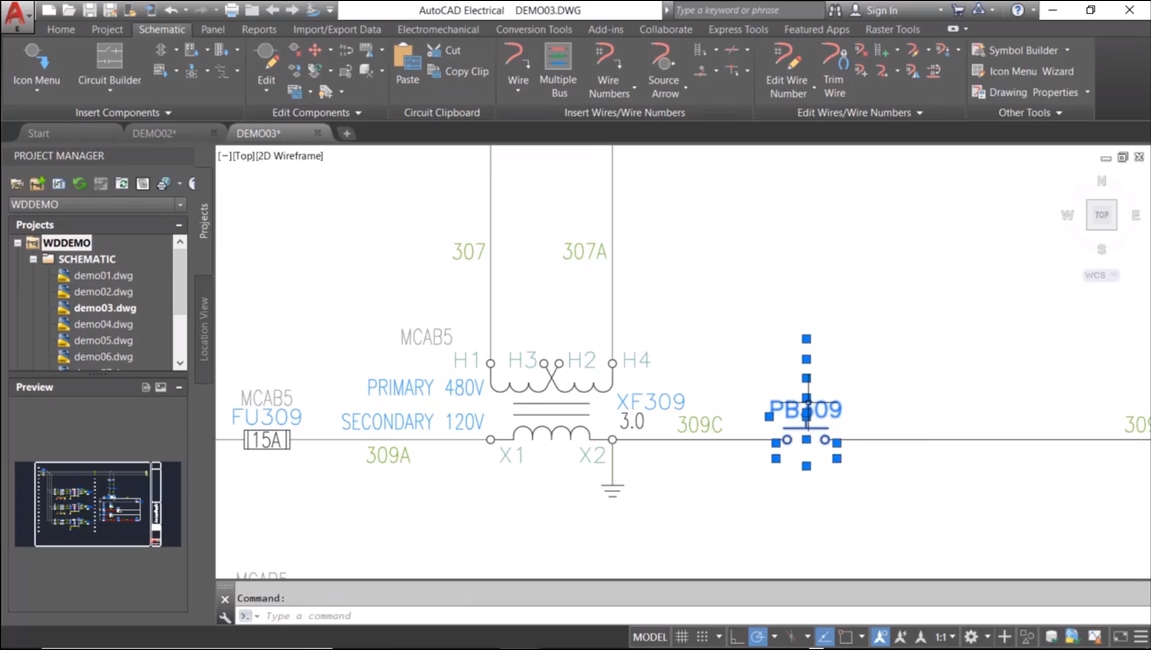
AutoCAD® with Electrical toolset. Source: Autodesk
Tinkercad® is a free, easy-to-use app for 3D design, electronics, and coding. It's used by teachers, kids, hobbyists, and designers to imagine, design, and make anything.
Revit® is a BIM (Building Information Modeling) software to drive efficiency and accuracy across the project lifecycle, from conceptual design, visualization, and analysis to fabrication and construction.
AEC(Architecture, Engineering & Construction) Collection® is a set of BIM and CAD tools for designers, engineers, and contractors that is supported by a cloud-based common data environment that facilitates project delivery from early-stage design through to construction.
Fusion 360® is an integrated CAD, CAM, CAE, and PCB software application. It unifies design, engineering, electronics, and manufacturing into a single software platform.
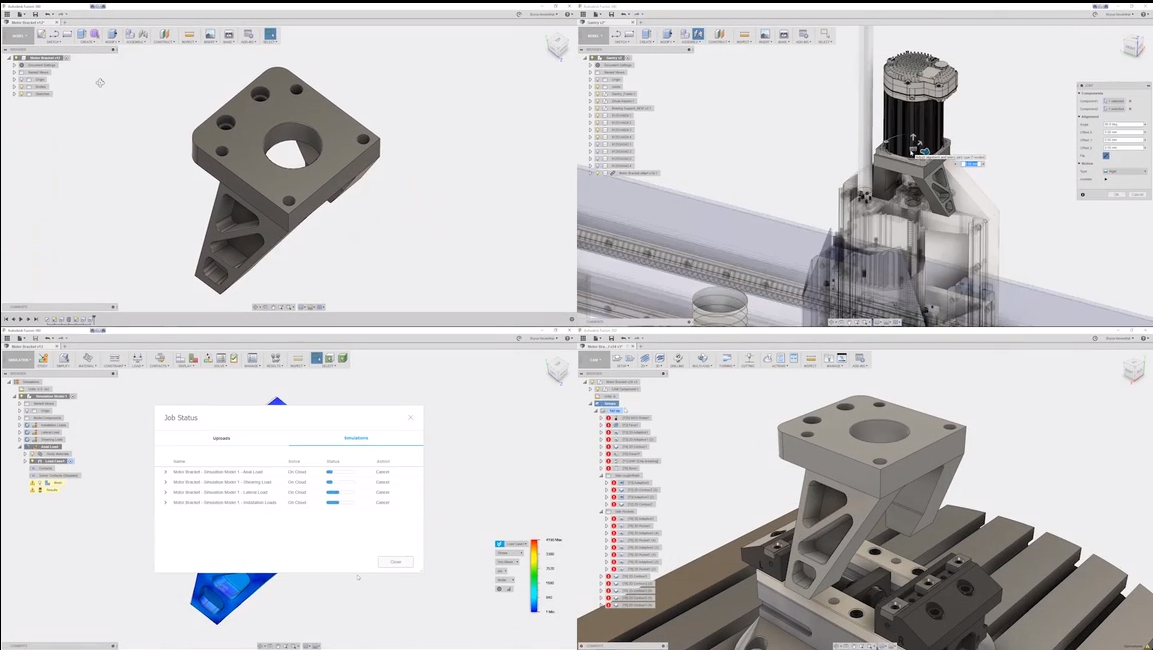
Autodesk® Fusion 360. Source: Autodesk
Fusion 360 with FeatureCAM® is a tool that gives you access to FeatureCAM Ultimate, PartMaker, Fusion 360, Fusion Team, and HSMWorks. With FeatureCAM CNC programming software uses manufacturing knowledge to intelligently make decisions, produce results, and remove repetitive processes.
Fusion 360 with Netfabb® is a software that offers a complete toolset for design and implementation for additive manufacturing. It streamlines workflows and automates processes around 3D print preparation. The software also includes access to Fusion 360, Fusion 360 Team, and additional capabilities through Fusion 360 Additive Extensions.
Fusion 360 Manage is a product lifecycle management platform that connects your people, processes, and data across departments and geographies. It gives you the flexibility to start today and expand tomorrow with PLM that adapts to your business.
Fusion Team is a cloud-based coll tool that helps eliminate the inefficiencies that disparate tools create when working with your internal and external teams.
Fusion 360 with PowerInspect® is a 3D measurement software offers a powerful way to inspect, validate, and manage quality for all measurement equipment. Now includes access to Fusion 360, Fusion 360 Team, and Fusion 360 – Machining Extension. PowerInspect includes comprehensive inspection tools that measure parts while they’re still in On Machine Verification (OMV). Machine tool probing helps you make informed scrap or rework decisions quickly.
Fusion 360 with PowerMill® CAM is a software provides expert CNC programming strategies for complex 3 and 5-axis manufacturing. This includes access to Fusion 360 and advanced manufacturing capabilities through Fusion 360 extensions.

CNC machining with Fusion 360 with PowerMill® CAM. Source: Autodesk
Fusion 360 with PowerShape® is a manufacturing CAD software combines surface, solid, and mesh modeling to help prepare molds, dies, and other complex parts for manufacture. This includes access to Fusion 360 and Fusion 360 Team.
Autodesk PartMaker® is a software that can produce CNC programs that drive main and sub-spindle machining operations. These can be used for turning, indexed and interpolated C-axis milling, Y-axis, and B-axis milling.
Robot Structural Analysis Professional is a structural load analysis software that verifies code compliance and uses BIM-integrated workflows to exchange data with Revit. It can help you to create more resilient, constructible designs that are accurate, coordinated, and connected to BIM.
Revit LT™ is a software that provides the most cost-effective BIM (Building Information Modeling) solution, you can produce high-quality 3D architectural designs and documentation.
Maya® is a 3D computer animation, modeling, simulation, and rendering software that can create realistic effects from explosions to cloth simulation.
Maya LT™ is a game design software for indie game makers that can create and animate realistic-looking characters, props, and environments using the sophisticated 3D modeling and animation tools.

Autodesk® Maya. Source:Autodesk
3DS Max® is a 3D modeling and rendering software for design visualization, games, and animation.

Autodesk® 3DS Max. Source:Autodesk
Arnold is an advanced Monte Carlo ray tracing(Global illumination) renderer that helps you work more efficiently.
ReCap™ is a Pro 3D scanning software to transform the physical world into a digital asset. With reality capture data you can better understand and verify existing and as-built conditions to gain insights and make better decisions.
Flame® is a 3D VFX and finishing software provides powerful tools for 3D compositing, visual effects, and editorial finishing. An integrated, creative environment means faster compositing, advanced graphics, color correction, and more.
Mudbox® is a 3D digital painting and sculpting software that let's you sculpt and paint highly detailed 3D geometry and textures.

Autodesk® Mudbox. Source:Autodesk
Character Generator® is a powerful 3D design and animation tools, Character Generator offers artists a web-based laboratory to create fully rigged 3D characters for animation packages and game engines.
Smoke® is a video effects software helps production studios increase productivity by combining editing workflows with node-based compositing tools in a timeline-centered editing environment.
ShotGrid formerly Shotgun Software, is software for creative project management software and review tools for film, TV, and games that streamlines workflows for creative studios.
Advance Steel® is a 3D modeling software for steel detailing, design, fabrication, and construction. it connects engineers and detailers through a seamless design and detailing workflow between Advance Steel and Revit, you can reduce the time required to move from design to fabrication while simultaneously reducing errors along the way.
Media & Entertainment Collection® is a collection that includes all of the tools you need to build a powerful and scalable 3D animation pipeline for complex simulations, effects, and rendering.
Civil 3D® is a civil engineering design software supports BIM (Building Information Modeling) with integrated features to improve drafting, design, and construction documentation.
Inventor® is a CAD software that provides professional-grade 3D mechanical design, documentation, and product simulation tools. Work efficiently with a powerful blend of parametric, direct, freeform, and rules-based design capabilities.
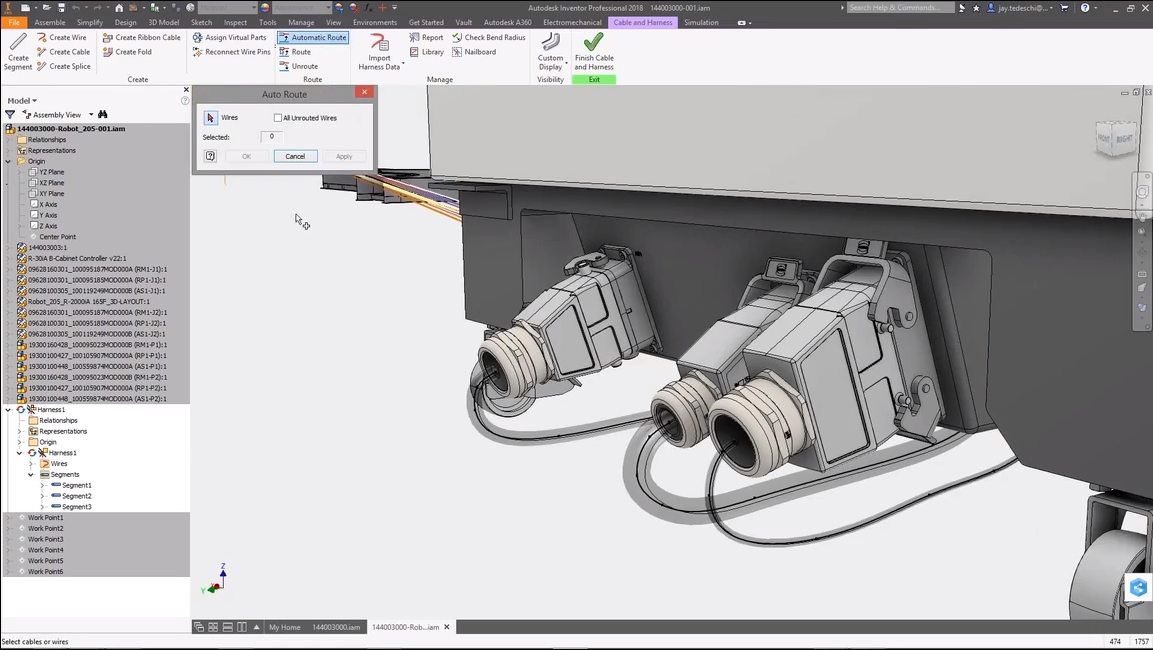
Autodesk® Inventor. Source:Autodesk
Inventor® CAM is an integrated CAM software for Inventor that simplifies CNC programming processes. Such as the machining workflow with CAD-embedded 2.5-axis to 5-axis milling, turning, and mill-turn capabilities.
Inventor Nastran® is a CAD-embedded finite element analysis software that delivers finite element analysis (FEA) tools for engineers and analysts. Simulation covers multiple analysis types, such as linear and nonlinear stress, dynamics, and heat transfer.
Inventor® Nesting is a CAD-embedded, true-shape nesting tools for Inventor that helps you optimize yield from flat raw material. Easily compare nesting studies to optimize efficiency and reduce costs, and export 3D models or DXF™ files of the completed nest for cutting path generation.
Inventor Tolerance Analysis® is an CAD-embedded tolerance stackup analysis software that is designed to help Inventor users make more informed decisions while specifying manufacturing tolerances.
Product Design & Manufacturing Collection is an integrated set of professional-grade applications that connect everyone, from concept to production, with shared tools to streamline your product development process.
Navisworks® is a project review software to improve BIM (Building Information Modeling) coordination. That can combine design and construction data into a single model.

Autodesk® Navisworks. Source:Autodesk
BIM Collaborate is cloud-based design collaboration and coordination software that connects AEC teams, helping you execute on design intent and deliver high-quality constructible models on a single platform.
BIM Collaborate Pro is cloud-based design collaboration and coordination software that connects AEC teams, helping you execute on design intent and deliver high-quality constructible models on a single platform.
InfraWorks® is a conceptual design software lets architecture, engineering, and construction professionals model, analyze, and visualize infrastructure design concepts within the context of the built and natural environment—improving decision making and accelerating project approvals.
SketchBook® is a drawing and painting software lets designers, architects, and concept artists sketch ideas quickly and create stunning illustrations.
Alias® is a product design software for sketching, concept modeling, surfacing, visualization. It can create and reuse templates across design and surfacing teams sharing surfacing language.
Assemble BIM Data is a tool that helps keep projects on track. Along with condition and connect BIM data to design reviews, estimating, change management, scheduling, work-in-place tracking, and more.
Autodesk® Forge is a cloud-based developer platform from Autodesk. That let's you access design and engineering data in the cloud with the Forge platform. Whether you want to automate processes, connect teams and workflows, or visualize your data using Forge APIs.
Autodesk® Rendering is a fast, high-resolution cloud rendering software that let's you produce stunning, high-quality renderings from designs and models with cloud rendering. This service uses cloud credits, which is a universal measure across Autodesk consumption-based cloud services to perform certain tasks in the cloud.
Autodesk® CFD is a computational fluid dynamics simulation software that engineers and analysts use to intelligently predict how liquids and gases will perform. It helps to minimize the need for physical prototypes while providing deeper insight into fluid flow design performance.
Autodesk® Drive is a way to securely store, preview, and share your 2D and 3D design data.
Autodesk® Viewer is a tool that supports most 2D and 3D files, including DWG, STEP, DWF, RVT, and Solidworks, and works with over 80 file types on any device. Get the feedback you need with Autodesk Viewer’s annotation and drawing tools for easy online collaboration.
Autodesk BIM 360® is a tool is part of the Autodesk Construction Cloud, connecting workflows, teams, and data to help you build better.
Autodesk® Build is a construction management software for field execution and project management that empowers you to seamlessly collaborate and deliver construction projects on time, on budget.
Autodesk® Takeoff is a tool that helps you work with competitive bids that are generated from accurate estimates produced from integrated 2D takeoffs and 3D quantities.
BuildingConnected is the argest real-time construction network that connects owners and builders through an easy-to-use platform to streamline the bid and risk management process.
Bid Board Pro is a tool that helps you see all bid invites across your entire office or division from one place. Know what needs to get done, who’s responsible for it and when it’s due. Track project files, deadlines and more during each stage of the bidding process.
TradeTapp is a tool that helps you significantly decrease the time it takes to analyze subcontractor risk, annually or for a specific project. Advanced risk profiles enable a streamlined process and offer financial benchmarking, key metric calculations, capacity recommendations and safety performance history.
Design Review is a CAD viewer software lets you view, mark up, print, and track changes to 2D and 3D files for free—without the original design software. Work with a variety of file formats, including: DWF, DWFx, DWG, and DXF (requires installation of free DWG TrueView software); Adobe PDF; as well as image file types such as.bmp, .jpg, .gif, .pcx, .pct, .png, .rlc, .tga, .tif, .mil, .cal, and more.
EAGLE is electronic design automation (EDA) software that lets printed circuit board (PCB) designers seamlessly connect schematic diagrams, component placement, PCB routing, and comprehensive library content.
Fabrication ESTmep™, CADmep™, and CAMduct™ is a software that provides an integrated set of tools for MEP specialty contractors to estimate, detail, and drive fabrication of mechanical building systems. Also, create high LOD models of piping, plumbing, or ductwork systems in AutoCAD using CADmep. Content libraries used in ESTmep, CADmep, and CAMduct can also be used in Revit to support BIM workflows. Available stand-alone or in the Architecture, Engineering & Construction Collection..
Formit is an architectural modeling software for BIM-based 3D sketching. The pro version of FormIt includes the tools in the FormIt app, plus Dynamo computation, and collaboration and analysis features.
Helius Composite is a tool that can help you simulate the material behavior of compound components. Built-in solvers minimize the need to have secondary finite element analysis (FEA) software to analyze material characteristics more quickly.
Helius PFA is a progressive failure analysis software that predicts failure stages of composite materials. Helius PFA enables you to integrate composite and elastomeric material properties into your finite element analysis (FEA) program.
HSMWorks is an ambedded CAM software for SOLIDWORKS® to design and generate CAM toolpaths without the hassle of changing software. Reduce cycle time and rework with CAD-embedded 2.5 to 5-axis milling, turning, and mill-turn capabilities. HSMWorks is included with your Fusion 360 subscription.
Insight is a building performance analysis software that empowers architects and engineers to design more energy-efficient buildings with advanced simulation engines and building performance analysis data integrated in Revit.
Moldflow® is a software tool that lets you troubleshoot problems with plastic injection and compression molding for design and manufacturing. Advanced tools and a simplified user interface help you address manufacturing challenges, such as part warpage, cooling channel efficiency, and cycle time reduction.
MotionBuilder® is a 3D character animation software. Work in an interactive environment optimized to help you work faster and more efficiently without compromising creativity.
PlanGrid Build is a Construction app built for the field. It allows you to complete tasks from anywhere on the jobsite with seamless access to Autodesk Build data, even when you’re offline.
Point Layout is a construction layout software helps contractors and subcontractors bring model accuracy to the field and back. Connect models to layout and quality workflows. Get direct file format compatibility with robotic total station hardware, including Leica, Topcon, and Trimble.
Structural Bridge Design® is a bridge analysis software for small to medium-span bridges used by engineers to deliver design reports faster.
Vault® is a product data management (PDM) software helps streamline workflows. Everyone works from a central source of organized data—collaborating, reducing errors, and saving time.
Vehicle Tracking® is a swept path analysis and design software to facilitate parking lot layout, roundabout design, and other design challenges impacted by vehicle movement.
VRED® is a 3D visualization software helps automotive designers and engineers create product presentations, design reviews, and virtual prototypes using interactive GPU raytracing and both analytic and cloud-rendering modes.
Within Medical® is a 3D printing orthopedic implant design software that enables designers to create medical implants to aid osseointegration.
Pype is a tool that helps you reduce project risk and strengthen client relationships by automating processes that are critical for owner satisfaction and contract compliance.
Pype Closeout is a tool provides a single portal for closeout documentation management, with digital document collection from subcontractors and powerful reporting dashboards. With subcontractor outreach automated, the Closeout platform ensures contract compliance and helps you get paid faster.
Pype SmartPlans is a tool that locates and extracts all submittals from your uploaded plans automatically. Export product, equipment, and finish schedules into excel with a single click. SmartPlans’ powerful automation uses cutting edge artificial intelligence and machine learning to intelligently read your drawings to extract submittals and schedules.
CAMplete is a software tool that provides G-code post-processing, verification, and simulation for different kinds of CNC machinery. Import data from leading CAM software then use proven post-processors and highly accurate 3D machine models, developed in partnership with machine tool builders, to rapidly produce high-quality, collision free NC machining code.
Vault PLM is a tool that combines Vault Professional with Fusion Lifecycle for enterprise-wide collaboration and product lifecycle management.

Introduction to Lidar Course - NOAA
Lidar 101:An Introduction to Lidar Technology, Data, and Applications(PDF) - NOAA
Understanding LiDAR Technologies - GIS Lounge
LiDAR University Free Lidar Training Courses on MODUS AI
Light Detection and Ranging Sensors Course on Coursera
Quick Introduction to Lidar and Basic Lidar Tools(PDF)
Light Detection and Ranging (lidar) is a technology used to create high-resolution models of ground elevation with a vertical accuracy of 10 centimeters (4 inches). Lidar equipment, which includes a laser scanner, a Global Positioning System (GPS), and an Inertial Navigation System (INS), is typically mounted on a small aircraft. The laser scanner transmits brief pulses of light to the ground surface. Those pulses are reflected or scattered back and their travel time is used to calculate the distance between the laser scanner and the ground. Lidar data is initially collected as a “point cloud” of individual points reflected from everything on the surface, including structures and vegetation. To produce a “bare earth” Digital Elevation Model (DEM), structures and vegetation are stripped away.
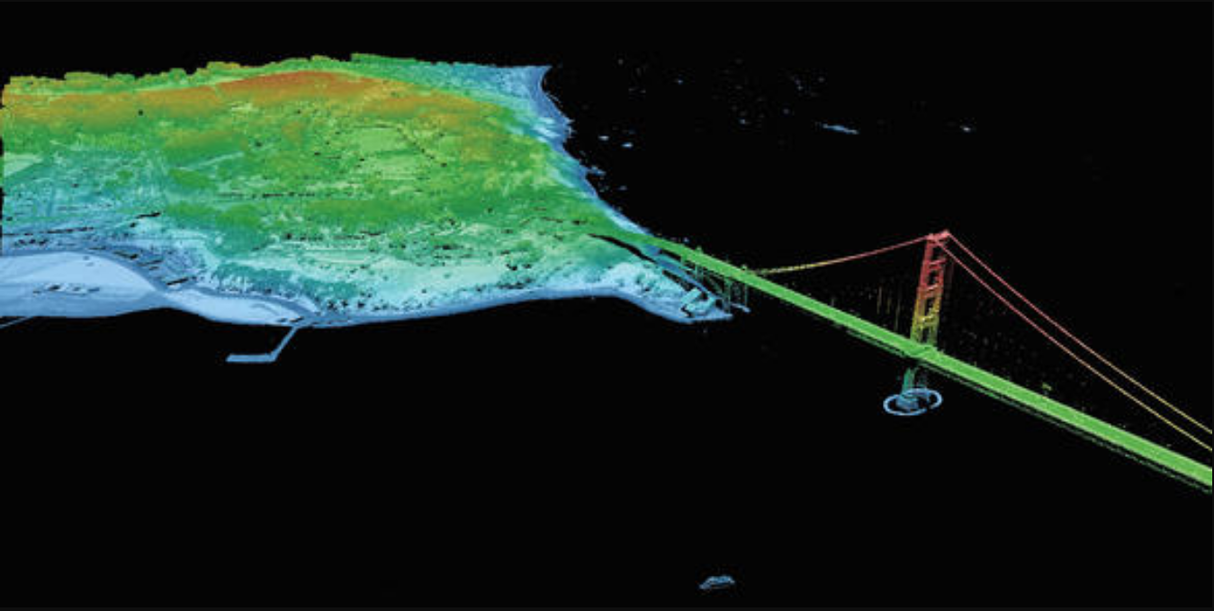
3D Data Visualization of Golden Gate Bridge. Source: USGS
Mola is a Modular Optimization framework for Localization and mApping (MOLA).

3D LiDAR SLAM from KITTI dataset. Source: MOLA
Lidar Toolbox™ is a MATLAB tool that provides algorithms, functions, and apps for designing, analyzing, and testing lidar processing systems. You can perform object detection and tracking, semantic segmentation, shape fitting, lidar registration, and obstacle detection. Lidar Toolbox supports lidar-camera cross calibration for workflows that combine computer vision and lidar processing.
Automated Driving Toolbox™ is a MATLAB tool that provides algorithms and tools for designing, simulating, and testing ADAS and autonomous driving systems. You can design and test vision and lidar perception systems, as well as sensor fusion, path planning, and vehicle controllers. Visualization tools include a bird’s-eye-view plot and scope for sensor coverage, detections and tracks, and displays for video, lidar, and maps. The toolbox lets you import and work with HERE HD Live Map data and OpenDRIVE® road networks. It also provides reference application examples for common ADAS and automated driving features, including FCW, AEB, ACC, LKA, and parking valet. The toolbox supports C/C++ code generation for rapid prototyping and HIL testing, with support for sensor fusion, tracking, path planning, and vehicle controller algorithms.
Microsoft AirSim is a simulator for drones, cars and more, built on Unreal Engine (with an experimental Unity release). AirSim is open-source, cross platform, and supports software-in-the-loop simulation with popular flight controllers such as PX4 & ArduPilot and hardware-in-loop with PX4 for physically and visually realistic simulations. It is developed as an Unreal plugin that can simply be dropped into any Unreal environment. AirSim is being developed as a platform for AI research to experiment with deep learning, computer vision and reinforcement learning algorithms for autonomous vehicles.

3D Autonomous Vehicle Simulation in AirSim. Source: Microsoft
LASer(LAS) is a public file format for the interchange of 3-dimensional point cloud data data between data users. Although developed primarily for exchange of lidar point cloud data, this format supports the exchange of any 3-dimensional x,y,z tuplet. This binary file format is an alternative to proprietary systems or a generic ASCII file interchange system used by many companies. The problem with proprietary systems is obvious in that data cannot be easily taken from one system to another. There are two major problems with the ASCII file interchange. The first problem is performance because the reading and interpretation of ASCII elevation data can be very slow and the file size can be extremely large even for small amounts of data. The second problem is that all information specific to the lidar data is lost. The LAS file format is a binary file format that maintains information specific to the lidar nature of the data while not being overly complex.
3D point cloud is a set of data points defined in a given three-dimensional coordinates system.. Point clouds can be produced directly by 3D scanner which records a large number of points returned from the external surfaces of objects or earth surface. These data are exchanged between LiDAR users mainly through LAS format files (.las).
ArcGIS Desktop is powerful and cost-effective desktop geographic information system (GIS) software. It is the essential software package for GIS professionals. ArcGIS Desktop users can create, analyze, manage, and share geographic information so decision-makers can make intelligent, informed decisions.
USGS 3DEP Lidar Point Cloud Now Available as Amazon Public Dataset
National Map Data Download and Visualization Services
USGS Lidar Base Specification(LBS) online edition


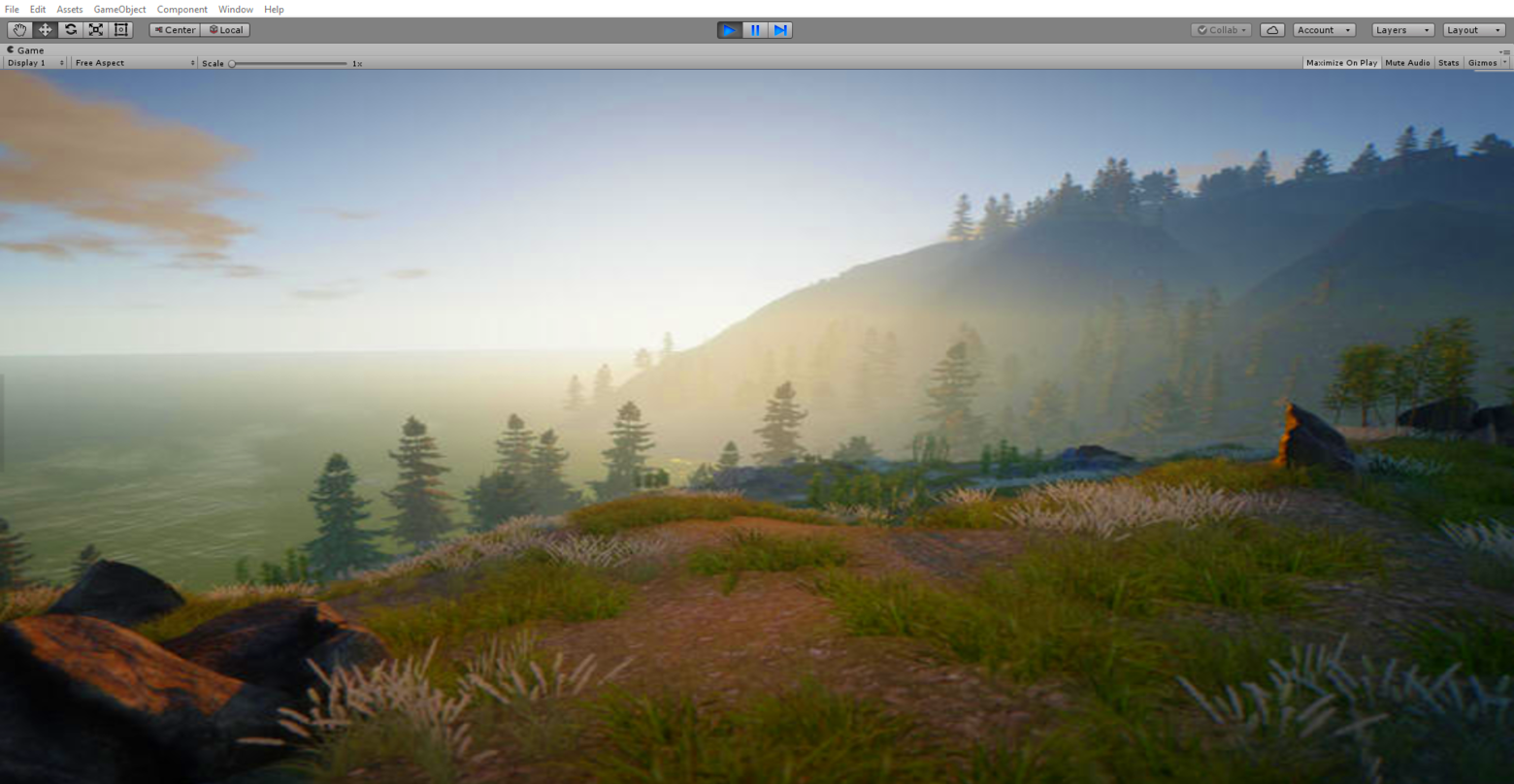


If you would like to Donate to the Godot Project

If you would like to Donate to the Blender Project

Checkout AWS Lumberyard(based on CryEngine)

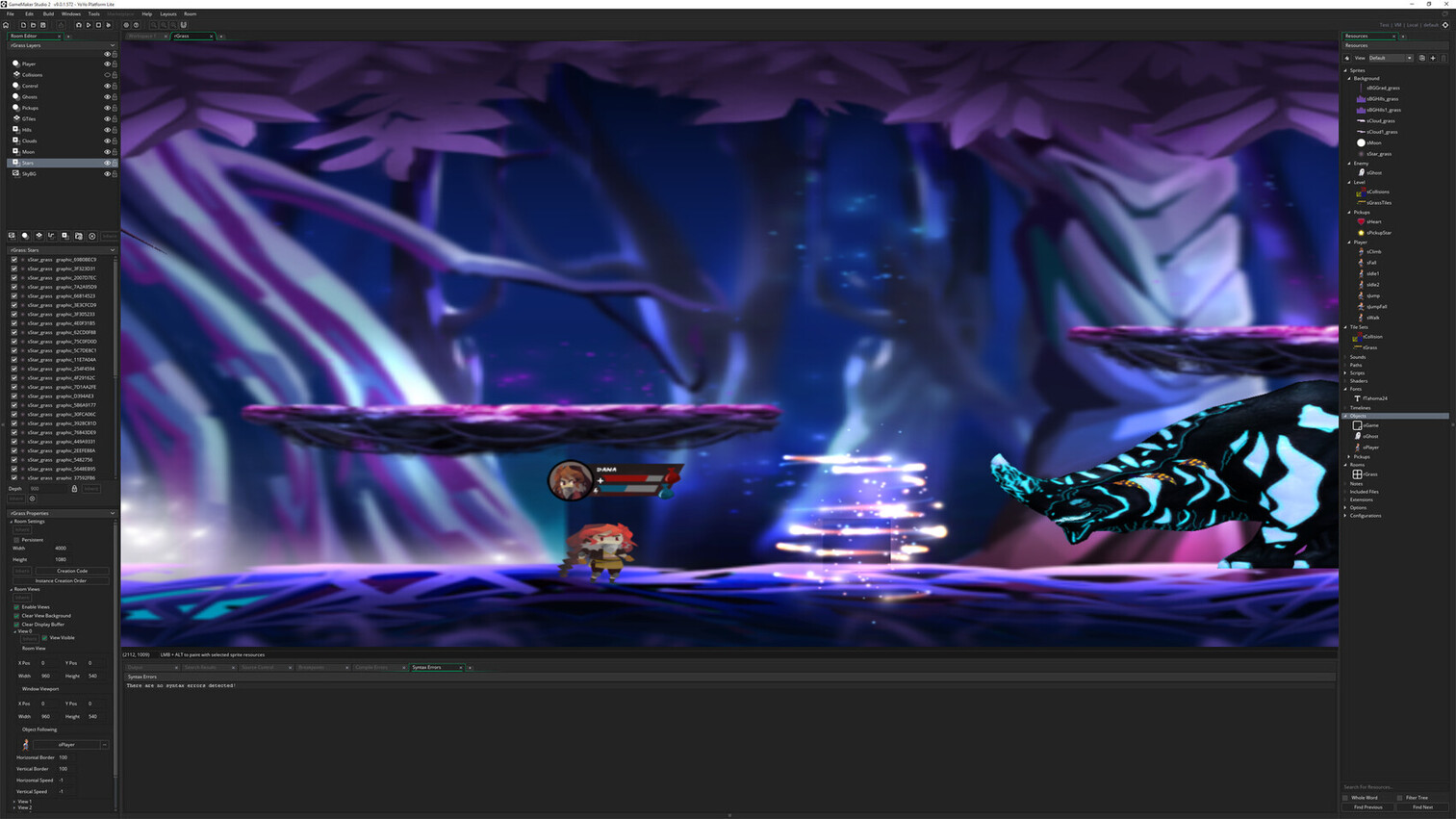
Unreal Online Learning is a free learning platform that offers hands-on video courses and guided learning paths.
Unreal Engine Authorized Training Program
Unreal Engine Training & Simulation
Getting Started with DirectX 12 Ultimate
Getting Started with Apple Metal
Game Design Online Courses from Udemy
Game Design Online Courses from Skillshare
Learn Game Design with Online Courses and Classes from edX
Game Design Courses from Coursera
Game Design and Development Specialization Course from Coursera
Unreal Engine is a game engine developed by Epic Games with the world's most open and advanced real-time 3D creation tool. Continuously evolving to serve not only its original purpose as a state-of-the-art game engine, today it gives creators across industries the freedom and control to deliver cutting-edge content, interactive experiences, and immersive virtual worlds.
Unity is a cross-platform game development platform. Use Unity to build high-quality 3D and 2D games, deploy them across mobile, desktop, VR/AR, consoles or the Web, and connect with loyal and enthusiastic players and customers.
Unigine is a cross-platform game engine designed for development teams (C++/C# programmers, 3D artists) working on interactive 3D apps.
Panda3D is a game engine, a framework for 3D rendering and game development for Python and C++ programs, developed by Disney and CMU. Panda3D is open-source and free for any purpose, including commercial ventures.
Source 2 is a 3D video game engine in development by Valve as a successor to Source. It is used in Dota 2, Artifact, Dota Underlords, parts of The Lab, SteamVR Home, and Half-Life: Alyx.
Havok is a middleware software suite that provides a realistic physics engine component and related functions to video games. It is supported and optimized across all major platforms, including Nintendo Switch, PlayStation®, Stadia, and Xbox. Along with integrations for Unity and Unreal Engine and are used in countless proprietary game engines.
AutoDesk 3ds Max is a professional software program for 3D modeling, animation, rendering, and visualization. 3ds Max allows you to create stunning game environments, design visualizations, and virtual reality experiences.
Houdini is a 3D procedural software for modeling, rigging, animation, VFX, look development, lighting and rendering in film, TV, advertising and video game pipelines.
A-Frame is a web framework for building virtual reality experiences in WebVR with HTML and Entity-Component. A-Frame works on Vive, Rift, desktop, mobile platforms.
AppGameKit is a powerful game development engine, ideal for Hobbyist and Indie developers. Where you can start coding in the easy to learn AppGameKit BASIC or use the libraries in C++ & XCode.
Amazon Lumberyard is an open source, AAA game engine(based on CryEngine) that gives you the tools you need to create high quality games. Deeply integrated with AWS and Twitch, Amazon Lumberyard includes full source code, allowing you to customize your project at any level.
Blender is the free and open source 3D creation suite. It supports the entirety of the 3D pipeline—modeling, rigging, animation, simulation, rendering, compositing and motion tracking, video editing and 2D animation pipeline.
CryEngine is a powerful real-time game development platform created by Crytek.
GameMaker Studio 2 is the latest and greatest incarnation of GameMaker. It has everything you need to take your idea from concept to finished game. With no barriers to entry and powerful functionality, GameMaker Studio 2 is the ultimate 2D development environment.
Godot is a feature-packed, cross-platform game engine to create 2D and 3D games from a unified interface. It provides a comprehensive set of common tools, so that users can focus on making games without having to reinvent the wheel. Games can be exported in one click to a number of platforms, including the major desktop platforms (Linux, Mac OSX, Windows) as well as mobile (Android, iOS) and web-based (HTML5) platforms.
Open Graphics Library(OpenGL) is an API used acrossed mulitple programming languages and platforms for hardware-accelerated rendering of 2D/3D vector graphics currently developed by the Khronos Group.
Open Computing Language (OpenCL) is an open standard for parallel programming of heterogeneous platforms consisting of CPUs, GPUs, and other hardware accelerators found in supercomputers, cloud servers, personal computers, mobile devices and embedded platforms.
OpenGL Shading Language(GLSL) is a High Level Shading Language based on the C-style language, so it covers most of the features a user would expect with such a language. Such as control structures (for-loops, if-else statements, etc) exist in GLSL, including the switch statement.
High Level Shading Language(HLSL) is the High Level Shading Language for DirectX. Using HLSL, the user can create C-like programmable shaders for the Direct3D pipeline. HLSL was first created with DirectX 9 to set up the programmable 3D pipeline.
DirectX 12 Ultimate is an API(for high performance 2D & 3D graphics) from Microsoft. DirectX 12 Ultimate brings support for ray tracing, mesh shaders, variable rate shading, and sampler feedback. Available in Windows 2004 version(May 2020 Update).
Vulkan is a modern cross-platform graphics and compute API that provides high-efficiency, cross-platform access to modern GPUs used in a wide variety of devices from PCs and consoles to mobile phones and embedded platforms. Vulkan is currently in development by the Khronos consortium.
Metal is a low-level GPU programming framework used for rendering 2D and 3D graphics on Apple platforms such as iOS, iPadOS, macOS, watchOS and tvOS.
MoltenVK is an implementation of Vulkan running on iOS and macOS using Apple's Metal graphics framework.
MoltenGL is an implementation of the OpenGL ES 2.0 API that runs on Apple's Metal graphics framework.
Mesa 3D Graphics Library is a project began as an open-source implementation of the OpenGL specification. A system for rendering interactive 3D graphics. Mesa ties into several other open-source projects: the Direct Rendering Infrastructure, X.org, and Wayland to provide OpenGL support on Linux, FreeBSD, and other operating systems.
OpenGL ES is the mobile subset of OpenGL. It's supported on all major mobile platforms, and is also the base for WebGL.
OpenCL is a framework for writing programs that execute across heterogeneous platforms consisting of CPUs, GPUs, DSPs, FPGAs and other processors or hardware accelerators.
EGL is an interface between Khronos rendering APIs such as OpenGL or OpenVG and the underlying native platform window system.
VDPAU is the Video Decode and Presentation API for UNIX. It provides an interface to video decode acceleration and presentation hardware present in modern GPUs.
VA API is an open-source library and API specification, which provides access to graphics hardware acceleration capabilities for video processing.
XvMC is an extension of the X video extension (Xv) for the X Window System. The XvMC API allows video programs to offload portions of the video decoding process to the GPU hardware.
AMD Radeon ProRender is a powerful physically-based rendering engine that enables creative professionals to produce stunningly photorealistic images on virtually any GPU, any CPU, and any OS in over a dozen leading digital content creation and CAD applications.
NVIDIA Omniverse is a powerful, multi-GPU, real-time simulation and collaboration platform for 3D production pipelines based on Pixar's Universal Scene Description and NVIDIA RTX.
LibGDX is a cross-platform Java game development framework based on OpenGL (ES) that works on Windows, Linux, Mac OS X, Android, your WebGL enabled browser and iOS.
cocos2d-x is a multi-platform framework for building 2d games, interactive books, demos and other graphical applications. It is based on cocos2d-iphone, but instead of using Objective-C, it uses C++. It works on iOS, Android, macOS, Windows and Linux.
MonoGame is a framework for creating powerful cross-platform games. The spiritual successor to XNA with thousands of titles shipped across desktop, mobile, and console platforms. MonoGame is a fully managed .NET open source game framework without any black boxes.
Three.js is a cross-browser JavaScript library and application programming interface used to create and display animated 3D computer graphics in a web browser using WebGL.
Superpowers is a downloadable HTML5 app for real-time collaborative projects . You can use it solo like a regular offline game maker, or setup a password and let friends join in on your project through their Web browser.
URHO3D is a free lightweight, cross-platform 2D and 3D game engine implemented in C++ and released under the MIT license. Greatly inspired by OGRE and Horde3D.
Vivox is a voice & text chat platform that's trusted by the world's biggest gaming brands and titles such as Fortnite, PUBG, League of Legends, and Rainbow Six Siege.
HGIG is a volunteer group of companies from the game and TV display industries that meet to specify and make available for the public guidelines to improve consumer gaming experiences in HDR.
GameBlocks is a Server Side Anti-Cheat & Middleware software.
ARKit is a set set of software development tools to enable developers to build augmented-reality apps for iOS developed by Apple. The latest version ARKit 3.5 takes advantage of the new LiDAR Scanner and depth sensing system on iPad Pro(2020) to support a new generation of AR apps that use Scene Geometry for enhanced scene understanding and object occlusion.
RealityKit is a framework to implement high-performance 3D simulation and rendering with information provided by the ARKit framework to seamlessly integrate virtual objects into the real world.
SceneKit is a high-level 3D graphics framework that helps you create 3D animated scenes and effects in your iOS apps.
ARCore is a software development kit developed by Google that allows for augmented reality applications in the real world. These tools include environmental understanding, which allows devices to detect horizontal and vertical surfaces and planes. It also includes motion tracking, which lets phones understand and track their positions relative to the world. Also ARCore’s Light Estimation API lets your digital objects appear realistically as if they’re actually part of the physical world.
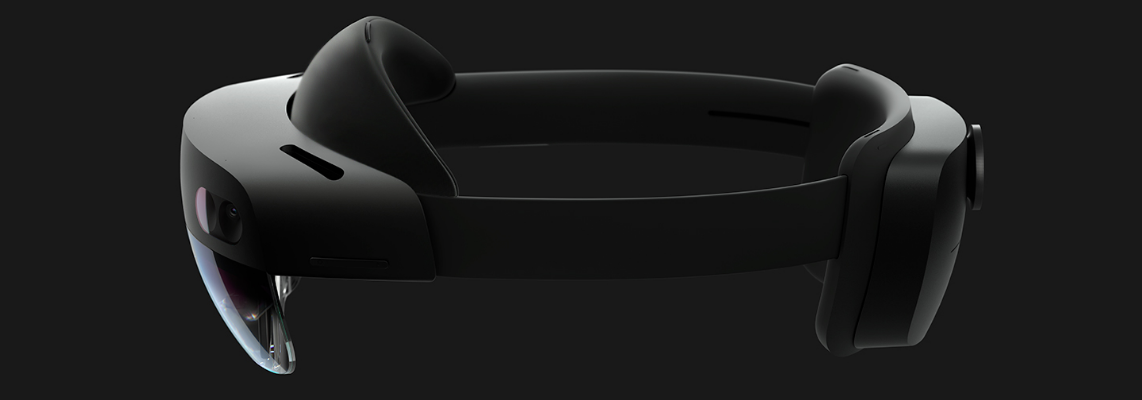
Microsoft HoloLens Headset. Source: Microsoft

PlayStation VR Headset. Source: PlayStation
SteamVR is the ultimate tool for experiencing VR content on the hardware of your choice. SteamVR supports the Valve Index, HTC Vive, Oculus Rift, Windows Mixed Reality headsets, and others.

SteamVR Home
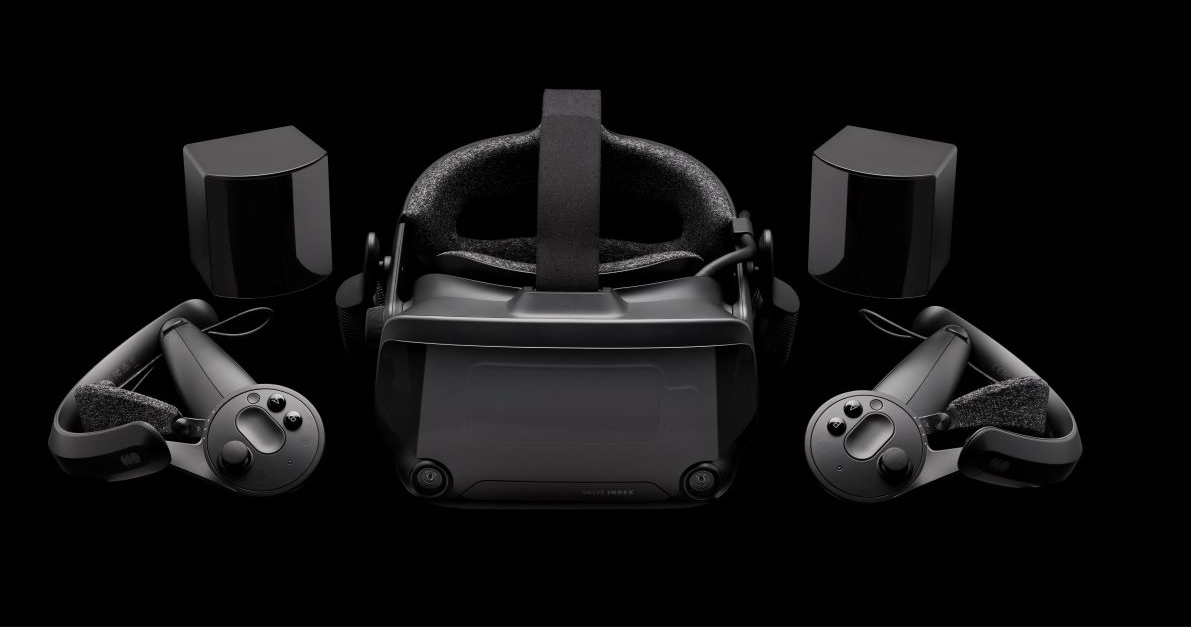
OpenVR is an API and runtime that allows access to VR hardware(Steam Index, HTC Vive, and Oculus Rift) from multiple vendors without requiring that applications have specific knowledge of the hardware they are targeting.
OpenVR Benchmark on Steam is the first benchmark tool for reproducibly testing your real VR performance, rendering inside of your VR headset.
OpenHMD is open source API and drivers that supports a wide range of HMD(head-mounted display) devices such as Oculus Rift, HTC Vive, Sony PSVR, and others.
openXR is a free, open standard that provides high-performance access to Augmented Reality (AR) and Virtual Reality (VR) collectively known as XR—platforms and devices.
Monado is the first OpenXR™ runtime for GNU/Linux. Monado aims to jump-start development of an open source XR ecosystem and provide the fundamental building blocks for device vendors to target the GNU/Linux platform.
Libsurvive is a set of tools and libraries that enable 6 dof tracking on lighthouse and vive based systems that is completely open source and can run on any device. It currently supports both SteamVR 1.0 and SteamVR 2.0 generation of devices and should support any tracked object commercially available.
Simula is a VR window manager for Linux that runs on top of Godot. It takes less than 1 minute to install. Simula is officially compatible with SteamVR headsets equipped with Linux drivers (e.g. HTC Vive, HTC Vive Pro, & Valve Index). We have also added experimental support to OpenXR headsets that have Monado drivers (e.g. North Star, OSVR HDK, and PSVR). Some people have gotten the Oculus Rift S to run Simula via OpenHMD (see here).

Eva is a 6-axis of freedom and ease of use, the lab robot arm easily automates the loading and unloading of samples into lab machines, precision balances and more. Eva can handle a range of common lab items including microplates, PCR tube strips, eppendorf tubes, petri dishes and microscope slides to automating repetitive and strenuous sample handling processes. Common manufacturing machine tending applications with Eva include start/end of line loading and unloading of machines such as CNC machines, CMMs, metal presses and chemical etching machines.

Eva lab robot arm from Automata. Source: Automata
AWS DeepRacer autonomous Car Kit
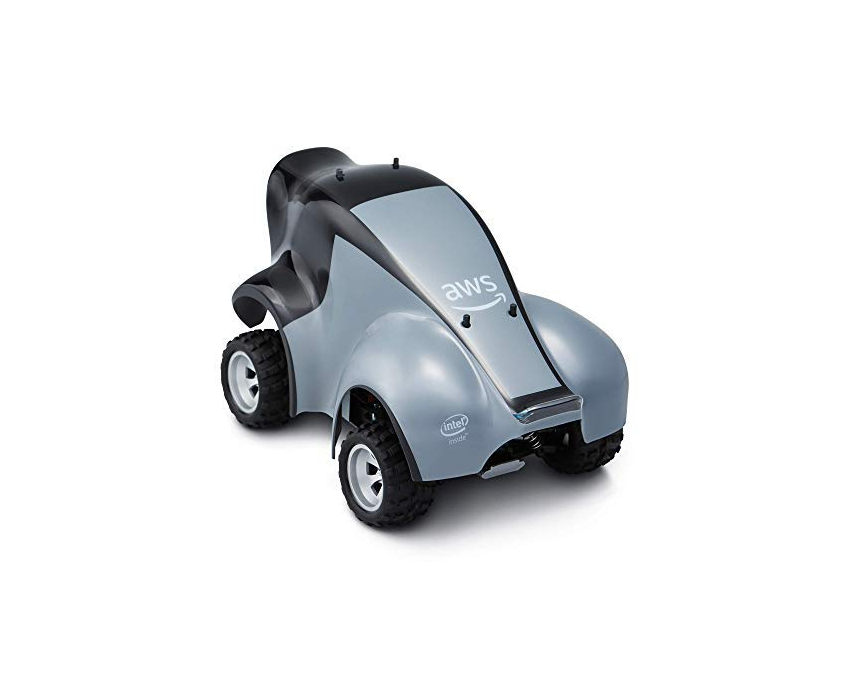
Checkout the AWS DeepRacer autonomous Car Kit
AWS DeepRacer autonomous Car Kit Hardware Specifications
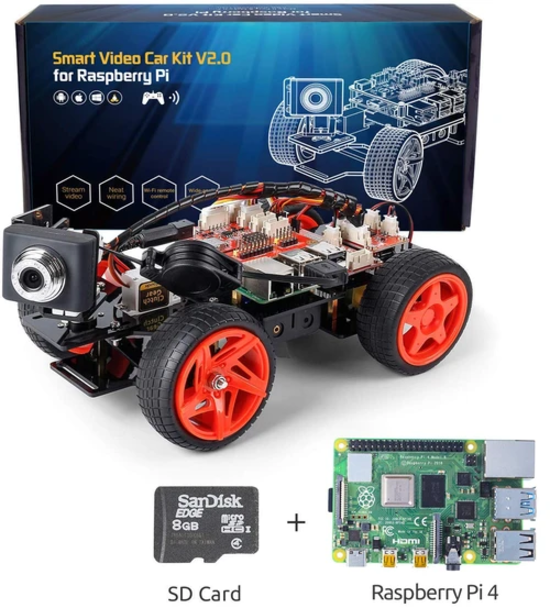
Checkout the SunFounder PiCar-V Kit V2.0 for Raspberry Pi
Robotics courses from Coursera
Learn Robotics with Online Courses and Classes from edX
Top Robotics Courses Online from Udemy
Free Online AI & Robotics Courses
REC Foundation Robotics Industry Certification
Carnegie Mellon Robotics Academy
RIA Robotic Integrator Certification Program
AWS RoboMaker – Develop, Test, Deploy, and Manage Intelligent Robotics Apps
Language Understanding (LUIS) for Azure Cognitive Services
Azure VM templates to bootstrap ROS and ROS 2 environments
Robot Framework is a generic open source automation framework. It can be used for test automation and robotic process automation. It has easy syntax, utilizing human-readable keywords. Its capabilities can be extended by libraries implemented with Python or Java.
The Robotics Library (RL) is a self-contained C++ library for robot kinematics, motion planning and control. It covers mathematics, kinematics and dynamics, hardware abstraction, motion planning, collision detection, and visualization.RL runs on many different systems, including Linux, macOS, and Windows. It uses CMake as a build system and can be compiled with Clang, GCC, and Visual Studio.
Robot Structural Analysis Professional is structural load analysis software developed by Autodesk that verifies code compliance and uses BIM-integrated workflows to exchange data with Revit. It can help you to create more resilient, constructible designs that are accurate, coordinated, and connected to BIM.
PowerMill is a software developed by Autodesk that provides powerful, flexible, easy-to-use tools for offline programming of robots. Get tools to help you optimize robotic paths and simulate virtual mock-ups of manufacturing cells and systems.
ROS is robotics middleware. Although ROS is not an operating system, it provides services designed for a heterogeneous computer cluster such as hardware abstraction, low-level device control, implementation of commonly used functionality, message-passing between processes, and package management.
ROS2 is a set of software libraries and tools that help you build robot applications. From drivers to state-of-the-art algorithms, and with powerful developer tools, ROS has what you need for your next robotics project. And it’s all open source.
MoveIt is the most widely used software for manipulation and has been used on over 100 robots. It provides an easy-to-use robotics platform for developing advanced applications, evaluating new designs and building integrated products for industrial, commercial, R&D, and other domains.
AutoGluon is toolkit for Deep learning that automates machine learning tasks enabling you to easily achieve strong predictive performance in your applications. With just a few lines of code, you can train and deploy high-accuracy deep learning models on tabular, image, and text data.
Gazebo accurately and efficiently simulates indoor and outdoor robots. You get a robust physics engine, high-quality graphics, and programmatic and graphical interfaces.
Robotics System Toolbox provides tools and algorithms for designing, simulating, and testing manipulators, mobile robots, and humanoid robots. For manipulators and humanoid robots, the toolbox includes algorithms for collision checking, trajectory generation, forward and inverse kinematics, and dynamics using a rigid body tree representation. For mobile robots, it includes algorithms for mapping, localization, path planning, path following, and motion control. The toolbox provides reference examples of common industrial robot applications. It also includes a library of commercially available industrial robot models that you can import, visualize, and simulate.
Intel Robot DevKit is the tool to generate Robotics Software Development Kit (RDK) designed for autonomous devices, including the ROS2 core and capacibilities packages like perception, planning, control driver etc. It provides flexible build/runtime configurations to meet different autonomous requirement on top of diversity hardware choices, for example use different hareware engine CPU/GPU/VPU to accelerate AI related features.
Arduino is an open-source platform used for building electronics projects. Arduino consists of both a physical programmable circuit board (often referred to as a microcontroller) and a piece of software, or IDE (Integrated Development Environment) that runs on your computer, used to write and upload computer code to the physical board.
ArduPilot enables the creation and use of trusted, autonomous, unmanned vehicle systems for the peaceful benefit of all. ArduPilot provides a comprehensive suite of tools suitable for almost any vehicle and application.
AirSim is a simulator for drones, cars and more, built on Unreal Engine (we now also have an experimental Unity release). It is open-source, cross platform, and supports hardware-in-loop with popular flight controllers such as PX4 for physically and visually realistic simulations.
The JPL Open Source Rover is an open source, build it yourself, scaled down version of the 6 wheel rover design that JPL uses to explore the surface of Mars. The Open Source Rover is designed almost entirely out of consumer off the shelf (COTS) parts. This project is intended to be a teaching and learning experience for those who want to get involved in mechanical engineering, software, electronics, or robotics.
Light Detection and Ranging(LiDAR) is a remote sensing method that uses light in the form of a pulsed laser at an object, and uses the time and wavelength of the reflected beam of light to estimate the distance and in some applications (Laser Imaging), to create a 3D representation of the object and its surface characteristics. This technology is commonly used in aircraft and self-driving vehicles.
AliceVision is a Photogrammetric Computer Vision Framework which provides a 3D Reconstruction and Camera Tracking algorithms. AliceVision aims to provide strong software basis with state-of-the-art computer vision algorithms that can be tested, analyzed and reused. The project is a result of collaboration between academia and industry to provide cutting-edge algorithms with the robustness and the quality required for production usage.
CARLA is an open-source simulator for autonomous driving research. CARLA has been developed from the ground up to support development, training, and validation of autonomous driving systems. In addition to open-source code and protocols, CARLA provides open digital assets (urban layouts, buildings, vehicles) that were created for this purpose and can be used freely. The simulation platform supports flexible specification of sensor suites and environmental conditions.
ROS bridge is a package to bridge ROS for CARLA Simulator.
ROS-Industrial is an open source project that extends the advanced capabilities of ROS software to manufacturing.
AWS RoboMaker is the most complete cloud solution for robotic developers to simulate, test and securely deploy robotic applications at scale. RoboMaker provides a fully-managed, scalable infrastructure for simulation that customers use for multi-robot simulation and CI/CD integration with regression testing in simulation.
Microsoft Robotics Developer Studio is a free .NET-based programming environment for building robotics applications.
Visual Studio Code Extension for ROS is an extension provides support for Robot Operating System (ROS) development.
Azure Kinect ROS Driver is a node which publishes sensor data from the Azure Kinect Developer Kit to the Robot Operating System (ROS). Developers working with ROS can use this node to connect an Azure Kinect Developer Kit to an existing ROS installation.
Azure IoT Hub for ROS is a ROS package works with the Microsoft Azure IoT Hub service to relay telemetry messages from the Robot to Azure IoT Hub or reflect properties from the Digital Twin to the robot using dynamic reconfigure.
ROS 2 with ONNX Runtime is a program that uses ROS 2 to run on different hardware platforms using their respective AI acceleration libraries for optimized execution of the ONNX model.
Azure Cognitive Services LUIS ROS Node is a ROS node that bridges between ROS and the Azure Language Understanding Service. it can be configured to process audio directly from a microphone, or can subscribe to a ROS audio topic, then processes speech and generates "intent" ROS messages which can be processed by another ROS node to generate ROS commands.
Linear algebra is the math of vectors and matrices. The only prerequisite for this guide is a basic understanding of high school math concepts like numbers, variables, equations, and the fundamental arithmetic operations on real numbers: addition (denoted +), subtraction (denoted −), multiplication (denoted implicitly), and division (fractions). Also, you should also be familiar with functions that take real numbers as inputs and give real numbers as outputs, f : R → R.
Linear Algebra - Online Courses | Harvard University
Linear Algebra | MIT Open Learning Library
Top Linear Algebra Courses on Coursera
Mathematics for Machine Learning: Linear Algebra on Coursera
Top Linear Algebra Courses on Udemy
Learn Linear Algebra with Online Courses and Classes on edX
The Math of Data Science: Linear Algebra Course on edX
Linear Algebra in Twenty Five Lectures | UC Davis
Linear Algebra | UC San Diego Extension
Linear Algebra for Machine Learning | UC San Diego Extension
Introduction to Linear Algebra, Interactive Online Video | Wolfram
Linear Algebra Resources | Dartmouth
We now define the math operations for vectors. The operations we can perform on vectors ~u = (u1, u2, u3) and ~v = (v1, v2, v3) are: addition, subtraction, scaling, norm (length), dot product, and cross product:
The dot product and the cross product of two vectors can also be described in terms of the angle θ between the two vectors.

Vector Operations. Source: slideserve

Vector Operations. Source: pinterest
We denote by A the matrix as a whole and refer to its entries as aij .The mathematical operations defined for matrices are the following:
• determinant (denoted det(A) or |A|) Note that the matrix product is not a commutative operation.
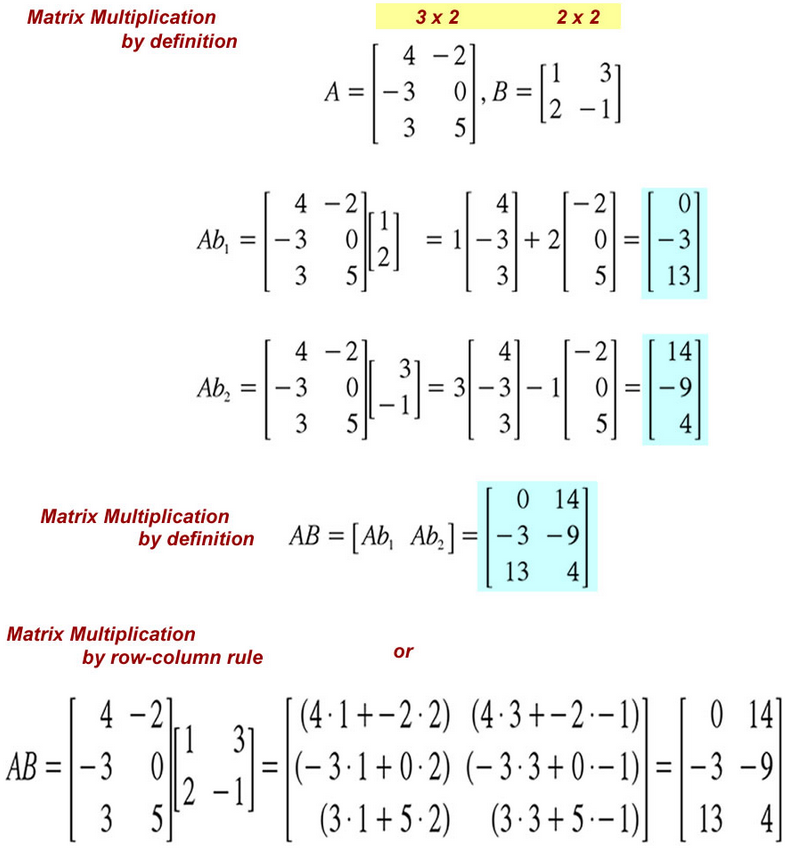
Matrix Operations. Source: SDSU Physics

Check for modules that allow Matrix Operations. Source: DPS Concepts
The matrix-vector product is an important special case of the matrix product.
There are two fundamentally different yet equivalent ways to interpret the matrix-vector product. In the column picture, (C), the multiplication of the
matrix A by the vector ~x produces a linear combination of the columns of the matrix: y = Ax = x1A[:,1] + x2A[:,2], where A[:,1] and A[:,2] are the first and second columns of the matrix A. In the row picture, (R), multiplication of the matrix A by the vector ~x produces a column vector with coefficients equal to the dot products of rows of the matrix with the vector ~x.

Matrix-vector product. Source: wikimedia

Matrix-vector Product. Source: mathisfun
The matrix-vector product is used to define the notion of a linear transformation, which is one of the key notions in the study of linear algebra. Multiplication by a matrix A ∈ R m×n can be thought of as computing a linear transformation TA that takes n-vectors as inputs and produces m-vectors as outputs:

Linear Transformations. Source: slideserve

Elementary matrices for linear transformations in R^2. Source:Quora

Fundamental theorem of linear algebra for Vector Spaces. Source: wikimedia

Fundamental theorem of linear algebra. Source: wolfram

System of Linear Equations by Graphing. Source: slideshare

Systems of equations as matrix equations. Source: mathisfun
In this section we’ll look at several different approaches for computing the inverse of a matrix. The matrix inverse is unique so no matter which method we use to find the inverse, we’ll always obtain the same answer.

Inverse of 2x2 Matrix. Source: pinterest
One approach for computing the inverse is to use the Gauss–Jordan elimination procedure.

Elementray row operations. Source: YouTube
Every row operation we perform on a matrix is equivalent to a leftmultiplication by an elementary matrix.

Elementary Matrices. Source: SDSU Physics
Finding the inverse of a matrix is to use the Transpose method.
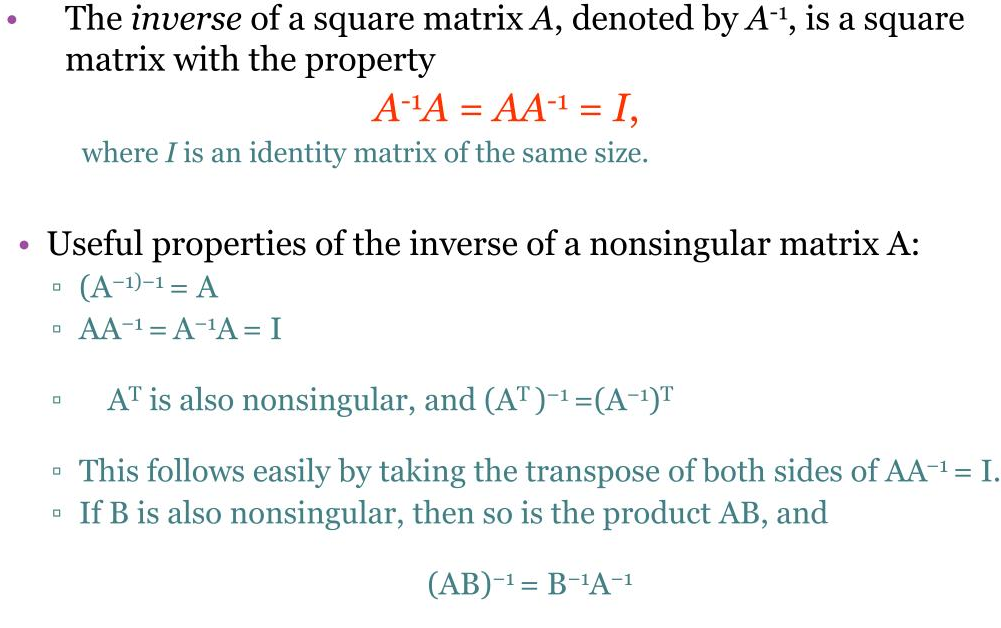
Transpose of a Matrix. Source: slideserve
In this section discuss a number of other important topics of linear algebra.
Intuitively, a basis is any set of vectors that can be used as a coordinate system for a vector space. You are certainly familiar with the standard basis for the xy-plane that is made up of two orthogonal axes: the x-axis and the y-axis.
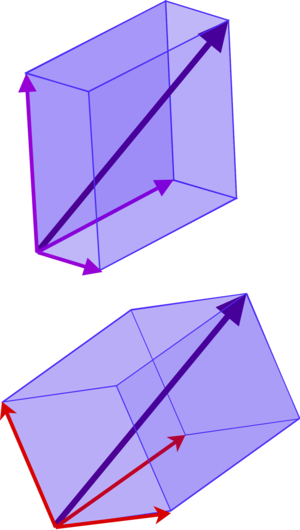
Basis. Source: wikimedia

Change of Basis. Source: wikimedia

Matrix representations of linear transformations. Source: slideserve
The dimension of a vector space is defined as the number of vectors in a basis for that vector space. Consider the following vector space S = span{(1, 0, 0),(0, 1, 0),(1, 1, 0)}. Seeing that the space is described by three vectors, we might think that S is 3-dimensional. This is not the case, however, since the three vectors are not linearly independent so they don’t form a basis for S. Two vectors are sufficient to describe any vector in S; we can write S = span{(1, 0, 0),(0, 1, 0)}, and we see these two vectors are linearly independent so they form a basis and dim(S) = 2. There is a general procedure for finding a basis for a vector space. Suppose you are given a description of a vector space in terms of m vectors V = span{~v1, ~v2, . . . , ~vm} and you are asked to find a basis for V and the dimension of V. To find a basis for V, you must find a set of linearly independent vectors that span V. We can use the Gauss–Jordan elimination procedure to accomplish this task. Write the vectors ~vi as the rows of a matrix M. The vector space V corresponds to the row space of the matrix M. Next, use row operations to find the reduced row echelon form (RREF) of the matrix M. Since row operations do not change the row space of the matrix, the row space of reduced row echelon form of the matrix M is the same as the row space of the original set of vectors. The nonzero rows in the RREF of the matrix form a basis for vector space V and the numbers of nonzero rows is the dimension of V.

Basis and Dimension. Source: sliderserve
Recall the fundamental vector spaces for matrices that we defined in Section II-E: the column space C(A), the null space N (A), and the row space R(A). A standard linear algebra exam question is to give you a certain matrix A and ask you to find the dimension and a basis for each of its fundamental spaces. In the previous section we described a procedure based on Gauss–Jordan elimination which can be used “distill” a set of linearly independent vectors which form a basis for the row space R(A). We will now illustrate this procedure with an example, and also show how to use the RREF of the matrix A to find bases for C(A) and N (A).

Row space and Column space. Source: slideshare

Row space and Column space. Source: slideshare
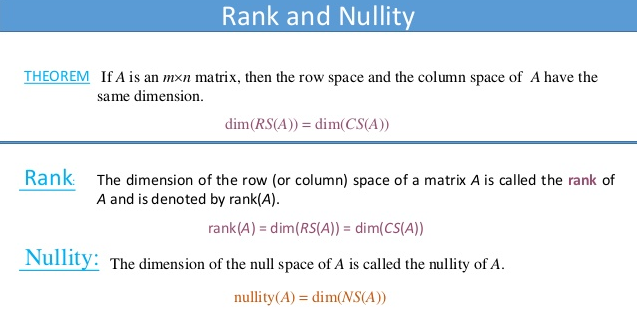
Rank and Nullity. Source: slideshare
There is an important distinction between matrices that are invertible and those that are not as formalized by the following theorem. Theorem. For an n×n matrix A, the following statements are equivalent:

Invertible Matrix theorem. Source: SDSU Physics
The determinant of a matrix, denoted det(A) or |A|, is a special way to combine the entries of a matrix that serves to check if a matrix is invertible or not.

Determinant of a Square Matrix. Source: stackexchange

Determinant of matrix. Source: onlinemathlearning
The set of eigenvectors of a matrix is a special set of input vectors for which the action of the matrix is described as a simple scaling. When a matrix is multiplied by one of its eigenvectors the output is the same eigenvector multiplied by a constant Aeλ = λeλ. The constant λ is called an eigenvalue of A.

Generalized EigenVectors. Source: YouTube
Linear regression is an approach to model the relationship between two variables by fitting a linear equation to observed data. One variable is considered to be an explanatory variable, and the other is considered to be a dependent variable.

Multiple Linear Regression. Source: Medium
Fuzzy logic is a heuristic approach that allows for more advanced decision-tree processing and better integration with rules-based programming.
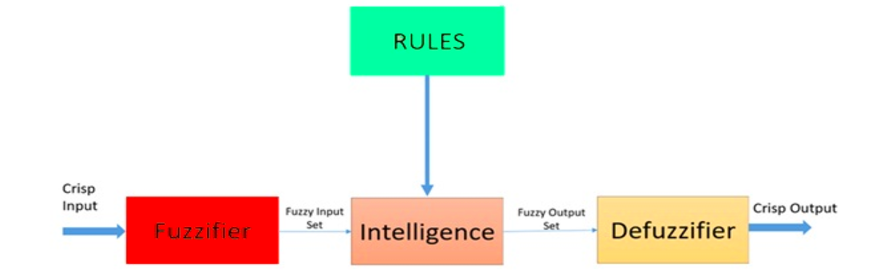
Architecture of a Fuzzy Logic System. Source: ResearchGate
Support Vector Machine (SVM) is a supervised machine learning model that uses classification algorithms for two-group classification problems.
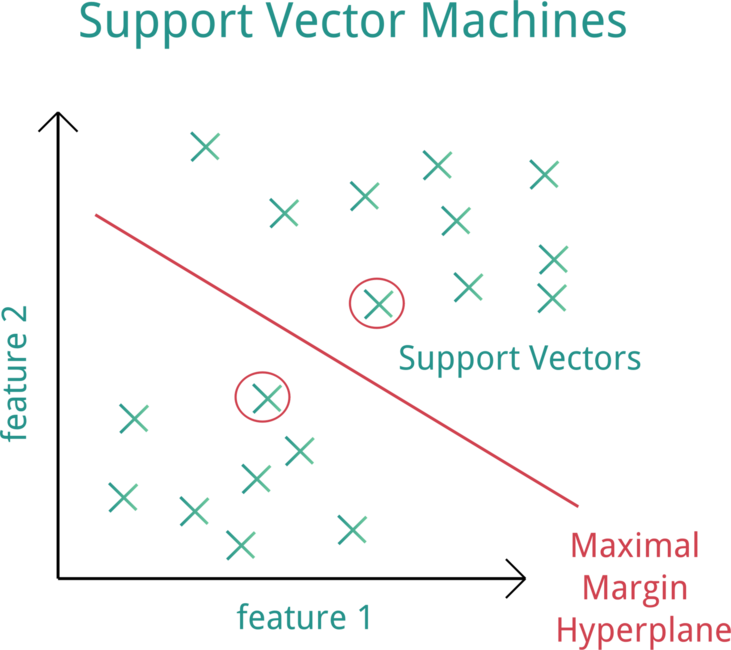
Support Vector Machine (SVM). Source:OpenClipArt
Neural networks are a subset of machine learning and are at the heart of deep learning algorithms. The name/structure is inspired by the human brain copying the process that biological neurons/nodes signal to one another.
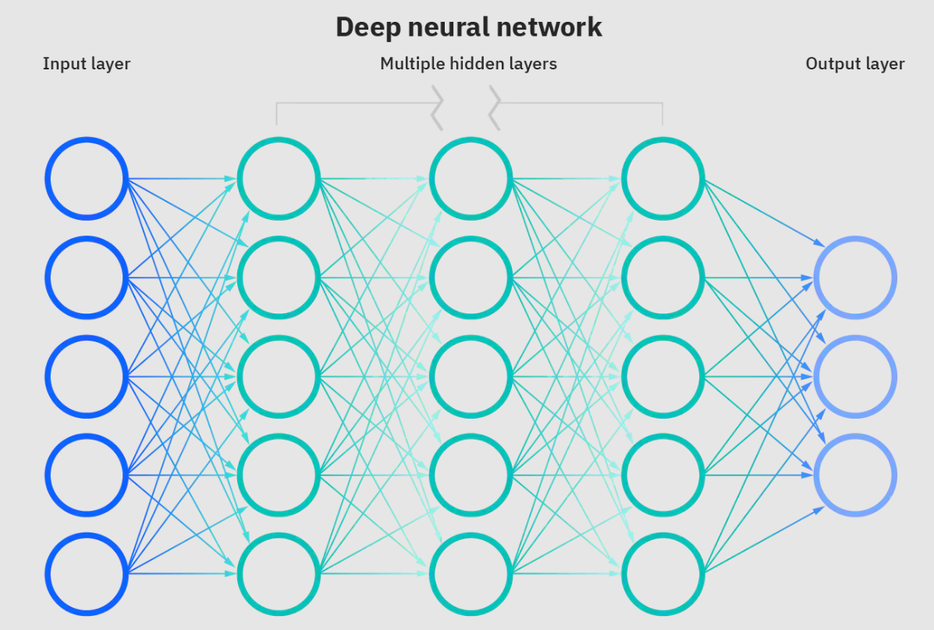
Deep neural network. Source: IBM
Convolutional Neural Networks (R-CNN) is an object detection algorithm that first segments the image to find potential relevant bounding boxes and then run the detection algorithm to find most probable objects in those bounding boxes.
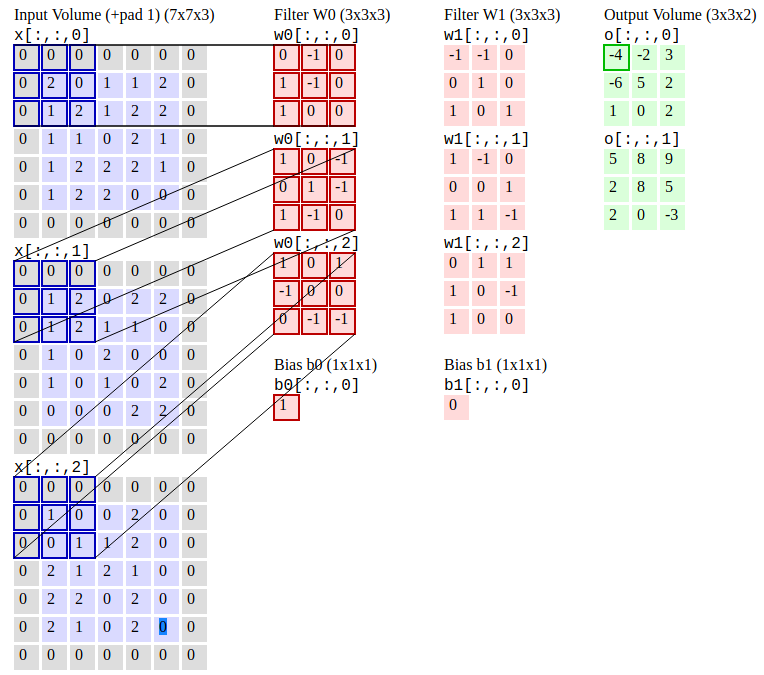
Convolutional Neural Networks. Source:CS231n
Recurrent neural networks (RNNs) is a type of artificial neural network which uses sequential data or time series data.

Recurrent Neural Networks. Source: Slideteam
Multilayer Perceptrons (MLPs) is multi-layer neural networks composed of multiple layers of perceptrons with a threshold activation.

Multilayer Perceptrons. Source: DeepAI
Random forest is a commonly-used machine learning algorithm, which combines the output of multiple decision trees to reach a single result. A decision tree in a forest cannot be pruned for sampling and therefore, prediction selection. Its ease of use and flexibility have fueled its adoption, as it handles both classification and regression problems.

Random forest. Source: wikimedia
Decision trees are tree-structured models for classification and regression.

**Decision Trees. Source: CMU
Naive Bayes is a machine learning algorithm that is used solved calssification problems. It's based on applying Bayes' theorem with strong independence assumptions between the features.

Bayes' theorem. Source:mathisfun

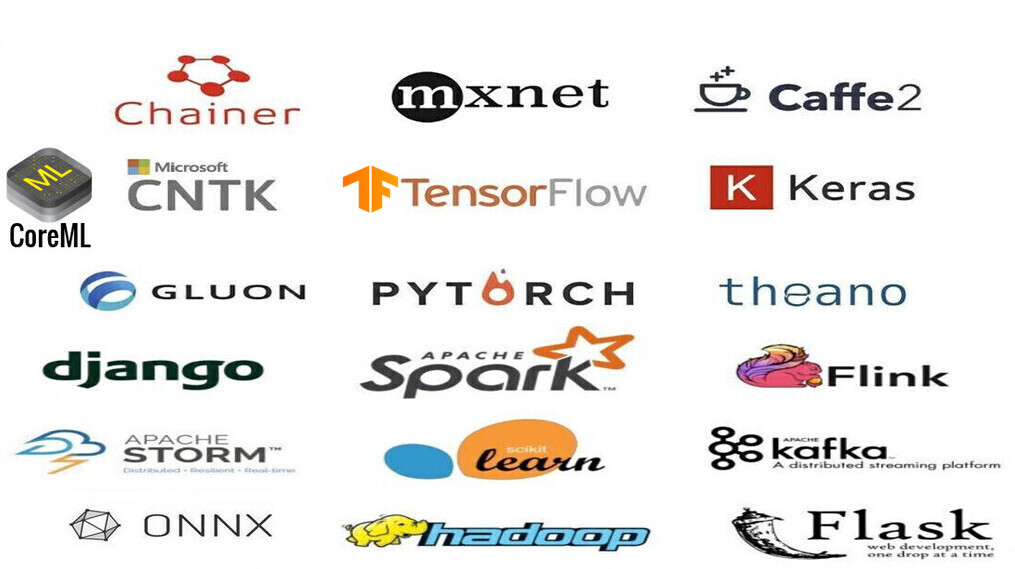
Machine Learning/Deep Learning Frameworks.
Machine Learning is a branch of artificial intelligence (AI) focused on building apps using algorithms that learn from data models and improve their accuracy over time without needing to be programmed.
Machine Learning by Stanford University from Coursera
AWS Training and Certification for Machine Learning (ML) Courses
Machine Learning Scholarship Program for Microsoft Azure from Udacity
Microsoft Certified: Azure Data Scientist Associate
Microsoft Certified: Azure AI Engineer Associate
Azure Machine Learning training and deployment
Learning Machine learning and artificial intelligence from Google Cloud Training
Machine Learning Crash Course for Google Cloud
Scheduling Jupyter notebooks on Amazon SageMaker ephemeral instances
How to run Jupyter Notebooks in your Azure Machine Learning workspace
Machine Learning Courses Online from Udemy
Machine Learning Courses Online from Coursera
Learn Machine Learning with Online Courses and Classes from edX
TensorFlow is an end-to-end open source platform for machine learning. It has a comprehensive, flexible ecosystem of tools, libraries and community resources that lets researchers push the state-of-the-art in ML and developers easily build and deploy ML powered applications.
Keras is a high-level neural networks API, written in Python and capable of running on top of TensorFlow, CNTK, or Theano.It was developed with a focus on enabling fast experimentation. It is capable of running on top of TensorFlow, Microsoft Cognitive Toolkit, R, Theano, or PlaidML.
PyTorch is a library for deep learning on irregular input data such as graphs, point clouds, and manifolds. Primarily developed by Facebook's AI Research lab.
Amazon SageMaker is a fully managed service that provides every developer and data scientist with the ability to build, train, and deploy machine learning (ML) models quickly. SageMaker removes the heavy lifting from each step of the machine learning process to make it easier to develop high quality models.
Azure Databricks is a fast and collaborative Apache Spark-based big data analytics service designed for data science and data engineering. Azure Databricks, sets up your Apache Spark environment in minutes, autoscale, and collaborate on shared projects in an interactive workspace. Azure Databricks supports Python, Scala, R, Java, and SQL, as well as data science frameworks and libraries including TensorFlow, PyTorch, and scikit-learn.
Microsoft Cognitive Toolkit (CNTK) is an open-source toolkit for commercial-grade distributed deep learning. It describes neural networks as a series of computational steps via a directed graph. CNTK allows the user to easily realize and combine popular model types such as feed-forward DNNs, convolutional neural networks (CNNs) and recurrent neural networks (RNNs/LSTMs). CNTK implements stochastic gradient descent (SGD, error backpropagation) learning with automatic differentiation and parallelization across multiple GPUs and servers.
Apple CoreML is a framework that helps integrate machine learning models into your app. Core ML provides a unified representation for all models. Your app uses Core ML APIs and user data to make predictions, and to train or fine-tune models, all on the user's device. A model is the result of applying a machine learning algorithm to a set of training data. You use a model to make predictions based on new input data.
Tensorflow_macOS is a Mac-optimized version of TensorFlow and TensorFlow Addons for macOS 11.0+ accelerated using Apple's ML Compute framework.
Apache OpenNLP is an open-source library for a machine learning based toolkit used in the processing of natural language text. It features an API for use cases like Named Entity Recognition, Sentence Detection, POS(Part-Of-Speech) tagging, Tokenization Feature extraction, Chunking, Parsing, and Coreference resolution.
Apache Airflow is an open-source workflow management platform created by the community to programmatically author, schedule and monitor workflows. Install. Principles. Scalable. Airflow has a modular architecture and uses a message queue to orchestrate an arbitrary number of workers. Airflow is ready to scale to infinity.
Open Neural Network Exchange(ONNX) is an open ecosystem that empowers AI developers to choose the right tools as their project evolves. ONNX provides an open source format for AI models, both deep learning and traditional ML. It defines an extensible computation graph model, as well as definitions of built-in operators and standard data types.
Apache MXNet is a deep learning framework designed for both efficiency and flexibility. It allows you to mix symbolic and imperative programming to maximize efficiency and productivity. At its core, MXNet contains a dynamic dependency scheduler that automatically parallelizes both symbolic and imperative operations on the fly. A graph optimization layer on top of that makes symbolic execution fast and memory efficient. MXNet is portable and lightweight, scaling effectively to multiple GPUs and multiple machines. Support for Python, R, Julia, Scala, Go, Javascript and more.
AutoGluon is toolkit for Deep learning that automates machine learning tasks enabling you to easily achieve strong predictive performance in your applications. With just a few lines of code, you can train and deploy high-accuracy deep learning models on tabular, image, and text data.
Anaconda is a very popular Data Science platform for machine learning and deep learning that enables users to develop models, train them, and deploy them.
PlaidML is an advanced and portable tensor compiler for enabling deep learning on laptops, embedded devices, or other devices where the available computing hardware is not well supported or the available software stack contains unpalatable license restrictions.
OpenCV is a highly optimized library with focus on real-time computer vision applications. The C++, Python, and Java interfaces support Linux, MacOS, Windows, iOS, and Android.
Scikit-Learn is a Python module for machine learning built on top of SciPy, NumPy, and matplotlib, making it easier to apply robust and simple implementations of many popular machine learning algorithms.
Weka is an open source machine learning software that can be accessed through a graphical user interface, standard terminal applications, or a Java API. It is widely used for teaching, research, and industrial applications, contains a plethora of built-in tools for standard machine learning tasks, and additionally gives transparent access to well-known toolboxes such as scikit-learn, R, and Deeplearning4j.
Caffe is a deep learning framework made with expression, speed, and modularity in mind. It is developed by Berkeley AI Research (BAIR)/The Berkeley Vision and Learning Center (BVLC) and community contributors.
Theano is a Python library that allows you to define, optimize, and evaluate mathematical expressions involving multi-dimensional arrays efficiently including tight integration with NumPy.
nGraph is an open source C++ library, compiler and runtime for Deep Learning. The nGraph Compiler aims to accelerate developing AI workloads using any deep learning framework and deploying to a variety of hardware targets.It provides the freedom, performance, and ease-of-use to AI developers.
NVIDIA cuDNN is a GPU-accelerated library of primitives for deep neural networks. cuDNN provides highly tuned implementations for standard routines such as forward and backward convolution, pooling, normalization, and activation layers. cuDNN accelerates widely used deep learning frameworks, including Caffe2, Chainer, Keras, MATLAB, MxNet, PyTorch, and TensorFlow.
Jupyter Notebook is an open-source web application that allows you to create and share documents that contain live code, equations, visualizations and narrative text. Jupyter is used widely in industries that do data cleaning and transformation, numerical simulation, statistical modeling, data visualization, data science, and machine learning.
Apache Spark is a unified analytics engine for large-scale data processing. It provides high-level APIs in Scala, Java, Python, and R, and an optimized engine that supports general computation graphs for data analysis. It also supports a rich set of higher-level tools including Spark SQL for SQL and DataFrames, MLlib for machine learning, GraphX for graph processing, and Structured Streaming for stream processing.
Apache Spark Connector for SQL Server and Azure SQL is a high-performance connector that enables you to use transactional data in big data analytics and persists results for ad-hoc queries or reporting. The connector allows you to use any SQL database, on-premises or in the cloud, as an input data source or output data sink for Spark jobs.
Apache PredictionIO is an open source machine learning framework for developers, data scientists, and end users. It supports event collection, deployment of algorithms, evaluation, querying predictive results via REST APIs. It is based on scalable open source services like Hadoop, HBase (and other DBs), Elasticsearch, Spark and implements what is called a Lambda Architecture.
Cluster Manager for Apache Kafka(CMAK) is a tool for managing Apache Kafka clusters.
BigDL is a distributed deep learning library for Apache Spark. With BigDL, users can write their deep learning applications as standard Spark programs, which can directly run on top of existing Spark or Hadoop clusters.
Eclipse Deeplearning4J (DL4J) is a set of projects intended to support all the needs of a JVM-based(Scala, Kotlin, Clojure, and Groovy) deep learning application. This means starting with the raw data, loading and preprocessing it from wherever and whatever format it is in to building and tuning a wide variety of simple and complex deep learning networks.
Tensorman is a utility for easy management of Tensorflow containers by developed by System76.Tensorman allows Tensorflow to operate in an isolated environment that is contained from the rest of the system. This virtual environment can operate independent of the base system, allowing you to use any version of Tensorflow on any version of a Linux distribution that supports the Docker runtime.
Numba is an open source, NumPy-aware optimizing compiler for Python sponsored by Anaconda, Inc. It uses the LLVM compiler project to generate machine code from Python syntax. Numba can compile a large subset of numerically-focused Python, including many NumPy functions. Additionally, Numba has support for automatic parallelization of loops, generation of GPU-accelerated code, and creation of ufuncs and C callbacks.
Chainer is a Python-based deep learning framework aiming at flexibility. It provides automatic differentiation APIs based on the define-by-run approach (dynamic computational graphs) as well as object-oriented high-level APIs to build and train neural networks. It also supports CUDA/cuDNN using CuPy for high performance training and inference.
XGBoost is an optimized distributed gradient boosting library designed to be highly efficient, flexible and portable. It implements machine learning algorithms under the Gradient Boosting framework. XGBoost provides a parallel tree boosting (also known as GBDT, GBM) that solve many data science problems in a fast and accurate way. It supports distributed training on multiple machines, including AWS, GCE, Azure, and Yarn clusters. Also, it can be integrated with Flink, Spark and other cloud dataflow systems.
cuML is a suite of libraries that implement machine learning algorithms and mathematical primitives functions that share compatible APIs with other RAPIDS projects. cuML enables data scientists, researchers, and software engineers to run traditional tabular ML tasks on GPUs without going into the details of CUDA programming. In most cases, cuML's Python API matches the API from scikit-learn.


CUDA Toolkit. Source: NVIDIA Developer CUDA
CUDA is a parallel computing platform and programming model developed by NVIDIA for general computing on graphical processing units (GPUs). With CUDA, developers are able to dramatically speed up computing applications by harnessing the power of GPUs. In GPU-accelerated applications, the sequential part of the workload runs on the CPU, which is optimized for single-threaded. The compute intensive portion of the application runs on thousands of GPU cores in parallel. When using CUDA, developers can program in popular languages such as C, C++, Fortran, Python and MATLAB.
CUDA GPU support for TensorFlow
NVIDIA Deep Learning cuDNN Documentation
NVIDIA GPU Cloud Documentation
NVIDIA NGC is a hub for GPU-optimized software for deep learning, machine learning, and high-performance computing (HPC) workloads.
NVIDIA NGC Containers is a registry that provides researchers, data scientists, and developers with simple access to a comprehensive catalog of GPU-accelerated software for AI, machine learning and HPC. These containers take full advantage of NVIDIA GPUs on-premises and in the cloud.
CUDA Toolkit is a collection of tools & libraries that provide a development environment for creating high performance GPU-accelerated applications. The CUDA Toolkit allows you can develop, optimize, and deploy your applications on GPU-accelerated embedded systems, desktop workstations, enterprise data centers, cloud-based platforms and HPC supercomputers. The toolkit includes GPU-accelerated libraries, debugging and optimization tools, a C/C++ compiler, and a runtime library to build and deploy your application on major architectures including x86, Arm and POWER.
NVIDIA cuDNN is a GPU-accelerated library of primitives for deep neural networks. cuDNN provides highly tuned implementations for standard routines such as forward and backward convolution, pooling, normalization, and activation layers. cuDNN accelerates widely used deep learning frameworks, including Caffe2, Chainer, Keras, MATLAB, MxNet, PyTorch, and TensorFlow.
CUDA-X HPC is a collection of libraries, tools, compilers and APIs that help developers solve the world's most challenging problems. CUDA-X HPC includes highly tuned kernels essential for high-performance computing (HPC).
NVIDIA Container Toolkit is a collection of tools & libraries that allows users to build and run GPU accelerated Docker containers. The toolkit includes a container runtime library and utilities to automatically configure containers to leverage NVIDIA GPUs.
Minkowski Engine is an auto-differentiation library for sparse tensors. It supports all standard neural network layers such as convolution, pooling, unpooling, and broadcasting operations for sparse tensors.
CUTLASS is a collection of CUDA C++ template abstractions for implementing high-performance matrix-multiplication (GEMM) at all levels and scales within CUDA. It incorporates strategies for hierarchical decomposition and data movement similar to those used to implement cuBLAS.
CUB is a cooperative primitives for CUDA C++ kernel authors.
Tensorman is a utility for easy management of Tensorflow containers by developed by System76.Tensorman allows Tensorflow to operate in an isolated environment that is contained from the rest of the system. This virtual environment can operate independent of the base system, allowing you to use any version of Tensorflow on any version of a Linux distribution that supports the Docker runtime.
Numba is an open source, NumPy-aware optimizing compiler for Python sponsored by Anaconda, Inc. It uses the LLVM
mikeroyal/Computer-Vision-Guide is a public repo on GitHub by mikeroyal. Computer Vision Guide.
It declares no license on GitHub. Public does not mean open source: without a license, nobody is granted the right to reuse it.
Its maker has not tagged a system, so it is unknown here. Its README says what it needs.
Open "Take it" on its page: Take My Repo writes an install plan for your machine and hands it to your AI agent (Claude Code, Codex or Cursor), which asks you before each step. Take My Repo has not tested it on any machine.
Its last change on GitHub was on 2022-01-09. Take My Repo does not judge from that whether it is maintained.
Nobody has reviewed it on Take My Repo yet, which says nothing about its quality.
Master programming by recreating your favorite technologies from scratch.
Open Source Computer Vision Library
Ultralytics YOLO27, YOLO26, YOLO11, YOLOv8 — object detection, instance segmentation, semantic segmentation, image classification, pose estimation, object tracking
😎 Awesome lists about all kinds of interesting topics [NOTE: Pull requests are temporarily disabled until I have a chance to catch up with the existing ones]
Self-Hosting Guide. Learn all about locally hosting (on premises & private web servers) and managing software applications by yourself or your organization. Including Cloud, LLMs, WireGuard, Automation, Home Assistant, and Networking.
Digital Forensics Guide. Learn all about Digital Forensics, Computer Forensics, Mobile device Forensics, Network Forensics, and Database Forensics.
Steam Deck Guide. Learn all about the Tools, Accessories, Games, Emulators, and Gaming Tips that will make your Steam Deck an awesome Gaming Handheld or a Portable Computer Workstation.
Apple Silicon Guide. Learn all about the A17 Pro, A16 Bionic, R1, M1-series, M2-series, and M3-series chips. Along with all the Devices, Operating Systems, Tools, Gaming, and Software that Apple Silicon powers.
Windows 10/11 Guide. Including Windows Security tools, Encryption, Nextcloud, Graphics, Gaming, Virtualization, Windows Subsystem for Linux (WSL 2), Software Apps, and Resources.
Photogrammetry Guide. Photogrammetry is widely used for Aerial surveying, Agriculture, Architecture, 3D Games, Robotics, Archaeology, Construction, Emergency management, and Medical.


