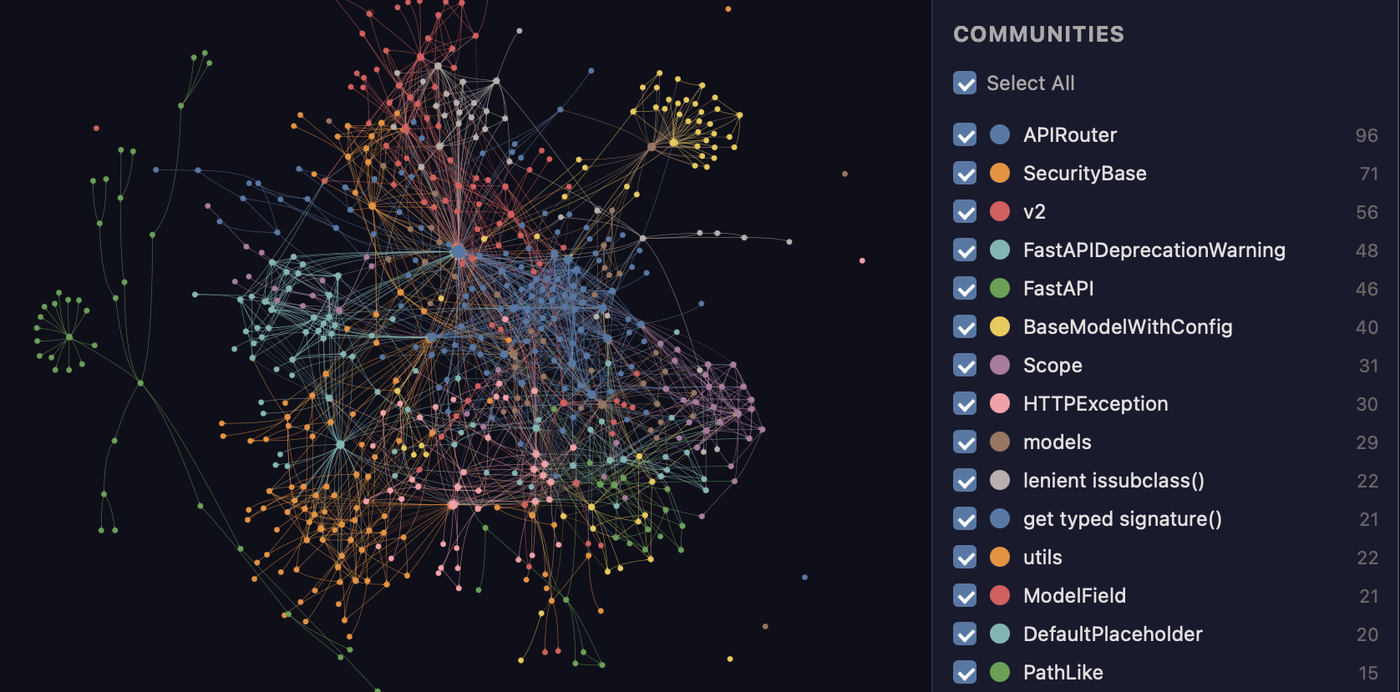
TreeDex
Tree-based, vectorless document RAG framework. Connect any LLM via URL/API key.
- 43
- MIT
- 8 mo ago
Repo mithun50/TreeDex, read from GitHub 13 min ago. mithun50 has not joined Take My Repo.
In short
mithun50/TreeDex is a public repo on GitHub by mithun50. Tree-based, vectorless document RAG framework. Connect any LLM via URL/API key. It declares the MIT license on GitHub. It is written mainly in TypeScript, has 43 stars and last changed on 2026-04-07. Nobody has reviewed it on Take My Repo yet, which says nothing about its quality. Read from GitHub on 2026-11-25.

TreeDex
Tree-based, vectorless document RAG framework.
Index any document into a navigable tree structure, then retrieve relevant sections using any LLM. No vector databases, no embeddings — just structured tree retrieval.
Available for both Python and Node.js — same API, same index format, fully cross-compatible.
How It Works
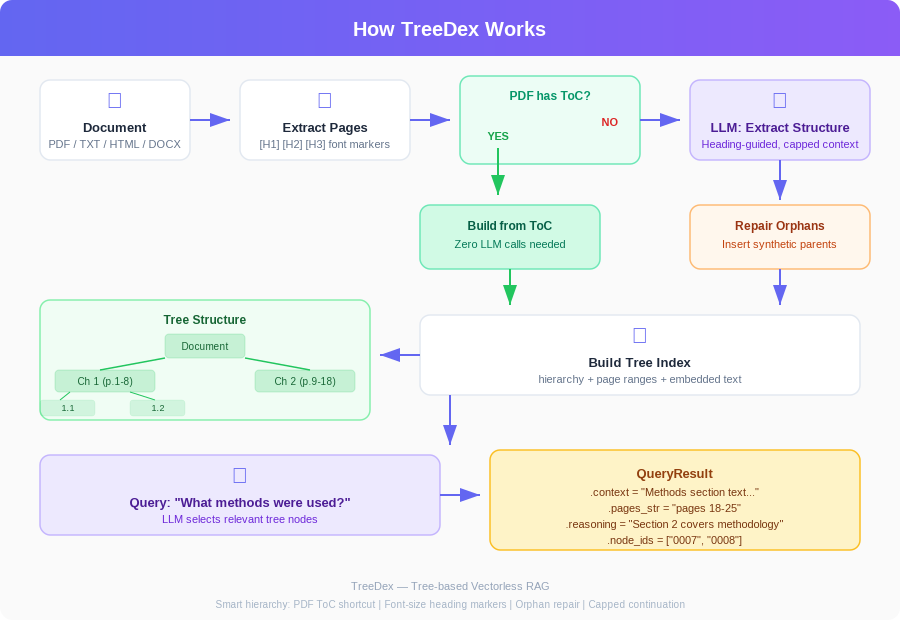
- Load — Extract pages from any supported format
- Detect — Auto-extract PDF table of contents or detect headings via font-size analysis (
[H1]/[H2]/[H3]markers) - Index — If a PDF ToC is found, build the tree directly (no LLM needed). Otherwise, LLM analyzes page groups with heading hints to extract hierarchical structure
- Build — Flat sections become a tree with page ranges and embedded text. Orphaned subsections are auto-repaired
- Query — LLM selects relevant tree nodes for your question
- Return — Get context text, source pages, and reasoning
Smart Hierarchy Detection
TreeDex uses multiple strategies to accurately extract document structure, especially for large (300+ page) documents:
- PDF ToC extraction — If the PDF has bookmarks/outline, the tree is built directly from it — zero LLM calls needed
- Font-size heading detection — Analyzes font sizes across the document and injects
[H1]/[H2]/[H3]markers so the LLM knows exactly which level each heading belongs to - Capped continuation context — For multi-chunk documents, the LLM sees a summary of top-level sections + recent sections instead of the full history, preventing prompt bloat
- Orphan repair — If the LLM outputs
"2.3.1"without a"2.3"parent, synthetic parents are auto-inserted to maintain a valid tree
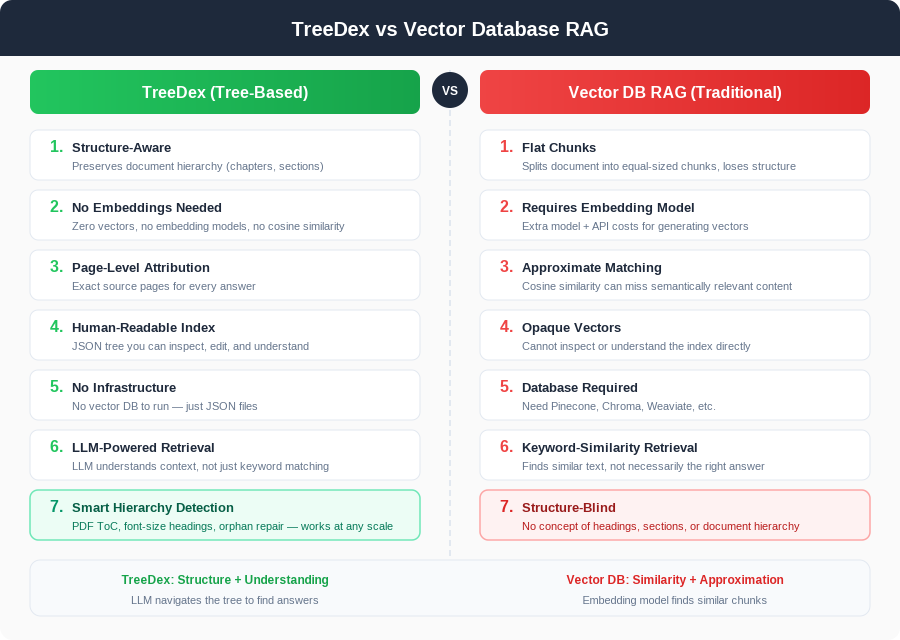
Why TreeDex instead of Vector DB?
Supported LLM Providers
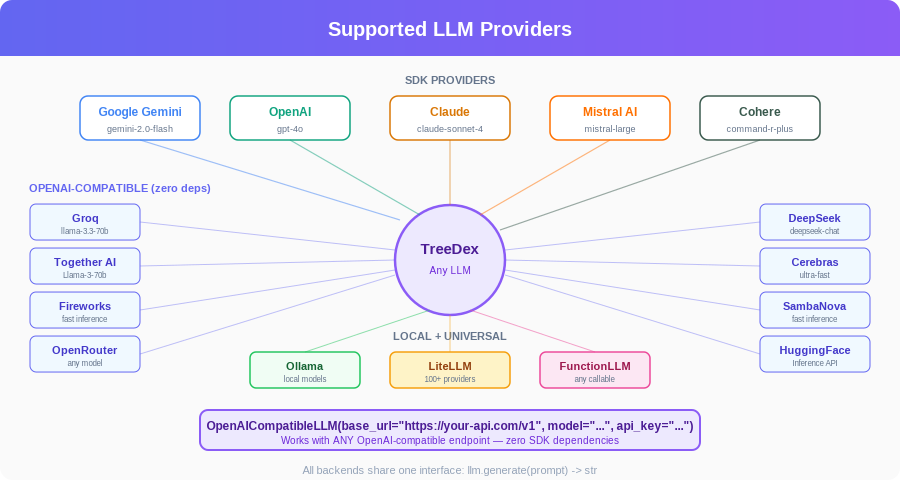
TreeDex works with every major AI provider out of the box. Pick what works for you:
One-liner backends (zero config)
| Backend | Provider | Default Model | Python Deps | Node.js Deps |
|---|---|---|---|---|
GeminiLLM |
gemini-2.0-flash | google-generativeai |
@google/generative-ai |
|
OpenAILLM |
OpenAI | gpt-4o | openai |
openai |
ClaudeLLM |
Anthropic | claude-sonnet-4-20250514 | anthropic |
@anthropic-ai/sdk |
MistralLLM |
Mistral AI | mistral-large-latest | mistralai |
@mistralai/mistralai |
CohereLLM |
Cohere | command-r-plus | cohere |
cohere-ai |
GroqLLM |
Groq | llama-3.3-70b-versatile | groq |
groq-sdk |
TogetherLLM |
Together AI | Llama-3-70b-chat-hf | None | None (fetch) |
FireworksLLM |
Fireworks | llama-v3p1-70b-instruct | None | None (fetch) |
OpenRouterLLM |
OpenRouter | claude-sonnet-4 | None | None (fetch) |
DeepSeekLLM |
DeepSeek | deepseek-chat | None | None (fetch) |
CerebrasLLM |
Cerebras | llama-3.3-70b | None | None (fetch) |
SambanovaLLM |
SambaNova | Llama-3.1-70B-Instruct | None | None (fetch) |
HuggingFaceLLM |
HuggingFace | Mistral-7B-Instruct | None | None (fetch) |
OllamaLLM |
Ollama (local) | llama3 | None | None (fetch) |
Universal backends
| Backend | Use case | Dependencies |
|---|---|---|
OpenAICompatibleLLM |
Any OpenAI-compatible endpoint (URL + key) | None |
LiteLLM |
100+ providers via litellm library (Python only) | litellm |
FunctionLLM |
Wrap any function | None |
BaseLLM |
Subclass to build your own | None |
Quick Start
Install
| Python | Node.js |
|---|---|
|
|
Pick your LLM and go
| Python | Node.js / TypeScript |
|---|---|
|
|
All providers work the same way
| Python | Node.js / TypeScript |
|---|---|
|
|
Wrap any function
| Python | Node.js / TypeScript |
|---|---|
|
|
Build your own backend
| Python | Node.js / TypeScript |
|---|---|
|
|
Agentic RAG — get direct answers
Standard mode returns raw context. Agentic mode goes one step further — it retrieves the relevant sections, then generates a direct answer.
| Python | Node.js / TypeScript |
|---|---|
|
|
Swap LLM at query time
# Build index with one LLM
index = TreeDex.from_file("doc.pdf", llm=gemini_llm)

# Query with a different one — same index, different brain
result = index.query("...", llm=groq_llm)
Save and load indexes
Indexes are saved as JSON. An index created in Python loads in Node.js and vice versa.
| Python | Node.js / TypeScript |
|---|---|
|
|
Supported Document Formats
| Format | Loader | Python Deps | Node.js Deps |
|---|---|---|---|
PDFLoader |
pymupdf |
pdfjs-dist (included) |
|
| TXT / MD | TextLoader |
None | None |
| HTML | HTMLLoader |
None (stdlib) | htmlparser2 (optional, has fallback) |
| DOCX | DOCXLoader |
python-docx |
mammoth (optional) |
Use auto_loader(path) / autoLoader(path) for automatic format detection.
API Reference
TreeDex
| Method | Python | Node.js |
|---|---|---|
| Build from file | TreeDex.from_file(path, llm) |
await TreeDex.fromFile(path, llm) |
| Build from pages | TreeDex.from_pages(pages, llm) |
await TreeDex.fromPages(pages, llm) |
| Create from tree | TreeDex.from_tree(tree, pages) |
TreeDex.fromTree(tree, pages) |
| Query | index.query(question) |
await index.query(question) |
| Agentic query | index.query(q, agentic=True) |
await index.query(q, { agentic: true }) |
| Save | index.save(path) |
await index.save(path) |
| Load | TreeDex.load(path, llm) |
await TreeDex.load(path, llm) |
| Show tree | index.show_tree() |
index.showTree() |
| Stats | index.stats() |
index.stats() |
| Find large | index.find_large_sections() |
index.findLargeSections() |
QueryResult
| Property | Python | Node.js | Description |
|---|---|---|---|
| Context | .context |
.context |
Concatenated text from relevant sections |
| Node IDs | .node_ids |
.nodeIds |
IDs of selected tree nodes |
| Page ranges | .page_ranges |
.pageRanges |
[(start, end), ...] page ranges |
| Pages string | .pages_str |
.pagesStr |
Human-readable: "pages 5-8, 12-15" |
| Reasoning | .reasoning |
.reasoning |
LLM's explanation for selection |
| Answer | .answer |
.answer |
LLM-generated answer (agentic mode only) |
Hierarchy Utilities
| Function | Python | Node.js | Description |
|---|---|---|---|
| ToC → sections | toc_to_sections(toc) |
tocToSections(toc) |
Convert PDF ToC entries to numbered sections |
| Repair orphans | repair_orphans(sections) |
repairOrphans(sections) |
Insert synthetic parents for orphaned subsections |
| Extract PDF ToC | extract_toc(path) |
await extractToc(path) |
Get ToC from PDF bookmarks (returns None/null if unavailable) |
Cross-language Index Compatibility
TreeDex uses the same JSON index format in both Python and Node.js. All field names use snake_case in the JSON:
{
  "version": "1.0",
  "framework": "TreeDex",
  "tree": [{ "structure": "1", "title": "...", "node_id": "0001", ... }],
  "pages": [{ "page_num": 0, "text": "...", "token_count": 123 }]
}
Build an index with Python, query it from Node.js (or vice versa).
Benchmarks
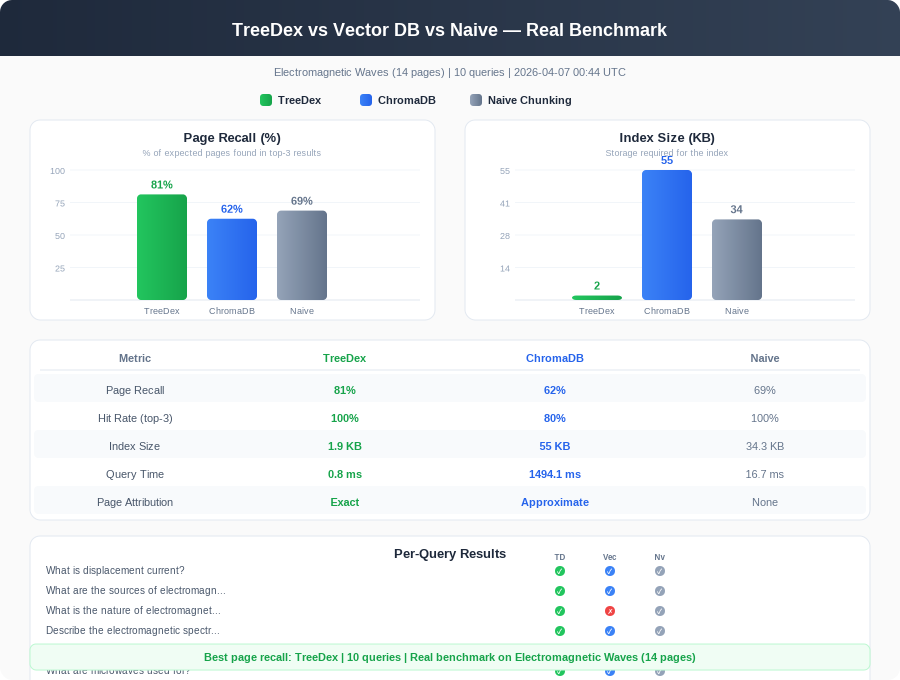
TreeDex vs Vector DB vs Naive Chunking
Questions
What is TreeDex?
mithun50/TreeDex is a public repo on GitHub by mithun50. Tree-based, vectorless document RAG framework. Connect any LLM via URL/API key.
Is TreeDex open source?
It declares the MIT license on GitHub.
Does TreeDex run on macOS, Windows or Linux?
Its maker has not tagged a system, so it is unknown here. Its README says what it needs.
How do I install TreeDex?
Open "Take it" on its page: Take My Repo writes an install plan for your machine and hands it to your AI agent (Claude Code, Codex or Cursor), which asks you before each step. Take My Repo has not tested it on any machine.
Is TreeDex still maintained?
Its last change on GitHub was on 2026-04-07. Take My Repo does not judge from that whether it is maintained.