
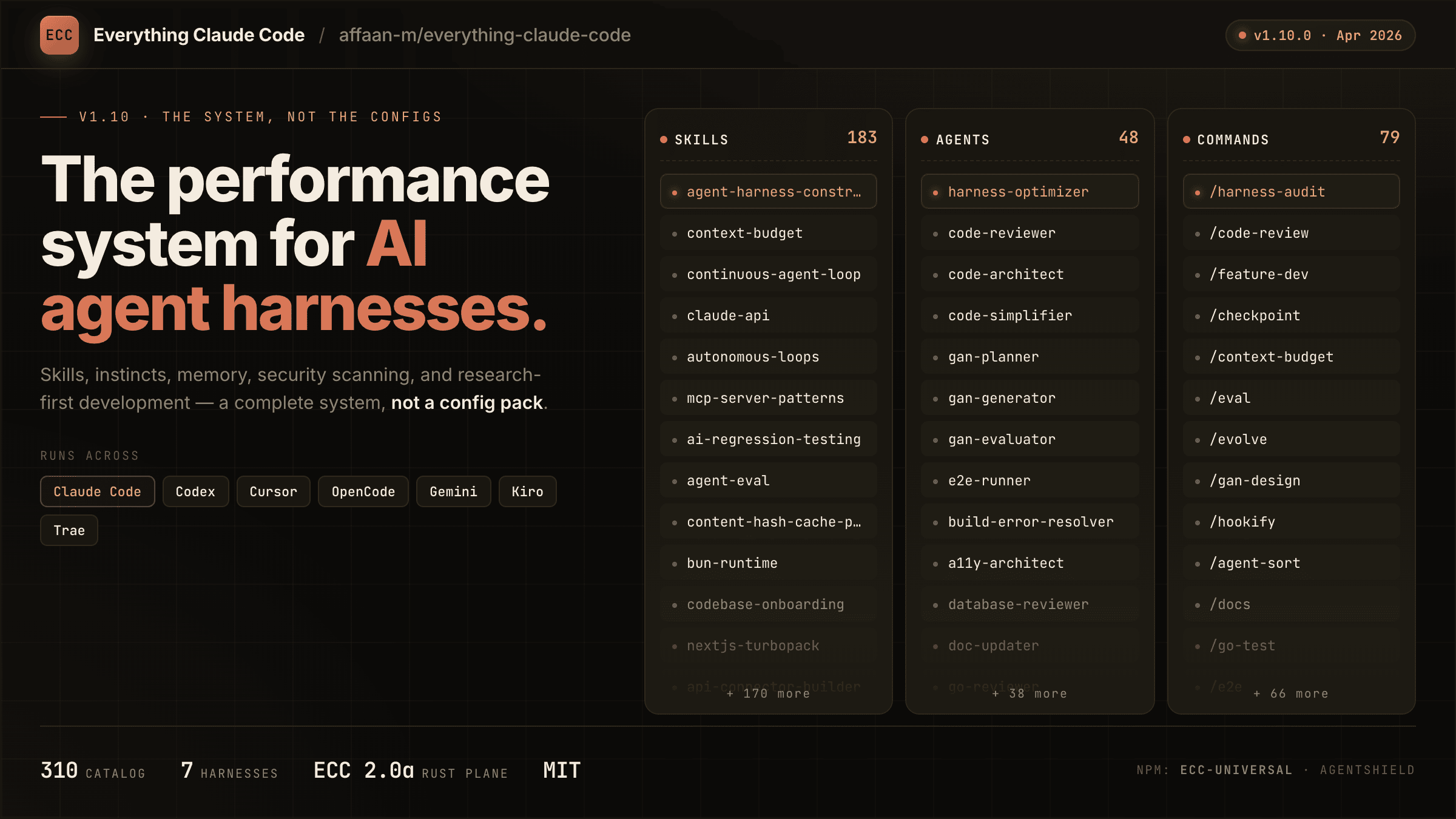
ECC
The agent harness performance optimization system. Skills, instincts, memory, security, and research-first development for Claude Code, Codex, Opencode, Cursor and beyond.
- 308k
- JavaScript
- MIT
- 2 d ago
Evidence-driven API compatibility: black-box probes, constrained AI reasoning, an allowlisted bridge, and deterministic verification.
Repo mkhan48-debug/protocolsmith-meta-hackathon, read from GitHub 1 min ago. mkhan48-debug has not joined Take My Repo.
mkhan48-debug/protocolsmith-meta-hackathon is a public repo on GitHub by mkhan48-debug. Evidence-driven API compatibility: black-box probes, constrained AI reasoning, an allowlisted bridge, and deterministic verification. It declares the MIT license on GitHub. It is written mainly in Python, has 1 stars and last changed on 2026-11-18. Nobody has reviewed it on Take My Repo yet, which says nothing about its quality. Read from GitHub on 2026-11-21.
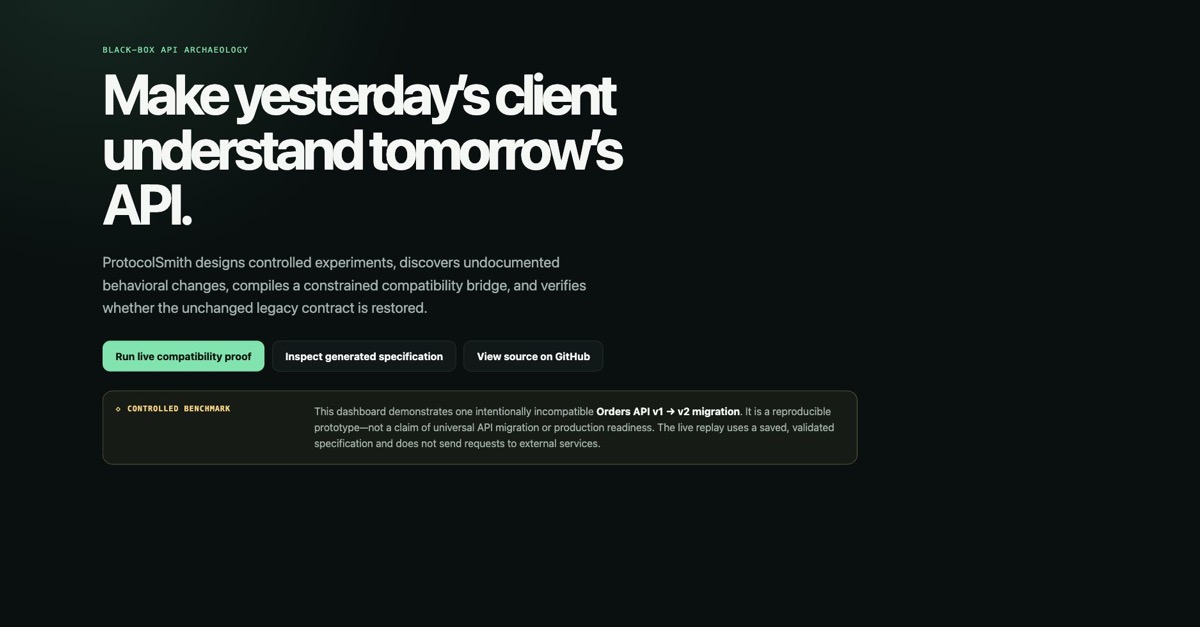
Make yesterday's client understand tomorrow's API.
ProtocolSmith is an API-archaeology prototype that observes behavioral differences between API versions, uses Meta Muse Spark to form and test compatibility hypotheses, compiles supported findings into a constrained adapter, and deterministically checks whether an unchanged legacy contract works again.
Built by Muhammad Rafae Khan for the Meta Global AI Developer Hackathon 2026 · Indie Developer track · Push the Frontier theme.
Important
ProtocolSmith currently demonstrates one synthetic, intentionally incompatible Orders API v1 → v2 migration. The recorded 15/15 result applies to that controlled benchmark; it is not a claim of universal API migration, production readiness, or customer deployment.
API migrations rarely fail only because a field was renamed. A client can break when request parameters, nesting, types, pagination, error bodies, HTTP semantics, or retained information change. Documentation often omits those behavioral details.
ProtocolSmith treats compatibility as an evidence problem:
The same legacy contract is exercised along three paths:
Unchanged legacy client → API v1
PASS

Unchanged legacy client → API v2 directly
EXPECTED INCOMPATIBILITY: the legacy "orders" field is absent

Unchanged legacy client → ProtocolSmith bridge → API v2
PASS for the controlled contract
The committed adapter translates the benchmark's observed differences:
page_size                → limit
customer_id              ← customer.id
orders                   ← data
id                       ← order_id
total_cents              ← amount.value
created_at               ← created
status                   ← state
next_page                ← pagination.next_cursor
HTTP 404 legacy error    ← HTTP 200 modern error object
The created_at conversion is intentionally not described as exact: v2
discarded time of day, so the bridge reconstructs midnight UTC and emits an
explicit warning.
| Evidence | Recorded result | What it supports |
|---|---|---|
| Paired discovery | 3 experiments; 10 reported changes | Candidate mappings for the known synthetic route |
| Active experiment | 6/6 controlled outcomes matched | page_size ↔ limit for the tested value |
| Adapter artifact | Constrained JSON rules | Reviewable deterministic execution plan |
| Verification receipt | 15/15 contract checks passed | Restoration of the tested synthetic legacy contract |
The active experiment uses a baseline, the other version's parameter name, and the proposed version-specific name against each API. Both swapped-name negative controls are required to pass before the mapping is accepted. The other adapter rules are supported by paired observations and deterministic replay; they have not each received an independent causal probe.
See docs/CONTROLLED_BENCHMARK.md for the full matrix, receipt contents, and unresolved risks.
Muse Spark 1.3 is part of the experimental reasoning loop, not a generic chat surface or a coding-only assistant. It performs three bounded tasks:
ProtocolSmith treats model output as untrusted data. Pydantic constrains the shape; deterministic code validates and executes the allowlisted operations. ProtocolSmith never executes arbitrary model-generated source code.
The live dashboard button does not call Muse. It replays local requests using the previously generated, committed specification.
flowchart LR
    A[Legacy API v1] --> P[Differential probe]
    B[Modern API v2] --> P
    P --> E[Evidence bundle]
    E --> M[Meta Muse Spark 1.3]
    M --> H[Typed hypotheses]
    M --> X[Active experiment]
    X --> P
    H --> C[Constrained compiler]
    C --> S[Declarative adapter spec]
    S --> R[Deterministic bridge]
    L[Unchanged legacy client] --> R
    R --> B
    R --> V[Verification receipt]
.env file is ignored so model credentials are not committed.These are prototype safeguards, not a production security guarantee. See SECURITY.md.
uvgit clone https://github.com/mkhan48-debug/protocolsmith-meta-hackathon.git
cd protocolsmith-meta-hackathon
uv sync --locked --all-groups
uv run protocolsmithNo API key is required for this replay. The launcher starts the synthetic API laboratory, bridge, and dashboard, then prints the dashboard URL. It attempts to open that URL in a browser; if no window appears, copy the printed URL manually.
Run v0.1.0 from a Git source checkout. The current Python wheel/sdist does not bundle the root-level dashboard template and evidence artifacts, so it is not being presented as a standalone PyPI distribution.
If the default ports already host a healthy ProtocolSmith pair, the launcher reuses it. If another local service occupies a default port, it selects nearby free ports and prints the selected URL. The printed URL is therefore authoritative.
To suppress browser auto-opening:
PROTOCOLSMITH_NO_BROWSER=1 uv run protocolsmith
Press Control+C once to stop services started by the active launcher.
Open the printed dashboard URL and select Run live compatibility proof. The dashboard shows the legacy pass, expected direct-v2 incompatibility, bridge pass, live contract checks, committed receipt, and known information loss.
Start the controlled API laboratory:
uv run uvicorn protocolsmith_meta_hackathon.lab_api:app \
  --host 127.0.0.1 \
  --port 8000
In another terminal, start the dashboard and bridge:
uv run uvicorn protocolsmith_meta_hackathon.dashboard_api:app \
  --host 127.0.0.1 \
  --port 8001
Open http://127.0.0.1:8001. For startup problems and port diagnostics, see
docs/DEMO.md.
With the stack running on its default ports:
# Original contract succeeds
uv run python scripts/legacy_client.py \
  --base-url http://127.0.0.1:8000/v1

# Same client encounters the expected incompatibility
uv run python scripts/legacy_client.py \
  --base-url http://127.0.0.1:8000/v2

# Same client succeeds through the generated bridge
uv run python scripts/legacy_client.py \
  --base-url http://127.0.0.1:8001
If the launcher selected alternate ports, use the URLs it printed instead.
uv run python -m compileall -q src scripts tests
uv run pytest -q
GitHub Actions runs the test suite, including the real local HTTP-stack proof,
on pushes to main and on pull requests.
The public showcase is generated from the same committed evidence and template:
uv run python scripts/build_static_showcase.py
Its replay is deliberately labeled recorded. The FastAPI stack remains the authoritative live demonstration.
| Artifact | Purpose |
|---|---|
artifacts/discovery_report.json |
Paired observations, model-assisted compatibility plan, confidence, and unresolved risks |
artifacts/active_probe_trace.json |
Muse proposal, six executed controls, assessment, and acceptance verdict |
artifacts/adapter_spec.json |
Constrained rules consumed by the deterministic bridge |
artifacts/verification_receipt.json |
15 recorded contract checks, supporting responses, and known loss |
This chain is auditable but not cryptographically signed or independently replicated. The dashboard's live button performs a compact five-request replay; the displayed 15/15 total comes from the broader committed receipt.
The normal demo does not need a model key. Regeneration does:
cp .env.example .env
# Add MODEL_API_KEY to the local .env file
Follow docs/REGENERATING_ARTIFACTS.md for the ordered procedure. Regenerated JSON is a new experimental result and must be reviewed rather than assumed equivalent to the committed evidence.
src/protocolsmith_meta_hackathon/
  lab_api.py          Synthetic incompatible API versions
  bridge_api.py       Constrained deterministic adapter runtime
  dashboard_api.py    Dashboard and live-proof endpoint
  demo.py             One-command launcher

scripts/
  build_static_showcase.py  Generate the serverless evidence replay
  check_meta_api.py   Meta Model API connection check
  legacy_client.py    Unchanged legacy contract client
  run_discovery.py    Differential evidence and Muse analysis
  compile_adapter.py  Constrained adapter compilation
  run_active_probe.py Model-designed controlled experiment
  verify_bridge.py    Deterministic verification receipt

artifacts/            Committed discovery-to-verification evidence
tests/                Unit, launcher, control-matrix, and HTTP-stack tests
docs/                 Demo, evidence boundary, regeneration, and release guides
assets/screenshots/   Browser-verified reviewer and social assets
null pagination values, USD, two statuses, and one error family
observedThe complete boundary is maintained in docs/CONTROLLED_BENCHMARK.md.
Until a GitHub release is tagged, the repository should be treated as an unreleased v0.1.0 development snapshot. The intended first release is a GitHub source release, not a PyPI package.
ProtocolSmith is available under the MIT License. Standard open-source dependencies are identified in the project metadata and are not claimed as original work.
mkhan48-debug/protocolsmith-meta-hackathon is a public repo on GitHub by mkhan48-debug. Evidence-driven API compatibility: black-box probes, constrained AI reasoning, an allowlisted bridge, and deterministic verification.
It declares the MIT license on GitHub.
Its maker has not tagged a system, so it is unknown here. Its README says what it needs.
Open "Take it" on its page: Take My Repo writes an install plan for your machine and hands it to your AI agent (Claude Code, Codex or Cursor), which asks you before each step. Take My Repo has not tested it on any machine.
Its last change on GitHub was on 2026-11-18. Take My Repo does not judge from that whether it is maintained.
The agent harness performance optimization system. Skills, instincts, memory, security, and research-first development for Claude Code, Codex, Opencode, Cursor and beyond.
Nobody has reviewed it on Take My Repo yet, which says nothing about its quality.
Write request and response migrations for Stripe-like versioning of your Ruby on Rails API. Make breaking changes without breaking things!
基于图像识别的自动化黑盒测试框架 | An automation black-box testing framework based on image recognition
Browser compatibility data for Web technologies as displayed on MDN
Reverse engineer anything with agents, from app behavior down to native binaries.


