
w3Develops
The w3develops.org open source codebase - Learn, build, and meetup with other developers on DISCORD https://discord.gg/WphGvTT and YOUTUBE https://youtube.com/w3develops
- 122
- TypeScript
- BSD-3-Clause
- 4 d ago
[project] repo for organizing goals and assets for the GSOC 2017 study group project
Repo mozillascience/studyGroup-GSOC, read from GitHub 2 d ago. mozillascience has not joined Take My Repo.
mozillascience/studyGroup-GSOC is a public repo on GitHub by mozillascience. [project] repo for organizing goals and assets for the GSOC 2017 study group project. It declares the MPL-2.0 license on GitHub. It is written mainly in JavaScript, has 6 stars and last changed on 2017-08-21. Nobody has reviewed it on Take My Repo yet, which says nothing about its quality. Read from GitHub on 2026-11-23.
The w3develops.org open source codebase - Learn, build, and meetup with other developers on DISCORD https://discord.gg/WphGvTT and YOUTUBE https://youtube.com/w3develops

Welcome to the planning repository for the 2017 Study Group Google Summer of Code (GSOC) project!
If you're interested in contributing, you should find all of the details here. We've centralized it into this repository, because the Study Groups project is distributed accross multiple repositories, and we'd like to keep things tidy and focused for the duration of the mentorship. Issues and roadmap goals will reflect changes accross multiple repositories on Github, so you'll have the opportunity to contribute to multiple aspects of this project.
Study Group Activity Visualizations
As seen on the Mozilla GSOC wiki, this project is part of 3 proposed projects under the "Mozilla Science Lab." Ours is the third project on that list, and involves creating visualizations of our distributed Study Group community activity, and unifying data collected from our mulitiple Study Group repositories.
For more background, the Mozilla Science Lab is a part of the Mozilla Foundation devoted to supporting a global community of scientists who want to open source their research and their learning materials. The Study Group program is a part of that initiative, and centers around a simple website that leverages Jekyll blog software and Github issues to enable the creation of a website for peer-learning groups. These groups collaborate and come together for in-person workshops and events that teach scientific programming concepts, open science practice, and scripting languages. Study Group Leads fork the Study Group Website Repository and customize the attached website (gh-page) to run meetups all over the world. They organize regular events, skill shares, co-work and create community around open science.
Currently, we have several repositories for Study Group Resources, which we welcome you to review, see the table below. Assess the usability and user experience of each, and let us know what you think in the issues here.
| Resource | Description | Additional Links | Owner |
|---|---|---|---|
| Study Group Website | main repository for Study Groups, Leads fork this repository to start their own study group and customize their website | code + issues | Aurelia |
| Study Group Orientation Guide | gitbook that explains how to start a study group and start planning events/workshops | code + issues | Zannah |
| Study Group Lessons | submoduled lesson outlines for a variety of programming and open science topics | check out the issues for additional lesson suggestions or implementations of the "standard" repo lessons | Aurelia |
| Study Group Events Tracker | website for submitting events with more detailed metadata on attendees and topics | code + issues | Aurelia |
| Study Group Events Crawler | set of scripts for pulling events from the forked Study Group repositories and creation JSON for visualizations | code + issues | Aurelia |
| Mozilla Study Group Project | part of the Mozilla Science Lab website, where the study group project and map of Study Group locations is featured | Mozilla Science Lab | |
| Gitter Chat | community chat room for all study group related issues and activity around the world | Questions specifically about GSOC? Ask them in the gitter chat for gsoc | Mozilla Science Lab |
Right now there's no easy way to see all the study group events, or to otherwise visualize Study Group project participation. We'd like to change that :smiley:.
Ideally, we'd like to have the following outcomes, subject to applicant interest:
_posts directory additions aka events have been made to those repos, how many members in the config.yml are logged, what features are being used and what features are being ignored)The Study Group project is primarily composed of Github infrastructure, Javascript, and occasionally Python. Contributors with Node and Javascript visualization skills are encouraged to apply!
All are welcome to contribute as the methods of contribution vary, review some of the issues and decide how to best apply your skills.
Ready to start contributing to this GSOC project? AWESOME, thanks for reading this far.
Project DescriptionProblem Statement and Outcomes in this READMEAurelia Moser, Community Lead, Mozilla Science Lab, @auremoser, aurelia[at]mozillafoundation[dot]org
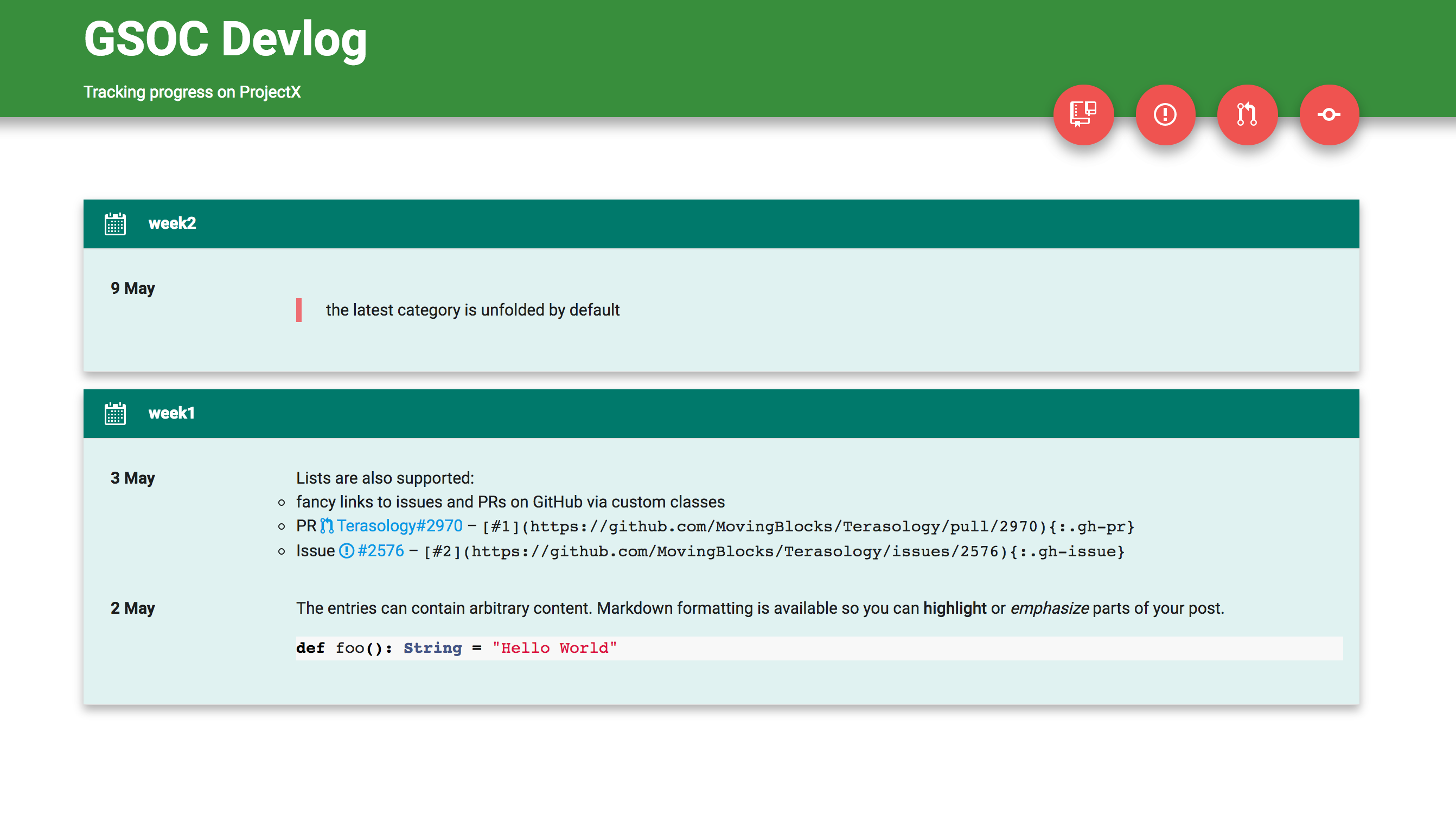
The Dev log is a place for our GSOC project to be tracked from week to week.
This template is not our work but is based on Karan's devlog (source :octocat:) with modifications by Mikhail. The source code was cleaned from content and enriched with some comments to help people get set up.
The design of the devlog page uses Material Design with Roboto font.
To set up your personal devlog you just have to clone this repository and fill it with content. Read more about using Jekyll with GitHub page on GitHub and/or Jekyll.
You should change your personal information and links to your project in
_config.yml. The site title and description is also adjustable in this file.
The devlog will show progress entries grouped by categories. Each entry is prefixed with its posting date and can hold arbitrary content in Markdown format.
Have a look at the example instance instance.
Please find posting examples in the
_postsdirectory of thegh-pagesbranch.
To start blogging, just create a file for each entry in _posts. The filename
should start with the date, e.g., 2017-07-01-first_entry.md.
The Front Matter holds information on the category and date.
---
date: 2017-07-01
category: week1
---

< .. content .. >
_posts directory (like this one) and the issues like (this one) in their forked Study Group websites. There is a guide for this in the Study Group README - how to setup your site.mozillascience/studyGroup-GSOC is a public repo on GitHub by mozillascience. [project] repo for organizing goals and assets for the GSOC 2017 study group project.
It declares the MPL-2.0 license on GitHub.
Its maker has not tagged a system, so it is unknown here. Its README says what it needs.
Open "Take it" on its page: Take My Repo writes an install plan for your machine and hands it to your AI agent (Claude Code, Codex or Cursor), which asks you before each step. Take My Repo has not tested it on any machine.
🔮 Word by word audio subtitle synchronisation tool and API. Developed under GSoC 2017 with CCExtractor.
Contains information about accepted GSoC 2017 Projects across various organizations along with the proposals.
Its last change on GitHub was on 2017-08-21. Take My Repo does not judge from that whether it is maintained.
Nobody has reviewed it on Take My Repo yet, which says nothing about its quality.
Take My Repo cannot say: it does not audit code and has not run studyGroup-GSOC. What is known comes from GitHub. It declares the MPL-2.0 license on GitHub. Its last change was on 2017-08-21. It has 6 stars, which measure popularity, not safety. Nobody has reviewed it on Take My Repo yet, which says nothing about its quality. Read the source before you run it. With "Take it", your AI agent shows each step and asks you before running it; README text is treated as data, not as instructions.


