
jit-notes
JIT in details.
- 8
- GPL-3.0
- 6 y ago
Repo mtumilowicz/jit-notes, read from GitHub 2 h ago. mtumilowicz has not joined Take My Repo.
In short
mtumilowicz/jit-notes is a public repo on GitHub by mtumilowicz. JIT in details. It declares the GPL-3.0 license on GitHub. It has 8 stars and last changed on 2021-02-14. Nobody has reviewed it on Take My Repo yet, which says nothing about its quality. Read from GitHub on 2026-11-24.
jit-notes
- references
- JVM JIT for Dummies
- Douglas Hawkins — Understanding the Tricks Behind the JIT
- JVM Mechanics by Douglas Hawkins
- Devoxx Poland 2016 - Douglas Hawkins - A Peak Inside the JIT
- Understand the Trade-offs of Using Compilers for Java Applications
- Toruń JUG #29 - "JIT me baby one more time" - Jarek Pałka
- WJUG #257 - Krzysztof Ślusarski - Just-In-Time compiler - ukryty "przyjaciel"
- An Introduction to JVM Performance
- Douglas Hawkins playlist
- Twitter's quest for a wholly Graal runtime - Voxxed Days Singapore 2019
- https://stackoverflow.com/questions/56698783/what-is-the-difference-between-java-intrinsic-and-native-methods
- https://stackoverflow.com/questions/9105505/differences-between-just-in-time-compilation-and-on-stack-replacement
- https://www.slideshare.net/dougqh
- https://blog.takipi.com/java-on-steroids-5-super-useful-jit-optimization-techniques/
- https://blog.codecentric.de/en/2012/07/useful-jvm-flags-part-1-jvm-types-and-compiler-modes/
- https://blog.joda.org/2011/08/printcompilation-jvm-flag.html
- https://medium.com/@julio.falbo/understand-jvm-and-jit-compiler-part-2-cc6f26fff721
- https://stackoverflow.com/questions/36955433/how-does-the-jvm-know-when-to-throw-a-nullpointerexception
- https://vlab.cs.ucsb.edu/papers/jitleaks.pdf
- https://advancedweb.hu/jvm-jit-optimization-techniques/
general
- JIT - just in time compiler
- "JIT is just complex pattern matchers" - Douglas Hawkins
- a technique of code compilation during runtime
- first usage: LISP
- code is compiled to something intermediary (bytecode) and then is compiled to native code (machine code) during runtime
- opposed to Ahead Of Time (AOT) compilation: C, C++, Go, Rust
- compilation: directly to machine code
- many optimizations during compilation
- restart - we start from the beginning
- java 9 - AOTC compiler
- loop of JIT compilation: interpret -> profile -> compile -> deoptimize -> interpret
- optimizes two things: methods and loops
- big part of JVM
- C2 - 19%
- C1 - 6,3%
- gc - 15%
- useful flags
-Xint- flag forces the JVM to execute all bytecode in the interpreted mode, which comes along with a considerable slowdown, usually factor 10 or higher-XX:+PrintCompilation- show basic information on when Hotspot compiles methods- shows timespan from start-up to compilation
- shows compilation identifier (each compilation bumps identifier by 1)
- C1 and C2 have separate identifiers
- hot spots - programming parts that are executed a lot
- spring configuration classes - only once during bootstrap
- rest controller methods - many times
- jit compilers consume transient resources (CPU cycles and memory)
- from under a millisecond to seconds of compile time
- can allocate 100s MBs
- takes time to get to "full speed" because there may be 1000s of methods to compile
- possible stop-the-world events, especially during deoptimization
- collecting profile data is an overhead
- cost usually paid while code is interpreted: slows start-up and ramp-up
mechanics
tiered
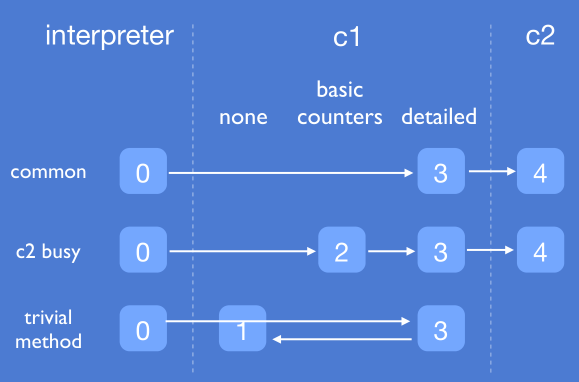
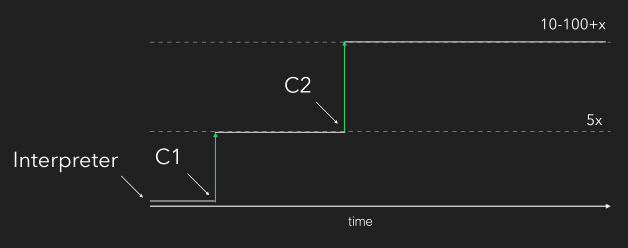
- C2 compilation time is nearly 4 times slower than C1, but the code is 2-10x faster than C1
counters
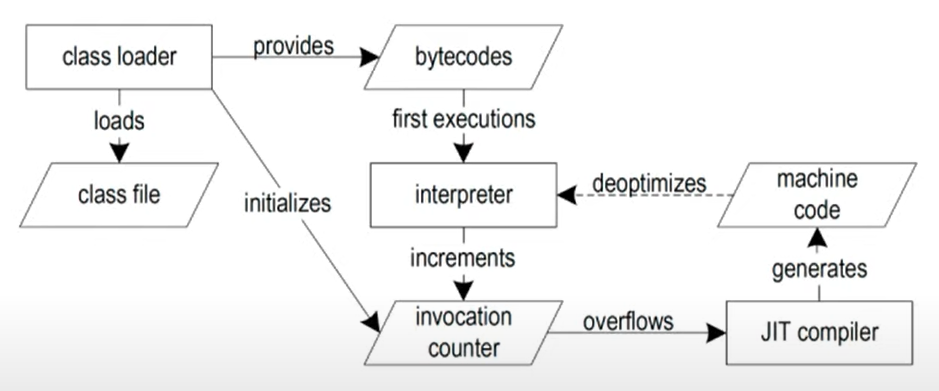
- hot method: invocation counter > invocation threshold
- hot loops: backedge (loop) counter > backedge threshold
- backedge (loop) counter - number of already happened iterations
- invocation + backedge counter > compile threshold
- medium hot methods with medium hot loops
- if counter > threshold -> compile loop
- C1: 2000 invocations
- C2: 10000 invocations
Compiler Task Queue
- JIT compilation is an asynchronous process
- when the JVM decides that a certain block of code should be compiled, that block of code is put in a queue
- not strictly first in, first out
- methods whose invocation counters are higher have priority
- not strictly first in, first out
- the JVM will continue interpreting the method, and the next time the method is called, the JVM will execute the compiled version of the method
- if method stays in a queue for too long - it will be removed from the queue
- maybe we don't need optimization for that method anymore
- on-stack replacement (OSR) context
- consider a long-running loop
- JVM needs the ability to start executing the compiled version of the loop while the loop is still running
- when the code for the loop has finished compiling, the JVM replaces the code (on the stack), and the next iteration of the loop will execute the much faster-compiled version of the code
deprecating old optimizations
- made not entrant
- there could exist many compilations of a single method simultaneously
- if methodA calls methodB, it wants to have the best compilation
- first time - it asks Call Dispatcher for the best compilation
- methodA caches that information
- first time - it asks Call Dispatcher for the best compilation
- subsequent calls
- if the methodB is made not entrant - methodA calls dispatcher and gets the best compilation
- if the methodB is not yet made not entrant - we have two compilations in the memory
- we have to accept the slower compilation
- somewhere in the meantime dispatcher will mark our compilation as made not entrant and redirect calls to the faster one
- made zombie - method was made not entrant and no thread has it on its stack
- could be removed
- made not entrant
c1
- fast
- trivial methods, up to 6 bytes (MaxTrivialSize) are inlined by default
- up to 35 bytes (in bytecode) (MaxInlineSize)
- inlining depth limit: 9 methods deep
c2
- slow but generates faster code (compared to C1)
- very complex
- learning curve way too steep
- the last few years no new major optimization
- reached its end-of-life already years ago
- by default limited by bytecode size of 325 (FreqInlineSize)
- if > 8000 bytecode - always interpreted
optimizations
golden rule of optimization: don't do unnecessary work
it is almost never a single optimization but a sequence of optimizations
public static void x(Object object) {
    if (object == null) {
        System.out.println("a");
    }
}

public void y() {
    x(this);
}
inlining:
public void y() {
   if (this == null) {
       System.out.println("a");
   }
}
null-check folding:
public void y() {
   if (false) {
       System.out.println("a");
   }
}
death code termination:
public void y() { } // method could be removedperforms speculative optimizations / optimistic compilation
- resulting optimized code assumes that the rarely-taken branch or dispatch will
never execute, and the missing code is replaced by a trap that is triggered if
the rare case should occur
- known as an uncommon trap
- resulting optimized code assumes that the rarely-taken branch or dispatch will
never execute, and the missing code is replaced by a trap that is triggered if
the rare case should occur
method inlining
- expanding optimizations horizon
- mother of all optimizations
- "if you remove every other optimization java will be very fast anyway" - Joshua Bloch
- tuning
- -XX:+MaxTrivialSize=6 // trivial methods are inlined by default
- -XX:+MaxInlineSize=35
- -XX:+MaxInlineLevel=9
- -XX:+MaxRecursiveInlineLevel=#
- class hierarchy analysis
- when dispatching a method call, the JVM checks how many implementations of that method is
- 1: it’s called monomorphic dispatch
- 2: it’s called bimorphic dispatch
- more: it’s called megamorphic dispatch
- monomorphic and bimorphic method calls can be inlined, while megamorphic calls can not
if classloader loaded only SinF - JIT could do inliningabstract class AMF { abstract double apply(double i); } class CosF / SinF / SqrtF extends AMF { double apply(double i) { return Math.cos / sin / sqrt (i) } } static double dol(AMF func, double i) { return func.apply(i); }static double dol(AMF func, double i) { return Math.sin(i); }
- when dispatching a method call, the JVM checks how many implementations of that method is
constant folding and propagation
public static long x() {
    int x = 14;
    int y = 7 - x / 2;
    return y * (28 / x + 2);
}
compiled into
public static long x() {
    return 0;
}
loop unrolling
lock coarsening/eliding
coarsening
public void needsLocks() {
    loop {
        process()
    }
}
private synchronized String process(String option) { }
compiled into
public void needsLocks() {
    synchronized(this) {
        loop {
            // inlined process()
        }
    }
}
eliding
public void elide() {
    var l = new ArrayList();
    synchronized(l) { // lock on local variable
        loop {
             l.add(...) // l never escapes this thread
        }
    }
}
compiled into
public void elide() {
    var l = new ArrayList();
    loop {
        l.add(...)
    }
}
dead code elimination
duplicate code elimination
escape analysis
public void x() {
    var f = new Foo("X", "Y");
    baz(f)
}

public void baz(Foo f) {
    sout(f.a)
    sout(",")
    quux(f)
}

public void quux(Foo f) {
    sout(f.b)
    sout("!")
}
compiled into
public void x() { // don't bother allocating foo object
    sout("X")
    sout(",")
    sout("Y")
    sout("!")
}
intrinsic
- JVM knows the implementation of an intrinsic method and can substitute the original java-code with machine-dependent well-optimized instructions (sometimes even with a single processor instruction)
- known to the jit
- don't inline bytecode, do insert "best" native code
- e.g. kernel-level memory operation
- e.g. optimized sqrt in machine code
- common intrinsics
- String#equals
- most Math methods
@HotSpotIntrinsticCandidate- extremely popular in that package
- System.arraycopy - 4 assembler instructions without a loop
- Unsafe.storeFence - calls directly CPU instruction
- Unsafe.allocateInstance - create instance bypassing constructor
- Object#hashCode
- Object#getClass
NullPointerException digression
- JVM implement the null check using virtual memory hardware
- JVM arranges that page zero in its virtual address space is mapped to a page that is unreadable + unwritable
- since null is represented as zero, when Java code tries to dereference null this will try to access a non-addressible page and will lead to the OS delivering a "segfault" signal to the JVM
- JVM's segfault signal (SEGV) handler could trap this, figure out where the code was executing, and create and throw an NPE on the stack of the appropriate thread
- without this, every deref should be guarded
public static int getSize(Collection collection) {
    if (collection == null) { // othervise checks like that should be added during compilation
        throw new NullPointerException();
    }
    return collection.size(); // assembler: segmentation violation
    // will crush JVM
}
- JVM implement the null check using virtual memory hardware
deoptimizations
Questions
What is jit-notes?
mtumilowicz/jit-notes is a public repo on GitHub by mtumilowicz. JIT in details.
Is jit-notes open source?
It declares the GPL-3.0 license on GitHub.
Does jit-notes run on macOS, Windows or Linux?
Its maker has not tagged a system, so it is unknown here. Its README says what it needs.
How do I install jit-notes?
Open "Take it" on its page: Take My Repo writes an install plan for your machine and hands it to your AI agent (Claude Code, Codex or Cursor), which asks you before each step. Take My Repo has not tested it on any machine.
Is jit-notes still maintained?
Its last change on GitHub was on 2021-02-14. Take My Repo does not judge from that whether it is maintained.