
LocalAI
LocalAI is the open-source AI engine. Run any model - LLMs, vision, voice, image, video - on any hardware. No GPU required.
- 50k
- Go
- MIT
- 1 h ago
Fast and portable Parakeet implementation in C++ with ggml
Repo mudler/parakeet.cpp, read from GitHub 13 h ago. mudler has not joined Take My Repo.
mudler/parakeet.cpp is a public repo on GitHub by mudler. Fast and portable Parakeet implementation in C++ with ggml. It declares the MIT license on GitHub. It is written mainly in C++, has 898 stars and last changed on 2026-10-30. Nobody has reviewed it on Take My Repo yet, which says nothing about its quality. Read from GitHub on 2026-11-20.
Brought to you by the LocalAI team, the folks behind LocalAI, the open-source AI engine that runs any model (LLMs, vision, voice, image, video) on any hardware, no GPU required.
A C++17/ggml port of NVIDIA's NeMo Parakeet speech recognition models, with voice activity detection, speaker diarization and identification, and sound-event tagging. It runs on CPU and on GPU backends, reads self-contained GGUF files, and needs no Python at inference time. Transcripts match NeMo (WER 0 on every published NeMo checkpoint).

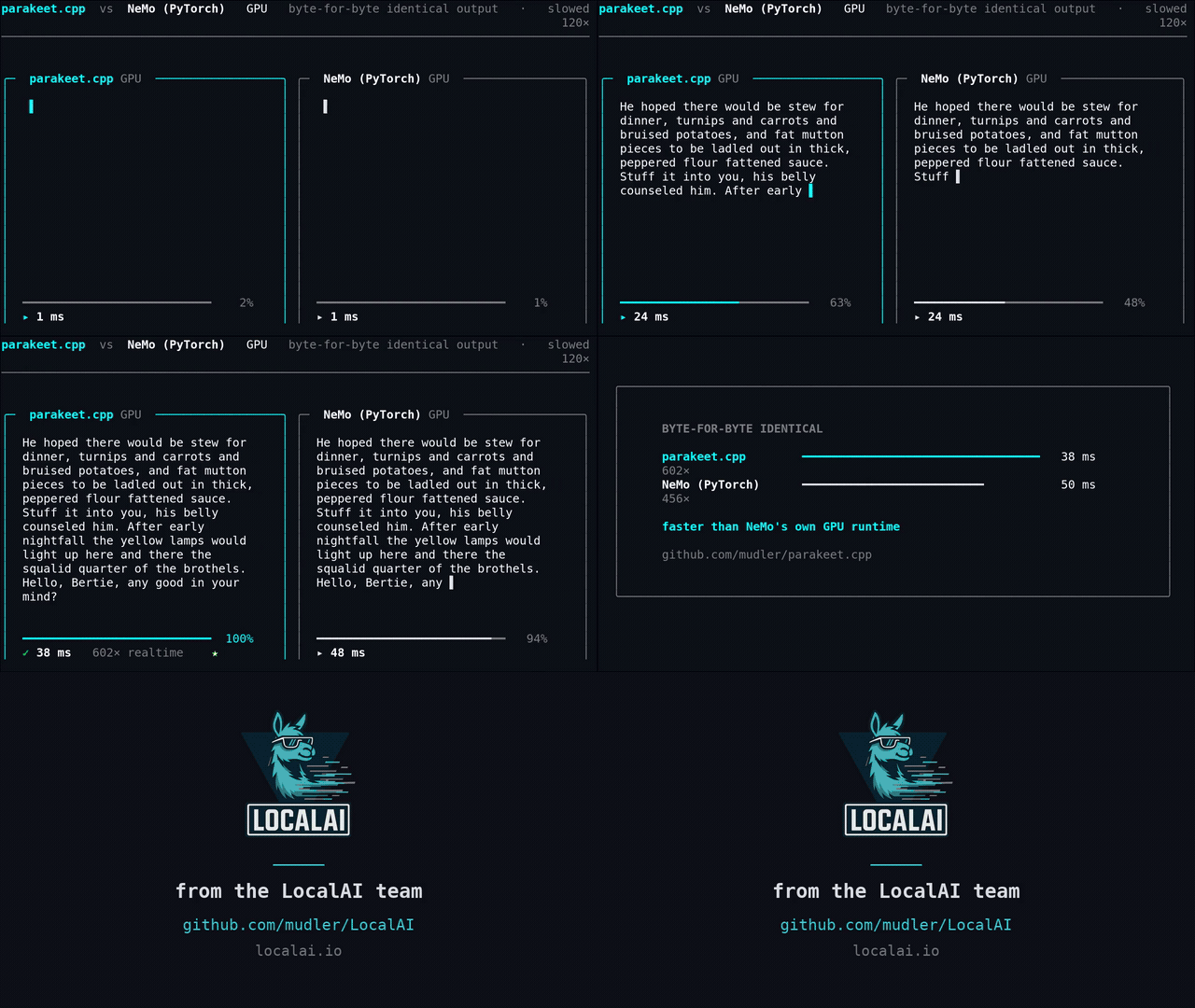
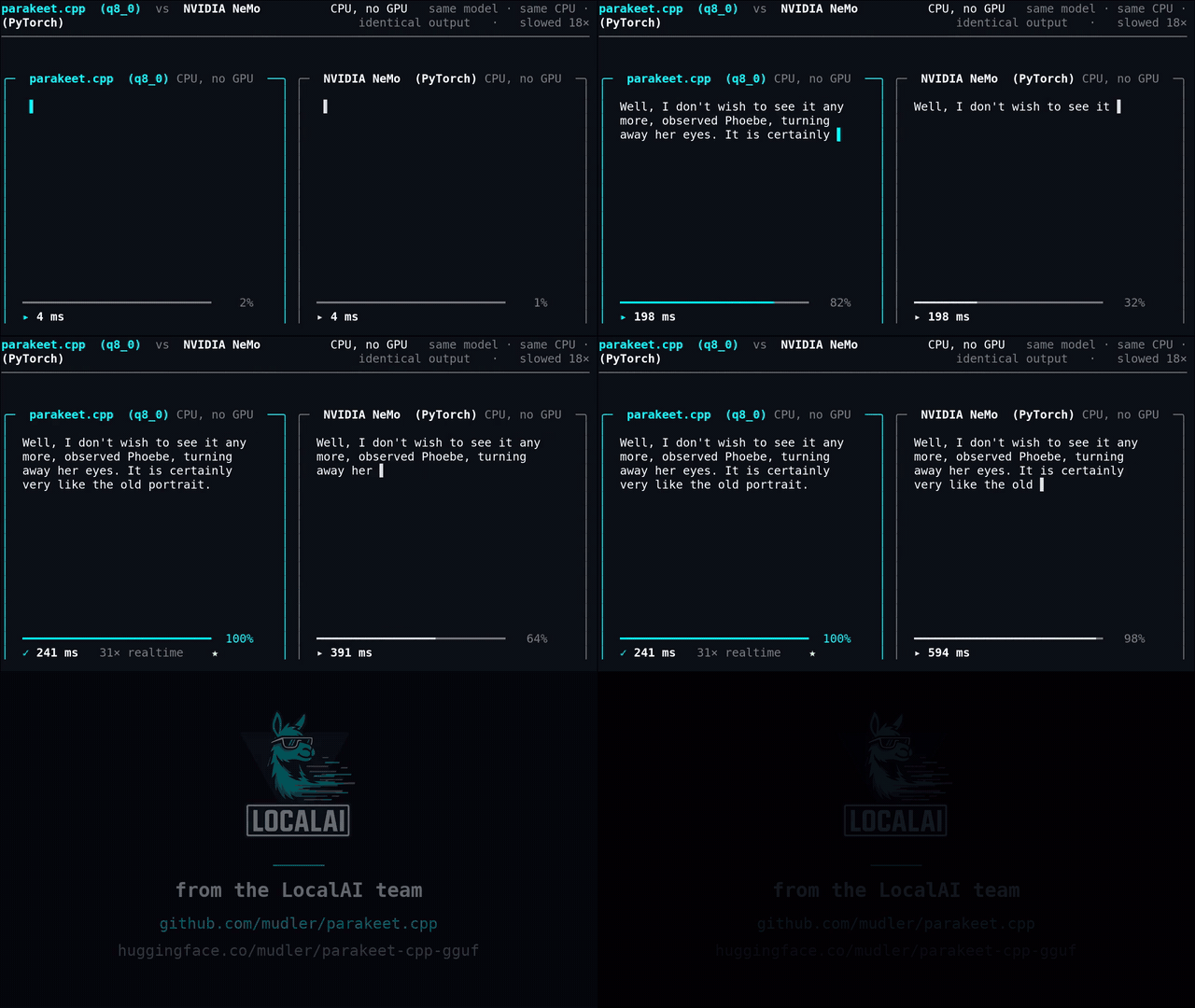
The same clip, side by side: identical output, parakeet.cpp finishes first (slowed down so a sub-100 ms race is watchable). More clips: Demos.
On this page: What is new | Demos | Quick start | Models | CLI cheat sheet | Server and Docker | C API | Build | Benchmarks | Documentation | Limits | Contributing | License
Latest tagged release: v0.5.0 (2026-08-01). Entries dated after it are on master, not in a release yet: build from source (see Build) or use the :latest Docker images.
parakeet_capi_speaker_embed_pcm returns the voice embedding of a clip, from a standalone encoder or a bundle voice component. docsvad and cannot transcribe. docstranscribe --vad to cut long audio at pauses. docsThe models are in mudler/parakeet-cpp-gguf, and LocalAI runs parakeet.cpp as its parakeet-cpp backend. The other docs are listed in the Documentation table.
Each clip is a short animated preview. The full video is linked below it. The clips below the first one were made for posts on X; the post links are not collected in this repository yet.
|
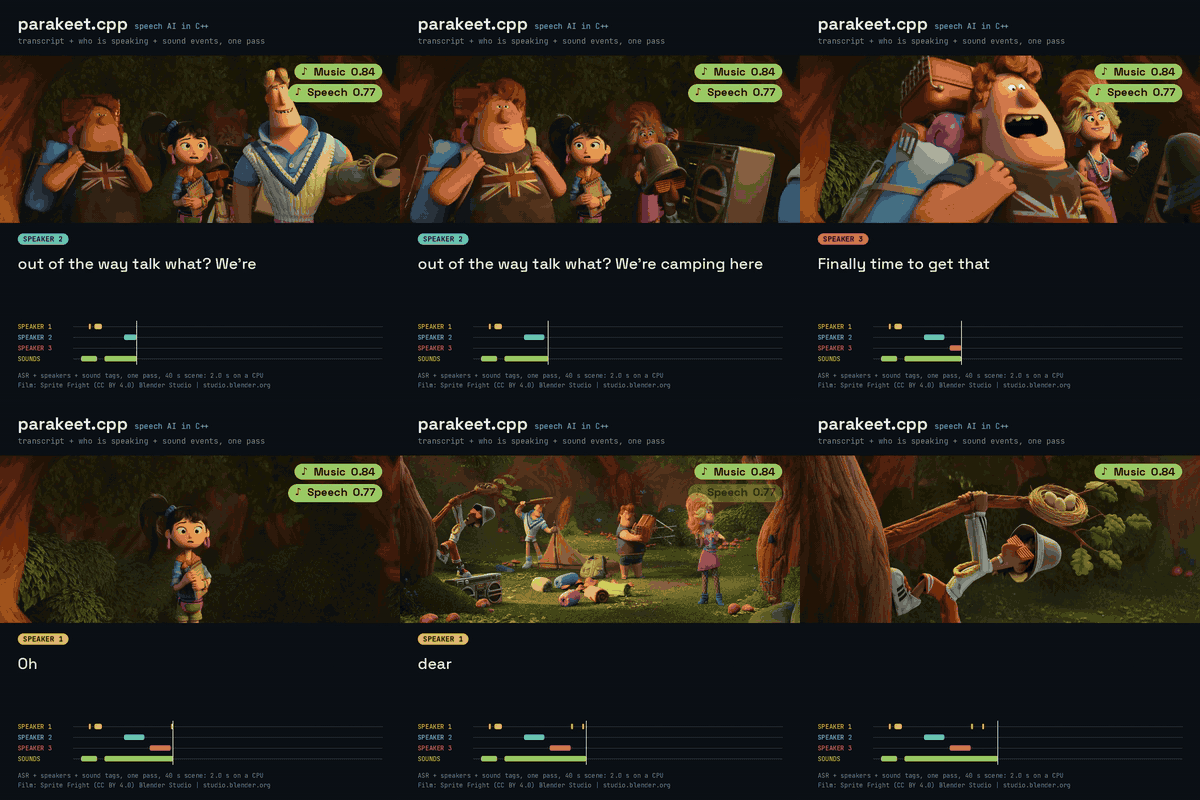
Words, speakers and sounds in one pass
Excerpt of the scene demo: ASR, diarization and CED sound tags together, on CPU (MP4 excerpt). Film: Sprite Fright, CC BY 4.0, Blender Studio. 2026-10-04-parakeet-demo-scene-sprite-fright.1.mp4 |
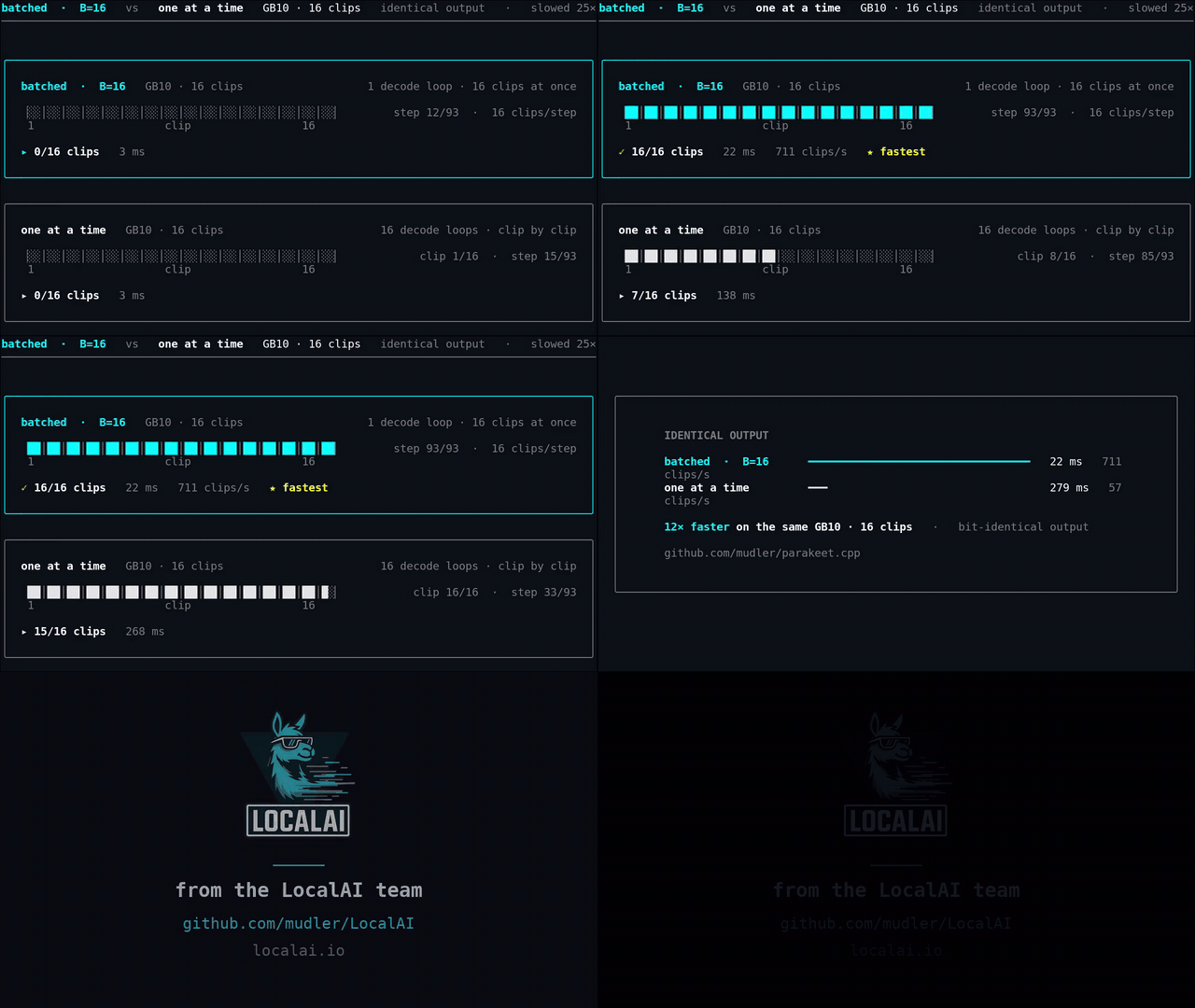
Batched decode: one loop, 16 clips
Serial against batched decode of 16 clips, with identical output (MP4). Details: batching.md. |
|
Nemotron 3.5 streaming against NeMo, on CPU
Same model, same CPU, identical output (MP4). |
More benchmarks
These are single-clip demos, not benchmarks. See Benchmarks. |
Get the CLI from a release (see Build to compile it yourself; the VAD and bundle commands below need a build from master). Then download a model. Everything is in mudler/parakeet-cpp-gguf:
HF=https://huggingface.co/mudler/parakeet-cpp-gguf/resolve/main
curl -LO $HF/tdt_ctc-110m-q8_0.gguf     # 178 MB, English, hybrid TDT+CTC
Transcribe. tests/fixtures/speech.wav is in this repository:
parakeet-cli transcribe --model tdt_ctc-110m-q8_0.gguf --input tests/fixtures/speech.wav
# Well, I don't wish to see it any more, observed Phoebe, turning away her eyes. It is certainly very like the old portrait.

parakeet-cli transcribe --model tdt_ctc-110m-q8_0.gguf --input tests/fixtures/speech.wav --timestamps
# 0.48-0.64  Well,  (0.79)
# 0.80-0.88  I  (1.00)
# ...
Find speech with VAD. Silero is a 1.3 MB file:
curl -LO $HF/silero-vad-f16.gguf
parakeet-cli vad --model silero-vad-f16.gguf --input tests/fixtures/two_speakers.wav
# {"mode":"speech","duration":23.605,"frame_sec":0.032,"backend":"cpu","segments":[{"start":0.514,"end":5.534}, ...]}

# Cut long audio at pauses with Silero, then transcribe each piece with any ASR model
parakeet-cli transcribe --model tdt_ctc-110m-q8_0.gguf --input long.wav --vad --vad-model silero-vad-f16.gguf
Use a bundle. One 338 MB file holds the 110M ASR model, Silero, diarization, CED sound tagging and a speaker encoder:
curl -LO $HF/parakeet-bundle-small.gguf
parakeet-cli info parakeet-bundle-small.gguf          # components, licences, sizes
parakeet-cli transcribe --model parakeet-bundle-small.gguf --input tests/fixtures/speech.wav --vad
parakeet-cli scene --model parakeet-bundle-small.gguf --diar parakeet-bundle-small.gguf \
  --sound parakeet-bundle-small.gguf --input tests/fixtures/two_speakers.wav
# [00:00.4 - 00:05.4]  Speaker 0: mister Quilter is the apostle of the middle classes, and we are glad to welcome his gospel.
# [00:06.8 - 00:10.8]  Speaker 1: Well, I don't wish to see it any more, observed Phoebe, turning away her eyes.
# ...
The published bundles are parakeet-bundle-small (110M ASR, 338 MB), parakeet-bundle-standard (0.6B v3 ASR, 1.1 GB) and parakeet-bundle-moondream-redux (packed Redux plus Silero, 215 MB). Each has a NOTICE-*.txt file with the credits and licences. See bundle.md.
To use it from a program, see C API. To serve it over HTTP, see Server and Docker.
All models below are published as GGUF in mudler/parakeet-cpp-gguf (f16, q8_0, q6_k, q5_k and q4_k for the ASR models). The NVIDIA models are validated at WER 0 against NeMo. Per-model parity: parity.md. Licences per model: licenses.md.
| Model | Type | Size | Notes |
|---|---|---|---|
| parakeet-tdt_ctc-110m | hybrid TDT+CTC | 110M | English, the small anchor checkpoint |
| parakeet-ctc-0.6b, parakeet-ctc-1.1b | CTC | 0.6B, 1.1B | English |
| parakeet-rnnt-0.6b, parakeet-rnnt-1.1b | RNNT | 0.6B, 1.1B | English |
| parakeet-tdt-0.6b-v2, parakeet-tdt-1.1b | TDT | 0.6B, 1.1B | English |
| parakeet-tdt-0.6b-v3 | TDT | 0.6B | 25 European languages |
| parakeet-tdt_ctc-1.1b | hybrid TDT+CTC | 1.1B | English |
| parakeet_realtime_eou_120m-v1 | RNNT, streaming | 120M | Cache-aware streaming with end-of-utterance events (--stream) |
| nemotron-3.5-asr-streaming-0.6b | RNNT, streaming | 0.6B | 40+ locales, language set with --lang (default auto), offline and streaming. OpenMDW-1.1 |
| nemotron-labs-unified-asr-0.6b | RNNT, unified | 0.6B | 40+ locales, language set with --lang (default auto), offline and buffered streaming (--stream, window set with --stream-latency or --stream-context). OpenMDW-1.1 |
| Nemotron-3-Diarization | Sortformer | n/a | Who spoke when, up to 8 speakers. See diarization.md |
| parakeet-ultra | TDT + VAD head | 0.6B | Moondream, from parakeet-tdt-0.6b-v3. CC-BY-4.0. Not NeMo-validated |
| parakeet-redux | TDT + VAD head | 0.6B | Moondream, ternary encoder. CPU only, offline only. CC-BY-4.0. Not NeMo-validated |
| Phonon-2.5, Phonon-2.5-English | TDT | 0.6B | Fermion Research, retrained from parakeet-tdt-0.6b-v3. 25 languages, or English only. The packed file is offline only; it runs on the CPU kernels, or is expanded to dense weights on a GPU. CC-BY-4.0. Not NeMo-validated, see phonon.md |
| Silero VAD | VAD | 1.3 MB | MIT. 16 kHz and 8 kHz |
| CED | sound events | 6 to 88 MB | 527 classes, from ced.cpp. See sound.md |
Convert your own checkpoint with scripts/convert_parakeet_to_gguf.py (see conversion.md) and quantize with parakeet-cli quantize (see quantization.md).
The binary is build/examples/cli/parakeet-cli. The full list of examples and options is in cli.md.
parakeet-cli info <model.gguf> [--component NAME]               # metadata; for a bundle, the component list
parakeet-cli transcribe --model M --input A.wav                 # default decoder; "--input -" reads WAV from stdin
parakeet-cli transcribe ... --decoder ctc|tdt                   # force a decoder
parakeet-cli transcribe ... --timestamps | --json               # per-word times and confidence
parakeet-cli transcribe ... --beam-size 4 --nbest 4             # TDT N-best, see docs/tdt-nbest.md
parakeet-cli transcribe ... --stream                            # cache-aware streaming (EOU and Nemotron models)
parakeet-cli transcribe ... --lang <locale>                     # Nemotron 3.5 language, default auto
parakeet-cli transcribe ... --vad [--vad-model silero.gguf]     # cut long audio at pauses (offline, greedy only)
parakeet-cli transcribe ... --vad-trim SEC                      # trim each piece to its speech plus SEC (default 0.3, 0 = whole cuts)
parakeet-cli transcribe ... --vad-run-gate 0.92                  # opt-in, for the Ultra/Redux head: drop speech runs with a low median probability (docs/vad.md)
parakeet-cli transcribe ... --min-local-conf 0.5                # opt-in: drop words invented on noise (docs/vad.md)
parakeet-cli vad --model M --input A.wav [--mode segments] [--probabilities] [--run-gate P]   # speech regions as JSON
parakeet-cli scene --model ASR --diar DIAR --sound CED --input A.wav            # words + speakers + sounds
parakeet-cli scene ... --speakers SPK.gguf --registry R         # name the speakers
parakeet-cli enroll --model SPK.gguf --name Ada --input ada.wav --registry R
parakeet-cli quantize <in.gguf> <out.gguf> <q4_0|q5_0|q8_0|q4_k|q5_k|q6_k>
parakeet-cli bench --model M --manifest F [--concurrency K]     # throughput
parakeet-cli bench-decode ... | bench-batch ...                 # batched decode, see docs/batching.md
Device selection is automatic: the CLI uses the first GPU the ggml registry reports. Set PARAKEET_DEVICE=cpu to force CPU, or a device name such as CUDA0 or Vulkan1. Ops that a backend lacks run on the CPU.
parakeet-server is a small OpenAI-compatible HTTP server (POST /v1/audio/transcriptions). It serves one model, one request at a time, WAV uploads only, so treat it as an example. For production use LocalAI, which embeds parakeet.cpp as a backend and adds a gallery, concurrency, multi-model serving, auth and metrics. See examples/server/README.md.
parakeet-server --model tdt_ctc-110m --port 8080
curl -F file=@audio.wav -F response_format=verbose_json http://localhost:8080/v1/audio/transcriptions
Images for the CLI and the server are published to GHCR on every push to master (CPU and CUDA, linux/amd64 and linux/arm64): ghcr.io/mudler/parakeet.cpp-cli and ghcr.io/mudler/parakeet.cpp-server. See docker.md.
include/parakeet_capi.h is a flat, exception-free C API for dlopen, FFI and LocalAI. Build the shared library with -DPARAKEET_SHARED=ON (see Build).
#include "parakeet_capi.h"

parakeet_ctx *ctx = parakeet_capi_load("model.gguf");   // load once, reuse
if (!ctx) { fprintf(stderr, "%s\n", parakeet_capi_last_error(ctx)); return 1; }

char *text = parakeet_capi_transcribe_path(ctx, "audio.wav", 0 /*default decoder*/);
if (text) { printf("%s\n", text); parakeet_capi_free_string(text); }
parakeet_capi_free(ctx);
parakeet_capi_abi_version()). v11 adds buffered streaming for unified checkpoints (parakeet_capi_stream_begin_opts and the stream kind, caps, presets and info queries). Later additions (VAD, bundle, encoder fingerprint, concurrency) are additive. LocalAI depends on the offline and streaming transcription symbols, so do not change their signatures without a coordinated bump.include/parakeet_capi.h.git clone --recursive https://github.com/mudler/parakeet.cpp cd parakeet.cpp cmake -B build && cmake --build build -j # CLI: build/examples/cli/parakeet-cli
Use -DGGML_NATIVE=OFF for a portable binary. For the shared library: cmake -B build-shared -DPARAKEET_SHARED=ON && cmake --build build-shared -j, which produces libparakeet.so.
| GPU backend | CMake flag | Status |
|---|---|---|
| CUDA | -DPARAKEET_GGML_CUDA=ON |
Release binaries for Turing (sm_75) and newer. Benchmarked on a GB10. |
| Metal | -DPARAKEET_GGML_METAL=ON |
Release binary for macOS arm64. Benchmarked on an M4. |
| Vulkan | -DPARAKEET_GGML_VULKAN=ON |
Release binaries for Linux and Windows. Needs the Vulkan loader. |
| ROCm (HIP) | -DPARAKEET_GGML_HIP=ON |
Forwarded to ggml. Not tested by us. |
GPU backends are not exercised in CI. Other options:
| Option | Default | Purpose |
|---|---|---|
PARAKEET_BUILD_TESTS |
OFF | ctest targets |
PARAKEET_BUILD_CLI |
ON | parakeet-cli |
PARAKEET_BUILD_SERVER |
ON | parakeet-server |
PARAKEET_SHARED |
OFF | libparakeet as a shared library |
PARAKEET_WITH_CED |
ON | Sound-event tagging (ced.cpp) |
PARAKEET_WITH_VOICEDETECT |
ON | Speaker identification (voice-detect.cpp) |
Pre-built binaries. Each release ships parakeet-cli bundles: Linux x64 (cpu, vulkan, cuda), Linux arm64 (cpu, vulkan), macOS arm64 (metal), macOS x64 (cpu), Windows x64 (cpu, vulkan, cuda), plus AppImages and library tarballs. On Windows with CUDA, also download cudart-parakeet-bin-win-cuda-x64.zip unless the CUDA toolkit is installed. The newest release (v0.5.0) does not include the features marked master above.
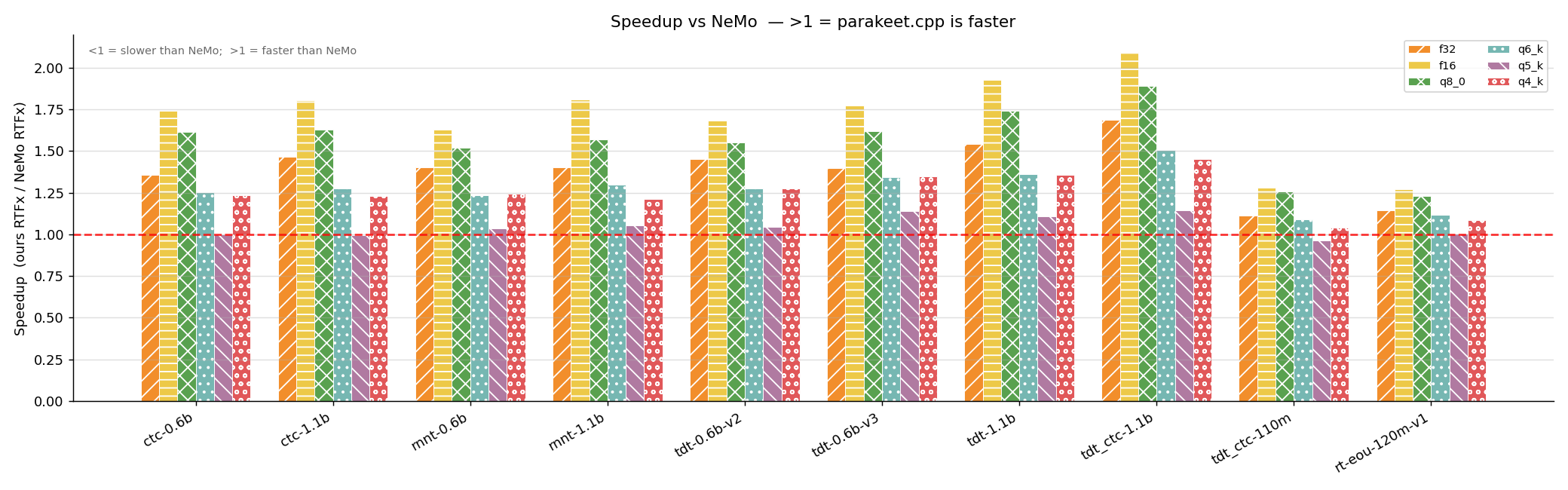
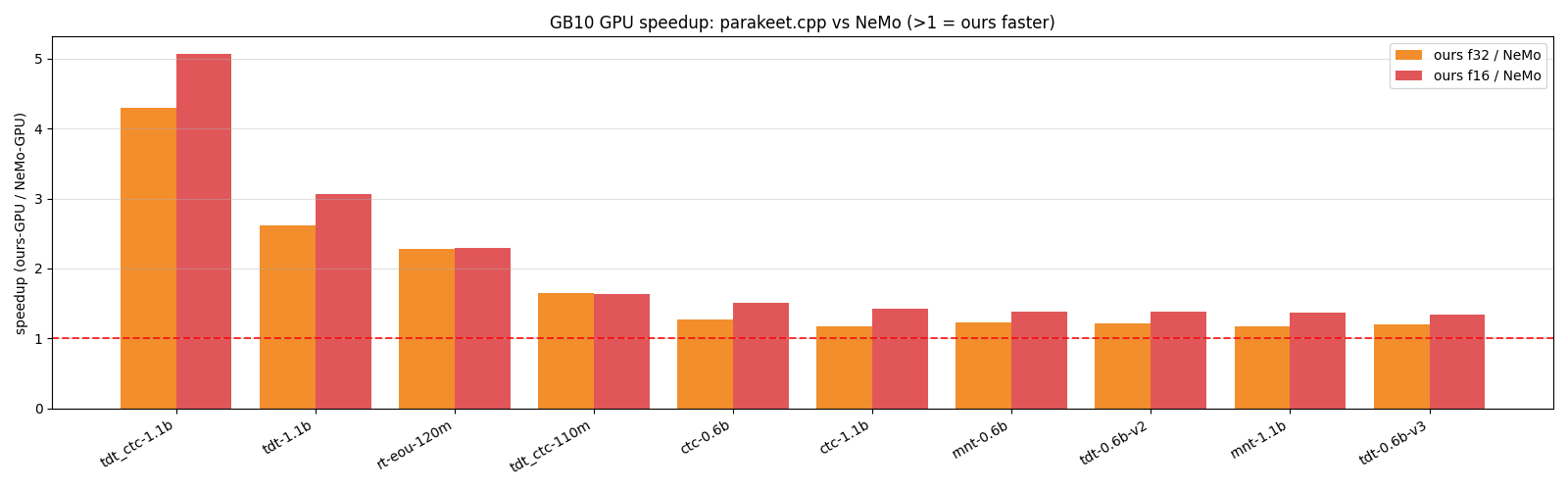
Speed is audio seconds over processing seconds (RTFx), against NeMo's PyTorch runtime on the same machine, batch size 1. Higher is faster. Numbers come from benchmarks/BENCHMARK.md: CPU runs use 8 threads on a 20-core x86 host, GPU runs use one NVIDIA GB10. These were shared development machines, not quiet lab hosts, so read the method before you quote a number.
| Measurement | Result | Source |
|---|---|---|
| CPU, f32, 10 models, LibriSpeech test-clean | 1.11x to 1.69x faster than NeMo (mean 1.40x), same transcripts | BENCHMARK.md, Headline |
| CPU, q8_0 | mean 1.56x, up to 1.89x, 37% of the f32 size | BENCHMARK.md, Quantization |
| GPU (GB10), f32 | median 1.25x, up to 4.3x (tdt_ctc-110m) |
performance.md |
| Nemotron 3.5, one 7.4 s clip, CPU | 2.40x at f32, 2.52x at q8_0 | BENCHMARK.md, Nemotron |
| Batched decode, batch 16 | about 10x to 12x on the GB10 (f16), about 3x to 5x on CPU (q5_k) | BENCHMARK.md, Batched decode |
| Apple M4, Metal against CPU | 1.3x to 5.6x, most on the 0.6B and 1.1B models | BENCHMARK.md, Apple Metal |
| Redux (packed ternary) against the same model in F16, CPU | median RTF 75.6 against 46.1 per utterance (8 threads, AVX-512 VNNI); 6.8x smaller file; WER 1.96% on 100 LibriSpeech utterances | ternary.md |
| Peak RAM against NeMo | about 2x lower at f32 (for example 2582 MB against 5598 MB on tdt-0.6b-v3) |
BENCHMARK.md, Headline |
VAD accuracy, speed and size, Silero against the Parakeet head against whisper.cpp, with the scripts to repeat them: vad-benchmarks.md. Some of those runs were not on a quiet machine, and the page says which. Transcript parity with NeMo, stage by stage: parity.md. Concurrency throughput (it can go up or down depending on model size and cores): concurrency.md.
| Page | What it covers |
|---|---|
| cli.md | Full CLI examples, the server, quantize |
| capi.md | C API examples, JSON shapes, streaming |
| vad.md | The two detectors, options, which one to use, VAD-only files |
| vad-benchmarks.md | Every VAD measurement and how to repeat it |
| ultra-redux.md | The Moondream models: files, credits, dequantized Redux |
| ternary.md | Packed ternary format, kernels, limits, speed |
| phonon.md | Phonon-2.5: the container, conversion, parity, WER, the packed files |
| bundle.md | Bundle GGUF format, selection rules, licences, build and verify |
| diarization.md | Diarization, speaker-attributed ASR, encoder fingerprint, speed |
| sound.md | Sound events (CED) and the scene stream |
| speaker.md | Enroll and name speakers, C API v9 and v10, speaker embeddings, what is not measured |
| batching.md | Batched decode, exactness, how to measure |
| concurrency.md | Backend pool, thread rules, measured throughput |
| tdt-nbest.md | TDT beam search and N-best output |
| parity.md | Coverage matrix and numerical parity against NeMo |
| performance.md | Headline speed numbers and where they come from |
| quantization.md | Which weights are quantized, size and WER per type |
| conversion.md | GGUF schema, Python setup, converting a model |
| docker.md | Docker images |
| licenses.md | Licence of every published model |
| benchmarks/BENCHMARK.md | Full CPU and GPU benchmark, plots, methodology |
| AGENTS.md | Repository layout, test list, rules for contributors and agents |
--run-gate, --vad-run-gate) removes most of the noise false alarms of the Redux head, not music.transcribe --vad is offline and greedy decoding only. VAD-only files cannot transcribe.bench and the streaming ASR modes do not take a bundle. No bundle was run on a GPU. See bundle.md.parakeet-server serves one model, one request at a time, WAV only.Issues and pull requests are welcome. Read AGENTS.md first: it has the repository layout, the performance invariants that must not regress, and the policy for AI-assisted contributions (an Assisted-by: trailer, no Co-Authored-By for AI).
cmake -B build -DPARAKEET_BUILD_TESTS=ON && cmake --build build -j
ctest --test-dir build --output-on-failure -LE model     # no model files needed
Tests labelled model need a converted checkpoint (set PARAKEET_TEST_GGUF and the other variables listed in AGENTS.md) and skip with exit code 77 when it is missing.
Community projects (not maintained by the core team):
parakeet.cpp is released under the MIT License. The model weights keep the licences of the original models, so check each model card. Most NVIDIA Parakeet models are CC-BY-4.0. nemotron-3.5-asr-streaming and Nemotron-3-Diarization are OpenMDW-1.1, parakeet_realtime_eou_120m-v1 is under the NVIDIA Open Model License, and the Silero VAD files are MIT. Fermion Research's Phonon-2.5 and Phonon-2.5-English are CC-BY-4.0 too (credit Fermion Research and NVIDIA; their training audio includes CHiME-6 under CC-BY-SA-4.0 and SPGISpeech under Kensho's terms, see docs/licenses.md). Moondream's parakeet-ultra and parakeet-redux are CC-BY-4.0: credit Moondream and NVIDIA (parakeet-tdt-0.6b-v3), link the license, and note that GGUF files made here are converted (and quantized, or dequantized for Redux) copies, not retrained models. The full table is in docs/licenses.md. A bundle keeps one licence per component (see bundle.md).
The Parakeet models are by NVIDIA NeMo (NVIDIA-NeMo/NeMo). Parakeet Ultra and Redux are by Moondream, derived from NVIDIA's parakeet-tdt-0.6b-v3. Phonon-2.5 is by Fermion Research, derived from the same model. Sound tagging uses CED by Heinrich Dinkel and colleagues at Xiaomi. The demo film is Sprite Fright, CC BY 4.0, Blender Studio.
If you use parakeet.cpp, please cite this repository and the original models:
@software{parakeet_cpp,
  title  = {parakeet.cpp: a C++/ggml inference engine for NVIDIA Parakeet ASR},
  author = {Di Giacinto, Ettore and Palethorpe, Richard},
  url    = {https://github.com/mudler/parakeet.cpp},
  year   = {2026}
}
Author: Ettore Di Giacinto (@mudler).
Built by the LocalAI team. If you want to run speech recognition (and LLMs, vision, voice, image, and video models) locally on any hardware with an OpenAI-compatible API, give LocalAI a star.
mudler/parakeet.cpp is a public repo on GitHub by mudler. Fast and portable Parakeet implementation in C++ with ggml.
It declares the MIT license on GitHub.
Its maker has not tagged a system, so it is unknown here. Its README says what it needs.
Open "Take it" on its page: Take My Repo writes an install plan for your machine and hands it to your AI agent (Claude Code, Codex or Cursor), which asks you before each step. Take My Repo has not tested it on any machine.
Its last change on GitHub was on 2026-10-30. Take My Repo does not judge from that whether it is maintained.
Nobody has reviewed it on Take My Repo yet, which says nothing about its quality.
LocalAI is the open-source AI engine. Run any model - LLMs, vision, voice, image, video - on any hardware. No GPU required.
:sailboat: The immutable, decentralized, statically built p2p VPN without any central server and automatic discovery! Create decentralized introspectable tunnels over p2p with shared tokens
LocalAGI is a powerful, self-hostable AI Agent platform designed for maximum privacy and flexibility. A complete drop-in replacement for OpenAI's Responses APIs with advanced agentic capabilities. No clouds. Local AI that works on consumer-grade hardware (CPU and GPU).
:brain: 100% Local Memory layer and Knowledge base for agents with WebUI
:package: :whale: 0-dependency Container-based Package Manager using SAT solver and QLearning