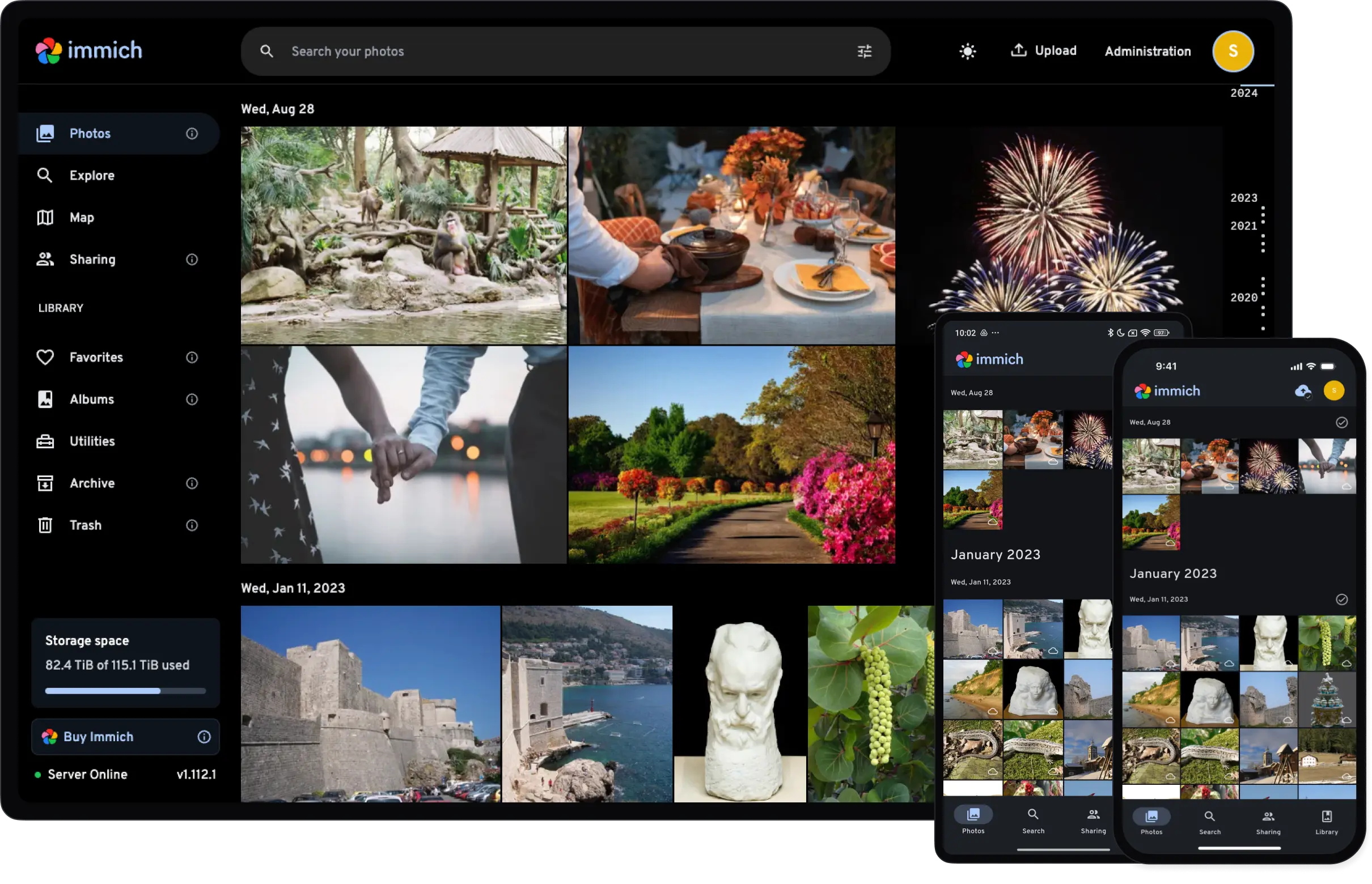
immich
High performance self-hosted photo and video management solution.
- 120k
- TypeScript
- AGPL-3.0
- 6 h ago
DaemonClient is an open-source tool that allows self-hosting a free, unlimited and post-quantum secured cloud storage ecosystem with the already available infrastructure and without the need for physical servers
Repo myrosama/DaemonClient, read from GitHub 23 h ago. myrosama has not joined Take My Repo.
myrosama/DaemonClient is a public repo on GitHub by myrosama. DaemonClient is an open-source tool that allows self-hosting a free, unlimited and post-quantum secured cloud storage ecosystem with the already available infrastructure and without the need for physical servers. It declares the AGPL-3.0 license on GitHub. It is written mainly in TypeScript, has 9 stars and last changed on 2026-11-21. Nobody has reviewed it on Take My Repo yet, which says nothing about its quality. Read from GitHub on 2026-11-24.
High performance self-hosted photo and video management solution.

Your own private cloud. Unlimited. Encrypted. $0/month.
Photos and Drive, running entirely on free tiers you control.

Cloud storage is expensive and you don't own any of it. DaemonClient combines two services with unusually generous free tiers — Telegram (unlimited file storage through bots and channels) and Cloudflare Workers (serverless compute plus a D1 database) — into a personal cloud where every user gets their own isolated stack:
There is no shared file server and no operator database holding everyone's photos. A photo you upload travels to your worker, gets encrypted, and lands in your Telegram channel as chunks only your stack can read back.
You can run the whole thing yourself. One command builds a complete install on your own Telegram, Cloudflare and Firebase accounts, with nothing pointing back at us — see Self-hosting.
| 📸 Photos | photos.daemonclient.uz | Timeline, albums, favourites, EXIF and map view, live photos, video, trash, zip downloads |
| 📁 Drive | drive.daemonclient.uz | Folders, previews, client-side encryption, and a WebDAV mount |
| 👤 Accounts | accounts.daemonclient.uz | One account for both, plus the guided setup and your dashboard |
| 📖 Docs | docs.daemonclient.uz | Architecture, the storage model, encryption, API reference, self-hosting |
flowchart LR
    subgraph Clients["Your devices"]
        WEB["Photos & Drive<br/>web apps"]
        DAV["Any file manager<br/>(WebDAV mount)"]
    end

    subgraph Stack["YOUR isolated stack"]
        W["Your Cloudflare Worker<br/><i>API · encryption · auth</i>"]
        D1[("Your D1 database<br/><i>metadata index</i>")]
        BOT["Your Telegram bot"]
        CH[("Your private channel<br/><i>encrypted 19 MB chunks</i>")]
    end

    WEB -->|metadata| W
    DAV --> W
    W <--> D1
    W <--> BOT
    WEB -.->|file bytes, direct| CH
    BOT <--> CH
Note the dotted line: on the web, file bytes never touch the worker. The browser chunks and encrypts a file itself and sends it straight to Telegram, and a service worker reads it back the same way. The worker only ever handles the index. That is what keeps a photo library inside a free tier that allows 100,000 requests a day.
The only shared components are the control plane — the accounts portal, the login endpoint, and the service that provisions per-user workers. None of them sit in the path of your bytes.
Three numbers explain most of the design:
| 19 MB | Telegram won't let a bot download a file bigger than 20 MB — uploads can be larger, which is a trap. Files are chunked below the cap and never merged. | |
| 10 ms | The CPU a free Cloudflare Worker gets per request. No image decoding, no transcoding, no big buffers. | |
| 50 | External subrequests per invocation. A 50-chunk file is already at the ceiling, so background jobs run one at a time. |
The full explanation is in docs/ARCHITECTURE.md.
git clone https://github.com/myrosama/DaemonClient.git
cd DaemonClient/immich-api-shim && npm install && cd ..
node selfhost/bin/daemonclient.mjs setup
About ten minutes, most of it you clicking around in Telegram and Cloudflare.
Then daemonclient web builds and deploys the three web apps to your own
Firebase Hosting.
A self-hosted install depends on nothing we run. Not your files, not your credentials, not a telemetry ping. The single outbound call to anything of ours is an anonymous check of the public GitHub releases feed, which sends nothing about your install and can be turned off. If this project disappears tomorrow, your install keeps working: the files are in your Telegram channel, the index is in your D1 database, and the code is in your clone under AGPL-3.0.
Full guide: docs/SELF_HOSTING.md.
Honesty is more useful than a feature list, so both columns:
Photos — timeline with month buckets and thumbhash placeholders, albums, favourites, archive, trash, EXIF (camera, lens, exposure) with a map view from GPS, live photos, video playback with range-aware multi-chunk streaming, server-side SHA-1 so re-installs deduplicate instead of duplicating, zip downloads, and background jobs that quietly repair missing checksums, EXIF and thumbnails while you use the app.
Drive — folders, uploads of any size, previews, search, true zero-knowledge encryption (keys derived in your browser; the worker only ever holds ciphertext), and WebDAV, so your cloud mounts as a normal drive in Windows Explorer, macOS Finder or any file manager.
Platform — long-lived sessions, one sign-in across all three apps, and per-user workers that auto-update on your next login.
| Mobile apps | Native iPhone and Android apps on the Rust core (core/) are being built (apps/ios, apps/android); not released yet. See Roadmap. |
| Videos over 100 MB from mobile | Cloudflare's request-body cap. Needs chunked upload in the app. Web uploads are unaffected — they bypass the worker entirely. |
| HEIC thumbnails | Blank unless you deploy the optional processor/. Workers cannot decode HEIC and Telegram won't thumbnail it. Every other format, video included, is fine. |
| Face recognition, smart search, places | Not implemented. They need ML this architecture has nowhere to run. The routes return correctly-shaped empty results rather than errors. |
| Sharing between users | Built and held pending a security review. One install, one owner, for now. |
POST /api/sync/ack |
Not implemented — every ack the mobile client sends is a no-op. |
More detail, including the four-times-duplicated storage code, is under known sharp edges.
Found something? Please report it privately — see SECURITY.md. Past issues are listed there too, because they are the shape of thing worth looking for.
| Directory | What lives there |
|---|---|
workers/user-worker/ |
⭐ The per-user worker: the entire Photos + Drive API — encryption, Telegram chunk I/O, D1, background repair |
selfhost/ |
The self-hosting CLI. Dependency-free, runs from a fresh clone |
workers/deployment/ |
Provisions per-user workers for the managed service and ships them updates |
apps/accounts-web/ |
Sign-up, the guided setup wizard, the dashboard |
workers/auth/ |
Cross-subdomain session broker (managed service only) |
immich/ |
The Immich fork: the Photos web app (web/) |
core/ |
The Rust core under the mobile apps: storage format, Telegram, sync, uploads |
apps/ |
The native mobile apps (ios/, android/) |
drive/ |
The Drive web app — not a fork |
processor/ |
Optional HEIC thumbnailer, deployed to each user's own Vercel |
workers/telegram-proxy/ |
CORS relay for the Telegram Bot API |
schema/ |
The D1 schema, defined once for both provisioners |
apps/site/ |
The landing page |
apps/docs-web/ |
The documentation site |
docs/ |
Architecture, API reference, self-hosting guide |
Every directory has its own README explaining what it is and how to run it.
Start with CONTRIBUTING.md — it covers where things live, the four hard constraints that explain most of the odd-looking code, and the mistakes already made so you don't have to repeat them.
cd workers/user-worker
npm install
npm test          # 294 tests
npx tsc --noEmit
Please don't test against anyone else's deployment, including ours. Self-hosting builds you a full stack in about ten minutes on free tiers; test there.
myrosama/DaemonClient is a public repo on GitHub by myrosama. DaemonClient is an open-source tool that allows self-hosting a free, unlimited and post-quantum secured cloud storage ecosystem with the already available infrastructure and without the need for physical servers.
It declares the AGPL-3.0 license on GitHub.
Its maker has not tagged a system, so it is unknown here. Its README says what it needs.
⚡ High-capacity personal cloud storage powered by Telegram MTProto. Single static binary with Google Drive-like Web Dashboard, resumable chunked uploads, HTTP 206 video streaming, and strict ToS Safe Mode.
Reverse engineer anything with agents, from app behavior down to native binaries.
"rsync for cloud storage" - Google Drive, S3, Dropbox, Backblaze B2, One Drive, Swift, Hubic, Wasabi, Google Cloud Storage, Azure Blob, Azure Files, Yandex Files
The agent harness performance optimization system. Skills, instincts, memory, security, and research-first development for Claude Code, Codex, Opencode, Cursor and beyond.
Fast, modern and advanced photo management suite. Runs as a Nextcloud app.
Open "Take it" on its page: Take My Repo writes an install plan for your machine and hands it to your AI agent (Claude Code, Codex or Cursor), which asks you before each step. Take My Repo has not tested it on any machine.
Its last change on GitHub was on 2026-11-21. Take My Repo does not judge from that whether it is maintained.
Nobody has reviewed it on Take My Repo yet, which says nothing about its quality.
Take My Repo cannot say: it does not audit code and has not run DaemonClient. What is known comes from GitHub. It declares the AGPL-3.0 license on GitHub. Its last change was on 2026-11-21. It has 9 stars, which measure popularity, not safety. Nobody has reviewed it on Take My Repo yet, which says nothing about its quality. Read the source before you run it. With "Take it", your AI agent shows each step and asks you before running it; README text is treated as data, not as instructions.