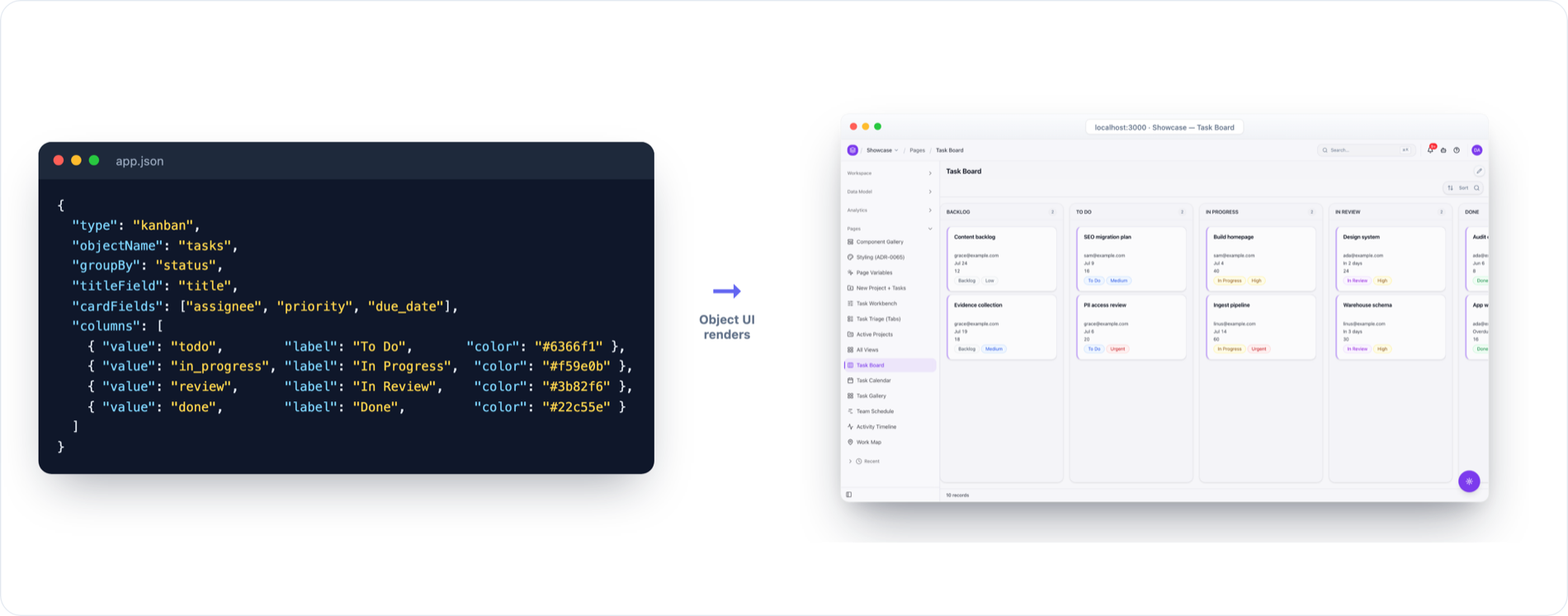
The schema-driven UI engine for the AI era: agents write compact JSON; Object UI renders production React — grids, kanban, dashboards, Gantt, visual designers.
Repo objectstack-ai/objectui, read from GitHub 20 h ago. objectstack-ai has not joined Take My Repo.
Computed from .objectstack-sha e649c2d91e27: the earliest published @objectstack/spec that contains it is 18.1.0.
@objectstack/client (devDependencies): ^18.0.0-next.1 → ^18.1.0@objectstack/lint (devDependencies): ^18.0.0-next.1 → ^18.1.0@objectstack/spec (devDependencies): ^18.0.0-next.1 → ^18.1.0a91f6bb: The Approvals Inbox opens a request on the page the platform serves for it, and its side sheet is gone (objectui#12484).
A row, a mobile card, Enter on the focused row, and a notification's ?request= deep link now open the request's record page: the sys_approval_request_detail page @objectstack/plugin-approvals serves, on the console's standard record route. That page shows the request's title (the flow's label), its decision panel (the declared amount and snapshot summary, the approvers, the step line and the decisions), its highlights, its target record, and its timeline. The deep link takes its own place in the browser history, so Back returns to where the reader came from; from a row, Back returns to the inbox.
The inbox's own request sheet is deleted. Its quick paths stay: inline approve and reject, bulk decisions, filters, sorting and keyboard navigation.
0093b2c: Settings pages: a url, email, phone or color value that misses the format its type declares now blocks Save (objectui#13287). No request goes out, the row is marked inline with a message naming what the format expects, and focus moves to the first such row, on the same path as the required check. The grammars are the settings service's own (objectstack#24882), judged on the trimmed value; an empty value is left to required, and a hidden or env-locked row is not judged. Adds console.settingsView.invalidPhone and console.settingsView.invalidColor to every locale pack; email and url reuse validation.email and validation.url.
0d12e95: An approver who is not an administrator sees the whole approval request page again: its fields, its decision panel with the decisions they may take, and its Timeline (objectui#13324).
The console reads a request, and its timeline, through the approvals routes, which serve a request to each party to it. The record page then gated what it drew on the permissions answer for the data API, which names neither approval object for a member, because the platform keeps that door closed to them. So the page folded the request down to its id, drew no decision, and dropped the Timeline. Opening a request from the Approvals inbox showed a blank page.
@object-ui/permissions adds ServerReadScope. Below it, the read verdicts for the objects it names (check(object, 'read') and checkField(object, field, 'read')) answer "allowed": whatever the server serves is what the viewer may read. Every other action, the field write and create verdicts, and every other object keep the enclosing provider's answer. The console mounts it for the two approval objects over every app. No read grant on either object is added: the data API stays closed to members.
4824ad7: A form field entry whose label, placeholder or helpText is an inline locale map ({ en, 'zh-CN' }) now renders in the visitor's language, on the public form /f/:slug and on the signed-in /forms/:name route (objectui#13380).
@objectstack/spec types all three keys as I18nLabel, so the map is valid metadata, but the form page passed it straight into text slots: a map on a label or help line blanked the page for every visitor (React error #31), and one on a placeholder read [object Object]. The map is now collapsed to the visitor's language when the form's rows are built, with the same resolver the console uses for an action's inline-map copy. A plain-string entry renders exactly as before.
d17f670: A Setup settings page reads its namespace again after a successful save or action, and takes the whole answer, manifest included (objectui#13382). The server computes parts of a namespace's manifest on every read: objectstack#25448 puts a live-status banner first on the page, so Setup → Email says whether mail leaves the machine. The page used to merge only the saved values and keep the manifest from its first load, so after an administrator configured SMTP the banner still said no mail leaves the machine until the page was reloaded.
The re-read does not show the loading placeholder. An action leaves the unsaved edits as they are. If the re-read fails, the page keeps the saved values and the success message, and does not turn into an error.
3a8a117: Integrations → Connect an AI agent no longer mints an API key in one click (objectui#13383). "Generate key" stays disabled while the name box is blank or whitespace-only, and the name is sent trimmed: a cleared box no longer mints a key under the default name Agent key. Clicking "Generate key" now opens an in-app confirm naming the key; Cancel creates nothing, and confirming creates the key and shows it once, as before. The name box still opens prefilled with Agent key, which is minted only once the administrator confirms it. This matches the Connect an Agent card (objectui#13355).
47138b7: The Console's first page load no longer downloads the chat UI (objectui#13410). The plugin-chatbot chunk (169.6 KB gzipped, the third-largest eager chunk) and most of vendor-markdown used to load on every page, including for users who never open a chat, because the console shell imported a handful of small helpers from the @object-ui/plugin-chatbot package root, and the root re-exports the renderer that registers the chat components when it is evaluated. Measured on the Console's production build, the eager closure drops by 254,055 gzipped bytes (3,326,111 to 3,072,056). The chat now loads when it is first shown: opening the dock, visiting /ai… or /s/:token, or rendering a chatbot, chatbot-enhanced or chatbot-floating node.
@object-ui/plugin-chatbot adds a side-effect-free @object-ui/plugin-chatbot/core subpath: useAgents, resolveDefaultAgentName, PLATFORM_DEFAULT_AGENT, agentHasCapability, the agent alias helpers (AGENT_ALIAS_GROUPS, agentAliasGroup, agentRouteName, resolveAgentParam, isBuiltinAgentName, isBuildAgent, isAskAgent), AI_USAGE_REFRESH_EVENT, emitAiUsageRefresh, publishHealthFromResponse and detectPendingApproval, with their types. Importing it registers nothing and reaches no chat UI module. The package root still exports every one of these names, unchanged.
@object-ui/app-shell takes those names from /core, and the ChatDock loads its default chat body on first render instead of importing it. resolveApiBase is still exported from the same places.
576fd25: A type: 'form' action fired inside an app opens its form inside that app, headed by a label, with a Cancel (objectui#13433).
The form opened on the app-less /forms/:name, so the app's sidebar, switcher and branding disappeared. The page was headed by the raw view name (showcase_task.form) and had only Submit, so the browser's Back button was the only way out without saving.
/apps/:appName/forms/:name, inside the app's own shell. The record page, object list and page action navigators open a form hop there when their own route is an app route. The console-wide runtime has no route of its own, so its form hops keep the app-less route. /forms/:name is unchanged and still serves every other link.title is headed by its object's label in the session's language. An authored view label or title still wins./f/:slug form has no Cancel.06ce712: Settings: a setting's visible predicate is evaluated with the renderer's expression interpreter, and a predicate that does not evaluate hides the setting.
The settings page used to compile a manifest's visible string into a JavaScript function and show the setting whenever that failed. It now evaluates the string with ExpressionEvaluator from @object-ui/core, the CSP-safe interpreter every other visible predicate in the renderer uses, with the namespace's values bound as data (${data.provider === 'cloudflare'}). A predicate it cannot evaluate hides the setting, the same way the server refuses a save whose visible it cannot parse. Every predicate the shipped manifests declare (comparisons, &&, ||, ! over data.<key>) reads as before.
@object-ui/sdui-parser@18.1.0
Computed from .objectstack-sha e649c2d91e27: the earliest published @objectstack/spec that contains it is 18.1.0.
@objectstack/spec (dependencies): ^18.0.0-next.5 → ^18.1.08556295: NavigationItemSchema now refuses a navigation entry whose visible reads data but which declares no dataSource, as @objectstack/spec's NavigationItemSchema already does (objectui#13076). The rule is the spec's own exported navItemVisibleDataNeedsDataSource, chained on every navigation arm (the flat arm and the doc arm), not restated, so objectui validate and the platform's save door refuse the same entry with the same issue at visible.
This narrows the published validator toward the spec: an entry such as { id: 'nav_envs', type: 'object', objectName: 'sys_environment', visible: 'data.total == 1' } validated clean here and failed at publish; it is now refused here too. Declare the dataSource whose bound value visible reads, or gate on current_user or features instead. An entry with a dataSource, or whose visible is a boolean, absent, or reads no data, is unaffected.
f1a4b08: Grids: hovering a lookup or master_detail cell no longer shows the referenced record's raw id (objectui#13377).
The table's cell wrapper set its title tooltip to the cell's raw value, and for a reference column that value is the related record's id. So hovering beside the drawn name, or beside "Restricted record" for a record the viewer cannot read, still showed the id.
@object-ui/types: TableColumn gains an optional foreignKey boolean: the column's raw value is the id of a referenced record. The zod mirror (TableColumnSchema) keeps it, and the static table column refuses it by name, like masked and chips.@object-ui/components: a data-table column with foreignKey: true draws no title tooltip. Nothing else changes for it: copy, CSV export, inline edit, search and sort behave as before.@object-ui/plugin-grid: ObjectGrid sets foreignKey on every lookup, master_detail, tree and user column, read from the column's own type or the object's field type. Every other column keeps its tooltip.cd14d8e: The bulk action confirm step reads confirmText as a string or as a { dialect: 'template', source } envelope (objectui#13183).
@objectstack/spec is making a bulk action's confirmText a template slot (objectstack#24947), so a parsed bulk definition serves the envelope where it served a string. The confirm step rendered confirmText as it came, so an envelope would have broken it. It now shows the string, or the envelope's source as written; a blank or absent value still shows the default sentence ("This will apply to N record(s)."). {{ }} holes are not filled yet: {{ count }} still shows as written. BulkActionDef.confirmText in @object-ui/types is typed string | { dialect?: 'template'; source: string }, and @object-ui/plugin-grid reads it through one helper, bulkConfirmTextSource.
1d178e0: types: a node derived from an @objectstack/spec schema keeps the spec's credential registry key ('value' | 'map', objectstack#25036, which marks the webhook's secret and headers as credential fields). credential joins CARRIED_REGISTRY_META_KEYS, so the derivation no longer drops it. The pin move to objectstack 830a63a6 put the key on the published surface, and the registry census (objectui#9102) reported it as unclassified.
6fb31dc: BulkActionDef.confirmText's template envelope types source as optional, as @objectstack/spec's Expression does, and so does its zod twin (objectstack#25438).
@objectstack/spec made a bulk action's confirmText a template slot (objectstack#24947), and its envelope carries source or ast. With source typed as required, @object-ui/plugin-view refused the spec's own bulk action type when it handed a named view's bulkActionDefs to the grid, so the console no longer built against the current spec. The confirm step is unchanged: an envelope with no source shows the default sentence ("This will apply to N record(s).").
Computed from .objectstack-sha e649c2d91e27: the earliest published @objectstack/spec that contains it is 18.1.0.
@objectstack/spec (devDependencies): ^18.0.0-next.1 → ^18.1.0Computed from .objectstack-sha e649c2d91e27: the earliest published @objectstack/spec that contains it is 18.1.0.
@objectstack/spec (dependencies): ^18.0.0-next.1 → ^18.1.0b911ebb: A navigation entry's API dataSource and a page element bound to the same read now make one request per console open (objectui#13323). Before, readElementApi shared a request only while it was in flight, so when the sidebar's read for an entry's visible had settled before the page element mounted, the element sent a second GET for an answer the console already held.
@object-ui/react exports ElementApiOpenScope (with useElementApiOpen and the ElementApiOpen type): inside it, a read that has already answered under the same open name is answered again with no request. A failed read is not kept, a read under another open asks again, and any notifyDataChanged drops what the open kept. readElementApi takes the open as an optional third argument; without one it behaves as before.
@object-ui/app-shell's ConnectedShell mounts the scope and names one open per visit of a history entry: following a link or a navigation entry, and Back or Forward, start a new open and read again, even on an entry visited before; a redirect that replaces the address (the app root's landing on its first entry) stays in the open. A language switch starts over. No read happens at a different time than before; only whether a second read in one open reaches the network changes.
d9aff15: A record page inside the Setup app no longer draws the floating managed-by badge (the amber "Identity" chip at the top-right of an organization, team, business unit or user record) (objectui#13385). The header's object label ("Organization") carries the badge's note instead: hovering or focusing it shows "Organization · Managed by the identity provider", and the note is the label's accessible description. The note is the badge's own tooltip title, under the same gate: only a caller who can author metadata sees it, and a platform object shows none. Every record page outside Setup, a sys_* object opened in another app included, and every list header keep the badge unchanged.
RecordContextValue (@object-ui/react) gains an optional, host-injected objectLabelNote, which page:header forwards to RecordTitleChip. RecordTitleChip (@object-ui/components) gains an optional objectLabelNote prop: with it the object label becomes a focusable tooltip trigger described by the note; without it the label draws exactly as before.
3aafc0d: A page node whose declared visibleWhen / visible / visibleOn predicate cannot be evaluated (over the CEL bounds, a type error, an unbound root, a missing function) is no longer rendered: page visibility gates now fail closed, as a page:tabs item already did. The fault is still reported once, and the console line says the node was withheld. A blank gate still means "no gate", and a predicate that evaluates decides as before. A page:tabs badge no longer counts a related list withheld this way. Form field rules keep their fail-open (objectui#13299).
601c406: The console line for a visibility predicate that cannot be evaluated, on a gate that withholds what it gates, no longer says "a navigation entry" was withheld. The same line is printed for a navigation entry, a page:tabs item and a page node, so it now says "an element whose visibility predicate cannot be evaluated is WITHHELD". The verdict, the line's opening, and when it is printed are unchanged (objectui#13303).
8e90779: An action's confirmText, successMessage and errorMessage read the template envelope and fill {{ }} holes (objectui#13367).
@objectstack/spec is making these three keys template slots (objectstack#24814), so a parsed action serves { dialect: 'template', source } where it served a string. Before this change the success toast skipped the envelope and showed the default text, and the error toast showed the generic failure. ActionRunner now reads a string or the envelope for all three, and fills {{ path }} / {{ path | formatter }} holes with @objectstack/formula's templateEngine, the engine the flow notifications render with:
confirmText: record (the record the action runs against, the clicked row on a list) and params (the action's static params);successMessage: result (the payload ${result.*} reads) and record;errorMessage: no hole is filled; the text shows as written.A sentence with no {{ }} hole keeps today's ${…} reading, so the platform's own ${result.email}-style success sentences still work until the spec converts them. A sentence is read in one dialect only: a value filled into a {{ }} hole is never read again as ${…}. An envelope with no text never reaches the dialog or a toast as an object; a confirmText envelope with no text still asks for confirmation.
useActionTextLocalizer keeps the envelope: it used to read it as a per-locale map and hand the runner the word template. A bundle entry replaces the envelope's source. On a flow action the console reads the envelope too, so the action's own success copy still outranks the flow's (flowSuccessCopy). @object-ui/core exports the reader it uses: ActionCopyTemplate, isActionCopyEnvelope, actionCopySource, hasTemplateHoles and fillTemplateHoles.
Clause-②: yes
Metadata-protocol: none
Updated dependencies [8556295]
Updated dependencies [cd14d8e]
Updated dependencies [5235d6d]
Updated dependencies [0093b2c]
Updated dependencies [ff77cfc]
Updated dependencies [49a536d]
Updated dependencies [241cb78]
Updated dependencies [404ccae]
Updated dependencies [ec627ab]
Updated dependencies [0f4adc3]
Updated dependencies [fa31856]
Updated dependencies [8e90779]
Updated dependencies [f1a4b08]
Updated dependencies [7f60e9d]
Updated dependencies [4eeb174]
Updated dependencies [afcf654]
Updated dependencies [2c3dc72]
Updated dependencies [2958f17]
Updated dependencies [1d178e0]
Updated dependencies [a14737b]
Updated dependencies [2c4e5f5]
Updated dependencies [6fb31dc]
Updated dependencies [ad74e98]