
OpenViking
Self-evolving Context Database for AI Agents. Unify Agent Memory, Knowledge RAG and Skills.
- 43k
- Python
- AGPL-3.0
- 13 h ago

An open, signed report format for whether an agent plugin, hook, skill, or AGENTS.md actually works.
Repo open-coder-ai/context-report, read from GitHub 8 h ago. open-coder-ai has not joined Take My Repo.
open-coder-ai/context-report is a public repo on GitHub by open-coder-ai. An open, signed report format for whether an agent plugin, hook, skill, or AGENTS.md actually works. It declares the Apache-2.0 license on GitHub. It is written mainly in Python, has 1 stars and last changed on 2026-11-02. Nobody has reviewed it on Take My Repo yet, which says nothing about its quality. Read from GitHub on 2026-11-24.
Self-evolving Context Database for AI Agents. Unify Agent Memory, Knowledge RAG and Skills.

Open-source guardrails for AI coding agents: rules the agent reads, checks that run as it writes, and gates at commit and in CI. context-report is the evidence arm: an open, signed report of whether an agent plugin, hook, skill or AGENTS.md actually works.
chock · chock-catalog · chock.sh (launching soon)
context-report is an open, signed report format for one question: does this agent context artifact actually work? A plugin, hook, skill, AGENTS.md or MCP server gets one row per measured fact, each row declaring whether it is recomputable by anyone or only claimed by the author, and never a single pass or fail for the artifact as a whole: the consumer sets its own thresholds. Free and open source (Apache-2.0).
A guard is only a guard if it starts. Chock's checks refuse known classes of flaw as the agent writes, at commit and in CI; many of them ship as agent plugins and hooks, and nobody records whether such an artifact reaches the agent at all, how it fails when it cannot run, or what it costs. context-report is the evidence for that: a predicate an author's CI produces and a catalog verifies at submission. A rule an agent reads is advice; a hook that exits non-zero is a control; context-report measures which one you actually have. The findings are under What it stops, below.
| Area | What gets refused | Policy | Tier |
|---|---|---|---|
| Java & Kotlin | injection, XXE, SSRF, unsafe deserialization, weak crypto, dependencies below a known fix | java-security |
commit |
| Unsafe code, IAM | eval, shell=True, os.system, pickle; IAM Action: * |
block-unsafe-code-execution, block-wildcard-iam |
commit |
| Supply chain | dependencies off an allowlist, Actions on a mutable tag, MCP servers and images at @latest |
verify-dependency-exists, pin-github-actions, block-unpinned-agent-components |
commit |
| Agent code | host execution, approvals switched off, credential leaks | agentic-code-security |
commit |
| OWASP Agentic Top 10 | a policy for each of ASI01 to ASI10; 7 have a slice refused at commit; 0 are fully covered | owasp-asi01…10 |
advisory |
| Accessibility | a stripped alt, aria-label, label or lang |
no-a11y-regression |
commit |
| Prompt injection, memory | bidi and tag characters; secrets written into agent memory | block-invisible-unicode, guard-memory-writes |
commit |
| Test integrity | deleted tests, lost assertions, new skips | protect-test-integrity |
commit |
| Also included | secrets, destructive commands, agent self-protection | scan-secrets, block-destructive-commands, protect-agent-config |
commit, in-agent |
No LLM, no tokens in the producer. context-report produce (reachability, cost and fault rows) runs the subject's own hook command on recorded payloads; nothing under src/context_report/produce imports a networking or model module (grep -rln "urllib\|anthropic\|http.client\|socket\|requests" src/context_report/produce, empty at 5fbef7b). Only the efficacy path, context-report run, calls the subject and judge models you configure. Chock adds no new place your code goes, and a report is a set of hashes and measurements.
chock is on PyPI, but the release there (0.15.2, 30 Sep 2026) is older than the engine this page describes. Install the frozen engine from its commit (Python 3.11 or newer):
pip install "chock @ git+https://github.com/open-coder-ai/chock@992711af4cf8d4fd9c4c861f10ef6e53374d75d7"
chock init ., then chock add <id> --ref <catalog commit> --verify-sha <sha256> --skip-compile for each policy, then chock sync --repo . --ci. Commit the result. Every clone runs chock sync --repo . once, because git never clones hooks. The commit gates are enforced at commit and in CI.chock install --selection '…' --apply command.pip install context-report (Python 3.10 or newer; the quickstart below runs end to end).
pip install context-report
mkdir -p my-plugin/hooks
cat > my-plugin/hooks/guard.py <<'PY'
#!/usr/bin/env python3
import json, sys
event = json.load(sys.stdin)
command = event.get("tool_input", {}).get("command", "")
if "destructive-pattern" in command:
    print(json.dumps({"decision": "deny", "reason": "blocked destructive command"}))
sys.exit(0)
PY
cat > my-plugin/hooks/hooks.json <<'JSON'
{
  "hooks": {
    "PreToolUse": [
      {"hooks": [{"command": "python3", "args": ["${CLAUDE_PLUGIN_ROOT}/hooks/guard.py"]}]}
    ]
  }
}
JSON
context-report produce --subject ./my-plugin --kind plugin --target claude_code --n 20 --out report.json
context-report verify report.json --subject ./my-plugin
verify reprints each row's basis and result, then ends with well-formed and bound: True —
never a "pass" for the artifact as a whole. report.json is one row per fact; each row's basis
is re-derivable (anyone can recompute it from the subject) or claimed (the author asserts
it). Three real rows from the report.json this exact block just produced:
[
  {
    "attribute": "reachability",
    "basis": "re-derivable",
    "result": "FAILED",
    "inputHash": "sha256:fc126ed825ddfeb440a0d1d5bf133780e4b275b8c4c18d1556ea5ab251405bc9",
    "conditions": {"cwdTested": ["root", "nested", "parent", "outside"]},
    "values": {"reachable_from": ["parent"], "unreachable_from": ["root", "nested", "outside"]}
  },
  {
    "attribute": "fault.malformedOutput",
    "basis": "re-derivable",
    "result": "PASSED",
    "inputHash": "sha256:85fab0cf63d9db25ab5aba6ada7d396feceb0474f3018f83c24ce542441c1a88",
    "conditions": {"cases": ["on_malformed_json", "on_empty_stdin", "on_null_tool_input", "control_benign"]},
    "reasoning": "exit 0 on malformed input is how a Claude Code hook fails open; whether that is acceptable is the consumer's threshold."
  },
  {
    "attribute": "cost.context_tokens",
    "basis": "re-derivable",
    "result": "PASSED",
    "inputHash": "sha256:8d2af315178e658732a9e48147395296f8b33277bfb7413d55ad9722053b9026",
    "conditions": {"tokenizer": "approx-regex-v1", "files": 1},
    "measurement": {"unit": "tokens", "n": 1, "min": 50, "max": 50, "mean": 50}
  }
]
reachability FAILED here is not a bug in the example: ${CLAUDE_PLUGIN_ROOT} resolves to the
relative path ./my-plugin you passed, so the hook only starts from the one cwd where that path
still points at the plugin — the exact failure mode the measurement below calls out.
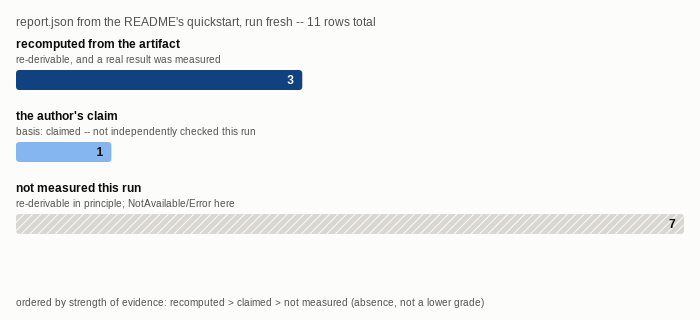
The full statement has 11 rows, not 3 — every row's basis, from this exact quickstart block run fresh:
Beyond one statement at a time, context-report run drives a whole manifest — subjects × models ×
tasks — and context-report compare puts every run of that manifest side by side; see
docs/cli.md for the manifest schema, --dry-run/--n/--resume, and which
model providers a manifest can reach.
| Layer | What it is |
|---|---|
| Evidence | context-report: a signed report of whether a plugin, hook or skill works. chock-threat-intel: a weekly ledger of threats, scored against the catalog. |
| Your agents | Claude Code, Cursor, Copilot, Codex, Gemini, Windsurf, Devin and the rest of the matrix. |
| Plugins | One generated repo per client: Claude Code, Cursor, Copilot, Codex, Devin. |
| chock-catalog | 71 policies, each labelled by what it enforces. Installed with chock add <id>. |
| chock | Governance as code: one policy becomes a git hook, a CI gate, native agent hooks and an AGENTS.md rule. |
| agentseam | The primitives: one handler API over each agent's hooks, instruction files, plugin packaging and config. |
| Templates | chock-quickstart is what chock init leaves behind. chock-example is a working adoption. |
A producer runs the artifact's own hook command against recorded per-target payloads and writes one row per fact.
A verifier recomputes each re-derivable row from the subject and checks the statement is well-formed and
bound to the artifact by digest. Trimmed from a committed statement over a real public plugin
(paper/measurements/catalog-sample/official/ai-plugins.json):
{
  "subjectKind": "plugin",
  "target": {"name": "claude_code"},
  "attributes": [
    {
      "attribute": "cost.context_tokens",
      "basis": "re-derivable",
      "result": "PASSED",
      "inputHash": "sha256:4e85a09a2014600e...",
      "conditions": {"tokenizer": "approx-regex-v1", "files": 2},
      "measurement": {"unit": "tokens", "n": 1, "mean": 2289}
    }
  ]
}
v0.1 rows: conformance · reachability · decision · fault.scriptMissing ·
fault.interpreterMissing · fault.timeout · fault.malformedOutput · cost.latency_ms ·
cost.context_tokens · interference · efficacy (extensions use an x- prefix). A row that
could not be measured says NotAvailable, Error or NotApplicable and why — never a silent
pass. v0.1 draft: schema at
spec/attestation/v0.1/schema.json, worked example at
spec/attestation/v0.1/examples/plugin-copilot.json,
predicate type https://open-coder-ai.github.io/context-report/attestation/v0.1, hosted at
https://open-coder-ai.github.io/context-report/attestation/v0.1/.
Efficacy needs two roles, never one: the subject model runs a task with the rule prepended and without it; the judge model never performs the task, only reads the transcript and decides whether that arm met the rule's criterion, held fixed across every subject model so a comparison across models is fair. A machine-checkable criterion is graded by code instead, never guessed at.
Subject models come from the manifest, never from code — one manifest lines up every model you can reach, the API-shaped ones answering without tools or a checkout:
open-coder-ai/context-report is a public repo on GitHub by open-coder-ai. An open, signed report format for whether an agent plugin, hook, skill, or AGENTS.md actually works.
It declares the Apache-2.0 license on GitHub.
Its maker has not tagged a system, so it is unknown here. Its README says what it needs.
Open "Take it" on its page: Take My Repo writes an install plan for your machine and hands it to your AI agent (Claude Code, Codex or Cursor), which asks you before each step. Take My Repo has not tested it on any machine.
CLAUDE.md / AGENTS.md 规则模板:放进项目根目录,让 Claude Code、Codex、Cursor 少返工(附前后对比)|Drop-in rules for AI coding agents
The agent harness performance optimization system. Skills, instincts, memory, security, and research-first development for Claude Code, Codex, Opencode, Cursor and beyond.
Open-source AI agent governance. Write the rules declaratively, Bernstein enforces them and produces the verifiable, replayable record. Free, Apache-2.0. https://bernstein.run
Reverse engineer anything with agents, from app behavior down to native binaries.
410 Claude Code skills & agent skills & plugins (120+ Agents, custom commands, 410+ skills, customizable references, scripts)for Claude Code, Codex, Gemini CLI, Cursor, and 8 more coding agents — engineering, marketing, product, compliance, C-level advisory, research, business operations, commercial & finance, and your daily productivity skills.
Its last change on GitHub was on 2026-11-02. Take My Repo does not judge from that whether it is maintained.
Nobody has reviewed it on Take My Repo yet, which says nothing about its quality.
Take My Repo cannot say: it does not audit code and has not run context-report. What is known comes from GitHub. It declares the Apache-2.0 license on GitHub. Its last change was on 2026-11-02. It has 1 stars, which measure popularity, not safety. Nobody has reviewed it on Take My Repo yet, which says nothing about its quality. Read the source before you run it. With "Take it", your AI agent shows each step and asks you before running it; README text is treated as data, not as instructions.





