
p10logs
Persistent, multi-cluster Kubernetes pod logs. One DaemonSet agent, one hub with a PVC, built-in UI. No metrics, no Elasticsearch, no Grafana.
- 4
- Apache-2.0
- 11 d ago
Repo p10node/p10logs, read from GitHub 2 h ago. p10node has not joined Take My Repo.
In short
p10node/p10logs is a public repo on GitHub by p10node. Persistent, multi-cluster Kubernetes pod logs. One DaemonSet agent, one hub with a PVC, built-in UI. No metrics, no Elasticsearch, no Grafana. It declares the Apache-2.0 license on GitHub. It is written mainly in Go, has 4 stars and last changed on 2026-11-13. Nobody has reviewed it on Take My Repo yet, which says nothing about its quality. Read from GitHub on 2026-11-23.
Similar repos
docker-selenium
Provides a simple way to run Selenium Grid with Chrome, Firefox, and Edge using Container Platform, making it easier to perform browser automation at scale

p10logs
Persistent, multi-cluster Kubernetes pod logs. Nothing else.
Demo: https://demo-p10logs.p10node.org (admin/BqJDmpsGRJE85Z0cULFOeoRP)
p10logs is a small, self-contained log system for Kubernetes: one DaemonSet agent that reads container log files straight off the node, one hub with a persistent volume that stores and indexes them, and a fast built-in UI to browse, search, and tail pods across any number of clusters. No metrics pipeline, no Prometheus, no Grafana, no Elasticsearch, no object store required.
Status: v1.1. Formats and the
/api/v1API are frozen since 1.0 (see docs/FORMATS.md). Verified by unit tests, a local end-to-end run (make e2e: ingest, filter, live tail, agent restart without loss or duplicates, kubelet rotation,kill -9hub recovery with WAL replay, pod deletion, index rebuild, per-cluster tokens, viewer roles, federation, S3 offload), a single-node kind run (make e2e-kind: chart install, real kubelet log files, label enrichment, Helm upgrade with data retained) and a multi-cluster kind run (make e2e-multi: 3-node hub cluster + spoke cluster pushing over the network, demo workloads, restart boundaries, 20 KiB lines, multiline traces, rate limits, token scoping, hub outage with spool and drain). See CHANGELOG.md.
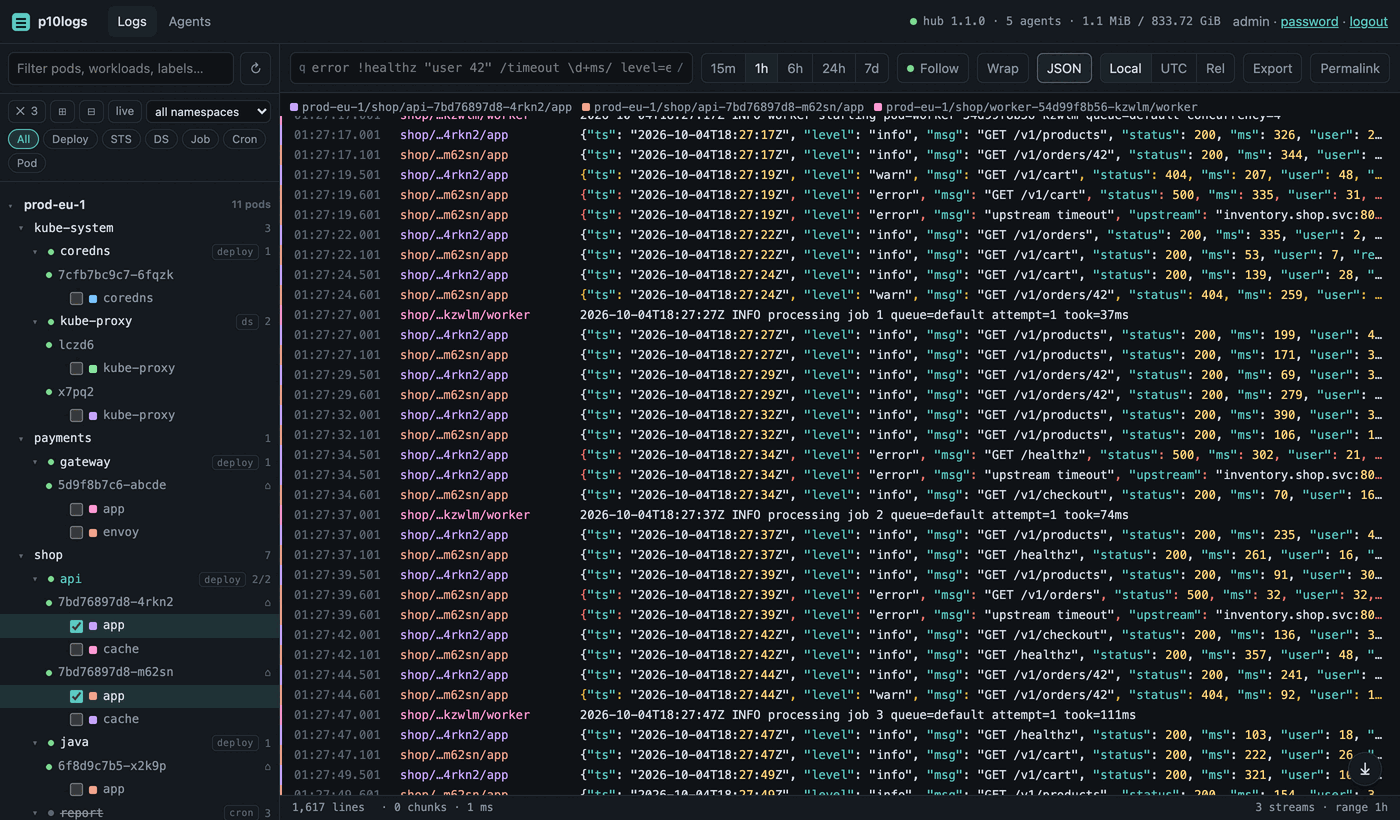
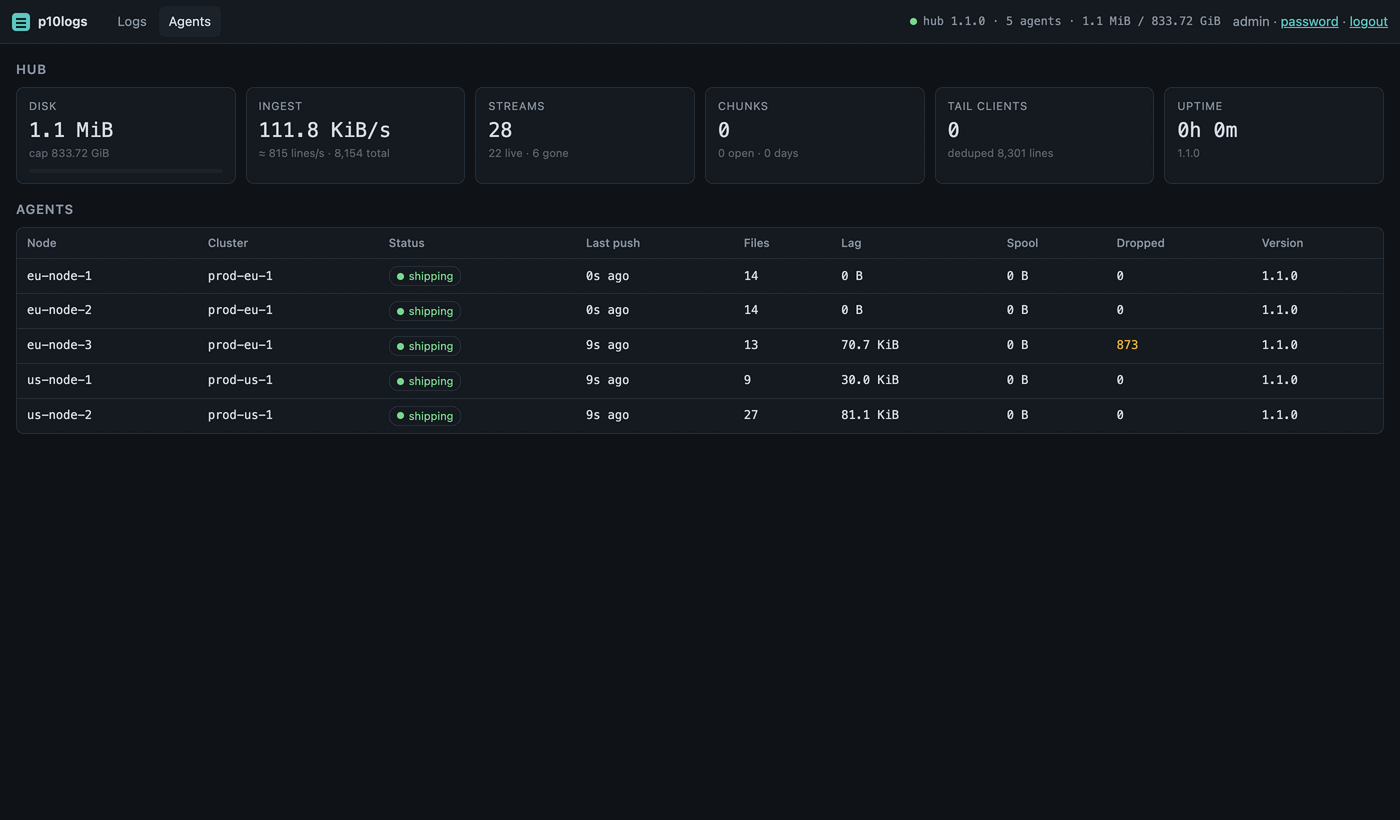
Screenshots
 |
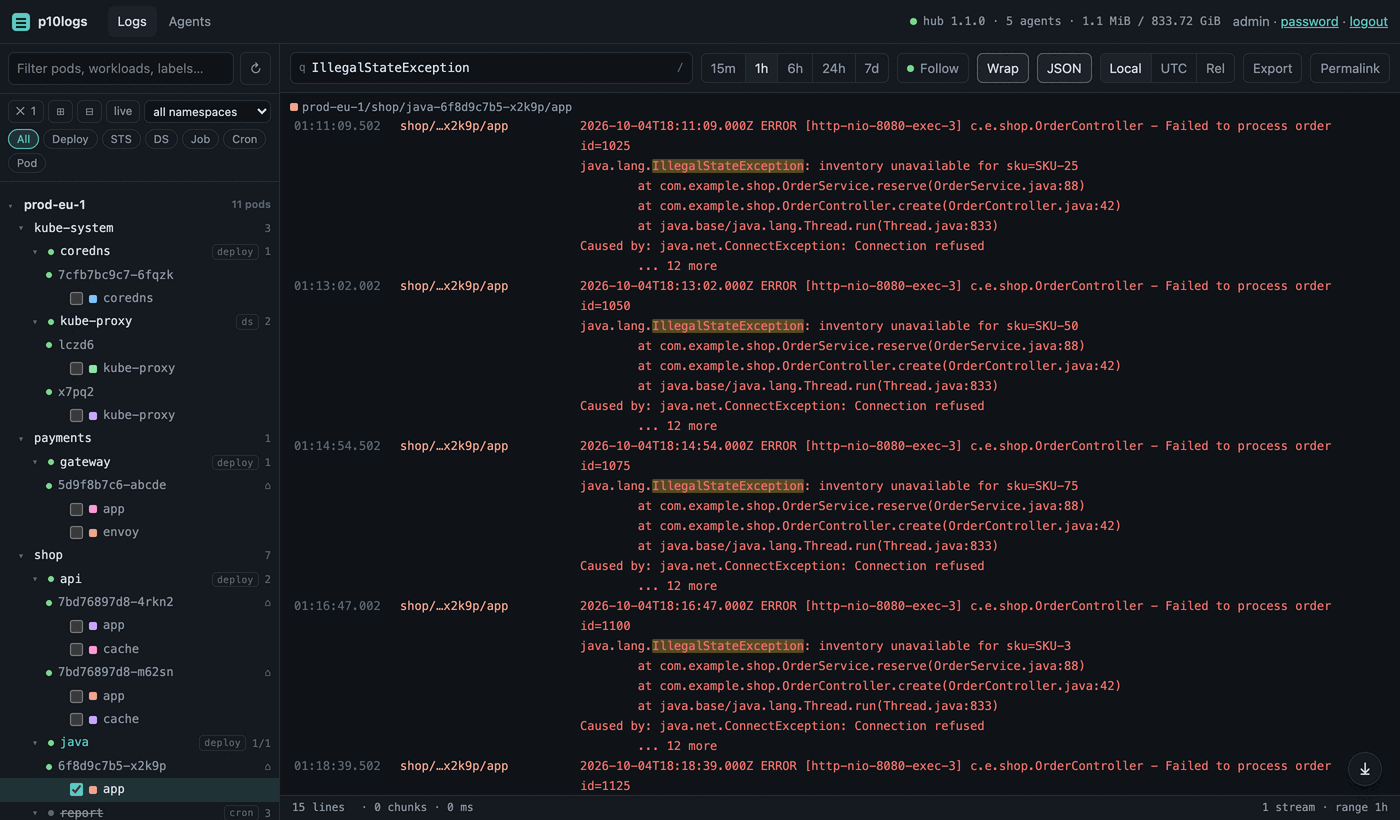 |
| Tree grouped by workload; three streams interleaved with a colour per pod, restart boundaries, JSON highlighting. | Filter IllegalStateException over joined stack traces, Wrap mode, search terms highlighted. |
Why another log tool
Teams that just want "show me the logs of that pod, including from before it restarted, across my clusters" currently choose between two bad options:
Live viewers without storage (Dozzle, kubetail, stern, kubectl logs) all stream
through the Kubernetes API server: browser → apiserver → kubelet → log file. Every open
container is a long-lived connection through the control plane, the kubelet polls and
issues a CRI status call per stream per second, the kubelet hard-kills any stream after
4 hours, only the current 10 MiB log file is ever visible, and nothing survives a pod
restart. Dozzle additionally polls the metrics API for CPU/RAM charts and does all
parsing and rendering in the browser, which is where its "UI timed out" and
200-container freezes come from. The lag you feel is structural, not a bug.
Full observability stacks (Elastic, SigNoz/ClickHouse, Loki + Grafana, OpenObserve) persist logs but ship metrics, traces, dashboards, compactors, and multi-gigabyte memory floors along with them. Loki's monolithic mode runs 1.5–7 GiB; Elastic and ClickHouse start at 4 GB and want much more.
VictoriaLogs is the honest exception: a single binary that stores logs in well under 2 GiB at high ingest rates. If you already run it, keep it. p10logs exists for people who want something even smaller and more opinionated: a pod-centric UI, a one-command Helm install that covers many clusters, built-in auth, and a grep-like filter instead of a query language.
What you get
- Every pod's stdout/stderr, persisted. Logs survive pod restarts, pod deletion, node reboots, and p10logs upgrades. Retention is time- and size-based, per namespace if you want.
- No API-server load. The agent reads
/var/log/podsdirectly; namespace, pod, container, and restart count come from the file path. Zero watches by default; with label enrichment on, exactly one watch per node, scoped to that node's pods. - Multi-cluster in one screen. Agents in any cluster push to one hub over HTTPS with a bearer token, egress-only, so private clusters and home labs work. Or run a hub per cluster and federate queries.
- Fast UI. Tree of
cluster → namespace → pod → container, live tail of one or many pods with server-side rate limiting, virtualized rendering, time range, filter, export, permalinks. Never opens a Kubernetes API stream. - Small. Target footprint: agent ~30 MiB RSS, hub a few hundred MiB for tens of GB/day. Two static Go binaries, one Helm chart, one PVC.
- Exactly-once, in practice. Agent checkpoints on the node; hub deduplicates by file offset. Restarting anything neither loses nor duplicates lines.
- Logs only. No metrics endpoint unless you turn it on. No scraping. No traces.
What it deliberately is not
- Not a query language or analytics engine. Filters are
word,!word,"phrase",/regex/,key=valuefor JSON lines. No aggregations, no SQL, no LogQL. - Not a full-text search cluster. Search is a time-bounded scan; a trigram bloom
filter per sealed chunk skips chunks that cannot contain the search words, so
cluster-wide "find this string in the last 30 days" is cheap when the string is rare,
and bounded by
query.maxScanByteswhen it is not. - Not HA. The hub is a single StatefulSet replica on a PVC; agents buffer to disk while it is down (restarts take seconds; the WAL makes them lossless). Back up the PVC or enable object-storage offload for durability beyond one disk.
- Not a collector for arbitrary files, syslog, or journald. Container stdout/stderr only.
- Not an alerting system.
How it compares
| p10logs | Dozzle | kubetail | Loki + Alloy | VictoriaLogs + vlagent | Elastic / SigNoz | |
|---|---|---|---|---|---|---|
| Reads logs from | node files | kube API | kube API (or agent: node files) | node files | node files | node files |
| Survives pod restart / deletion | yes | no | no | yes | yes | yes |
| Rotated log files visible | yes | no | no | yes | yes | yes |
| Load on apiserver | none | 1 stream per container viewed | 1 stream per container viewed | none (labels: watch) | none | none |
| Multi-cluster | one chart, push or federate | Docker only | desktop context switch | tenants | tenants | yes |
| Typical hub RAM | hundreds of MiB (target) | n/a | n/a | 1.5–7 GiB | 0.6–2 GiB | ≥ 4 GB |
| Metrics shipped by default | no | CPU/RAM polling | no | Grafana stack | optional | full platform |
| UI | pod tree, tail, search | container list, tail, stats | pod tail, search | Grafana | vmui (query-first) | full platform |
| Auth built in | token + basic/OIDC | users file | none | Grafana | none (vmauth) | yes |
| Query language | grep-like | none | none | LogQL | LogsQL | KQL / SQL |
Numbers as of 2026-09 from independent benchmarks and vendor docs: VictoriaLogs vs Loki (Truefoundry), log collectors benchmark 2026 (VictoriaMetrics), Loki sizing, SigNoz capacity planning, Dozzle K8s guide, kubetail cluster agent.
Architecture
  every node                                        one hub (StatefulSet + PVC)
  ┌────────────────────────────┐                    ┌────────────────────────────────┐
  │ /var/log/pods/…/0.log      │                    │ POST /api/v1/push              │
  │        │ scan 2s + tail    │   zstd NDJSON      │   auth → WAL → dedup → chunk   │
  │        ▼                   │ ───────────────►   │        │                       │
  │ p10logs-agent (DaemonSet)  │   HTTPS, bearer    │   ┌────┴─────┐                 │
  │  parse CRI · batch · ship  │                    │   ▼          ▼                 │
  │  checkpoint · disk buffer  │                    │ /data/days  live bus → SSE     │
  └────────────────────────────┘                    │ index.sqlite                   │
                                                    │ retention loop                 │
   other clusters ───────────────────────────────►  │ GET /api/v1/{streams,query,    │
   (agents only, egress-only)                       │   tail,export}  ·  UI at /     │
                                                    └────────────────────────────────┘
- Agent: Go, DaemonSet, runs as root with a read-only filesystem and no
capabilities. Discovers
<ns>_<pod>_<uid>/<container>/<restart>.log, parses the CRI format (including 16 KiB partial-line reassembly), follows kubelet rotation by inode, checkpoints read offsets to a hostPath so restarts resume exactly, batches and zstd-compresses lines, and pushes over HTTP. If the hub is unreachable it spools to a bounded disk buffer on the node. - Hub: Go, StatefulSet with one PVC. Every push is fsynced to a write-ahead log and acknowledged, buffered per stream in memory, then written to a per-stream chunk under a UTC day directory as a large zstd frame. Chunks seal at 4 MiB or 5 minutes with a footer (frame time index + trigram bloom filter), the SQLite catalog is derived state, retention deletes day directories, cold chunks can live in any S3-compatible bucket, and the UI is embedded.
- UI: single-page app embedded in the hub binary. Virtualized list, no external assets, all state in the URL.
Full details, on-disk formats, wire protocol, and failure-mode table: docs/ARCHITECTURE.md.
Quick start
Requirements: Kubernetes ≥ 1.26, Helm ≥ 3.8, a default StorageClass, containerd or CRI-O (legacy Docker works with one extra value).
helm install p10logs oci://ghcr.io/p10node/charts/p10logs \
  --namespace p10logs --create-namespace \
  --set global.clusterName=dev

# hostPath volumes need the "privileged" Pod Security level in this namespace
kubectl label ns p10logs pod-security.kubernetes.io/enforce=privileged --overwrite

kubectl -n p10logs port-forward svc/p10logs-hub 8080:8080
open http://localhost:8080
First sign-in is admin / admin; the hub then asks you to set a new password and keeps
it hashed on its data volume. Prefer to manage it outside? Set
hub.auth.ui.basic.password or existingSecret and no onboarding happens. For a public
demo add hub.auth.ui.basic.lockPassword=true: the configured password is the only one
accepted and nobody can change it from the UI.
Within a few seconds the tree fills with every namespace and pod on the cluster, including logs that were already on disk before p10logs was installed (current plus rotated files, up to what kubelet kept).
Multi-cluster
Hub + spokes (default recommendation): install once with an Ingress in the central cluster, then install agents only in each other cluster:
# central
helm install p10logs oci://ghcr.io/p10node/charts/p10logs -n p10logs --create-namespace \
  --set global.clusterName=central \
  --set hub.ingress.enabled=true \
  --set 'hub.ingress.hosts[0].host=logs.example.com' \
  --set 'hub.ingress.tls[0].secretName=p10logs-tls' \
  --set 'hub.ingress.tls[0].hosts[0]=logs.example.com'

TOKEN=$(kubectl -n p10logs get secret p10logs-ingest -o jsonpath='{.data.token}' | base64 -d)

# each spoke
helm install p10logs oci://ghcr.io/p10node/charts/p10logs -n p10logs --create-namespace \
  --set global.clusterName=prod-eu-1 \
  --set hub.enabled=false \
  --set agent.hub.url=https://logs.example.com \
  --set agent.hub.token=$TOKEN
Spokes need outbound HTTPS only. Serve the hub over HTTP/2 (any TLS ingress does) so several browser tabs can tail at once; HTTP/1.1 caps a browser at six connections per host. Agents compress before sending (text logs shrink 5–10×) and spool to local disk during hub outages.
Per-cluster tokens (hub.auth.clusterTokens) stop a leaked spoke token from
writing as another cluster. Federation (hub per cluster, one UI: hub.federation.peers)
is described in docs/MULTI_CLUSTER.md; stream ids from a peer
appear as <peer>/<id> and the tree shows which hub serves each cluster.
Configuration
All configuration is Helm values. The important ones:
| Value | Default | Meaning |
|---|---|---|
global.clusterName |
default |
Label stamped on every line. Unique per hub. |
agent.enabled / hub.enabled |
true / true |
Topology switches. Spoke = hub.enabled=false. |
Questions
What is p10logs?
p10node/p10logs is a public repo on GitHub by p10node. Persistent, multi-cluster Kubernetes pod logs. One DaemonSet agent, one hub with a PVC, built-in UI. No metrics, no Elasticsearch, no Grafana.
Is p10logs open source?
It declares the Apache-2.0 license on GitHub.
Does p10logs run on macOS, Windows or Linux?
Its maker has not tagged a system, so it is unknown here. Its README says what it needs.
How do I install p10logs?
Open "Take it" on its page: Take My Repo writes an install plan for your machine and hands it to your AI agent (Claude Code, Codex or Cursor), which asks you before each step. Take My Repo has not tested it on any machine.


