
CrySentry
A Static Analysis Tool for Java Crypto API Misuse Based on Tai-e
- 0
- LGPL-3.0
- 5 mo ago
Repo pascal-lab/CrySentry, read from GitHub 18 h ago. pascal-lab has not joined Take My Repo.
In short
pascal-lab/CrySentry is a public repo on GitHub by pascal-lab. A Static Analysis Tool for Java Crypto API Misuse Based on Tai-e. It declares the LGPL-3.0 license on GitHub. It is written mainly in Java, has 0 stars and last changed on 2026-06-15. Nobody has reviewed it on Take My Repo yet, which says nothing about its quality. Read from GitHub on 2026-11-23.
CrySentry: A Static Analysis Tool for Java Crypto API Misuse Based on Tai-e
CrySentry is a static analysis tool for detecting Java cryptographic API misuses based on Tai-e whole-program pointer analysis and taint analysis.
Features
The current implementation supports multiple classes of crypto API misuse detection, including:
- weak or deprecated cryptographic algorithms,
- predictable or non-cryptographically secure sources,
- invalid iteration counts or key sizes,
- unsafe or forbidden cryptographic API usages,
- missing or insufficient security checks,
- and composite misuse patterns involving multiple conditions.
Why CrySentry?
"Cryptography is a vital technology that underpins the security of information in computer networks". As the cornerstone of modern security frameworks, cryptography is crucial for protecting sensitive data, safeguarding transactions and communications, authenticating identities, and more.
The Java platform provides cryptography-related functionalities through the Java Cryptography Architecture (JCA) and the Java Secure Socket Extension (JSSE), enabling encryption, key generation, secure communication, and other tasks.
However, the complexity of crytpo API usage, combined with developers' general lack of security knowledge, often results in cryptographic API (crypto API) misuses, leading to security vulnerabilities such as sensitive data leaks, broken authentication, and man-in-the-middle attacks.
Existing crypto API misuse detectors still suffer from false negatives caused by restricted interprocedural tracking and insufficient alias analysis, as well as false positives introduced by coarse-grained detection rules.
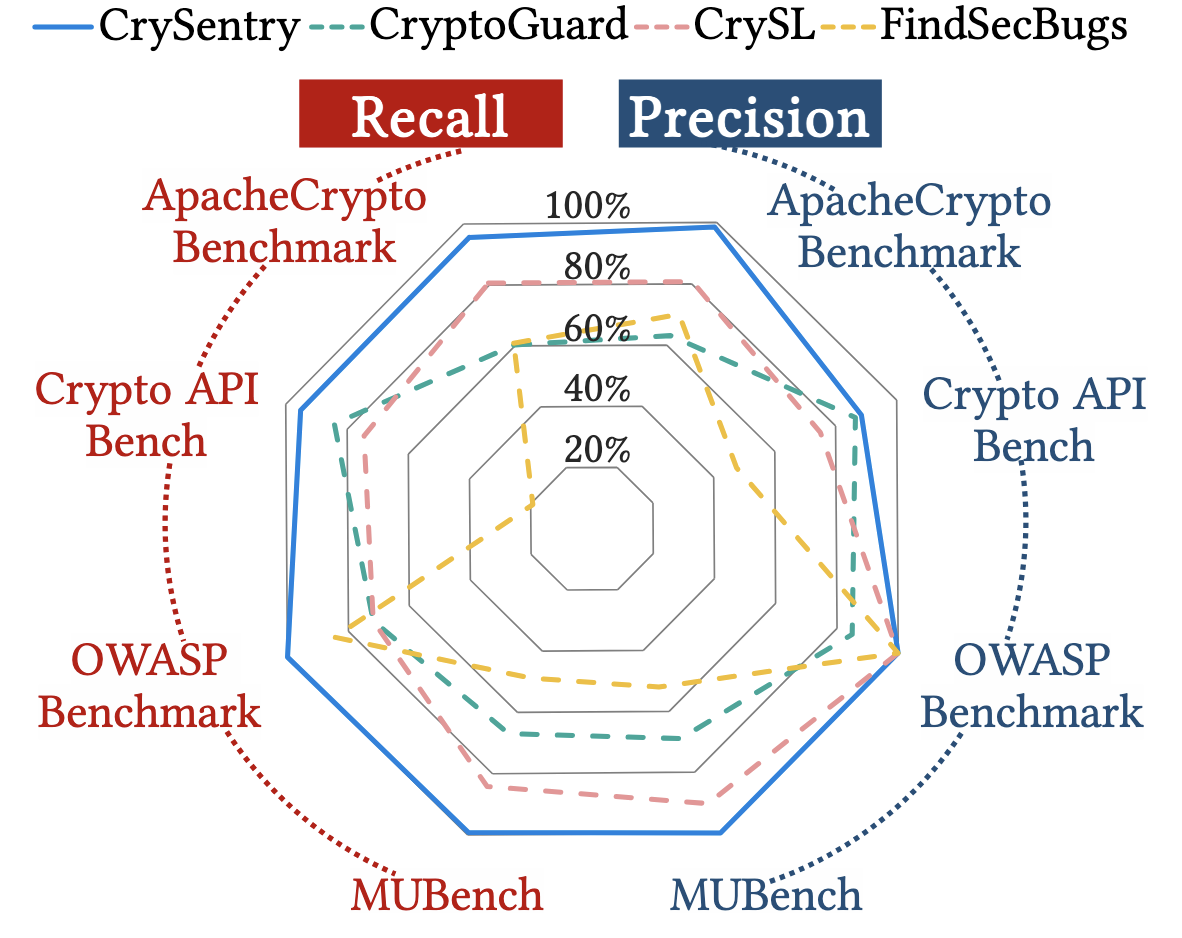
On four widely used crypto API misuse benchmark suites: MUBench, OWASP Benchmark, Apache Crypto API Bench, and Crypto API Bench, CrySentry achieves consistently better soundness (97.5% average recall) and precision (96.7% precision), compared with state-of-the-art tools including CryptoGuard, CrySL, and FindSecBugs.
Figure 1: Evaluation overview comparing CrySentry with existing tools.
Overview
A major and challenging class of crypto API misuse involves insecure crypto information being used in security-sensitive API calls. CrySentry is designed to detect such misuses using Tai-e’s whole-program pointer analysis and taint analysis framework.
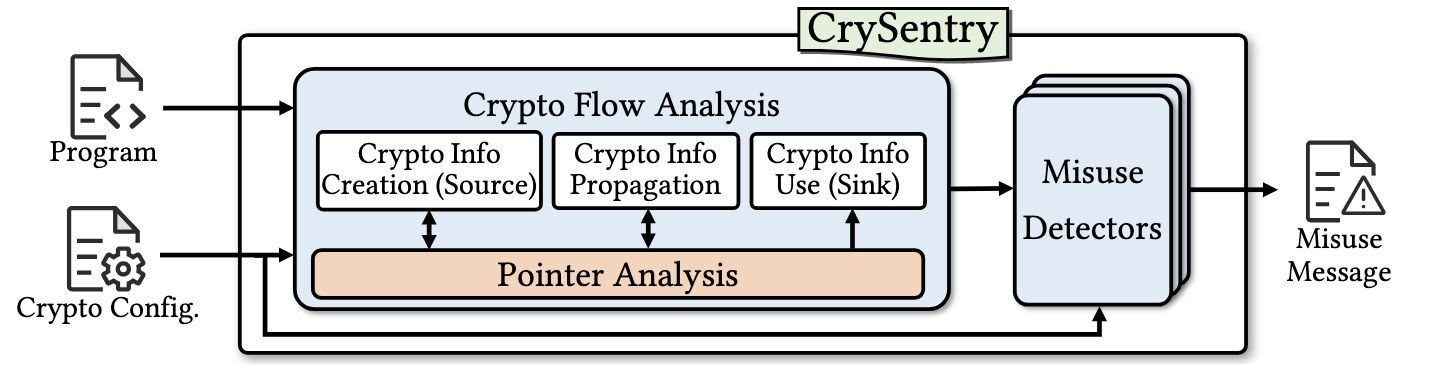
Figure 2: Overview of CrySentry.
CrySentry models:
- crypto-related information as sources,
- security-sensitive crypto APIs as sinks,
- and tracks the propagation of crypto information through Tai-e pointer analysis and taint analysis.
- For the collected crypto-related taint flows, CrySentry applies configurable misuse detectors to determine whether the flows indicate potential security risks or vulnerabilities (e.g., insecure crypto information in security-sensitive API calls).
Users can flexibly configure crypto sources, crypto sinks, propagation rules, and misuse detection rules, allowing CrySentry to be adapted to different APIs, frameworks, and security policies.
Usage
CrySentry is executed through Tai-e’s standard entry point. To run the analysis, prepare an options file and pass it to Tai-e with --options-file:
java -jar tai-e.jar --options-file /path/to/options.yml
A minimal example of the options file is shown below (the demo options.yml file can be found in the root directory of the project; when running from a JAR, the paths in this file should be replaced with absolute paths):
optionsFile: null
printHelp: false
classPath: []
appClassPath:
  - /.../crypto-benchmarks/activemq/original-classes.jar

mainClass: null
inputClasses: []
javaVersion: 8
prependJVM: true
allowPhantom: true
worldBuilderClass: pascal.taie.frontend.newfrontend.AsmWorldBuilder
outputDir: /.../output/activemq
preBuildIR: false
worldCacheMode: false
scope: REACHABLE
nativeModel: true
planFile: null

analyses:
  pta: |
    plugins:[pascal.taie.analysis.pta.plugin.cryptomisuse.reachableplugin.CryptoReachablePlugin];
    crypto-output:/.../crypto-output/activemq.json;
    crypto-config:/.../src/main/resources/crypto-config.yml;
    implicit-entries:false;
    only-app:false;
    merge-string-builders:true;
    cs:1-call;
    advanced:hashmap;
    propagate-types:[reference,byte,char,int];


onlyGenPlan: false
keepResult:
  - $KEEP-ALL
jreDir: null
extractAllClasses: false
noAppendJava: false
useNonParallelCWAlgorithm: false
frontendOptions: {}
0. Configure the JDK version
CrySentry supports two modes for selecting the JDK used during analysis, following the JDK configuration mechanism of Tai-e.
If prependJVM is set to true, CrySentry uses the JDK that executes tai-e.jar as the analysis JDK.
If prependJVM is set to false, the analysis JDK must be specified via javaVersion (default is 6). In this mode, CrySentry requires that a java-benchmarks directory exists in the current working directory. This is the only requirement for enabling this mode.
A common way to prepare the working directory is:
- Clone the CrySentry repository.
- Initialize and fetch submodules
(this will obtain the
java-benchmarksdirectory.):
git submodule update --init --recursive
- Ensure
tai-e.jaris placed in the same directory asjava-benchmarks.
1. Configure the target application
The option appClassPath specifies the Java program to be analyzed.
appClassPath is a list, so you can provide:
- a directory that contains application JARs,
- multiple JAR files,
- or a mix of relative and absolute paths.
For example:
appClassPath:
  - /path/to/app/build/libs/app.jar
  - /path/to/another.jar
  - /path/to/benchmark-dir
CrySentry will treat these paths as the application under analysis. In practice, this means you should place the benchmark or target program here.
classPath is used for the dependency libraries of the application, such as third-party JARs or framework JARs required to resolve references during analysis.
The distinction between appClassPath and classPath, as well as their impact on the analysis, follows the semantics defined by Tai-e. For detailed information, please refer to the Tai-e documentation:
https://tai-e.pascal-lab.net/docs/current/reference/en/command-line-options.html
A typical setup is:
appClassPath:
  - /.../crypto-benchmarks/activemq/original-classes.jar
classPath:
  - /path/to/dependency1.jar
  - /path/to/dependency2.jar
2. Set the analysis entry points
CrySentry provides a special plugin, CryptoReachablePlugin, to identify analysis entry points. This plugin marks all methods in the application code as reachable entry points, so the analysis can cover the whole application instead of being limited to a manually specified main method.
plugins:[pascal.taie.analysis.pta.plugin.cryptomisuse.reachableplugin.CryptoReachablePlugin];
If this plugin is not enabled, CrySentry follows Tai-e's default behavior and starts the analysis from the configured main method.
Users may customize the analysis entry points by implementing their own entry-point finder. The implementation of CryptoReachablePlugin provides a simple example that can be adapted to support application-specific entry-point discovery strategies.
Other Tai-e plugins can also be used in the same way.
3. Configure CrySentry in the PTA option block
CrySentry is configured inside the pta analysis section. The following options are the key ones:
crypto-output:/.../crypto-output/activemq.json;
crypto-config:/.../src/main/resources/crypto-config.yml;
crypto-outputspecifies where CrySentry writes the detection results.crypto-configspecifies the crypto misuse rules and propagation rules used by the detector.
Both options are required to enable crypto misuse detection. If either option is missing, Tai-e will perform pointer analysis only, and CrySentry's crypto misuse analysis will not be activated.
The rest of the PTA options are Tai-e settings that control pointer analysis behavior, such as context sensitivity, heap abstraction, and analysis scope. These options affect analysis precision and scalability of the underlying pointer analysis, but CrySentry’s crypto detection logic itself is driven mainly by crypto-output and crypto-config.
A few commonly used settings are:
cs:1-call;— use 1-call-site-sensitive pointer analysis.advanced:hashmap;— enable Tai-e's specialized analysis for HashMap.propagate-types:[reference,byte,char,int];— enable propagation for the primitive types commonly involved in cryptographic computations. This option is highly recommended; disabling propagation of these types may cause CrySentry to miss relevant data flows and lead to unsound detection results.merge-string-builders:true;— treat allStringBuilderinstances as a single object in pointer analysis.
4. Understand the crypto configuration file
The crypto-config.yml file defines the actual detection logic. CrySentry uses it to identify insecure API usages, track crypto-related values, and recognize misuse patterns.
The configuration is organized into several groups.
4.1 patternMatchRules
These rules detect insecure algorithms or insecure API arguments by matching string patterns at specific call sites.
Example:
patternMatchRules:
  - { method: "<javax.crypto.Cipher: javax.crypto.Cipher getInstance(java.lang.String)>", index: 0, pattern: "(.)*DES(.)*|(.)*DESede(.)*|AES|..." }
This rule checks the first argument of Cipher.getInstance(String). If the string object pointed to by this argument (i.e., the cryptographic algorithm name) matches an insecure pattern such as DES, RC4, Blowfish, or AES/ECB, CrySentry reports a Pattern Match issue.
In general, patternMatchRules are used for:
- insecure cipher algorithms,
- weak message digests,
- weak MAC algorithms,
- insecure key generators,
- insecure signatures,
- insecure URL or network-related API usages.
4.2 predictableSourceRules
These rules identify APIs whose arguments should be sufficiently random or unpredictable, but may receive predictable values.
Example:
predictableSourceRules:
  - { method: "<javax.crypto.spec.SecretKeySpec: void <init>(byte[],java.lang.String)>", index: 0 }
  - { method: "<javax.crypto.spec.IvParameterSpec: void <init>(byte[])>", index: 0 }
  - { method: "<java.security.SecureRandom: void <init>(byte[])>", index: 0 }
These rules help detect cases where keys, IVs, salts, or passwords are derived from weak or predictable values. CrySentry reports such issues as Predictable Source.
4.3 cryptoSources
These rules define crypto-related input sources that may be insecure or insufficiently random.
Example:
cryptoSources:
  - { method: "<java.util.Base64$Decoder: byte[] decode(java.lang.String)>", type: "byte[]", index: result }
  - { method: "<java.util.Random: void nextBytes(byte[])>", type: "byte[]", index: 0 }
These sources model values such as pseudo-random outputs or externally provided data, which do not necessarily satisfy cryptographic security requirements.
When such values flow into crypto-sensitive APIs (e.g., key generation, IV construction, or encryption parameter specification), they may introduce risks such as weak randomness or attacker-controlled cryptographic inputs.
CrySentry tracks the propagation of these values and reports a potential misuse when they influence security-critical cryptographic operations.
4.4 numberSizeRules
These rules detect invalid numeric parameters, such as too small iteration counts or key sizes.
Example:
numberSizeRules:
  - { method: "<javax.crypto.spec.PBEParameterSpec: void <init>(byte[],int)>", index: 1, min: 1000, max: 50000 }
This rule checks whether the iteration count is within an acceptable range. Values outside the specified range are reported as a Number Size issue.
4.5 forbiddenMethodRules
These rules specify APIs that should not be used.
Example:
forbiddenMethodRules:
  - { method: "<javax.crypto.spec.PBEKeySpec: void <init>(char[])>" }
If an application invokes a forbidden method, CrySentry reports it as a direct misuse.
4.6 coOccurrenceRules
These rules describe APIs that must be considered together when detecting certain security conditions.
Example:
coOccurrenceRules:
  - { method: "<javax.net.ssl.SSLSocketFactory: javax.net.SocketFactory getDefault()>", index: "['createSocket', '!<javax.net.ssl.HostnameVerifier: boolean verify(java.lang.String,javax.net.ssl.SSLSession)>']" }
These rules are used to detect combinations of API behaviors that together indicate insecure usage, such as using an SSL socket factory without proper hostname verification.
4.7 influencingFactorRules
These rules capture methods whose return values or exception behavior influence security decisions.
Example:
influencingFactorRules:
  - { method: "void checkClientTrusted(java.security.cert.X509Certificate[],java.lang.String)", index: exception, factor: null, type: use }
  - { method: "java.security.cert.X509Certificate[] getAcceptedIssuers()", index: return, factor: "getAcceptedIssuers()", type: def }
These are useful for SSL/TLS-related checks, where security depends not only on direct API calls but also on whether trust validation is actually performed.
4.8 compositeRules
These rules combine multiple rule types to express more complex misuse patterns.
Example:
Questions
What is CrySentry?
pascal-lab/CrySentry is a public repo on GitHub by pascal-lab. A Static Analysis Tool for Java Crypto API Misuse Based on Tai-e.
Is CrySentry open source?
It declares the LGPL-3.0 license on GitHub.
Does CrySentry run on macOS, Windows or Linux?
Its maker has not tagged a system, so it is unknown here. Its README says what it needs.
How do I install CrySentry?
Open "Take it" on its page: Take My Repo writes an install plan for your machine and hands it to your AI agent (Claude Code, Codex or Cursor), which asks you before each step. Take My Repo has not tested it on any machine.