
graphql-engine
Blazing fast, instant realtime GraphQL APIs on all your data with fine grained access control, also trigger webhooks on database events.
- 32k
- TypeScript
- Apache-2.0
- 3 d ago
Code for RATION: Towards Quantitative Risk-Based Access Control for AI Agents
Repo perplexityai/RATION, read from GitHub 15 min ago. perplexityai has not joined Take My Repo.
perplexityai/RATION is a public repo on GitHub by perplexityai. Code for RATION: Towards Quantitative Risk-Based Access Control for AI Agents. It declares the MIT license on GitHub. It is written mainly in Python, has 2 stars and last changed on 2026-11-05. Nobody has reviewed it on Take My Repo yet, which says nothing about its quality. Read from GitHub on 2026-11-23.
Yuntao Du1,2, Harsh Chaudhari1, Yuetian Chen1,2, Ron Heichman1, Ashish Jayamohan1, Kumar Pallav1, Mahim Patel1, Kaiyuan Zhang1,3, Kyle Polley1, Jerry Ma1, Ninghui Li1,2
1Perplexity, 2Purdue University, and 3Rutgers University
[!WARNING] This is a research artifact released to reproduce the results in our paper. This is not a Perplexity product, and we are not planning to provide support for and/or maintain this codebase.
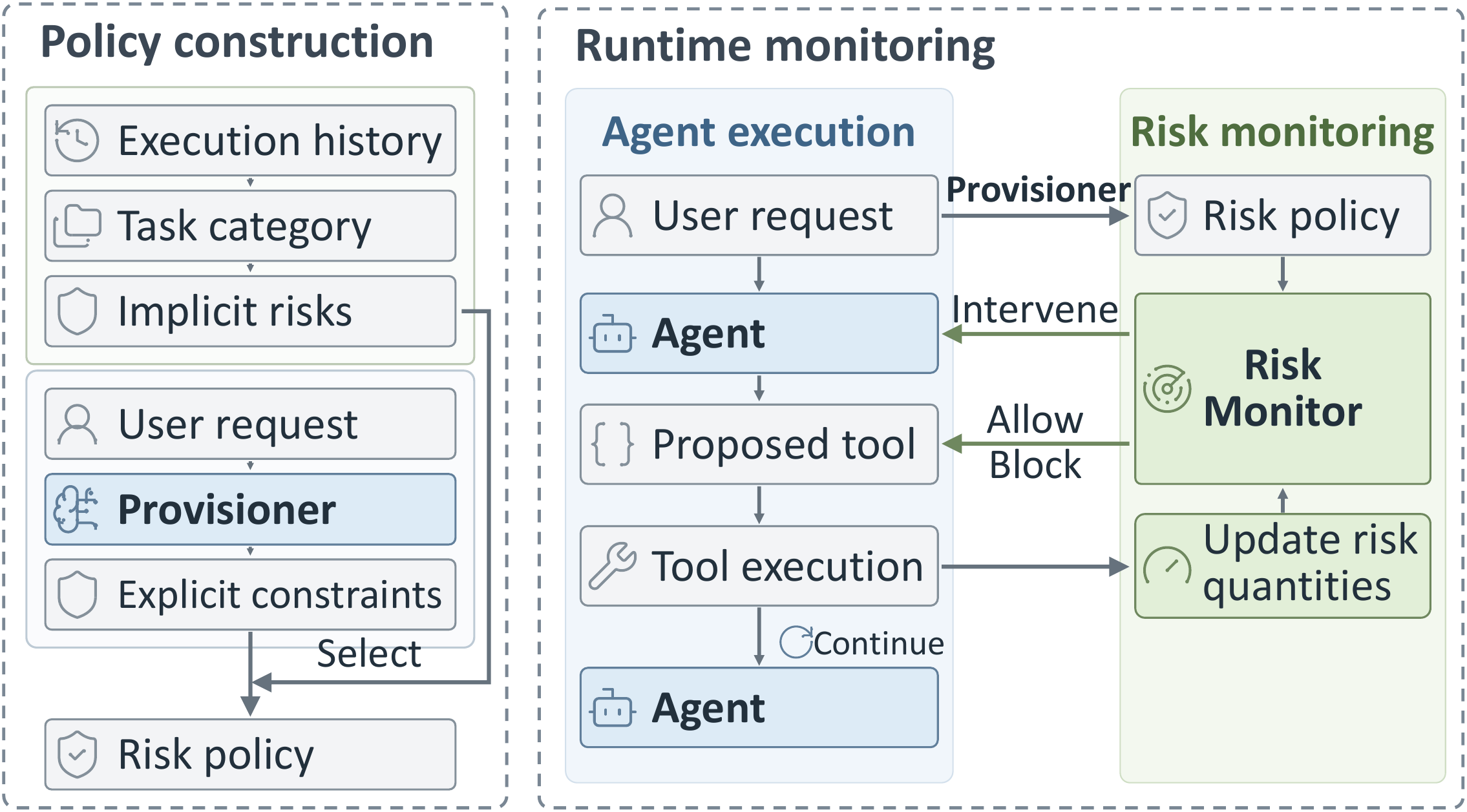
RATION protects tool-using AI agents against indirect prompt injection (IPI). Instead of restricting individual actions, it regulates the measurable risks that accumulate during task execution.
This repository contains the RATION implementation, the risk policies used in the paper, and the harnesses for the four benchmarks: DTap, AgentDyn, AgentDojo and ASB.
The example runs the Provisioner and the Risk Monitor on an AgentDyn payment task with a scripted LLM, without network access. It shows an allowed call, a call outside the tool allow-list, a payment that violates a value constraint, a call held at a behavioral threshold, and a call blocked by the user's per-action limit.
uv venv --python 3.12 .venv
uv pip install --python .venv/bin/python -e ".[agentdojo]"
.venv/bin/python examples/quickstart.py
docs/method.md describes the method and how to put RATION in front of another agent; docs/policies.md describes the policy files.
ration/                     RATION core: risk policy, Provisioner, Risk Monitor, feedback
adapters/<benchmark>/       RATION in each benchmark harness
  environments/<domain>/    policy.yaml and policies.<model>.json for every domain
  config/                   Provisioner and feedback prompts
baselines/                  the baseline defenses compared in the paper
benchmarks/<benchmark>/     benchmark settings, tool interfaces, folds and task lists
scripts/<benchmark>/        run.sh (setup, run, report) and the benchmark harness
scripts/common/             OpenAI client, local OpenAI-compatible proxy, metrics
reproduced_results/         per-task results of the main comparison
examples/, docs/, tests/
Requirements: Python 3.12, uv and an OpenAI API key. ASB also needs Python 3.11 (uv downloads it). DTap needs a Linux host with Docker.
uv venv --python 3.12 .venv
uv pip install --python .venv/bin/python -e ".[agentdojo]"
cp .env.example .env        # then set OPENAI_API_KEY
The agent model is GPT-5.4 (gpt-5.4) on DTap and GPT-4.1 (gpt-4.1) on AgentDyn, AgentDojo and
ASB (benchmarks/<benchmark>/protocol.json). The Provisioner uses the same model as the agent.
Every LLM call, including those made by the benchmarks' internal judges and simulators, goes to the
OpenAI API.
Every benchmark has one controller with three commands: setup, run and report. A run is
resumable: completed tasks are kept, and running the same command again executes only the tasks
that are missing or failed with an API error. Results are written to
results/<benchmark>/defense/ration/main_results/run1/<domain>/.
scripts/dtap/run.sh setup travel
scripts/dtap/run.sh run ration travel
scripts/dtap/run.sh report ration
setup and run take one domain. The report needs all 14 domains: travel telecom research code medical browser os-filesystem customer-service finance crm legal workflow windows macos. The
windows and macos domains run virtual machines and need /dev/kvm. Download their images after
setup with hf download AI-Secure/decodingtrust-windows-qcow2 --repo-type dataset --local-dir vendor/dtap/dt_arena/envs/windows/windows and hf download AI-Secure/decodingtrust-macos-qcow2 --repo-type dataset --local-dir vendor/dtap/dt_arena/envs/macos/macos.
run starts a local OpenAI-compatible proxy on port 8903 that forwards every request to the OpenAI
API with your OPENAI_API_KEY. The openrouter.ai/v1 segment in its URL is only a path the proxy
accepts; no request goes to OpenRouter. The proxy has no authentication and listens on all
interfaces (0.0.0.0) so that the medical environment's Docker container can reach it. Run DTap
on a trusted network or behind a firewall, or set PROXY_HOST=127.0.0.1 when you do not run
medical.
scripts/agentdyn/run.sh setup
scripts/agentdyn/run.sh run ration
scripts/agentdyn/run.sh report ration
scripts/agentdojo/run.sh run ration
scripts/agentdojo/run.sh report ration
scripts/asb/run.sh setup
scripts/asb/run.sh run ration
scripts/asb/run.sh report ration
reproduced_results/ contains the per-task results of the main comparison in the paper. The main
table and the per-domain metrics can be recomputed from these files with the Python standard
library only:
python3 scripts/reproduce_results.py
python3 -m scripts.agentdojo.report --source reproduced --run-key run1 --condition ration
The metrics are Attack Success Rate (ASR), Utility Under Attack (UA) and Benign Utility (BU), in
percent with 95% confidence intervals. --source results reads a fresh run instead. AgentDyn and
AgentDojo average their domains equally, and ASB pools its 400 attacked executions. DTap averages
its 14 domains equally; within the eight domains that partition tasks into categories, it averages
the categories. Confidence intervals propagate the binomial variance through the same weights.
Run the tests with .venv/bin/python -m unittest discover -s tests.
Benchmarks: DTap, AgentDyn, AgentDojo and ASB. The baselines build on the released code of CaMeL, DRIFT, Progent, AttriGuard, MELON, DataSentinel, Prompt Guard 2, PI Detector and AgentDojo's built-in defenses.
RATION is released under the MIT License. Some code, prompts and data come from other projects and keep their original licenses; see THIRD_PARTY_NOTICES.md.
@misc{du2026ration,
  title         = {{RATION}: Towards Quantitative Risk-Based Access Control for {AI} Agents},
  author        = {Du, Yuntao and Chaudhari, Harsh and Chen, Yuetian and Heichman, Ron and Jayamohan, Ashish and Pallav, Kumar and Patel, Mahim and Zhang, Kaiyuan and Polley, Kyle and Ma, Jerry and Li, Ninghui},
  year          = {2026},
  eprint        = {2610.24311},
  archivePrefix = {arXiv},
  primaryClass  = {cs.CR},
  url           = {https://arxiv.org/abs/2610.24311}
}
perplexityai/RATION is a public repo on GitHub by perplexityai. Code for RATION: Towards Quantitative Risk-Based Access Control for AI Agents.
It declares the MIT license on GitHub.
Its maker has not tagged a system, so it is unknown here. Its README says what it needs.
Open "Take it" on its page: Take My Repo writes an install plan for your machine and hands it to your AI agent (Claude Code, Codex or Cursor), which asks you before each step. Take My Repo has not tested it on any machine.
Its last change on GitHub was on 2026-11-05. Take My Repo does not judge from that whether it is maintained.
Nobody has reviewed it on Take My Repo yet, which says nothing about its quality.
Blazing fast, instant realtime GraphQL APIs on all your data with fine grained access control, also trigger webhooks on database events.
AutoGPT is the vision of accessible AI for everyone, to use and to build on. Our mission is to provide the tools, so that you can focus on what matters.
🔍 An LLM-based Multi-agent Framework of Web Search Engine (like Perplexity.ai Pro and SearchGPT)
Reverse engineer anything with agents, from app behavior down to native binaries.
A list of Free Software network services and web applications which can be hosted on your own servers
Read-only developer endpoint scanner for on-disk package, extension, and developer-tool metadata, built to check exposure to known software supply-chain compromises.
The official MCP server implementation for the Perplexity API Platform
Sandboxed Platform for Agentic Code Execution: pluggable-runtime sandboxes for running agent and user code in isolation.
Visibility into AI agent activity on endpoints, with on-device detection, optional pre-action blocking, and forensic reconstruction.








