typeid
Type-safe, K-sortable, globally unique identifier inspired by Stripe IDs
- 3.7k
- Go
- Apache-2.0
- 13 d ago

🐇 pikaid {Official Java implementation} - Small · Sortable · Secure IDs 🔑 26-character lowercase Base36 IDs · Sortable by timestamp · Cryptographically random 🚀
Repo pikaid/pikaid-java, read from GitHub 1 min ago. pikaid has not joined Take My Repo.
pikaid/pikaid-java is a public repo on GitHub by pikaid. 🐇 pikaid {Official Java implementation} - Small · Sortable · Secure IDs 🔑 26-character lowercase Base36 IDs · Sortable by timestamp · Cryptographically random 🚀. It declares the MIT license on GitHub. It is written mainly in Java, has 3 stars and last changed on 2026-11-10. Nobody has reviewed it on Take My Repo yet, which says nothing about its quality. Read from GitHub on 2026-11-24.
Small · Sortable · Secure ID generator
pikaid is the official Java implementation of a compact, chronologically sortable, collision-resistant identifier format for databases, APIs, and distributed systems.
This is the immutable, unversioned pikaid format, documented in specification revision 1.0.4.
BINARY(17) or readable CHAR(26).A pikaid contains 26 lowercase Base36 characters: a 7-character Unix-seconds timestamp followed by 19 characters encoding 96 bits of cryptographic randomness. Its binary form is 17 bytes: 5 unsigned big-endian timestamp bytes followed by 12 randomness bytes.
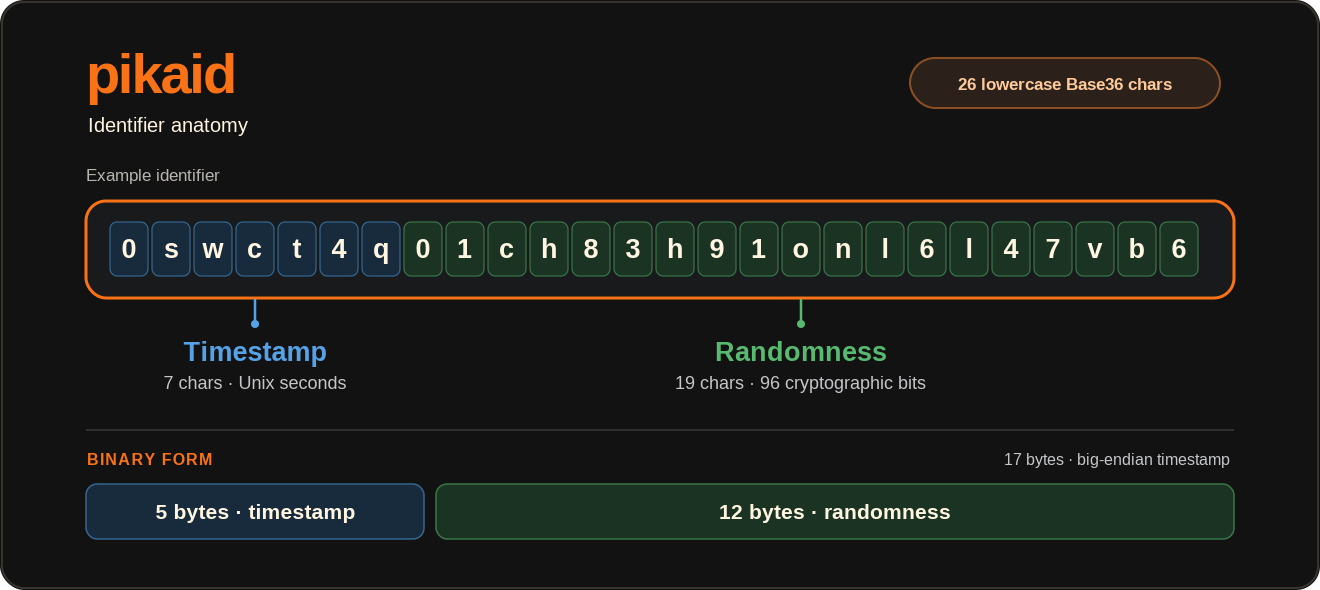
Ordering: Different seconds sort chronologically. Within the same second, randomness—not issuance order—decides the order.
Security: These are identifiers, not secrets, session credentials, authentication tokens, or API keys.
--release 17 and has no
runtime dependencies outside the JDK../mvnw) downloads a compatible Maven version.From this public source repository, compile the library before using it locally:
git clone https://github.com/pikaid/pikaid-java.git
cd pikaid-java
./mvnw -q -DskipTests package<dependency> <groupId>dev.pikaid</groupId> <artifactId>pikaid</artifactId> <version>1.0.0</version> </dependency>
implementation("dev.pikaid:pikaid:1.0.0")To install the built artifact into your local Maven repository:
./mvnw install
Save this complete example as Main.java in the repository root and run javac -cp target/classes Main.java && java -cp target/classes:. Main:
import dev.pikaid.Pikaid;

public class Main {
    public static void main(String[] args) {
        Pikaid id = Pikaid.generate();

        String text = id.toString();            // 26 lowercase Base36 characters
        byte[] binary = id.toBinary();          // exactly 17 bytes
        long timestamp = id.timestamp();        // unsigned Unix seconds
        String randomness = id.randomnessHex(); // 24 lowercase hexadecimal characters

        Pikaid fromText = Pikaid.parse(text);
        Pikaid fromBinary = Pikaid.fromBinary(binary);

        assert fromText.equals(id);
        assert fromBinary.equals(id);
        System.out.println(text);
    }
}
Use pikaid to identify users, orders, invoices, uploads, events, and API resources. Independent services can generate compact IDs without a shared counter, while timestamp-based ordering helps with indexing, sorting, and logs.
Specification revisions describe the format; they do not change the encoded identifiers.
| Method | Purpose |
|---|---|
Pikaid.generate() |
Generate with the current UTC second and a CSPRNG. |
Pikaid.generate(long timestamp) |
Generate with an explicit timestamp and a CSPRNG. |
Pikaid.generateBinary() |
Generate and return the 17-byte binary form. |
Pikaid.of(long timestamp, byte[] randomness) |
Deterministic factory for fixtures and raw-field pipelines. |
Pikaid.parse(String value) |
Strictly parse 26-character text. |
Pikaid.fromBinary(byte[] value) |
Strictly decode exactly 17 bytes. |
Pikaid.isValid(String value) |
Full semantic validation, returning false on failure. |
Pikaid.isWellFormed(String value) |
Shape-only length/alphabet check. |
timestamp() / timestampInstant() |
Timestamp as unsigned seconds or a UTC Instant. |
randomness() / randomnessHex() |
Defensive copy of the twelve bytes or lowercase hex. |
toBinary() |
New 17-byte binary representation. |
toString() |
Canonical 26-character text. |
compareTo(Pikaid other) |
Timestamp, then unsigned suffix order. |
All public types and members are documented in the generated Javadoc.
import dev.pikaid.Pikaid;
import java.util.HexFormat;

// Randomness still comes from the CSPRNG.
Pikaid fixed = Pikaid.generate(1_700_000_000L);

// Deterministic factory for fixtures and interoperability pipelines.
// Normal production generation should use generate(...) or PikaidGenerator.
Pikaid known = Pikaid.of(
        1_700_000_000L,
        HexFormat.of().parseHex("00112233445566778899aabb"));

System.out.println(known); // 0s44we8002loz3po6mcf6vsn23
if (Pikaid.isValid(candidate)) {
    Pikaid id = Pikaid.parse(candidate);
    // ...
}

Pikaid.parse(candidate);        // throws PikaidFormatException if invalid
Pikaid.fromBinary(bytes);       // throws PikaidFormatException if invalid
Pikaid.isWellFormed checks only the 26-character length and lowercase Base36
alphabet. It does not verify the 96-bit randomness limit, so its result must
not be described as full validity. Use Pikaid.isValid for semantic validation.
Strict parsing never normalizes, trims, case-folds, truncates, or silently
coerces input. Uppercase letters, non-ASCII characters, separators, wrong
lengths, randomness above 2^96 - 1, and binary timestamps above
78,364,164,095 are all rejected.
import dev.pikaid.Pikaid;
import dev.pikaid.PikaidGenerator;

PikaidGenerator generator = new PikaidGenerator(); // SecureRandom + system UTC clock
Pikaid id = generator.generate();
byte[] binary = generator.generateBinary();
PikaidGenerator also accepts a SecureRandom and a Clock for controlled
environments. Random-source failures propagate; generation fails closed and
never falls back to a weaker source.
BINARY(17) or an equivalent fixed-width binary
type, or CHAR(26)/VARCHAR(26) with a verified ASCII-compatible or binary
collation. Default case-insensitive or punctuation-insensitive collations are
not automatically safe for equality or ordering.The approximate collision probability for n identifiers in one timestamp
bucket is 1 - exp(-n(n-1) / (2 * 2^96)); the 50% threshold is about
3.31 * 10^14 identifiers in the same second.
| Representation | Size | Recommended for |
|---|---|---|
| BINARY(17) | 17 bytes | Compact primary keys and indexes |
| CHAR(26) | 26 characters | Readable SQL, debugging, URLs, and logs |
Use an ASCII bytewise/binary collation for text columns (for example, ascii_bin on MariaDB/MySQL). Case-insensitive or locale-aware sorting is not a substitute for canonical bytewise comparison.
The CI workflow runs native tests, pinned automated conformance checks, and language-specific quality gates. To run the native checks locally from a checkout: ./mvnw verify.
Automated passing tests are not a security certification. The independent CSPRNG source and failure-path audits (P-GENERATE-RNG-SOURCE and P-GENERATE-RNG-FAILURE) still require separate human evidence.
The supported build runtimes are JDK 17 and JDK 21. The project targets Java 17 bytecode and is verified on both toolchains.
export JAVA_HOME=/path/to/jdk-17   # or jdk-21
./mvnw verify
The verify lifecycle compiles with -Xlint:all -Werror, runs the full JUnit 5
suite, enforces JaCoCo coverage thresholds, generates Javadoc, and builds the
library, sources, and Javadoc jars. The MIT license text is packaged as
META-INF/LICENSE in both the library and sources jars, so redistributors that
ship a bare jar carry the notice even without the repository checkout. Generated
files are reproducible for a given JDK and Maven toolchain:
project.build.outputTimestamp is pinned, so repeated clean builds of the same
commit with the same toolchain produce byte-identical artifacts. Different JDKs
may emit different but compatible bytecode and Javadoc HTML, so cross-toolchain
builds are verified for behavior and content rather than byte equality.
The local JUnit 5 suite runs on every platform in the CI matrix and includes:
v1.2.0 fixture (4 valid, 6 invalid
strings, 4 invalid binary values);The official fixture is vendored at
src/test/resources/vectors/pikaid-v1.json with SHA-256
b0c9dfdd063613424414fef5c9065fbd2f81d645d0ab42b34e27cde715613500.
It comes from
pikaid/pikaid-php v1.2.0,
commit e3f843edeb5157a5d2d25196cac0d69580810a95; the pikaid-v1 filename is
historical and does not version the identifier format. The digest is asserted by
OfficialVectorsTest, so any change to the vendored file fails the build.
pikaid/pikaid-java is a public repo on GitHub by pikaid. 🐇 pikaid {Official Java implementation} - Small · Sortable · Secure IDs 🔑 26-character lowercase Base36 IDs · Sortable by timestamp · Cryptographically random 🚀.
It declares the MIT license on GitHub.
Its maker has not tagged a system, so it is unknown here. Its README says what it needs.
Open "Take it" on its page: Take My Repo writes an install plan for your machine and hands it to your AI agent (Claude Code, Codex or Cursor), which asks you before each step. Take My Repo has not tested it on any machine.
Reverse engineer anything with agents, from app behavior down to native binaries.
安卓设备唯一标识解决方案,可替代移动安全联盟(MSA)统一 SDK 闭源方案。包括国内手机厂商的开放匿名标识(OAID)、海外手机平台的安卓广告标识(AAID),另外也提供了 IMEI/MEID、AndroidID、WidevineID、PseudoID、GUID 等常见的设备标识的获取方法。
Its last change on GitHub was on 2026-11-10. GitHub counts 1 open issue and pull requests. Take My Repo does not judge from that whether it is maintained.
Nobody has reviewed it on Take My Repo yet, which says nothing about its quality.
Take My Repo cannot say: it does not audit code and has not run pikaid-java. What is known comes from GitHub. It declares the MIT license on GitHub. Its last change was on 2026-11-10. It has 3 stars, which measure popularity, not safety. Nobody has reviewed it on Take My Repo yet, which says nothing about its quality. Read the source before you run it. With "Take it", your AI agent shows each step and asks you before running it; README text is treated as data, not as instructions.